Forum menu
How can you not? When you rent, your money goes into someone else’s pocket. When you buy, it ends up in yours. How can this not be desirable?
I think some people in this thread are either deliberately not reading the 'social housing' bits of my posts, don't understand how it works (long term [u]secure[/u] leases, low rents, run as not-for-profit) or don't want to admit that it might be a better solution for lots of people than buying a house (and the associated headaches that come with it.)
a policy of subservience under the guise of home ownership
Very much this.
Based on its value today or the value 20 years ago…..
Not sure? The rent is about half a free market rent
What kayla says is the answer
Having a roof over your head not only gives you security it also massively reduces your outgoings in retirement which for many renters are picked up or subsidised by the state. The point about social care above is also very valid, a house in that context is another way of saving for future costs.
TH asserting that renting could be cheaper than buying is absurd. The house still needs to bought and a return made on it in a reasonable timescale otherwise the investor wouldn't invest. On top of that you still have repairs, someone has to pay for them. So at the very least the renter will pay the same as a home owner on a like for like property. Then the renter has to pay the additional costs of property management, landlords don't do it for free, tax on the landlords income and pretty much all landlords will want to do more than cover their costs, ie make a profit, otherwise what is the point.
After all that extra expenditure the renter has nothing and the landlord has a paid for asset which if they are still renting they will still do so for around market rate.
All this applies to social housing as well except maybe the profit element but in the case of social housing you're also paying for the social housing companies overheads as well.
Renting will always be more expensive unless subsidised and badly knocks social mobility.
All this applies to social housing as well except [s]maybe[/s] the profit element but in the case of social housing you’re also paying for the social housing companies overheads as well.
Which is fine by me. I'm contributing to lots of people's wages (not just one, ie a single landlord who [i]probably[/i] doesn't need even more money) and in exchange I get a house to live in and they'll come and fix it for me when it goes wrong.
A massive part of problem is people seeing houses as 'investments' or sources of income.
A massive part of problem is people seeing houses as ‘investments’ or sources of income.
They are thought, you cannot necessarily blame people for that as your statement seems to suggest. You should be blaming the system. Essentially, to improve matters the UK would have to shift to the left in a huge way. It's almost like saying that right-wing politics has shitty outcomes for the majority of people....
Is it not obvious that I already blame the system? 🤣
Well that sentence was blaming 'people' even though we probably both know that people behave as the system allows them to.
TH asserting that renting could be cheaper than buying is absurd.
Its not absurd at all. Its just Social Housing not built for profit, normally by the state to provide quality housing for its own people.
Doesnt always have to be the state, my Nan spent a good 20ish years in a genuinely nice Almshouse.
In theory renting could be cheaper but unlikely where the market is controlled by individuals and companies for profit. Reality is that’s how it works in UK and rents will rise in line with inflation and supply and demand. Mortgages in the main over the long term don’t follow this track. A mortgage of £1,000 per month today is likely to feel like loose change in 20 years accounting for inflation.
The answer to the problem is to increase supply. This is only going to be possible by making BTL / Second home a bad investment thus releasing properties back into the market and lowering prices. Unfortunately any government or (prospective one) wouldn’t get into power with this policy.
Just banning BTL or changing tax doesn't increase supply - you'd actually reduce supply and make the housing problem worse. Not everyone wants to buy a house or is at the stage in their life when it makes sense etc. A good supply of rental properties is good for the economy as it facilitates movement of labour to where demand is greatest.
It's a simple equation of demand outstripping supply. There isn't room to build the a city the size of Portsmouth every year and it's not just about building houses. It's building schools, hospitals and everything else that is required.
The country is too densely populated and the situation will get worse and worse. It's not unique to the UK - there are housing crises in many places.
There are just too many damn people in the world and too many of them who would like to make the UK their home.
Building houses is expensive, because land is expensive as is building decent homes, as they require skilled tradesmen, who get paid well...and they are build from expensive materials. This isn't the 1890's when there was abundant land to be built on, by a skilled workforce who were paid nearly nothing by modern standards.
Obviously building more affordable housing is important. I do find the social housing thing a bit perplexing - I know a few people who have historically been eligible for it, but then keep the house and the subsidised rent long term even though they are now on decent incomes. I’m not sure how this affects the market, or even if it does at all but it seems strange.
TH asserting that renting could be cheaper than buying is absurd. The house still needs to bought and a return made on it in a reasonable timescale otherwise the investor wouldn’t invest
Here is the rub of the problem... property is viewed as a safe investment, and always (almost) goesone way in value. This has to be protected even tho' it's a bad outcome for a lot of people and that number will grow, because that's how it works. It'll take a brave man to flatten that growth out tho' it will do so itself at some point..
I'd answer to Joe above that most of that isn't true. Lots of places are densely populated , and that the problem with the UK is both price of property being disproportionately high, and concentration of wealth in the SE distorting the UK market. Luckily the UK isn't a country with high immigration or it would be even worse
There isn’t room to build the a city the size of Portsmouth every year and it’s not just about building houses. It’s building schools, hospitals and everything else that is required.
The country is too densely populated and the situation will get worse and worse.
There is loads of room if there was the will to build more. If we had the population density of Singapore, a functional country, then the entire population of China, USA and Russia could live here. That's an extreme example but we can certainly comfortably accommodate quite a few more people and have the space for a lot more houses.
TH asserting that renting could be cheaper than buying is absurd. The house still needs to bought and a return made on it in a reasonable timescale otherwise the investor wouldn’t invest
Unless it's an old house.
I lived on a private Estate for years and rents are below market. Even now.
I like the idea, I've owned my own home for 4 years and in my early 30s and have no intention of ever moving. So I can remortgage to 100 years, reduce my payment down to zip, now freeing up loads of cash to pay into a pension/early retirement fund. And the house is there already set up for my kids when I pass. What's not to like.
I'm essentially a long term, very cheap rent paying tenant in my own home, with a guarantee my spawn will also be ok.
Andylc makes a good point.
I remember seeing Bob Crow on Question Time a few years ago, going on about how he still lives in a council house as it "keeps him in touch with the people".
He was earning £80k+. Bollocks to keeping in touch, it's denying a house to someone who actually needs it, at the expense of the taxpayer who is subsidising the accommodation of an already very wealthy man.
A massive part of problem is people seeing houses as ‘investments’ or sources of income.
But the majority view their own home as a home.
My experiance of social housing was a house that just about did what we needed it to do. Albe it in an area that was inconvienance to live in. Fairly troublesome and ergo there was an incentive to get out of there asap...
Which is why right to buy in principle is a good idea as long as the money from the rent and sale of properties is channelled back into building more houses. As long as the rent paid and the purchase price cover the cost to build new the system refreshes the housing stock without blocking social housing for those who need it and doesn't turf people out of their homes for many years.
Previous implementation of right to buy was diabolical, Thatcher actively banned the sale money from being reinvested. Social housing should not be seen as life long (for most people), it should be seen as a stepping stone to home ownership accepting their will always be a need for good social housing and some people will need lifelong support.
Obviously building more affordable housing is important. I do find the social housing thing a bit perplexing – I know a few people who have historically been eligible for it, but then keep the house and the subsidised rent long term even though they are now on decent incomes. I’m not sure how this affects the market, or even if it does at all but it seems strange.
Ok, there's a bit of misinformation here. Rents are only 'subsidised' if you're eligible for some kind of assistance (housing benefit for example) otherwise the rent is unsubsidised, ie you pay it all yourself. Not everyone who lives in social housing is on benefits.
Social housing should not be seen as life long
Why on Earth not? Done properly it provides secure housing for people and jobs for loads of different trades.
Removal of the profit element is subsidised over the free market.
No matter how you cut it social housing is appealing from a cost pov.....
Being put 10 floors up in a tower block less so.
Which is why right to buy in principle is a good idea as long as the money from the rent and sale of properties is channelled back into building more houses.
Except its not as easy as just building more houses, there's planning, obtaining land and getting nimbys to agree to more social housing near them, before you even start on the actual job of building houses.
It’s just a dead cat from the Dead Cat Party.
I’ve heard talk of 50, and now 100 year mortgages. Unless the interest rate is halved for 50 years, and quartered for 100 years, then the repayments are only going to reduced a small amount. It would only be the repayment part that would be reduced.
Like I said, dead cat.
Social housing is cheaper to build using direct labour and no profits and state owned brownfield sites
It does not have to be shit housing. We had some very good stock before it was all sold. Rest of Europe has good social housing. What makes us so special that we cannot? A shit scheme in Edinburgh was flattened and nice social housing built instead
We had some very good stock before it was all sold.
I do wish folk would stop harping on about the great sell.
Of the stuff they sold a huge %age would have been massively outdated by now and required significant refit and still be fairly shit. - I live in such a case.
1950s corporation housing . Minimal insulation and design doesn't allow for much retrofit.
It's such that my neighbours house is going to auction rather than being retained in social housing stock.......
And it can be a nice house but if it's in an inconvienance area it's still a shit house....you get minimal say in social housing as to where your going to live like it or lump it if your lucky enough to be offered
Social housing is cheaper to build using direct labour and no profits and state owned brownfield sites
Lastly are those facts or assumptions.....
The rest of Europe, bar maybe the Netherlands have inadequate social housing and no real forward plan on how to achieve this, they also have the same house price and private rental concerns, so it’s not just a UK issue, or easily solved
I’ve heard talk of 50, and now 100 year mortgages. Unless the interest rate is halved for 50 years, and quartered for 100 years, then the repayments are only going to reduced a small amount. It would only be the repayment part that would be reduced.
But owning, even with a mortgage, Harold sof advantages over renting. I have a mortgage but I can build an extension if I want, change the windows, new bathroom, even something like get a cat without asking anyone. Well, ok,I still need permission for the extension but not from a landlord.
Monthly costs being equal a mortgage is still better than rent.
The other advantage of extra long mortgages is that inflation erodes the debt. If your rent or interest only mortgage is £500 a month today, in 40 years time the mortgage is still only £500 but the rent would be £1500. The difference would easily cover both covering bills, and paying off the principal. Most people can expect to live 50 years after they turn 30, so it's cheaper to have a house, even without considering the value of the asset you have for free at the end
But as others have said, if we do see 50 year mortgages, it can't be the start of another house price increase, too many times we've seen schemes and changes that should improve the market for buyers at the lower end, but all too often this is eroded away after a couple of years, as it just feeds the market yet again.
We do need a reduction in house prices, not a crash, as all that does is put millions of homeowners into potentially serious financial issues with their asset to debt ratio and ability to remortgage, and with a crash credit would become harder, so those trying to get a mortgage would probably lose out on favourable rates, or need more deposit, but there has to be a happy medium.
There are many ways to skin this particular cat. However, even if the government (the tories specifically, but applies to the Labour Party too I guess) does commit to doing something worthwhile to address the issue there will be a huge number of self-interests going on, some party donors company will be making a mint whilst churning-out thousands of terrible affordable/social properties (probably on flood plains, on on a postage stamp between two dual carriageways), there will be no infrastructure to support dropping thousands of families into a particular postcode, the local authority crippled with costs trying to maintain thousands of poorly built houses, which will subsequently deteriorate to ghetto status within 10 years.
The sad reality is that until we address the decline in standards of UK politics - we cannot trust the same people (or type of people) who deliberately broke the system, to fix it.
I said before that the Conservative party is effectively now the "UK GOP" - Nobody anywhere near power has absolutely any interest in "fixing" anything that would genuinely improve life for the majority of the UK population. Even on those issues that would both deliver genuine improvements for people AND be vote winners (new hospitals anyone?) - we have accepted a reality where there is no accountability to deliver after the votes have been cast.
Personally, I am hopeful that covid shifting office-workers to a wfh model by default will result in a huge number of benefits - being able to work for a business based in the southeast, whist living in rural Wales (for example) being a huge one.
However, you have that absolute tit Jacob-Rees Mogg setting the government's policy that this must be prevented, and we must squander this enormous opportunity - why? So that the status quo can not only continue, but funnel even more money into the pockets of their chums.
Sorry - bit of a rant - but thinking that the current crop of bastards in Westminster (of all colours) are going to deliver anything different than a continued erosion of quality of life for the average person in the street, is just a fantasy.
And me, no will from the top to sort the problem other than coming up with slogans.
The rental market is getting worse.
Surely we're in danger of reaching the point where people who are renting are unable to make the jump to home ownership as it'll be impossible to even consider saving up a deposit, that's if we're not already there!
Well the requirement for borrowers to prove they can cope with a 3% increase in base rate has been dropped from today. It might not have an immediate effect due to other factors but when the market next starts growing in the double digit range it'll certainly have an effect. Suddenly people will have less of a barrier on how much they can borrow so sellers will up their prices accordingly.
50 year mortgages with fewer restrictions to protect people from overextending? It can only go one way.
House prices up by 11% this year, no end of this rise in site, we don't really learn much even when you have a financial meltdown like in 2007/08, we're way past madness now, and the sad truth is folk love it, being able to have this fake wealth, ah well, just another thing for our kids to fix when we're all gone.
https://www.bbc.co.uk/news/business-62390578
I cannot fathom how prices continue to rise – are people trying to get their moves completed and mortgage rates fixed before the steady increase in rates that will inevitably happen soon so are willing to pay more and more?
I have a colleague, possibly around mid 50's-60, very well paid, who said he'll never pay off his mortgage, ever. Now he must have a lovely house, but this sounds a bit mad to me, as someone who paid off the mortgage before I was 50 ?
Other issues are houses being 'held' empty to pay for care fees. Just about to sell MIL's 4 bed detached, that's been empty 3 years as it was much cheaper to have a council charge on the house, rather than sell and pay for a care home. House is now being sold to pay fees, but it's been an empty family house for 3 years.
Is he on an interest only mortgage??
I've no idea but it just seems odd - I suppose if he's relying on house prices to increase and doesn't need it to fund care homes ? It's a way of having a super posh home above your earning potential ?
I'm amazed that he was able to get a mortgage that would not be considered repayable by the bank. Surely they'd have set out a payment schedule that covered it?
It’s a way of having a super posh home above your earning potential ?
Or has a modest home that meets his needs but circumstances in his life mean that he doesn't think it will be fully paid for in his lifetime?
I’m amazed that he was able to get a mortgage that would not be considered repayable by the bank. Surely they’d have set out a payment schedule that covered it?
There are some niche 'lifetime' mortgages available that can see you into very old age but the lender maintains a security on the property.
I’m amazed that he was able to get a mortgage that would not be considered repayable by the bank. Surely they’d have set out a payment schedule that covered it?
Because of his age?
Someone with a decent pension, especially DB has a guaranteed income for life.
I’ve no idea but it just seems odd – I suppose if he’s relying on house prices to increase and doesn’t need it to fund care homes ? It’s a way of having a super posh home above your earning potential ?
Both of the above? Also inheritance tax blag?
If he's on a cheap interest only mortgage, then perhaps he's putting the rest of the money he would otherwise spend on the mortgage into his care home/retirement fund?
I don't know him well enough to ask. He'll have a good pension ! Just seems a really strange comment he made. Based in the North, but 'home' is Brighton, commutes and stays over.
Just seems a really strange comment he made.
Perhaps he was just having a shit day?
I cannot fathom how prices continue to rise – are people trying to get their moves completed and mortgage rates fixed before the steady increase in rates that will inevitably happen soon so are willing to pay more and more?
Constrain supply below demand and prices normally rise. Lower number of transactions means you need less people able to afford 'a bit more' to push the stats up.
A strong labour market and limited housing stock helped to boost UK house price annual growth by double digits in July, despite rising interest rates, high inflation and lower affordability.
Housing stock remains low, with the average number of properties on sale per surveyor at a 40-year low, and both the effect of inflation running at a 40-year high of 9.4 per cent and record low consumer confidence were highlighted by a cooling of mortgage transactions managed by Nationwide.
https://www.ft.com/content/782987d0-732e-4620-ad85-ab87c6494123
How anyone young is supposed to find money to save for a deposit independently right now is frightening.
The assault on the young continues, a few generations ago you could reasonably expect to own a home in your 20s, that you could afford to heat, get a university degree without 50k of debt at double the market interest rate and support a family with only one of you working.
Riots are coming, make no mistake.
Perhaps interest rates and their relation to equity should be inverted. That way, those with the most, benefit the least at the point when they can easily afford it.
Like tax, but for mortgage interest.
Riots are coming, make no mistake.
I also think we're in a bit of a 'how to boil a frog' situation.
Long term we will hit boiling point - and as well as protest, I suspect we will still see a huge challenge in the housing market.
It sure was a good time for Priti Patel (only in office because of Brexit) to push through laws outlawing protest. Not what you might call a coincidence.
The assault on the young continues, a few generations ago you could reasonably expect to own a home in your 20s, that you could afford to heat, get a university degree without 50k of debt at double the market interest rate and support a family with only one of you working.
In an odd way it must be affordable though, otherwise no one would buy them and it would have collapsed already.
I don't think anyone really want's to go back to the days when women didn't work. So the reality is that household incomes have doubled, and as almost all that extra wasn't needed for non-housing costs we've ended up in a situation where the new normal is to spend 75% of two incomes on a house, not 50% of one, which roughly corelates to house prices trebling relative to average earnings.
It's shit and there's no winners, but it's the fairly inevitable outcome as houses are the one thing everyone needs where there isn't an unlimited supply.
The assault on the young continues, a few generations ago you could reasonably expect to own a home in your 20s, that you could afford to heat, get a university degree without 50k of debt at double the market interest rate and support a family with only one of you working.
Yep - when my dad was 27 (in 1979), he was earning roughly a teacher's salary, and bought a 3-bed house with a garden in a decent part of town for about 3 years' wages. He had left school with a couple of O levels and done an apprenticeship at the post office.
When I was 27, a similar house was more like 8 years of a teacher's wage. And now it's probably over 10 years.
(My step FiL bought his first house in 50's in a 'new' estate in Buxton for 5 month's wages!)
And yes, now 50% of young people also pay an additional 9% on their earnings in Student Loan repayments.
I just don't see how we can continue to squeeze the young much longer.
In an odd way it must be affordable though, otherwise no one would buy them and it would have collapsed already.
True... but affordable for who?
It seems that over the last 15 years, houses are increasingly being bought by landlords for private rentals. Levels of owner-occupiers are now barely above the levels of the early 80's and peaked in the mid 2000's. Makes sense: landlords are more likely to be older, asset-rich, good candidates for BTL mortgages and so on. So yeah they are 'affordable' because someone, somewhere, is affording them - but....
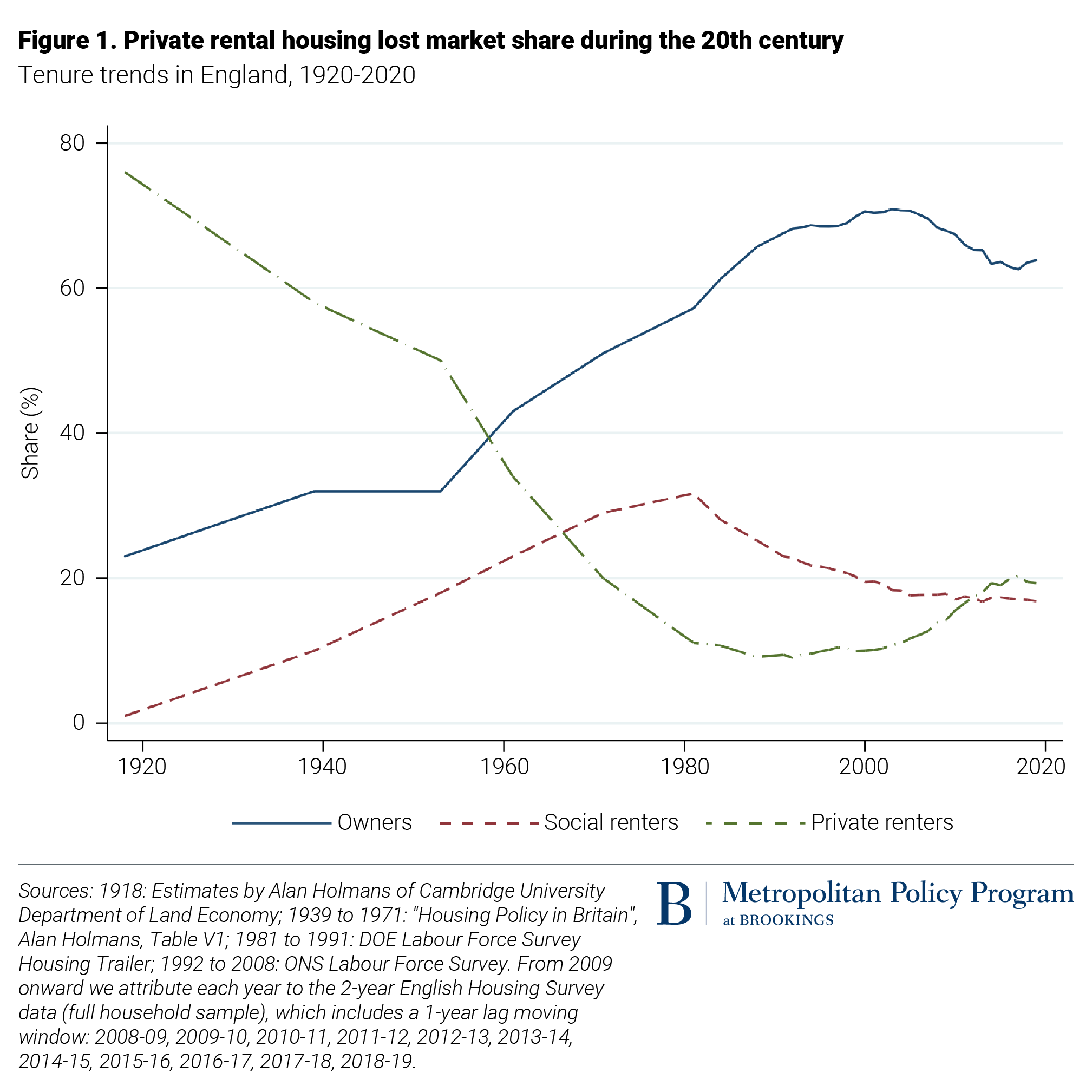
Just noticed you can clearly see in that graph where Right To Buy kicks in - that sudden boost in the owner-occupiers in the early 80's, mirrored by a corresponding drop in social renters. And then it all ran out of steam in the 90's
True… but affordable for who?..... landlords
Yea, that's another problem.
My original thoughts were along these lines, 2 incomes has become the norm and as a result the multiple of income to mortgage amount has gone form 3x to 9x.
Yep – when my dad was 27 (in 1979), he was earning roughly a teacher’s salary, and bought a 3-bed house with a garden in a decent part of town for about 3 years’ wages. He had left school with a couple of O levels and done an apprenticeship at the post office.
When I was 27, a similar house was more like 8 years of a teacher’s wage. And now it’s probably over 10 years.
Which in itself creates a chicken and egg scenario with landlords. Are landlords pricing people out of the market, or is the market just reflecting what people can afford, but as a result of that they can't afford it until they're settled down as a couple? So you end up with people renting longer, which drives demand for rentals?
I don't think it's right, or good for the economy that house prices are this high, but there's an argument that you're seeing a correlation and implying a causation.
Totally anecdotal, but we're looking as first time buyers right now and numerous nice, finished houses that we've bid on have gone to cash buyers way over asking. To me that says either large portfolio landlords, or inheritance buys.
Had a look at rightmove history yesterday and spotted a 2020 newbuild that sold this year for £110k over original price. £110,000 in 2 years! We knew things had got expensive but when you really look at the upticks in numbers it certainly feels like a bubble ready to burst. Every house we look at is the most expensive to have ever sold on a street, by at least £30k
That graph really brings it home that renters are staying in rented homes for far longer before buying with lots never making the jump.
So the reality is that household incomes have doubled, and as almost all that extra wasn’t needed for non-housing costs we’ve ended up in a situation where the new normal is to spend 75% of two incomes on a house, not 50% of one, which roughly corelates to house prices trebling relative to average earnings.
Which really screws over the likes of me who are single and only have one income.
Are landlords pricing people out of the market, or is the market just reflecting what people can afford, but as a result of that they can’t afford it until they’re settled down as a couple? So you end up with people renting longer, which drives demand for rentals?
Landlords are pricing on the assumption that a couple will move in, single people are being driven out of the market.
To me that says either large portfolio landlords, or inheritance buys.
Or downsizers moving up from the South East!
Are landlords pricing people out of the market, or is the market just reflecting what people can afford, but as a result of that they can’t afford it until they’re settled down as a couple? So you end up with people renting longer, which drives demand for rentals?
Both, I'd imagine. Because in addition, the higher rental prices are, the longer it takes people to save up a deposit, so the longer they'll need to rent, which drives demand for rentals, which pushes the rental prices up, which makes it more attractive to become a landlord....!
So you end up with people renting longer, which drives demand for rentals?
A major impact is the need for large deposits. Which can be tricky if you are paying out large amounts in rent. Whereas a landlord can ratchet up by remortgaging for the increased value and stick the deposit down on the next one. In theory risky but when you have the government desperate to prop up the values it becomes less so.
The problem with housing as a market is you dont really have a choice in the matter. You cant really chose to not bother.
We have some houses near us that sold in the last year - for over asking price, on average over 20%, a few 30% over asking, one for 38%(!) over..
Now showing negative / slowing house prices.
https://www.zoopla.co.uk/property/uprn/122006187/
https://www.zoopla.co.uk/property/uprn/122003512/
https://www.zoopla.co.uk/property/uprn/124024739/
https://www.zoopla.co.uk/property/uprn/122004758/
Or downsizers moving up from the South East!
Or, as we have, families moving north pre and post-pandemic.
An example: We have one neighbouring family who lived in London, looked at what are the best state schools in Scotland were. Dunblane High School was the answer. So they moved here having never even visited until the house search, offered 25% over asking in 2019 and now aim to get their toddler into said 'best' state school in Scotland.
2022 and some people here are still claiming housing is affordable. Just look at wage stagnation vs average deposit size, multiplies of income required and average mortgage length.
So the reality is that household incomes have doubled, and as almost all that extra wasn’t needed for non-housing costs we’ve ended up in a situation where the new normal is to spend 75% of two incomes on a house, not 50% of one, which roughly corelates to house prices trebling relative to average earnings.
You are completely missing the greed of BTL and the rigged credit rating system.
2022 and some people here are still claiming housing is affordable.
It can still be done - my niece is just buying her first house, she's early 30s, single and has a good but not mega job. House is in Exmouth too so not some grim ex industrial town.
2022 and some people here are still claiming housing is affordable. Just look at wage stagnation vs average deposit size, multiplies of income required and average mortgage length.
Except you missed the bit where I pointed out that household incomes doubled since the start of that graph it switched from the default of a man going to work and a housewife to two full time incomes. Which means that any comparison of prices/deposits Vs incomes is completely irrelevant as it's not how people live anymore.
It's inevitably going to lead to massive inflation in the one thing we all buy but where supply is restricted because we're* all trying to buy the same houses, but have* many times the budgets to do it that our parents had.
The only way that will reverse is if the cost of everything else goes up meaning those 2-income households have less money to compete with each other in the housing market ................
*collectively as a population. You or I might not completely fit that description, but as a population the average is now a two income household which means that the money left over after food, clothes and everything else is much higher, so it get's spent on rent/saving for a deposit/paying a mortgage.
It certainly feels like some kind of turbulence is kicking up a notch. I'm just hoping we can exchange very soon and be moved. For our example, we've sold in a very popular south Manchester area, and sold for asking price. We were actually a bit on the cheap side compared to similar properties. One EA wanted us to put it on £40k above what it sold. Some of the new build sites we went to view have called us recently. We didn't think those plots would be available to us (we have to have sold ours before reserving on many sites). Things definitely seemed to have stalled in some areas.
2022 and some people here are still claiming housing is affordable.
I’ve not noticed this, other than pointing out that some people are buying them and hence ipso facto they are ‘affordable’.
Pretty much everyone agrees, that housing is ridiculously expensive. I would argue though, that whilst it may be worse than ever, it was not in any way easily affordable in 60’s, 70’s or 80’s… as some appear to suggest.
My parents bought a 2 bedroomed house when they married in their mid twenties. On one wage. However, I rarely saw my father as he worked 70+ hours every week. When I did see him, he was so irritable I wished I didn’t. We had an outdoor toilet. My friends didn’t even have a bathroom, but used a tin bath in their living room - once a week.
My wife and I were both 28 when we bought our first, rundown 2 bed flat. Having scrimped and saved for years to get the deposit. Interest rates were 15% iirc.
Recently my eldest daughter bought her flat in her mid 20’s having scrimped for 4 years, living in a multi-shared house.
My youngest daughter, has been fortunate enough to inherit a modest amount of money, that has enabled her (in her mid 20’s) to buy a house. She has been lucky. Like what I presume is an increasing number of young people, reaping the benefits of grandparents who bought in the 60’s and 70’s.
The situation now is dire, but the people who bought before, or are moving from ‘down South’, are not to blame imho. It is successive governments and those who voted for them.
I could never bring myself to buy to let, as it must surely inflate prices. But, I find it hard to totally condemn those that do, rather than see their meagre savings vanish before them due to inflation.
Are you really trying to say house prices are high because more women are working and so people now have more money to spend? Apart from the ridiculousness of this logic - have you seen the price of childcare? People with high rent do not have savings.
I’ve not noticed this,
Erm.. you go on to make an argument that affordability has not gotten worse.
The truth is, the home has been turned into a financial product used to enrich people that are deemed "credit worthy"
I could never bring myself to buy to let, as it must surely inflate prices. But, I find it hard to totally condemn those that do, rather than see their meagre savings vanish before them due to inflation.
The issue with BTL is you can take a loan out to do it and be massively leveraged.
So you start with £10k, buy a £100k asset, then make your 7% form it and pay 2% interest on the loan.
So in terms of making a return on your "savings" they're making 50% ROI (in that example).
Then you wait a year or two for prices to go up 10%, cash out that 10% by remortgaging and repeat.
I'd rather see the sector limited to actual bigger businesses (very non-lefty of me) by limiting the balance sheets of landlords to for example 50% debt. That would realistically (in my mind anyway) mean pension funds owning tower blocks rather than individuals buying up individual houses.
Apart from the ridiculousness of this logic
You mean, simple statement of fact?
The truth is, the home has been turned into a financial product used to enrich people that are deemed “credit worthy”
You've said this twice now, but with the exception of people who really shouldn't be allowed anywhere near a credit card, who doesn't have a good enough credit rating to get a mortgage? I had to get a credit card, use it for nothing other than to get a phone contract, and that was enough to get me a mortgage. It's hardly 'rigged' if it's that easy to play the game that a £10/month sim card was enough.
You’ve said this twice now, but with the exception of people who really shouldn’t be allowed anywhere near a credit card, who doesn’t have a good enough credit rating to get a mortgage?
Absolutely oblivious to the situation. Plenty of people pay fair higher rent than they could borrow as a mortgage.
Are you really trying to say house prices are high because more women are working and so people now have more money to spend?
it's one of the factors. There is no single reason. The emergence/popularity of BTL mortgages in the 1990s and 2000s, selling off of social housing stock and plenty of other factors all also contributed.
Absolutely oblivious to the situation. Plenty of people pay fair higher rent than they could borrow as a mortgage.
Because interest rates have been <2% for a decade now. Watch that collapse if rates rise. Banks quite rightly want to make sure you can afford the repayments if they revert back to historical averages.
And if everyone can then afford a more expensive house, then prices would just go up again. Because that's exactly what happens every time 'affordability' increases, cut the stamp duty, prices rocket, interest rates drop, prices rocket, wages go up, prices rocket.
The only way you'd break that cycle is to massively oversupply housing to remove the link between what people can afford to pay and it's value, which is never likely to happen again.
My opinion is relax/reduce planning law to increase the volume of houses built, but impose stricter controls on the building process to improve the quality.
This should improve supply and reduce speculation.
As a homeowner, I have no problem with interest rates rising if it means house prices will fall. The commoditization of the home is the problem, all these other factors are just symptoms of this. I agree we need to build more housing, in particular, social, but let's not pretend greed has nothing to do with high house prices.
but let’s not pretend greed has nothing to do with high house prices.
But once you're a home owner, you've got no real influence on it's value. The value will always be determined by the almost inevitable bidding war between buyers.
Call it greed all you want, but people need houses and as a result will pay whatever they an afford unless there's an oversupply of housing stock.
As a homeowner, I have no problem with interest rates rising
I'm going to infer this puts you more "out of touch" with the younger end of the market than most, because most of us are mortgaged to the hilt to afford anything. I'm dreading my next mortgage renewal.
If you are mortgaged to the hilt (I am) then you aren’t really a homeowner.
If you are mortgaged to the hilt (I am) then you aren’t really a homeowner.
Fair point, don't make it even more depressing 😂
I’m going to infer this puts you more “out of touch” with the younger end of the market
Nonsense, I am thinking of my kids and society in general. What do you think is going to happen when generation rent gets to retirement age?
The greed is not from people living in their own homes, it's from BTL, second homeowners, holiday homeowners, unscrupulous student landlords, foreign investors who don't even bother renting out their properties and politicians who prop it up all up time and time again because they have their own property portfolios.