Forum menu
[Closed] The biggest lie in British politics (Economics and Johann Hari content)
British politics today is dominated by a lie. This lie is making it significantly more likely you will lose your job, your business, or your home. The lie gives a false explanation for how we came to be in this crisis, and prescribes a medicine that will worsen our disease. Yet it is hardly being challenged.Here’s the lie. We are in a debt crisis. Our national debt is dangerously and historically high. We are being threatened by the international bond markets. The way out is to eradicate our deficit rapidly. Only that will restore “confidence”, and therefore economic growth. Every step of this program is false, and endangers you.
- [url= http://johannhari.com/2011/03/29/the-biggest-lie-in-british-politics ]Johann Hari: The biggest lie in British politics[/url]
Discuss
And? I thought everyone with any sense knew this
TandemJeremy - MemberAnd? I thought everyone with any sense knew this
Indeed, only the chronically stupid or criminally reckless would disagree
The guy is a hack rehashing other peoples' arguments.
Agreed, everything Johann Hari says is fact.
Perhaps he is but it doesn't affect the underlying facts.....
Does this guy know the difference between debt and deficit? I doubt it, he looks to be as credible an economist as the big poo I did earlier.
Gordon Brown will be damned by history for his role in deregulating the banks – the real cause of this crisis.
so it is Gordon's fault then......
Either he missed out on Economics 101 or he has deliberately created a bullshit premise.
Why does this guy have any credibility?!
Does this guy know the difference between debt and deficit? I doubt it
He's using the term 'debt' in the same way that the government is, is he not? [url= http://twitter.com/#!/johannhari101/status/52718276924551168 ]His Twitter replies[/url] to people who've made the same point imply that he is aware of the difference.
that a pretty powerful, well reasoned and argued rebuttal there are you an academic djglover?
Seems to make sense to me.
I love the description of Krugman as a Nobel prize winning economist "whose predictions have consistently proved right through this crisis" - that neatly encapsulates the problem with all economic arguments: they're based on pet theories, incomplete data, and wishful thinking. Krugman's had a good run this time, there are so many economic experts out there that someone had to. For all this article may claim to be the truth it's just another educated guess, which may or may not be true.
(And he's wrong about Spain: the credit agencies are downrating Spain because of 20% unemployment and a collapsed property market, not because of the spending cuts.)
love his biog
Since he began work as a journalist, Johann has been attacked by the National Review, the Daily Telegraph, the Daily Mail, John Pilger, Daniel '007' Craig, Peter Mandelson, Peter Oborne, Private Eye, the Socialist Worker, Cristina Odone, Jon Gaunt, the Spectator, Andrew Neil, Mark Steyn, the British National Party, Medialens, al Muhajaroun and Richard Littlejohn. 'Prince' Turki Al-Faisal, the Saudi Ambassador to Britain, has accused Johann of "waging a private jihad against the House of Saud". (He's right). Johann has been called 'Maoist' by Nick Cohen, 'Horrible Hari' by Niall Ferguson, "an uppity little queer" by Bruce Anderson, 'a drug addict' by George Galloway, "fat" by the Dalai Lama and "a c**t" by Busted.
Interesting selective use of Keynes. What does he say you should do on the up side of the cycle ?
What does he say you should do on the up side of the cycle ?
...surely that is irrelevant?
Not really, Hari neatly ignores the importance of timing: you can't go on spending loads more than you earn indefinitely, at some point you have to reduce the difference. Whether the current government has jumped the gun or not is crucial to the debate.
mogrim - are you suggesting that we might be on the 'up side of the cycle' then?
The truth is that since the end of WW2 Britain has almost always been had a budgetary deficit. Even in the 50s when we "never had it so good". There has only been four short periods since the of WW2 when Britain wasn't in deficit. Three of them occurred under Labour governments. Only once since the end of WW2 has there been no deficit under a Tory government - despite the fact that the Tories have been power most of that time.
The truth is that the Tories have never worried about deficit before - even when they peaked under them.
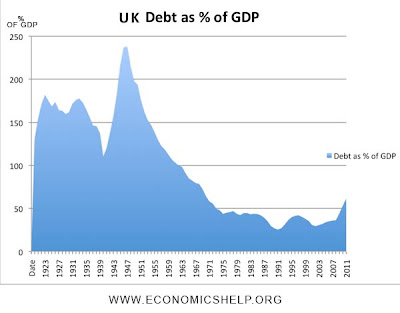
The truth is that deficits are an automatic consequence of recessions, as the graph below shows, and the world has just experienced the worst global recession since the 1930s. If it didn't feel like the worst global recession since the 1930s, then it is only because of the actions which the previous government took.
The truth is that countries which spend their way out of economic crises deal with their deficit quicker and better. Getting people back to work is the answer.
This is precisely what Argentina did when almost 10 years ago it was so much in debt (due to neo-liberal policies) that it was responsible for the largest sovereign debt default in history. They spent their way out of the crises.
For many years now Argentina has had one of the fastest growing economies in the world. Last year its economy grew by 9.2%, compare that with the shit we're in.
[url= http://www.thenews.com.pk/TodaysPrintDetail.aspx?ID=37588&Cat=3&dt=3/23/2011 ]Argentina’s primary budget surplus widened by 19 percent in February[/url]
[url= http://www.voltairenet.org/article168738.html ]Argentine President says, "It’s time to end the myth of the free market"[/url]
This government's cuts have nothing to do with wanting to clear the deficit, and everything to do with a pathological and idealogical hatred of welfare provisions and public services.
The global crises caused by their mates the wealthy and powerful bankers, has given them a golden opportunity which they are determined not to miss. As things go wrong, which undoubtedly they will, they will blame everything on the last Labour government. But they will have achieved their aim, and those who matter will have remained very wealthy and privileged. They will almost certainly get away with it.
Sucker Britannia
Argentina also has inflation of 20-40%?
About 25%. And ?
Are you going to trot out the Thatcherite bollox which says that inflation is the root of all evil ?
Or that unemployment is "a price worth paying" to reduce inflation, as Tory Chancellor Norman Lamont claimed ?
Nope (40% on food BTW). But without a heavily unionised workforce the populace would probably be suffering! 25% inflation would kinda suck if your salary wasn't growing with it.
if your salary wasn't growing with it
So you understand the solution then ?
(40% on food BTW)
Where do you get your figures from ? 13.1% and 10.6%
http://socyberty.com/economics/venezuela-bolivia-and-argentina-with-higher-inflation-rates/
It's worth pointing out that when Argentina was gripped in a crises caused by failed neo-liberal policies (like those pursued by our Tory government) every week children were reported dying of starvation. That's despite the fact that Argentina is one of the most fertile countries in the world, and is one of the world's most significant exporters of food.
The present Argentine government's policies has slashed poverty and unemployment. Who gives a **** if food prices are going up if you have a job ? Unemployment is a far greater evil than inflation. Wages will pay the food bill, no wages will pay for nothing. Inflation is a symptom of a highly active capitalist economy. That's not to say that inflation shouldn't be tackled though - just get your priorities right.
I'll have to dig it out. It was an article from some Argentinian Economists that have been studying the price rises of a typical shopping basket of goods. It was sent to me by the finance dept of our Argentine office.
I'm not arguing with you ernie... but I do no for a fact that even those who are in the unions are getting salary increases less than current inflation rates and that the Argentinian Government is in cloud cuckoo land when it comes to forecasting inflation.
mogrim - are you suggesting that we might be on the 'up side of the cycle' then?
No idea, doubt anyone has tbh. But you can't simply ignore the possibility just because you don't agree with cutting public services.
Umm... I wasn't ignoring it, just stating it's irrelevant when we are clearly not on the 'up side of the cycle'.
We are languishing at the bottom, periloulsy close to finding a whole new cliff to fall off... should we be cutting a vital source of economic stimulation?
Umm... I wasn't ignoring it, just stating it's irrelevant when we are clearly not on the 'up side of the cycle'.
We are languishing at the bottom, periloulsy close to finding a whole new cliff to fall off... should we be cutting a vital source of economic stimulation?
Is the UK really "languishing at the bottom"? Is there [b]definitive[/b] evidence, either way?
Whatever. I'm going to bed. I'll reply in the morning! (Not running away, promise! 🙂 )
You need to give me a kiss before you go!
I'll be back to talking rubbish on other threads by the time you wake up.
Government cam borrow.money cheaper than anyone else so why not? Inflation with house prices stupidly expensive as they ate now might be a good idea.
Yes I know how unreliable Argentine government inflation figures are. But inflation rates are a neo-liberal smokescreen. They are not anywhere near as important as they like to make out they are, jobs and growth are far more important......Thatcher was lying.
Just look at how low inflation was when the neo-liberals where last in power in Argentina :
Does that look good to you ? Well in 2002 Argentina was responsible for the largest sovereign debt default in history, unemployment was at 25%, and 57% of the population was living in poverty. The country was ****ed. So much for the neo-liberals and their low inflation.
No idea, doubt anyone has tbh. But you can't simply ignore the possibility just because you don't agree with cutting public services.
Well if you have no idea of course you cannot ignore any possibility nor give weight to any probability. I doubt you will find an economist or politician who will claim that we are in anything other than a slump [z-11 probably thinks everything is ok] and therefore the downside of the cycle. In previous years there was more than now. GDP growth rate for example and even peak GDP though [ given inflation] that will be surpassed soon enough.
Is there definitive evidence, either way?
I am not sure ...the last few years seem to be litterd with such succesful stories about the world economy, our economy, Euro Zone, Ireland , Greece etc it is really quite hard to work out whether this is the good times or the bad.
We could debate how bad and whether we are over the worst/making it worse/making it better but it seems foolish to discuss whetherr this is bad or not tbh. Dont the Tories say it is all labours fault are they trying to give them credit or blaimng them?
Sorry to p*ss on the bonfires of anyone who thinks they have evidence the current plan is a bad one. Or that Labour's plan would be a good one. Who knows? And how can anyone claim they do ffs? This is unknown territory, we've not had this happen before: it's global, all kinds of stuff is kicking off in the Middle East and Japan which will impact on confidence and price of oil and other key goods, US is facing a potential long term decline, BRIC countries are changing the balance of global power - all of which is unprecedented.
We can show as many graphs as we like 'proving' our own view but one-off case studies of some historic event don't prove anything - they're not comparing like for like - there's nothing in history to compare our current situation.
It's a bit like charging down a rocky descent you've never ridden before - you just get on with it as best you think, hold on tight, deal with it as it comes up and if you make it down ok, pretend you were under control all the way 🙂
Frankly no-one knows the best solution to this one. Politicians will claim their ideas are the best, of course they will, if they don't act like they're confident the people will panic...
Rant over and finger's crossed...
And how can anyone claim they do ffs? This is unknown territory, we've not had this happen before: it's global, all kinds of stuff is kicking off in the Middle East and Japan which will impact on confidence and price of oil and other key goods, US is facing a potential long term decline, BRIC countries are changing the balance of global power - all of which is unprecedented.
I don't see how this is unprecedented. Looks like history repeating to me and as such lessons can be taken from such history to determine whether the economic plans of Governments are sh*t or not.
It's a bit like charging down a rocky descent you've never ridden before
so presumably then line choice[plan] is irrelevant as is the skill of the rider [knowledge]or the quality of the bike [state of the economy] in predicting the likely success of getting down in one piece as none of us know what will happen?
Because something lacks certaintiy it does not mean that we cannot evaluate the benefits/risks and likely outcomes.
Close your eyes and grab a fistful of brake?
Interesting euphamism I bet you say that to all the girls
... and boys. Hell, I'm not racist.
That won't make the cabbage fat.
Sorry to p*ss on the bonfires of anyone who thinks they have evidence the current plan is a bad one. Or that Labour's plan would be a good one. Who knows? And how can anyone claim they do ffs?
Well the government certainly claims that their plan is the correct one, that's why they insist there is no need for plan B........plan A will work perfectly.
And as El-bent mentions, there are plenty of historical precedents. Whilst every situation might be unique and different, certain things never change, eg, recessions cause deficits.
And the whole justification of Vince (economist extraordinaire) Cable's spectacular acrobatics, whereby he ditched all of the economic policies he stood for at the general election, was the events in Greece. He claims that Greece's problems made him realise the importance of clearing the deficit immediately.
Obviously that's all complete bollox, but it shows how economists are very keen to use historical examples to justify the conclusions they come to. Despite the fact that personal prejudices is always the deciding factor.
Despite the fact that personal prejudices is always the deciding factor.
very true.
Was in Lisbon this weekend. They dont seem to give a shit ATM 😉
Isn't economics just another name for hindsight?
Johann Hari is a complete bellend.
Do you think you could sum up what you mean by that konabunny ?
It's a bit like charging down a rocky descent you've never ridden before - you just get on with it as best you think, hold on tight, deal with it as it comes up and if you make it down ok, pretend you were under control all the way
Because every time you ride a rocky descent it's like the first time? Are you a goldfish? In reality, you learn from experience, when you ride any piece of trail you use the precedents and skills and lessons you've already learned. If you really treat rocky descents like that, you must be a truly awful rider - I always suspected that Tories couldn't ride bikes, now I can see why 😉

[In reference to the inflation rate in Argentina, which is around 25% according to Bloomberg]
Are you going to trot out the Thatcherite bollox which says that inflation is the root of all evil ?
Ernie, you've just proven that you know stuff all on the subject.
Does that look good to you ? Well in 2002 Argentina was responsible for the largest sovereign debt default in history, unemployment was at 25%, and 57% of the population was living in poverty. The country was ****ed. So much for the neo-liberals and their low inflation
Not an expert on the Argentine crisis, but a quick read of [url= http://en.wikipedia.org/wiki/Argentine_economic_crisis_(1999%E2%80%932002)#The_1990s ]Wikipedia[/url] seems to show the causes are the non-neo-liberal policies of fixing the currency, high government spending and massive corruption. Even the graph you show as "evidence" seems to go against current economic policy, nobody likes negative inflation.
Still, that's not to say that you're completely wrong: focussing on inflation and ignoring unemployment won't help, although any politician worth his salt should be able to sell a low inflationary policy as one helping employment, and vice versa.
Ernie, you've just proven that you know stuff all on the subject.
He's the poor man's TJ, full of wind and pickles 😆
Ernie, you've just proven that you know stuff all on the subject.
Perhaps you could explain why his opinion is wrong/confused rather than just accuse him of a lack of understanding. You seem a tad stuck in the playground approach of just telling someone they are wrong rather than explaining your own view or explaining why they are wrong.
I really dont undestand why people post up to just say X poster is wrong whilst offering no explanation for this view.
You're wrong, you know, junkyard. Full of it in fact
😉
Are you going to trot out the Thatcherite bollox which says that inflation is the root of all evil ?[b]"Ernie, you've just proven that you know stuff all on the subject". [/b]
😀 So inflation is the root of all evil ? !
Not an expert on the Argentine crisis, but a quick read of Wikipedia seems to show the causes are the non-neo-liberal policies
Well perhaps it requires a little bit more than a quick read of Wikipedia ?
Then perhaps you'll realise that the whole of Latin America was used as a neo-liberal experiment by Washington.
And because the neo-liberal experiment could be enforced by brute force and government death squads, they didn't have to worry about what the people thought and they didn't have to water it down like Thatcher did - it was much purer neo-liberalism.
When the US installed dictatorships eventually collapsed through their own incompetence and failings, US political and economy hegemony continued, as the neo-liberal experiment also did.
Under President Carlos Menem Argentina continued the neo-liberal experiment, and the privatisation of anything and everything, for example, carried on unabated.
To give you an example of just how more committed President Menem was to the free market than even Thatcherite Tories, take the example of Argentna's railways.
Here in Britain we accept that the free market cannot be applied to the railways, so when they were privatised the government was committed to give the new private owners massive government aid (several rimes more than when they were nationalised) President Menem said that there would be no government aid for the new owners of Argentina's railways. Of course no one was interested in buying something which would produce no profit, so as a good neo-liberal who was committed to "the market knows best" Menem decided that railways were not viable and scrapped the.
Today Argentina has no railways (which were originally built by the British btw) as a direct result of pure uncompromising neo-liberal bollox that "the market always knows best", despite the fact that Argentina is the 7th largest country in the world (here's some local trains within Buenos Aires city though) Fortunately the present social democratic government is in the process of rebuilding the railways with French help.
Slowly Latin America is freeing itself from the shackles of US political and economy hegemony and the neo-liberal nightmare, the result for its people is nothing short of stunning.
As far as "high government spending" in Argentina under the free-market neo-liberals is concerned, you do understand some of the contradictions of capitalism, do you not mogrim ? Or will it come as a surprise to you to learn that in Britain under Thatcher's neo-liberal policies both taxation and government spending went up ?
EDIT : One of the most common excuses the neo-liberals give for Argentina's failure under the neo-liberal experiment is that it was due to "massive corruption" like you did mogrim. Well there was undoubtedly corruption in Argentina, but that didn't suddenly stop when the government changed economic direction. Argentina is as corrupt today as it's always been, and yet the economy is doing immeasurably better.
Clubber No i am not you are you know you are
😆
Hari confuses debt and deficit, probably deliberately. He probably understand this but is relying on there being a lot of gullible people who don't understand the difference and are looking for straws to clutch to.
Comparisons of the UK situation with Argentina do have some value; the financial crisis that caused Argentina to default on their debt was largely due to running an excessive deficit. Fernandez put much of Argentina's economic recovery down to their inability to borrow since their debt-default - they have few options but to spend only what they can raise in taxes. They also addressed the debt, to quote Christina Fernandez in 2008:
[i]"The administration which took office in 2003 made debt reduction and twin surplus policies state policies. So we set about thoroughly and painstakingly reducing our debt then, because we knew that this was a very important problem not just because a debtor must pay their debts in all contexts, but essentially because this is also a way to boost your relations based on credibility and trust vis-a-vis the rest of the world."[/i].
Useful lessons for the UK, and which would imply more agressive cuts to public spending than the ones proposed by either the coalition or Labour.
Argentina defaulted. Should we default...what would that do to sterling, and interest rates?
what would be the effect on the subsequent interest rate rises on everyone who currently carries large debt (mortgages). What will happen to the banks who currently pretend that an average house is worth £165000, when the price discovery forces them to write down the value to £70-80000.
I think you need to look how Christina Fernandez's husband reduced the debt Rio. And I think you need to look at her advice to Greece with its present debt crises - she suggests the complete opposite to the neo-liberal solution.
I'm going on a bike ride now - I'll try and dig out a link later.
Junkyard's pants, yesterday
[img] http://t1.gstatic.com/images?q=tbn:ANd9GcSTV5t2goT7bDG3ES-iJS54tB9MiZtg6NR-UpGXCmtp1N5iJnCO [/img]
Johann Hari is a complete bellend.
Agreed, but in this case he is probably right.
Stop!
Dunno if anyone is interested, but there is a good series on R4 at the moment, which should still be on iplayer, by the folks who produce More or Less called The Story of Economics.
Now, carry on...
"a c**t" by Busted
Surely the worst insult in the history of insults...
😀
Should we default...what would that do to sterling, and interest rates?...the price discovery forces them to write down the value to £70-80000
Sterling down; interest rates up; why would banks reduce the value of the outstanding debt? Negative equity-tastic!
konabunny - Member
Johann Hari is a complete bellend.
I agree and believe his article proves he is an opinionist writer and not a journalist, it's his own agenda approach to the subject. That makes him just the same as almost all economists, politicians and us armchair bullsh1ters on here (Me included though I do doft my cap to many others on here). At least with his house buying analogy he must acknowledge that the bills need to be paid at some point by someone. Who, when and will that be fair?
The biggest lie in British Politics is the politicians themselves.
They will lie to everyone to get themselves in power.
Johann Hari obviously has his own agenda and plainly comes from one policital direction.
Some members of this forum, although well read and quite knowledgeable, also have political agendas and appear to subscribe to 'If you can't dazzle them with diamonds, baffle them with bull sh1t'.
I don't care what anyone says, Keynes got it wrong, Thatcher got it wrong, Blair/Brown got it wrong and I'm sure the coalition will get it wrong too. And who will suffer? We all will.
Politicians have been playing with our lives for centuries, royalty before that. We need something radically new and we will never get it. Do you hear that, WE WILL NEVER GET IT.
We'll continue to have the Tories screwing the people and Labour screwing the country.
And I'm sick of all of them.
I don't care what anyone says, Keynes got it wrong, Thatcher got it wrong, Blair/Brown got it wrong and I'm sure the coalition will get it wrong too. And who will suffer? We all will.
You ned to read some Marx he shares your view on the inadequacies of the capitalist system whatever the tinkering
I don't care what anyone says, Keynes got it wrong, Thatcher got it wrong, Blair/Brown got it wrong and I'm sure the coalition will get it wrong too. And who will suffer? We all will.
As Junkyard suggests, you have simply identified the failings of capitalism. Capitalism is more or else in constant crises and governments govern under conditions of almost constant crises management. The only thing anyone needs to worry about at election time is who do they trust most to manage the crises in their favour.
Social democracy provides solutions to some of the most damaging and intolerable aspects of capitalism, but it does not offer a solution to all the problems.
It does indeed often create new problems which didn't exist before - an excellent example is inflation. Low levels of unemployment, which are generally associated with social democratic Keynesian economics, has a tendency to create higher levels of inflation.
The connection between low levels of unemployment and higher inflation and visa-versa, is indisputable. Even the former Tory Chancellor Norman Lamont, publicly admitted the connection between the two when he famously said, [i]"If higher unemployment is the price we have to pay in order to bring inflation down, then it is a price worth paying."[/i]
Contrary to brooess's claim, we can indeed predict to a great extent the outcome of many economic policies. In truth, despite the fact that it would appear otherwise, economics is a precise science......just like everything else, if you understand the concept of the butterfly effect/chaos theory/dialectical materialism. If things appear as a "mystery" to us, then it is simply that because we have failed to understand them. Everything has a logic, other than religion.
.
Useful lessons for the UK, and which would imply more agressive cuts to public spending than the ones proposed by either the coalition or Labour.
Here you are Rio, if you think that the UK has useful lessons to learn from Cristina Fernandez de Kirchner, here's that link where she gives her views on how the Greeks should deal with their crises (and remember the coalition government says the we are faced with a simular situation to Greece, just less serious)
[url= http://www.monstersandcritics.com/news/business/news/article_1553785.php/Argentine-president-warns-Greece-against-austerity-measures ]Argentine president warns Greece against austerity measures[/url]
Note : [i]"The recipes that are being imposed on Greece are identical to those that were applied here in 2001,' Fernandez de Kirchner stressed."[/i]
So if you want to learn lessons from Cristina Fernandez de Kirchner, as you say you do Rio, then listen to what she has actually said, ie, [u]austerity is not the solution[/u].
Johann Hari obviously has his own agenda
Not necessarily - he's quite happy to rip off other people's agendas if it fills the 550 words he has to file by teatime or whatever.
http://www.sourcewatch.org/index.php?title=Johann_Hari
I see what you mean Konabunny, hardly credible is he. Mind you his columns could just be a form of trolling like we do on here at times.
I think Richard Littlejohn and Liz Jones are trolls: "blah blah immigrants blah blah lazy civil servants pc gone mad fat people should be shot you can't trust the Muslims lesbian teachers health and safety Tony B-lair ZaNu Labour handcart". It's just empty controversial crap that can reliably plug in the gaps between the Sainsbury's advert in p.14 and the Morrisons ad on p.16, get pageviews for the site and generally keep their names in circulation by pissing people off.
Hari is a careerist with a messiah complex. The tax-dodging stuff is legit but the thing to remember is that he's only doing it because it's good for him and it's of the moment. If there were any mileage in dropping that and moving onto the next issue to mark him out as the enfant terrible of British journalism, he would.
Social democracy provides solutions to some of the most damaging and intolerable aspects of capitalism, but it does not offer a solution to all the problems.
The problem is that Social Democracy is only Capitalism with a conscience. Agreed that for anybody with some form of social conscience it would probably be a solution to many of the world’s problems, but like so many political ideologies, you need to take the people out of the equation.
True Communism is a great idea, but it will never work. Not only does someone have to be in charge, but more problematic, someone will want to be in charge. Then it stops being communism and becomes a dictatorship.
And do we want Social Democracy or Democratic Socialists? Human nature, power, greed, etc mean it will never work. Try and enforce the situation, like we tend to see with labour governments, and all we get is a excessive governmental interference (nanny state).
As for Marxism; politics of envy. I haven't got anything, so you shouldn't either. Ok it was born out of very difficult time and I can fully understand the desire for a classless society, but it cannot be relevant today. The majority of 'aristocats' now live in houses that they cannot afford to keep maintained and certainly cannot afford to repair. Who are the bourgeoisie these days? Footballers, Katie Price? And who are the proletariat? Is it hard working people like nurses (do you include doctors?) and teachers? Or is it the drugged up scum who make our lives a missery by burgling our houses and stealing our bikes? Or the parents of the ferral kids we see on our streets who don't give a sh1t about what they are doing?
Where would we be if it hadn't been for the capitalists? NO industrial revolution. No computers, all of us driving round in VW Beetle's? As we discovered in the 70's, so much of the publicly owned industry was starved of investment (and I know people will blame the previous torey governments, because that is what they've been told) but we wouldn't have even had these industries if it wasn't for capitalists in the first place.
True Communism is a great idea, but it will never work. Not only does someone have to be in charge, but more problematic, someone will want to be in charge. Then it stops being communism and becomes a dictatorship.
I'm not sure, but I think you might be confusing communism with socialism. You do not have "someone" in charge with communism......that's the whole point of communism. Of course you could argue that human society hasn't reached the level of development where it can be autonomous and self-governing, but that's a different argument. And it should be remembered that there was once a time when people argued that democracy was pie in the sky and could never work as society would never evolve to that level of development.
As for Marxism; politics of envy......... it cannot be relevant today.
Marxism is no more the politics of envy than abolitionism and the movements for the emancipation of the disenfranchised were. It is about legitimate and denied rights. And never in my life has Marx's critique of capitalism been more relevant than it is today. Which probably explains why global sales of Das Kapital took off after the international banking crises.
Where would we be if it hadn't been for the capitalists? NO industrial revolution.
Where would be be if it hadn't been for the proletariat ? No industrial revolution.
Actually the industrial revolution was not the result of capitalism, it's the other way round - capitalism is the result of the industrial revolution.
Of course the other big lie is about public sector pensions.
for example the NHS pension fund is in surplus - paying out less than it takes in and overall the public sector pension commitments is under 2% of GDP and stable or decreasing over the years.
Where would be be if it hadn't been for the proletariat ? No industrial revolution.
Thought the proletariat sprung up out of the industrial revolution, being part of marxist theory (itself a reaction to capitalism, of course)? Unless you decide to apply the term retroactively, I suppose.
Something you said earlier:
In truth, despite the fact that it would appear otherwise, economics is a precise science
Rubbish. Define a [i]precise[/i] way to measure unemployment and inflation, then. Define a [i]precise[/i] way to measure the submerged economy when calculating unemployment. It's not precise - it's getting better, it might be able to measure trends, but it's a long way off accurate predictions which surely is a fundamental part of a "precise science".
Thought the proletariat sprung up out of the industrial revolution
Yes it did. And ?
Rubbish. Define a precise way to measure unemployment and inflation, then. Define a precise way to measure the submerged economy when calculating unemployment.
😕 ?
Whether you can or cannot precisely measure unemployment is completely irrelevant. Economics is a precise science in the same way as weather patterns are a precise science. The fact that we are often completely unable to predict the weather is irrelevant - none of it happens by chance. As I said, everything has a logic. Unless you're religious.
Ernie. I know exactly what communism is. What you misinterpreted or chose to ignore is that even in communist states someone has to govern i.e. be in charge. And that usually means someone 'wants' to be in charge.
One of the forefathers of socialism, Robert Owen, attempted to create self sustaining communes in America. They all failed, basically because he wasn't there to govern them
As for your comments to my post and the post of Mogrim about the proletariat,you appear to be arguing about which came first, the chicken or the egg. Society may have needed the proletariat to provide the manual labour, but without the ideas and the money to support them, the industrial revolution would certainly not have happened.
As for economics and weather systems being a precise science. Sorry, but you are mistaken. We might understand the principles of how they work, but the fact that we cannot predict accurately the simple outcome of a number of parameters makes them anything but a 'precise science'. It is certainly not irrelevant,as science virtually relies on our ability to predict a specific outcome.
By your argument the principles of plate tectonics are a precise science. Try explaining that one to the people of Japan.
Ernie. I know exactly what communism is. What you misinterpreted or chose to ignore is that even in communist states someone has to govern i.e. be in charge.
I suggest you read up on the "withering away of the state". How can you have "someone" in charge if there is no state structures ?
you appear to be arguing about which came first, the chicken or the egg
No I wasn't arguing about which came first, the chicken or the egg. I was challenging your claim that the industrial revolution was solely down to "the capitalists". I think you'll find that the proletariat played quite an important role. And yes, capitalism was the result of the industrial revolution, not the other way round. There's no chicken and egg about it.
By your argument the principles of plate tectonics are a precise science. Try explaining that one to the people of Japan.
Why would I have a problem explaining to the Japanese people that plate tectonics is a precise science which involves a conflict of opposing forces ? Do they believe that it is all down to divine intervention ? 😕
Your definition of Communism is a philosophy that has never existed. The nearest thing we've had in modern times is Cuba. Great health care, but that's about all that can be said about it. And you can't tell me that Castro wasn't in charge. So much so that when he's ill, relatives take over.
As for the industrial revolution. Take away the investors and the inventors and what have you got? Nothing, there is no scope for the industrial revolution to have begun. The proletariat would still have existed (those of lower social class, not specifically working class), but working on farms etc. Take away the proletariat and there is still the possibility that the industrial revolution may have happened.
You may well be able to explain the principles of opposing forces, but that does not make it a precise science.
I have a genuine question for you. I've been wracking my brains to think of a socialist or communist country or state, now or in history that has progressed humanity in any positive way? And I don't mean ideologically, I mean practically. You know, 'What did the Romans ever do for us?'
Whether rightly or wrongly, the only ones I can think of have been driven by violent domination or greed.
mavisto - the philosophy clearly exists. True communism has not on any large scale. You mistake the totalitarian states called communist for true communism.
Your definition of Communism is a philosophy that has never existed
It's the only one that I'm aware of. It's certainly Marx's definition, which after all is what we're talking about.
Cuba is not communist, it does not claim to be communist. It claims to be socialist, and in the commonly accepted definition of the word, that is exactly what it is.
TJ I am fully aware that the philosophy of Communism exists.
I was actually trying to make the point that communism has never really existed other than as a philosophy. The so-called communist countries and states are of course totalitarian regimes. That was also my point. Many of these countries profess to being communist, but are nothing of the sort.
It is a philosophy that had never had a working application.
Ernie I concede that Cuba is not communist, but I believe Castro is still the head of the Communist Party. But they are certainly not socialist. Huge human rights violations, torture of its people, doesn't sound very social to me.
And Ernie, Can you or TJ answer my question please I'd really like to know.
I have a genuine question for you. I've been wracking my brains to think of a socialist or communist country or state, now or in history that has progressed humanity in any positive way? And I don't mean ideologically, I mean practically. You know, 'What did the Romans ever do for us?'
Why me or TJ ? We're not a partnership you know.
I really need to get on with stuff but : [i] a socialist or communist country or state, now or in history that has progressed humanity in any positive way? And I don't mean ideologically, I mean practically. You know, 'What did the Romans ever do for us?'[/i]
Well it's a huge subject and not one I want to immerse myself into hours of pointless discussion, but there are examples of socialism having transformed backward feudal agrarian societies into industrial superpowers within a very short period of time. And in some cases becoming even more technologically advanced in certain areas than other far more established capitalist countries. I'm not sure whether you also include creating the world's first national health service, an idea since adopted by most of the advanced capitalist countries in the world, despite the fact that it is based not simply on a socialist principle, but on the advanced communist principle of [i]"from each according to their ability, to each according to their need"[/i], as an example of a "practical" achievement. Then there is abolition of unemployment and the huge increases in life expectancy - are these "practical" achievements ? Or the lack of involvement by socialists countries in armed conflicts, certainly in comparison with capitalist countries ? And so it goes on........how long is a piece of string really. Then of course there is the subject of the failings under socialism, another huge subject worthy of endless discussions imo, although it's not what you asked. Basically you're asking too much imo. STW can only deal with small easy to chew debates imo.