UPDATE: Reviews section refreshed, redesigned, searchable: Go take a look
mudshark - MemberTroll, ignorant or stupid?
Seems liked a fair point to me.
Um...if someone's struggling to pay for fuel do they really have the money to pay for a move and the likely higher property prices of being close to work? Most people have to compromise between property prices, commuting times and travel costs - I've known people who thought it sensible to live in Norfolk and Herefordshire in order to get a reasonable standard of living and put up with the commute.
Anyway, I'm one of TJ's rich elite so probably shouldn't care....
If fuel is expensive and encouragement is made to travel by alternative transport then it should available and reasonably priced. At the moment it isn't. Where I live a bus ride of 1 mile each way costs 5 pounds. 5 pounds for 2 miles!!!!! I don't use the bus as I can walk to work but some people have no choice.
It's getting to a point where people become confined to their local area because they can't afford to travel due to high fuel prices and no reasonable alternative.
Yup stop the biggest industry in rural areas, tourism, by driving up the cost then whilst there's no more coming into area and transport cost have increased watch the prices of goods in rural areas soar, jobs lost and people move out of the area. Great do it straight away.
Arguably it's the fact that transport is too cheap that has meant that foreign goods (to that area) are cheaper than locally produced and have put all the local industries out of business, so rural areas are only have tourism as a viable business....
I agree there is no argument there.
Hmm, call me daft if you like.
But I'm pretty sure the biggest industry in most rural areas by some margin is agriculture.
But I'm pretty sure the biggest industry in most rural areas by some margin is agriculture.
How many people does an average farm employ Vs lets say a small hotel?
Couldn't say, goes googling.
Not many hotels round my folks place in Norfolk. Plenty of farms though.
Are you including small market towns etc in your thinking?
Are you including small market towns etc in your thinking?
Yup.
Parts of Cumbria, Northumberland and other counties rely very much on tourists of course there's agriculture too but that would also be effected by rising fuel costs.
http://www.nfus.org.uk/farming-facts
Well, quite a few in Scotland according to this.
Around 65,000 people are directly employed in agriculture in Scotland – this represents around 8% of the rural workforce and means that agriculture is the third largest employer in rural Scotland after the service and public sectors. It is estimated that a further 250,000 jobs (1 in 10 of all Scottish jobs) are dependent on agriculture.
The tourism sector is of vital importance to the Scottish economy - worth £4.3bn in direct expenditure from overnight visitors (2012) and providing employment to 185,900 within the tourism growth sector (2011).
😀
I was just getting to that
http://www.visitscotland.org/what_we_do/deliveringforscotland.aspx
Tourism already pays the wages of 200,000 people working in Scotland. Increased investment will increase jobs.
The problem is, how many of those tourists are in rural areas. To be honest, I'm talking genuinely rural.
How much of that money goes into Edinburgh?
No doubt golf is a big earner in rural areas.
Edit
However, we also know that in the Highlands employment in the tourist sector accounts for as much as 20%, with some areas entirely dependent on it.
http://www.ruralcommission.org/consultation/rural-tourism/
Toasty - Member
Well the rising price and lower wages seems to have changed things around here, loads more people commuting via bike, there's barely enough room for all the bikes in the office I work at.[b]If you live in the country, miles away from everything and have trouble affording petrol, tough. Move closer to work like everyone else does.[/b]
Says someone who clearly works in a town or city, and can easily commute by bike. If you live in a largely rural county like Wiltshire, there are fewer options, do you seriously advocate someone selling up and moving to a town miles away before they've found a job, just to be close, or finding a job, then having to drive miles commuting, trying to sell a house and finding one that is actually affordable, in a place where affordable housing is likely to be in short supply, due to it being where the jobs are?
mudshark - Member
Um...if someone's struggling to pay for fuel do they really have the money to pay for a move and the likely higher property prices of being close to work? Most people have to compromise between property prices, commuting times and travel costs - I've known people who thought it sensible to live in Norfolk and Herefordshire in order to get a reasonable standard of living and put up with the commute.
Exactly my point.
For all of us complaining there are no jobs in the country, what do you think will happen to all the companies in big towns who suddenly can't get staff anymore ? Would they not look to relocate ?
Don't be daft! Where would they locate to? And the staff would still have to travel, for the simple reason that rural communities are by definition small and widely spread apart. And what about kids and school? Once, most villages had their own small school, but they've all closed, because there aren't enough children in each village to make them viable, so there is often just one school serving villages as much as six or seven miles away, in all directions, along very narrow, winding lanes. And no coaches serving them, because the coach companies don't make enough money.
The kids going to high school in Chippenham come from villages covering a huge area of North Wiltshire, in a radius of maybe ten-twelve miles, how else can they get to school, when there are no coaches?
I'm guessing your talking about secondary schools?
If you live in a largely rural county like Wiltshire
I would love to, but can't as there's no work for me there.
do you seriously advocate someone selling up and moving to a town miles away before they've found a job, just to be close, or finding a job, then having to drive miles commuting, trying to sell a house and finding one that is actually affordable, in a place where affordable housing is likely to be in short supply, due to it being where the jobs are?
yes, if you have to.
it's happened before during the industrial revolution, and it's happening right now in developing countries like China.
If you can't work to sustain your bucolic idyll, what choice is there? Can't magic more oil out of thin air.
Over the last 30 years many people have gotten used to cheap fuel (is still cheaper in real terms than pretty much any time previously), and have changed their lifestyle to accommodate that financial cost. However, that percentage cost of transport relative to income has changed, and its now becoming more expensive relative to income to commute large distances. Personally I don't think this is a bad thing but it will require a systematic reevaluation of people's lifestyles and a change to our expectations.
Real term price of petrol:
[img] 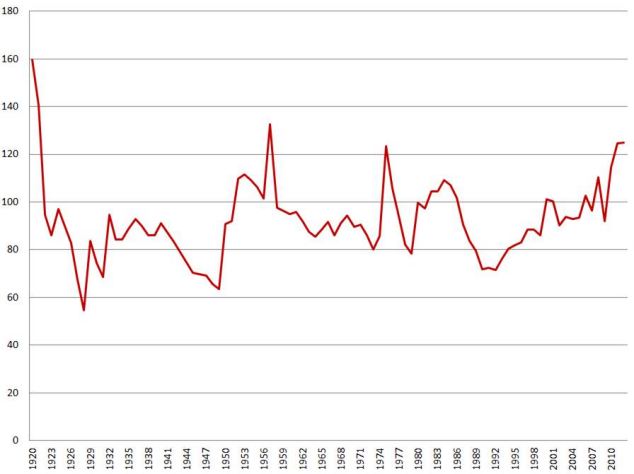 [/img]
Im going to use my best friends situation as a real world example & would love to hear the thoughts of all those saying raise petrol prices & live closer to work...
4-5 years ago he bought his first home with his partner, a real fixer upper, put his heart & soul into it doing as much as he could, did a brilliant job, it stretched him some what, but was all affordable.
3.5 Years ago, find out first baby on the way, happy families
3 Years ago get made redundant from Job in Liverpool, (approx 8 miles from home)
Spends approx 6 months unemployed, looking for a another Job/career, Baby arrives & things start to become tighter.
2.5 Years ago he finally gets back onto the ladder, all be it on a lower wage, problem is the job is in Manchester, 100 Mile a day commute, has a 50+mpg car, drives sensibly to save cash etc...
Since then his partner has gone back to work part time at her Job in Southport, Both Parents who look after kid are close to home making work possible.
Before anyone states the obvious, of course he has looked for work closer to home...
So please explain to me what he should be doing in your eyes? & explain to me how putting people who are already under financial pressure under even more is fair / right? this is a common situation up & down the country, if you think it isn't, your out of touch, if you think tough, we'll id rather not hear your thought's.
timc
At last someone with a real world example of how it it is for many people.
I also work in Liverpool but there is no way I'm moving near to work (Toxteth) until recently my wife worked in Chester so we live roughly 1/2 way between.
Sadly due to her MS we have had the house adapted at our cost. Should we junk all that just so I can save about £2000 a year on traveling?
Even if I rode my bike every day it would still cost close on £1000 a year.
So please explain to me what he should be doing in your eyes?
http://www.carpooling.co.uk/carshare/Liverpool/Manchester.html
He doesn't live in central liverpool or work in central manchester, has to be at his desk for 8am, occasionally needs to travel with work to site, even without travelling to site a city centre to city centre share wouldn't really work with commuting costs & time at each end.
It's always possible construct or quote an extreme example to argue a point.
Your friends circumstances appear unfortunate. If its his only option for the moment he should of course do what he has to, but for his sanity and long term work life balance look to reduce his travel.
Its costing time and money that would otherwise be spent with and on his family.
That some one is willing to do a 100 mile commute is an example that petrol is cheap IMO. If they will not consider a car share that just adds to it. Sounds like they are in a tough situation but the current cheap price of fuel is helping them out.
I'm all for reduced car usage, it's massively important, but simply ramping up the price right now would have devastating consequences. Most people would rather not do it with the current price of fuel, so we need alternatives.
Only a long term government strategy can do this.
It's always possible construct or quote an extreme example to argue a point.
It's not that extreme.
Molgrips plus one.
The fact that so many car journeys ae less than five miles means that there are alternatives already that aren't being taken! Ramp up the cost of fuel and folk will start to make more sensible choices. Instead of driving 200m to the shop to pick up the weekend papers, they will save their fuel for the daily commute.
I really struggle to understand how some people can be so hard up yet still make such irresponsible choices when it comes to transport and lifestyle. It's not as if this propblem hasn't been foreseen and deliberately taking a job with such a long commute as some of those mentioned seems foolhardy and short sighted.
Just wait for the time when petrol reaches the price of beer!
Regardless of the short-term problems, ultimately fuel will approach being prohibitively expensive, and lifestyles will change. And that, is the end of it.
Public transport may already be subsidised monetarily, but that's nothing like the subsidy (above and beyond the oil itself) the environment puts into the world's car habit, and one day that subsidy will run out. Sadly, it will probably run out for those least deserving of the ensuing catastrophe first.
I really struggle to understand how some people can be so hard up yet still make such irresponsible choices when it comes to transport and lifestyle.
Maybe you should ask, instead of (as you appear to be doing) condemning their actions without knowing. I'm sure people have their reasons. No-one wants to spend hours in the car and hundreds of pounds a month on fuel.
Just wait for the time when petrol reaches the price of beer!
Student £1 a pint night in the union = £1.75/l
Motorway services £1.60/l, so not far off!
piemonsterIt's not that extreme.
It is, it's the most extream example anyone on this thread knows of (otherwise they'd be using that example).
Maybe you should ask, instead of (as you appear to be doing) condemning their actions without knowing. I'm sure people have their reasons. No-one wants to spend hours in the car and hundreds of pounds a month on fuel.
Oh I do, it's part of my job! The number of people who do have legitimate reasons for the majority of their vehicle use is so small compared to those who just don't care (or who can afford not to care). The examples on this thread of folk who do need to use the vehicles the way they do are not the norm, unfortunately.
If no one wants to spend hours in their car and hundreds of punds on fuel why do they? Because the alternatives they are offered aren't appealing based on their perception of them? Because they can afford to waste their time and money? Because they have no other choice? The latter is certainly not the majority in my opinion.
Relatively, yes. Absolutely, no. Compared to average UK wages, fuel ain't that expensive. Compared to other countries (Venezuala), it's a rip-off.
People make short journeys by car because the alternatives are not attractive or non existent.
I live about 6 miles from work and drive most days.
The wife and I work near each other so one car covers both journeys
Its quicker and cheaper to travel by car than by any form of public transport
Its a purely financial decision. The added comfort and convenience is a bonus.
When I worked in another part of the city that didn't have free parking I cycled almost everyday as the £5 a day parking made driving less practical.
Its not really a rip off though is it? Just better priced to reflect the true cost of using it. Some, as this thread suggest belive that could be even higher.
Sitting at my desk looking out a ground floor window at cars accelerating up a town centre road 40mph + isnt going to encourage anyone to use alternatives.
Hike the price up to cover the indirect damage, make the alternatives more appealing, all nudges in the right direction.
There will be some pain, but the overall effect will be positive, one person unable to get to a job is a vacancy for someone else.
The fact that so many car journeys ae less than five miles means that there are alternatives already that aren't being taken!
Really? I'd wager that for a significant proportion of journies less than 5 miles a car would be the "best" choice regardless of the price of fuel. Its is where personal motorised transport excels, it is cheap, convienient and efficent.
e.g. I will drive to the local mini-supermarket to get stuff even though it is less than a mile away because if I go on my bike it may get nicked and if I walk it will take me 20 mins and that time is of much more value to me to spend at home than any price that could be inflicted on me by fuel duty.
Penalising people into making a different choice is not the answer, it just builds resentment and anger at "green" policies.
Nobody is going to cycle to the supermarket just beacuase the petrol to get there costs £1 instead of 50p or even £2.
The same is true of their place of work or their kids school. Price is not an factor is their choice of transport for these trips. So we need to accept this and work within the rules of the real world. Two things need to be done...
a) Make personal motorised transport have a much lower impact on the environment through improved technology and alternative fuels without affecting the existing benefits of convienience, cost and effieciency.
b) Offer viable alternatives that have the same hygene factors as driving. This requires huge investments in infastructure. People will get the bus if it is a cheap as driving and doesn't take longer and stops near their house. People will cycle to work if it is is safe away from traffic and there is somewhere safe to park their bike and have a shower and there is a pool car to do work things on if required.
These things are happening already but they should be persued much more agreesively, with much more investment up front.
I'm going to go against the grain here and say no; petrol should not cost anywhere near £6.30 a gallon.
My reason for saying this is that it's allowed the end cost of public transport to escalate beyond all reason.
We need to get a grip on transport costs in this country and we need to do it now. Once we've got the comprehensive and reasonably priced rail network Prescott promised us in 1997, the cost of petrol can double or triple for all I care.
I will drive to the local mini-supermarket to get stuff even though it is less than a mile away because if I go on my bike it may get nicked and if I walk it will take me 20 mins and that time is of much more value to me to spend at home than any price that could be inflicted on me by fuel duty.
Well maybe you're in fine shape but many aren't and for those any exercise will be of use, indeed if they went to a shop a mile away for their shopping three times a week this might be all the exercise they need to get some basic benefit. Oh and when I worked in Sutton it was quicker for me to ride from West London than to drive - bit far for many but I saved money and time by riding.
Says someone who clearly works in a town or city, and can easily commute by bike.
Yep, that's me. I made the choice to live closer to my work so I could cycle, instead of being reliant on the car.
So long as people continue to make unnecessary car journeys in fuel inefficient cars, I can only conclude that fuel is too cheap.
Really? I'd wager that for a significant proportion of journies less than 5 miles a car would be the "best" choice regardless of the price of fuel. Its is where personal motorised transport excels, it is cheap, convienient and efficent.
Best because it is cheap and convenient maybe, not best for all the other reasons social, environmental, health etc. There is also a contradiction here, your "best" is based on it being cheap, but this is regardless of the price of fuel. I'm afraid I don't understand this.
e.g. I will drive to the local mini-supermarket to get stuff even though it is less than a mile away because if I go on my bike it may get nicked and if I walk it will take me 20 mins and that time is of much more value to me to spend at home than any price that could be inflicted on me by fuel duty.
Will, those a pretty spurious reason for me! But then I'm not you and I don't know if your or my opinion can be easily transplated to large segments of the population! If I'm worried about my bike getting nicked, I'll lock it up, if it's 20 mins to walk to the shops I'll do that as I'll get some exercise/fresh air at the same time. we all have reasons for our choices.
Penalising people into making a different choice is not the answer, it just builds resentment and anger at "green" policies.
Except it isn't just a "green" policy, it's a social policy, health policy, a financial policy (congestion costs £billions) and ultimately a fairness-of-society policy what with the majority of the population subsidising the motorist.
Nobody is going to cycle to the supermarket just beacuase the petrol to get there costs £1 instead of 50p or even £2.
Well, that's just an argument to raise the price even further then!
The same is true of their place of work or their kids school. Price is not an factor is their choice of transport for these trips. So we need to accept this and work within the rules of the real world. Two things need to be done...
Price is not a factor again? Well, make it one! Make the motorist pay the full cost of their behaviour.
a) Make personal motorised transport have a much lower impact on the environment through improved technology and alternative fuels without affecting the existing benefits of convienience, cost and effieciency.
Not relevant to much of the intention behind reducing car journeys
b) Offer viable alternatives that have the same hygene factors as driving. This requires huge investments in infastructure. People will get the bus if it is a cheap as driving and doesn't take longer and stops near their house. People will cycle to work if it is is safe away from traffic and there is somewhere safe to park their bike and have a shower and there is a pool car to do work things on if required.
There are too many carrots already in many cases, it's time to start using the sticks more effectively.
This is based on Manhattan, but I'm sure a similar study could be done for big British cities and yield results in the same order of magnitude:
[url= http://blogs.reuters.com/felix-salmon/2009/07/03/how-driving-a-car-into-manhattan-costs-160/ ]http://blogs.reuters.com/felix-salmon/2009/07/03/how-driving-a-car-into-manhattan-costs-160/[/url]
Gives an interesting illustration of the cost of congestion alone. Almost $160 extra economic burden, *per car* in the Manhattan rush hour.
how many of us could go mtb ing without a car?
how many of us could go mtb ing without a car?
:waves:
Yeah - Quote wars!
Peyote - My point; that you have sucessfully disectued into minute detail while seing the wider point fly over your head; is that the price of fuel is not even the tiniest factor in transport method for short and irregular journeys. No ammount of duty is going to change that and the wider economy would be crippled before people stopped using their cars for this type of trip.
So do a) to reduce the impact of these trips rather than pissing into the wind to try to reduce them, embrace the convienence and effiecncy of personalised motorised transport rather than continue to go down the dead end of expanding comunal alternatives such as busses beyond the point they are efficient.
And do b) to reduce the journeys that can be reduced without having to resort to policies that penalise people. Sitting in a car is penalty enough and people mostly don't pick this option through choice but necessity.

