Biking in the local hills and one of the old forest tracks has been upgraded to take logging trucks. Noticed loads of large egg-shaped rocks in amongst the hardcore surface. They seem to have a solid core then layers of different rock around the outside - roughly the size of a decent cannonball (size 12 boot for reference).
Any idea what these are?
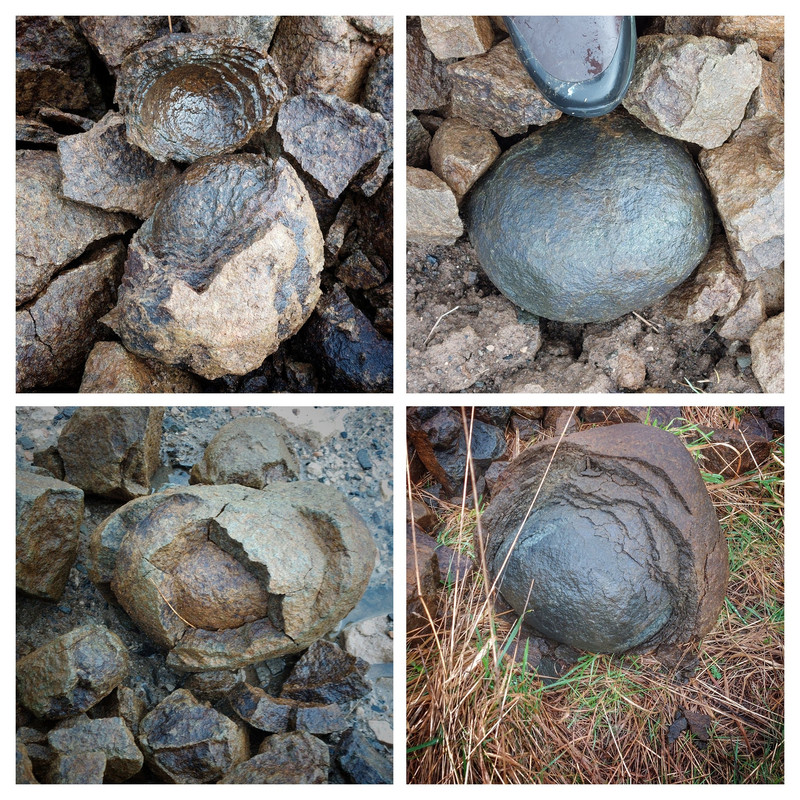

Dinosaur eggs? Fossilised prehistoric giant onions? (IANAG)
Ask the logger who he got his rocks off?
Probably fossilised prehistoric giant baby Robin eggs though.
Basaltic ejecta
Fireballs of lava from a volcano which cooled to give the layers
Agreed, pillow basalts or similar
Concretions - deposits from percolating water around some central starting nucleus.
If you are careful, you can paint the shells.

Thanks geologists of STW - area is Ayrshire/Galloways border in Scotland so material will have come from local quarries I suspect.
Basalt ejecta with what's called 'onion skin weathering'.
Not sure of the lithology but I agree with pistola, that the joints (partings) are due to exfoliation during weathering in the shallow subsurface. Those rocks look pretty weathered. I don't think they are pillow basalts but cracking a few open might give further clues.
Never heard of those before, but they’re really cool!
roughly the size of a decent cannonball
This, of course, is a perfectly acceptable unit of measure on STW.
Probably abbreviates to 'dcb' and can now join kg, A, m, mol and so on as a coherent 🙂
As @DrJ noted: Concretions. Look like the contain some form of iron (ferruginous / hematite).
Here is a big one:
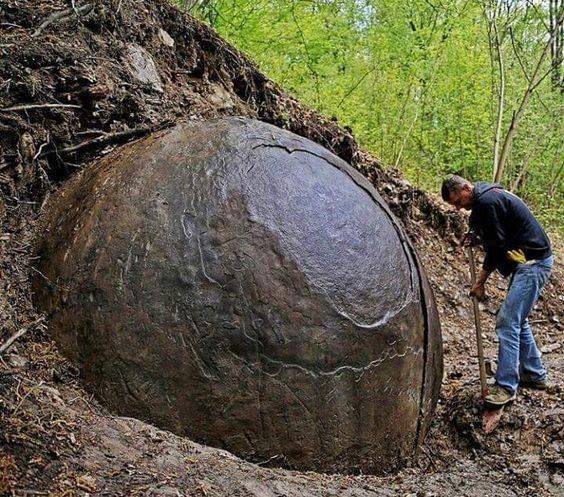
The worlds oldest Scotch Egg, recently found behind the tills of Tesco.
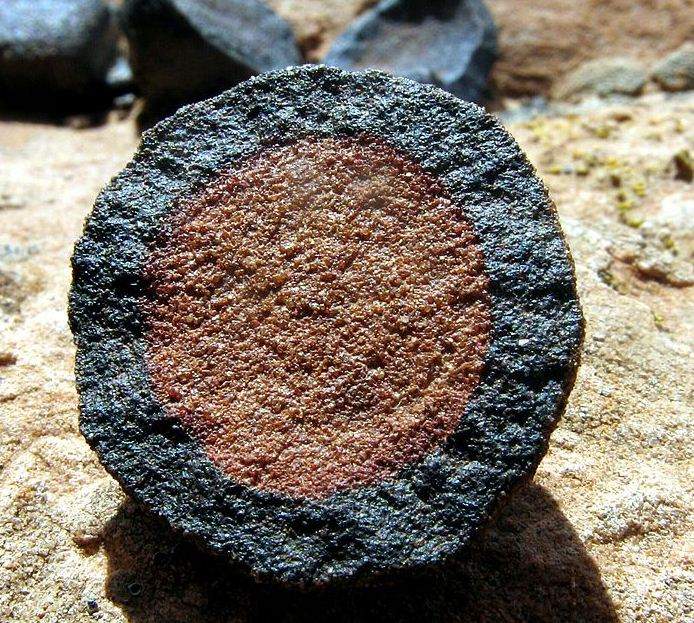
Here is a big one:

Spheroidal weathering of basalt.
Probably.
I found very similar but softer in my garden, in-situ in the glacial till. It was definitely sedimentary as it was quite crumbly, so I'm going with concretion.
soz for hijack, saw these on twitter & wondered if anyone recognises them. Found on a beach in Scotland is all I know.
Bits of fossilised coral?
maybe. Struck me as being manmade and rolled around on the shore for decades.
Thanks again for comments.
I don’t think they are pillow basalts but cracking a few open might give further clues.
I will attempt to crack one open next time I am up that hill.
@bonni I had to look up what Lithology meant but from the hill I had line of sight to the likes of 'nearby' Ailsa Craig, Loudon Hill and Benbeoch - that all seem to have volcanic connections
So I finally managed to get back up on the track where the rocks were liberally strewn. Removed the outer 'onion' layers of a couple and cracked open the 'cannonball' cores (below). Does that help in identification?
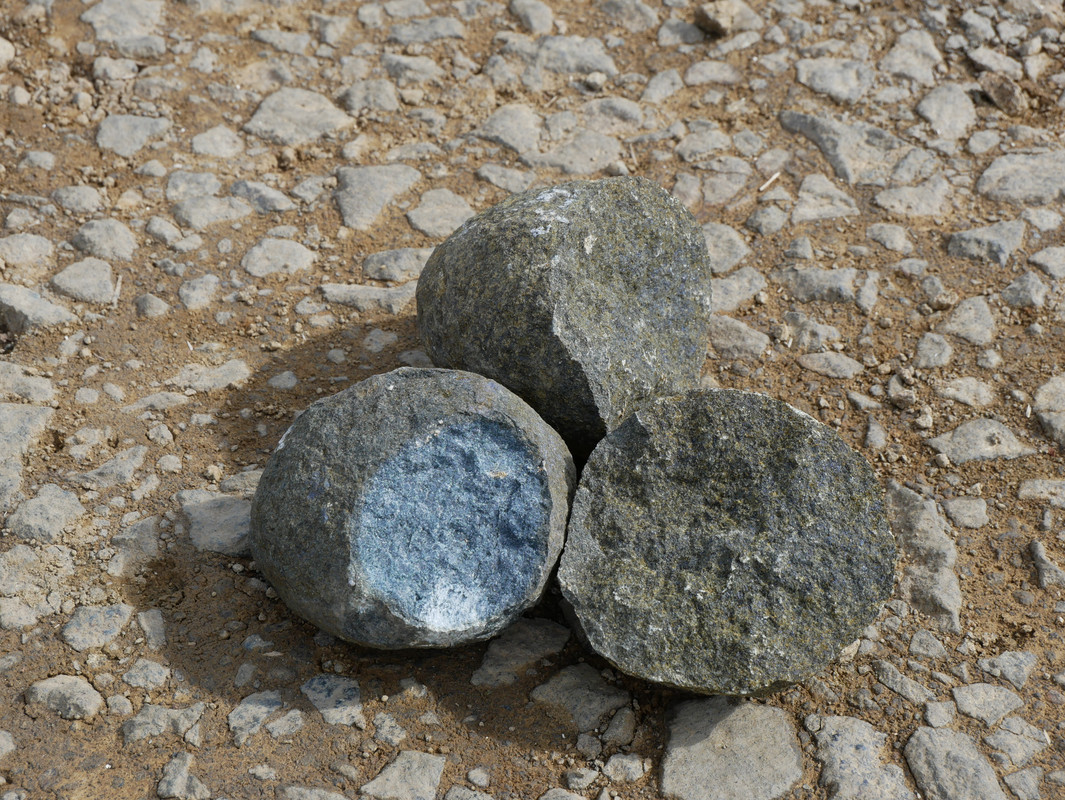
Hi @vmgscot,
Sorry I missed your comment directed at me.
I can't really tell from the pictures what the rock is. However, it looks medium to coarse grained which would suggest that it's not a pillow basalt. Pillow basalts are usually very fine grained as they are basically lava that has been extruded into water. The water quenches the rock rapidly, preventing crystal growth.
If you are in Ayrshire, there's a chance that it could be of sedimentary or igneous origin according to BGS maps: https://www.bgs.ac.uk/map-viewers/geology-of-britain-viewer/
There are other geology-types on here, possibly with knowledge of that part of the World, that could have a better stab at rock ID than me. Good luck!
from the hill I had line of sight to the likes of ‘nearby’ Ailsa Craig, Loudon Hill and Benbeoch
Got me curious now as thats my neck of the woods (on the occasions I actually get to go home currently) - whereabouts are you coming across these?.I know nothing about rocks but have a tendency to carry nice ones home with me 🙂
I was having a clamber about on the quasi-volcanic landscape near Ardeer recently where an ironworks once tried (and failed) to build its own harbour by pouring molten slag into the sea - so the geology of the beach is made up of rock thats only decades old rather millions or billions
Obsevations:
Colour: dark grey with rusty concentric weathering.
Grain size: fine grained
Structure: no small scale structure visible, the centres of the eggs are homogeneous, if the egg shapes result from weathering from fractures then there's a structure in 10s of cms.
On the basis of that I'm going with a fine grained basic igneous rock with spheroidal weathering - basalt.
@bob_summers - I’m wondering if those objects might have been weights to hold down fishing gear, like a sein-net, with floats along the top, or fishing lines, the shape looks too symmetrical as do the holes, which appear to be full of accumulated sand and mud. Possibly carved from local stone.
@bob_summers they might be belemnite fossils? IANAG, but have a hazy memory from a Lyme Regis field trip 30 years ago.
@spandex_bob could be! I’ve only ever seen the photos they sent me, so no idea of size or texture
@maccruiskeen - they have been used in building up a forest road so timber lorries can get in/out the forests around Dalgig (west of Cumnock). No idea where they have come from but I wouldn't imagine the source would be too far away as it would be costly to transport the material far.
The site is also next to the House of Water opencast and the Pennyvenie opencast sites so maybe the material comes from one of the many big 'holes' and big spoil heaps now left to litter our landscape.