UPDATE: CLASSIFIEDS section refreshed, redesigned, searchable: Go take a look
some of the kids from the wifes secondary school didnt know that sheep are not put away at night.
Do they have little sheep size bivvy bags?
It’s not the “green movement” it’s science fact
I assume you accept burning methane (CH4) produces more co2 per mol than ethene (C2H4) for instance?
Yes of course, but it produces the same amount of energy per mol of co2 released. Therefore no difference.
I get that point -see my original post. My point is that it is no better or worse from a co2 point of view than any other burnable.
But is far worse.
I am anti bullshit – I think the green movement would go a lot further if it stopped mumbling bullshit stories into its yoghurt.
Seems you’re not it would appear you create it. Why not read the link Houns kindly provided you.
“ It has a lower calorific value than coal (generating less energy per tonne when it is burned) and yet it produces higher CO2 emissions per unit, so it is the least climate-efficient way to produce electricity or heat”
Plus (as in the article) digging it out and burning it releases methane which is about 28 times more powerful than CO2
Hold yer horses, so many cross posts I haven't had a chance to read it.
Only many posts telling you it’s bad and you’re wrong, and you replying that it’s some green conspiracy theory and you don’t believe the scientific evidence
Houns - I think the article just agree with what I said - I see that digging it out is bad - that's is why "it produces higher CO2 emissions per unit," because it produces CO2 and methane during digging out.
But when you burn it the calorific value is directly proportional to the co2 produced. That's all I was trying to say..
I then asked the question "Is peat a carbon capture machine-I mean does it capture more carbon over time, other than that donated by the rotting vegetation that is initially composed of? "
And according to this - https://www.researchgate.net/publication/321976674_The_Role_of_Peatlands_and_Their_Carbon_Storage_Function_in_the_Context_of_Climate_Change
They do, which answers my question.
I pretty much clearly said I agree that we shouldn't burn it.
Shhhh! He’s reading.
Only many posts telling you it’s bad and you’re wrong, and you replying that it’s some green conspiracy theory and you don’t believe the scientific evidence
I was asking for scientific evidence that's all. But because I questioned, the answer you want to give is that I am Donald Trump. Well done.
I get the damage to the land issue, that alone is good enough to stop burning it.
THE VERY FIRST THING I SAID.
But when you burn it the calorific value is directly proportional to the co2 produced
No its not.
Ethane c2h6 produces the same volume of co2 per mol as ethene C2H4.
Do they produce the same amount of energy when combusted?
From Wikipedia because I'm not doing the maths
Ethane -1560.4 kJ mol−1
From chegg since Wikipedia doesn't list
Ethene -1411.1 kJ/mol
So that's roughly 780kj/mol co2 from Ethane, or 705 from ethene, so 10%. Roughly.
To put it in GCSE terms for you:
Bond breaking requires energy, bond making releases it, so very crudely with organics, (for a given chain length) the less h20 you make the less energy you release.
Looks interesting peteC have you tried them?
no. I live next to 300 acres of woodland...
but I remember seeing them on countryfile, and know how much of a pain Bracken is. Anything that helps keep it down is good.
I've not seen but have seen enough bracken fires to attest to the fact it burns very well.
I shall have a look see for some.
I’ll repeat, I’ve never been anywhere you need to burn stuff in a fire, in an actual house to keep warm.
Then you've a very different upbringing from one that i recognise, Every single house/cottage i grew up in (70's/80's) had open fires in all the rooms, and two of the houses had central heating from a Rayburn in the kitchen which never went out/needed 24hr constant feeding with cut peat (very exotic having heating in the rooms without needing to light a fire), as you glibly suggest that oil is a viable method of heating an old cottage then i guess that you have the means to pay for it. I'd like to see you working for minimum return in a very rural highland/island area whilst being able to afford to pay an ever increasing amount of your income on oil for heating.
Most of my mothers family still cut and burn peat up in Argyll for their heating, many others in the area do so as well and during the summer months it is common to see the crofts helping each other out by all pitching in to get the peat cut/dried for the following winter.
I agree it's unnecessary in areas of mains gas connection as you have alternatives that are reliable and i imagine you also have better insulated modern housing.
I assume you live somewhere where there are alternatives, which makes your point moot.
I suggest you assume nothing
The housing association fitted an air source heating system 7 years ago after removing an open fire with back boiler to feed 6 radiators in my 1 bedroom bungalow as there is no gas supply in my area, it would have better if they insulated my house to a decent standard first but point blank refused to do so. I used to spend £1000/year on electricity as the air source heating is utter shite retrofitted to an 40yr old leaky bungalow so i reopened the fireplace and fitted a multi fuel stove for heating which at least warms the house up and i have an unlimited amount of free firewood/peat, they now want to fit a tesla power wall battery to store cheap off-peak electricity which i imagine is so they can claim "green" credentials and have access to a government grant to do so, personally i'd rather they insulate the walls, under floor, attic and replace the thin 40yr old wooden double glazing which would make much more of a difference.
Ideally i'd do the insulation myself but on my pitiful disability income that is a pipe dream so i'll continue to burn whatever fits in my fire, mostly well seasoned wood with the occasional chunk of peat

i guess that you have the means to pay for it.
That's not what I'm arguing. I'll happily accept it is expensive - My contention is people are saying it's necessary when it's not, it's just expensive.
Yeah I guess if you have the cash a helicopter to get it to your house is on the cards.
For some people it is necessary and the only option where they live. Just because you cannot imagine such circumstances in 21st century UK, based on your somewhat limited experience, it doesn't mean they don't exist.
Yeah I guess if you have the cash a helicopter to get it to your house is on the cards.
And if the world at large doesn't stop using the cheapest (£) possible option it'll soon be necessary.
In the context of the thread, that means, wood, those bracken things, heather, hell even non sulphur free coal in place of peat.
For some people it is necessary and the only option where they live.
Cost aside, where, why?
Read the thread instead of pontificating
Cost aside, where, why?
It’s all in the thread.
Where ?
Not just outside Bristol anyway
Only a guess, but I suspect the environmental impact of a few Northern trolls burning peat pales into insignificance compared to the 'average' STW chappie with his £5,000 bike, his delightful children, his trail dog, his daily driver T6, his wife's essential Audi estate, his wood burner, his ethically sourced trousers, his avocado habit, but most of all his coffee and craft beer snobbery...
I object to the likening to a Northern Troll, I self identify as a Highland Hairy Dwarf Hunchback thank you very much, those Northern Trolls have no place up here with their vindictive and punitive bridge tolls, they tried it on with their Skye bridge fiasco and got rightly chased.
Clip clop...!
Lots of people on here maybe need to look outside of their urban utopian mound of moral high ground.
I had never considered peat being bad for the environment. I had been going to the peat hill since I was a toddler. A great day out, soup in a thermos, big picnic with neighbours on their peat banks.
I’m glad we did as it would have been a bit chilly otherwise!
Still a huge amount of people doing it, not because of the rustic smell, but to survive the winter.
Would it surprise you that there are also several, very large businesses who cut pests every year in order to make a very sought after product, bringing in huge amounts of money to the UK Government!
Would it surprise you that there are also several, very large businesses who cut pests every year in order to make a very sought after product, bringing in huge amounts of money to the UK Government!
No, but I’m not sure why we should continue to destroy such an environment when it‘s not necessary.
Fairly simple, because the Government make millions if not billions of pounds from it every year.
Woah, late to the party , but did someone say not all the carbon is attached to organics?
Better throw a third of chemistry in the bin so.
My contention is people are saying it’s necessary when it’s not, it’s just expensive.
Choice is;
1 Unaffordable house upgrades
vs
2 Burn stuff to avoid freezing
About a gazillion people couldn't care less about the semantics here.
Woah, late to the party , but did someone say not all the carbon is attached to organics?
Better throw a third of chemistry in the bin so.
So carbon dioxide, carbon monoxide, cyanides carbonates and so on. All likely to be present in differing amounts in peat.
About a gazillion people couldn’t care less about the semantics here.
I won't argue that.
some of the kids from the wifes secondary school didnt know that sheep are not put away at night.
Do they have little sheep size bivvy bags?
Bivvy baaaaags actually.
Bivvy baaaaags actually.
You are PP and I claim my five pounds
Peat is also a bit rubbish to burn in my experience when I lived up in Scotland with a backboiler and stove for warmth. Happily have a supply of old floorboards coming in at the moment for a bit of warmth. I worked up in Lewis for a while and people had there own sections of peat to cut and use. Quite a pleasant social day out if you don’t mind physical messy work.
Quite a pleasant social day out if you don’t mind physical messy work.
Must be a Scottish thang. Everyone I know who’s done turf cutting says it’s a horrible days work, heavy cutting, lots of strain on the back and midges. They have a rather impressive enormous home made tractor / machine for doing it near us now.
If you’ve just spent “summer” working as a deckhand round the Hebredies believe me cutting peat is a pleasant way to spend the day!
Dangerousbrain - in chemistry, virtually everything with a carbon atom is classed as organic.
Was being a smartarse.
Dangerousbrain – that term applies to all forumites
Dangerousbrain – in chemistry, virtually everything with a carbon atom is classed as organic.
I'm aware of that.
Was being a smartarse.
In which case sorry I missed the being a smart arse bit. I guess it just needed a hotter cup of tea.
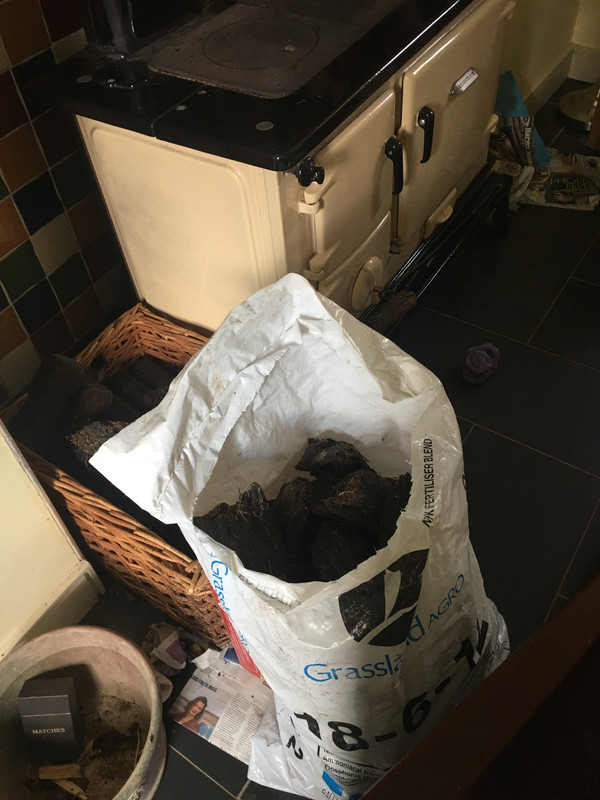
Boiler in house has broken and it’s freezing, time for turf
I am anti bullshit – I think the green movement would go a lot further if it stopped mumbling bullshit stories into its yoghurt.
Well that's just rude - there is a lot of science behind why peat bogs are beneficial. Take time to read through things published by:
Historically they have been exploited:
Fuel - there are relict peat cutting sites throughout the UK. There will probably always be some properties where peat cutting is the only option. In my opinion these will be fractions of fractions of a percent to the total number of households and falling.
Compost - mainly a lowland bog problem. There is a real push to reduce the peat content of compost. I think the industry was actually left to self regulate on this one - consequently reductions have been pitiful.
Agriculture - draining and improving, there was a big push on this post war. Essentially plowing a single drainage ditch through the bog surface - known as a Grip - there were large grants available to do this. The separation of the the grip was based on the grant payment.
Forestry - monoculture planting over large areas of bog in the upland.
Wildfire has been a big cause of damage - once you loose the surface vegetation, which is hard to establish without some fairly invasive work, then the bog erodes at rates upto a couple of cm a year. Washing away in the rain, desiccating and blowing away in dry weather.
Benefits other than biodiversity:
Carbon capture - once you have got to the point where sphagnum is growing the bog will start to build. The rate of growth is not quick enough to make peat harvesting sustainable.
Water quality - this is really a degraded bog issue. Water from peat bogs is the colour of tea, water companies then spend of a lot of money treating it to the point where people can make tea with it. It's really about improving the quality of the raw material.
Flood risk - here it's really about slowing the flow and making catchments less flashy. Trying to get the flood profile away from rapid rise and fall to a slower steady rise and fall.
Whats being done:
Strangely enough rather than weaving Yogurt there are people throughout the UK focused on different areas of peatland research and restoration. The project most familiar to mountain bikers is Moors for the Future.
Depending on what the actual cause of damage was the projects tend to be looking at:
Grip blocking / profiling
Removing Trees
Gully blocking / profiling - gullies are taken as the channels formed though natural processes
Stabilising bare peat
Increasing biodiversity
Reducing trampling damage
Sphagnum inoculation - this is the big that actually gets the bog building processes functioning. At lot of the earlier other treatments are really about getting you to this point.
In industry:
Peat free alternatives for composts - for example bracken and sheeps wool mixes
What can we do:
Buy peat free
Don't start burning peat and try to find alternatives if you are one of the very rare people who have to
Ride responsibly - some of that loam might not be, plumes of dirt = erosion. Pick routes according to the ground conditions.

