The other thread got a bit tasty and was closed, so let's see if we can keep this one open.
As I see it, there are the following opinions, each of which seem valid:
a) DLA should be available to those who need it. Those who don't should be given help to equip them with the skills to re-enter the job market.
b) Assessment of who does need it is, at best, tricky.
Are the current changes being made by the Government an 'attack on the poor', or a necessary consequence of a) and because of b), never going to be easy?
Discuss. First to rant loses.
dla has nothing to do with being in or out of work
[i]dla has nothing to do with being in or out of work [/i]
Okay then, so what's the fuss about?
I think the debate usually gets clouded due to B. I don't think many people have a problem with A. There often seems to be a view that because it can be difficult on deciding who is eligible everybody who claims should be. There's also a lot of people who genuinely believe they should be entitled who then get rather distressed when they find they aren't eligible and blame the system rather than consider that they may not be the best people to make an impartial judgement on their circumstances.
Same argument applies to means testing general benefits, most people would agree the support should go to those who need it, exactly who those people are and how they are defined is where the different views come in.
Assessment of who does need it is, at best, tricky
No, it isn't.
But it should be done by medical types, not French accountants.
Well if the primary aim of the government was to help disabled people, then I think we can safely say that the "current changes" would be warmly welcomed by the disabled and the organisations which represent them.
That however does not appear to be the case, in fact they appear to be vehemently opposed to them. Draw your own conclusions.
do you mean employment and support allowance? esa?
[i]it should be done by medical types, not French accountants[/i]
Using what criteria? I assume it would have to be the same for everyone in order to be fair.
If you are able to work without assistance then you should. If the government can assist you back to work then you should take the assistance. There will be grey areas and disputes.
Suitable Work as for anyone not working for a prolonged period should be what you can do not what you want to do. Retraining and education are as much a part as removal of benefits.
However I believe dla is not work related.
[i] if the primary aim of the government was to help disabled people[/i]
What if the primary aim was to prevent people claiming DLA that shouldn't be? Is that a bad thing?
Racist, whats wrong with being French. I can see whats wrong with being an accountant, they all wan to be lion tamers.
The problem is PEOPLE. If there is a system people will play it. Some rich people play the tax system, some poor people play the benefits system. Get rid of people and it'll all be fine.
[i]do you mean employment and support allowance? esa?[/i]
I'll be honest, I don't know. I'm talking about the benefit that is threatened to be removed should the new assessments determine that someone is fit for work.
What if the primary aim was to prevent people claiming DLA that shouldn't be?
Well if the primary aim was to prevent people claiming DLA that shouldn't be, then I think we can safely assume that the disabled and the organisations which represent them would have no problem with that.
However the disabled and the organisations which represent them appear to be unconvinced by that argument.
glupton1976 - Member
The problem is PEOPLE. If there is a system people will play it. Some rich people play the tax system, some poor people play the benefits system. Get rid of people and it'll all be fine.POSTED 4 MINUTES AGO # REPORT-POST
This I tend to agree with.
Well if the primary aim was to prevent people claiming DLA that shouldn't be, then I think we can safely assume that the disabled and the organisations which represent them would have no problem with that.However the disabled and the organisations which represent them appear to be unconvinced by that argument.
Or perhaps they represent both. As above the people in the middle of the judgements tend to be the least objective. Not saying they are right or wrong just not the person to make an objective decision
glupton1976 - Member
The problem is PEOPLE. If there is a system people will play it. Some rich people play the tax system, some poor people play the benefits system. Get rid of people and it'll all be fine.
This government's own report found that the fraud rate for DLA is 0.5%.
ATOS have been tasked with reassessing people and moving them onto the new PIP (personal independent paymetns), but at the same time cutting the number of claimants by 20%.
This is nothing to do with fraud.
[i]ATOS have been tasked with reassessing people and moving them onto the new PIP (personal independent paymetns), but at the same time cutting the number of claimants by 20%. [/i]
Do you have a source for that figure?
one of the more sensible comments on the [i]other [/i] thread was that you can agree with the "why" but not the "how".
I think [u]everyone[/u] is in favour of having a system there for people that need help, but at the same time ensuring that it's not exploited. However, it seems like it's the way that this has been done that is causing people significant distress.
Before they started the whole process, why didn't somebody stop and say: "hang on.... taking benefits from disabled people? This has the potential to be quite controversial - lets make sure that this is done properly"
Doesn't matter if you're a leftist or a rightist - seems like a basic leadership issue
However the disabled and the organisations which represent them appear to be unconvinced by that argument.
+
There's also a lot of people who genuinely believe they should be entitled who then get rather distressed when they find they aren't eligible and blame the system rather than consider that they may not be the best people to make an impartial judgement on their circumstances.
it has the word disability in it, surely this will be closed.
I think everyone is in favour of having a system there for people that need help, but at the same time ensuring that it's not exploited.
It's impossible to have a perfect system, so you have to decide how many wrong decisions you're prepared to accept. The greater the number of fraudulent claims turned down, the greater the number of real claimants who'll also be rejected. The figure of 0.5% fraud sounds low enough to me (assuming it's true), anyone think it should be lower?
The problem is that the assessment is being done by staff with no medical knowledge, and scant training. It has been rushed in with little thought to the very real consequences for the lives of the most disadvantaged in society.
Thus its very broad brush and simplistic. This leads to some horrendous errors. ie: people with terminal cancer being declared fit for work. The better half has seen first hand how the process terrifies those with serious mental health issues who are simply not equipped to deal with the process
Another problem is the widespread suspicion that there are clear targets for removing people from benefits.The government deny this but refuse to release the documents that prove this not to be the case. Which is a tad suspect, to say the least. If you've nothing to hide....?
Also, and most importantly: it is not achieving its stated aim. To reduce costs. as a huge amount of people who dispute the tribunals conclusions have their benefits reinstated on appeal. This is a hugely expensive process who's cost is being born by the taxpayer, not ATOS who are making the mistakes. Yet another case of us picking up the tab for the mistakes of the private sector, while they continue to make money from a shoddy and ill-conceived service. G4s? A2E? Its all getting depressingly familar isn't it?
It's impossible to have a perfect system, so you have to decide how many wrong decisions you're prepared to accept. The greater the number of fraudulent claims turned down, the greater the number of real claimants who'll also be rejected. The figure of 0.5% fraud sounds low enough to me (assuming it's true), anyone think it should be lower?
I completely agree. If the 0.5% figure is true.... and has been derived meaningfully - that's acceptable to me (as a taxpayer).
It then becomes a question of public confidence in the system, something that will be hard to achieve for an issue that is difficult to debate publically (as we have shown!) for fear of being cast as a souless b*stard!
Thus its very broad brush and simplistic. This leads to some horrendous errors. ie: people with terminal cancer being declared fit for work
you can agree with the "why" but not the "how".
You can have terminal cancer but (technically) be fit for work. BUT that very different to saying that benefits should be withdrawn from that person.
Depends on the remit given to the people conducting the assessments.
Before I get shouted at - I'm not saying that somebody with terminal cancer should get there benefits withdrawn!
t-minus ** seconds...
patriotpro - to be honest fella, you're the only one not adding anything meaningful
[i]You can have terminal cancer but (technically) be fit for work. BUT that very different to saying that benefits should be withdrawn from that person.
Depends on the remit given to the people conducting the assessments.
[/i]
Absolutely. The benefit should be to support you because you are unable to work because you are ill, not just because you are ill.
[i]
Before I get shouted at - I'm not saying that somebody with terminal cancer should get there benefits withdrawn![/i]
I suppose that I am saying that, if properly and fairly assessed.
Right - just to make sure everyone is signing from the same hymn sheet. What is the system that we're moving from and what are we moving to?
Who makes/made the decision whether someone is fit for work, and who will do it in the new system?
Overall
1. A small number of those who get ESA are just taking the piss they could work but they ar elazy - my guess less than 1 %
2. a higher percentage/majority could work if
a) they recieve support
b)Employers adapt the workplace for them
c) someone funds it
I dont see a long list oif employers willing to take on the disabled - the public sectors outperforms th eprivate sector by about 10 X iirc in terms of employing the disabled
3. Some just need to retrain and consider their options - ie they cannot do thier old job so in the past they were declared unfit for worlk - eg brickie with shot kneess and back for example but could drive.
4. Some are just unfit for work whatever we do
This current system has F all to do with this and is simply a method of reducing costs by saying everyone can work
For example if you have OCD you get 12 month on ESA then you have to comply with JSA terms or loose your benefits - this is wher ethe great saving will be as many disabled will no tbe able to compley even if they try. I work with a lad with aspergers, everyone knows he wants work but he cannot comply with the rules even with support.
From what I can tell if you turn up for the appointment you are deemed fit to work - ie you can get there so you can get to work
the only person I know who di dget turned down has serious mental helath issues and pleaded and cried through the assement to be classed as fit to work
Whatever it is it is not about empowering disabled people or they would be thankfull.
FWIW everyone has a sick note from a registered Dr but only the view of the assement ones count - well till it gets overturned on appeal
I know of one person who worked up until 3 days before he died. That was his choice as he was a positive chap. It should not be a bureaucrats decision to insist on working up until the end as we profess to be a civilised society.
You can have terminal cancer but (technically) be fit for work. BUT that very different to saying that benefits should be withdrawn from that person.
If you're terminally ill and were still at work before the illness then I think you should be entitled to some money, since unless a miracle occurs you won't be claiming a pension.
IHN - Member
"ATOS have been tasked with reassessing people and moving them onto the new PIP (personal independent paymetns), but at the same time cutting the number of claimants by 20%."Do you have a source for that figure?
The Telegraph:
[url] http://www.telegraph.co.uk/news/politics/9263453/500000-to-lose-disability-benefit.html [/url]
The cost of disability living allowance, which is intended to help people meet the extra costs of mobility and care associated with their conditions, now outstrips unemployment benefit and [b]will soon be £13 billion annually.[/b]...
An official impact assessment of the plans, released this month, reveals the scheme will [b]cut benefit payments by £2.24 billion annually[/b] – and lead to about 500,000 fewer claimants.
The Guardian:
[url] http://www.guardian.co.uk/news/datablog/2012/jan/18/disability-living-allowance-data [/url]
Under the new proposals, those receiving PIP will be more rigorously assessed in order to continue receiving payment. [b]The government estimates the proposals will save around 20%, or £2bn, from the current £12.6bn scheme.[/b]
Wow, just wow.
From what I can tell if you turn up for the appointment you are deemed fit to work
Junkyard - depressingly, that is [i]exactly[/i] what is happening
Lifer - thanks.
However, what that lot says is that the government estimate that the scheme will produce a 20% saving.
That's very different to saying that ATOS have been tasked to cut the number of claimants by 20%.
[i]If you're terminally ill and were still at work before the illness then I think you should be entitled to some money, since unless a miracle occurs you won't be claiming a pension. [/i]
That's not how it works, and not how it should work. There's not an individual 'pot' of benefits cash that everyone's entitled to before they die. You get it when you need it, and if you don't need it, you don't get it.
IHN - Member
patriotpro - to be honest fella, you're the only one not adding anything meaningful
Not everything has to be meaningful. tbh i was just having a bit of fun, nothing else.
Which of these people is worthy of DLA?
i) ex soldier, leg blown off in afghanistan, uses prosthetic leg to get around
ii) person who gets panic attacks and cannot go out the house without company
iii) drug addict Alcoholic who's alcoholic girlfriend claims for help feeding and washing him as he's too pissed to bother doing it himself
iv) obese person who can't get to the shops because they are too fat to get out the door (thank god for tesco home delivery service)
(ps. if someone is terminally ill, then they are automatically awarded DLA under the special rules)
That's very different to saying that ATOS have been tasked to cut the number of claimants by 20%.
You are being rather pedantic. The Telegraph link states :
[i]"An official impact assessment of the plans, released this month, reveals the scheme will cut benefit payments by £2.24 billion annually – and lead to about 500,000 fewer claimants"[/i]
I think you'll find that "500,000 fewer claimants" represents a cut of about 20% in the number of claimants.
Oh, as a matter of interest:
[img] 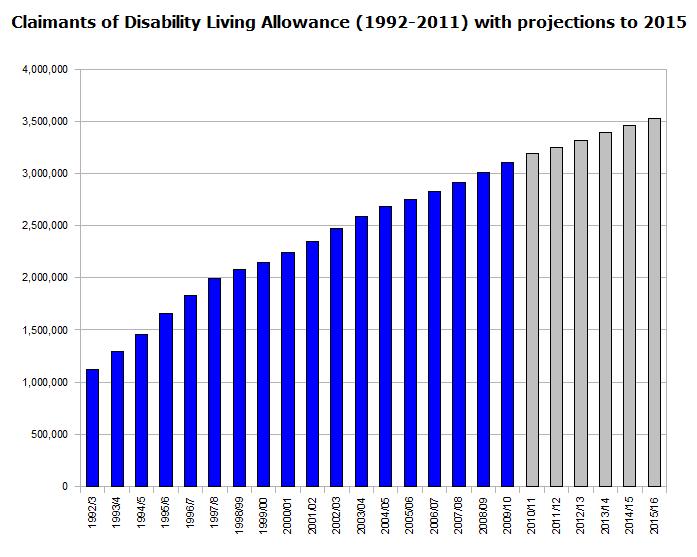 [/img]
You are being rather pedantic. The Telegraph link states :"An official impact assessment of the plans, released this month, reveals the scheme will cut benefit payments by £2.24 billion annually – and lead to about 500,000 fewer claimants"
I think you'll find that "500,000 fewer claimants" represents a cut of about 20% in the number.
Maybe, but my point is that they (the government) obviously want fewer claimants, but that's different to giving ATOS a target that basically says "for every five people you assess, one has to fail the test".
On a kind of aside, wasn't DLA basically brought in to buy off/support miners who would otherwise have gone onto the unemployment figures when all the mines were shut?
this is wher ethe great saving will be as many disabled will no tbe able to compley even if they try.
I've claimed JSA on two separate occasions in the past. I would have preferred not to but the insurances I took out against redundancy required me to in order to pay out.
Complying with the requirements isn't hard; you just have to find and apply for jobs. That said, lot's of people even without any kind of disability still need help with doing even that and there are schemes to help with this.
It doesn't matter what the outcome of any application is, you will qualify for JSA as long as you've made the effort to find and apply for work.
Ernie, INH is not being pedantic, he’s making an important point. Estimating the savings is not the same as saying ‘find 20% of people we can remove the benefit from or else’.
they (the government) obviously want fewer claimants, but that's different to giving ATOS a target that basically says "for every five people you assess, one has to fail the test".
So you don't deny that the government wants ATOS to cut the number of DLA claimants then - you just dispute that ATOS has been given a target ?
I'm sure ATOS knows exactly what is expected of it, specially as targeted results is very much the protocol followed by UK governments these days.
You lot need to get a better understanding of what DLA is and how it is awarded. Its not all about ability to work.
My wife gets DLA (we use it to get a car on the Motability scheme) because she has cerebral palsy. She has held down her current job for 27 years!
So you don't deny that the government wants ATOS to cut the number of DLA claimants then
Not speaking for INH, but I would agree with the statement 'the government thinks it can reduce the the cost of DLA by 20% by getting a certain number of people off the benefit and back into work or removing benefit for people currently receiving that might not need it'.
The parts that are debatable are whether that is 'fair', which is only something the electorate can decide collectively and whether it's realistic.
I agree that you don't need to have a performance target written into a contract in order to induce a certain type of behaviour that trends towards the unspecified goal. What gets measured becomes important, ergo, people at ATOS will be tacitly working towards a target. After all, their job relies on the contract.
It doesn't matter what the outcome of any application is, you will qualify for JSA as long as you've made the effort to find and apply for work.
That's because the requirements for JSA are very simple. Are you applying for jobs? Thats a yes/no answer.
But Whats JSA got to do with disability living allowance assessment? Thats massively more complex in assessing somebodies illness or disability, and subsequent ability to work. The main problem with this assessment seems to be the total lack of consistency in the criteria, due to being carried out by unskilled and barely trained staff. And the suspicion that outcomes are being pre-ordained by a target-driven culture
I assume that the government has said to ATOS "here's a set of tests we want you to apply to current DLA claimants". I assume that the government thinks that the test criteria are such that 20% of the current claimants will be deemed to be no longer eligible [edited after Mad_pierre's valid point]
That's different to the government saying "here's a test, make sure 20% fail it".
[i]I'm sure ATOS knows exactly what is expected of it,[/i]
I'm sure ATOS knows exactly what it is contractually obliged to do and it will do nothing else and will be able to prove that anything deemed unseemly was a contractual obligation. There's no room for tipping of winks when it comes to deals like this, especially when they're in such a controversial area
My wife gets DLA (we use it to get a car on the Motability scheme) because she has cerebral palsy. She has held down her current job for 27 years!
There is a question here that I really want to ask, but fear it will tip the thread into the abyss. Can anyone think of a sensitive way of putting it?
FWIW, I don't have a problem with the 'what' (that being a rigourous assessment of need for this, or indeed any, benefit), or particularly the 'why' (an aim to reduce the benefit bill) but there do seem to be massive problems with the 'how' (the assessment method).
Zulu-Eleven - MemberWhich of these people is worthy of DLA?
i) ex soldier, leg blown off in afghanistan, uses prosthetic leg to get around
ii) person who gets panic attacks and cannot go out the house without company
iii) drug addict Alcoholic who's alcoholic girlfriend claims for help feeding and washing him as he's too pissed to bother doing it himself
iv) obese person who can't get to the shops because they are too fat to get out the door (thank god for tesco home delivery service)
According to the Daily Telegraph article the government doesn't think that your ex soldier with their leg blown off in Afghanistan and who uses a prosthetic leg to get around, "is worthy of DLA".
[i][b]The rigorous new process being introduced by Mr Duncan Smith could lead to those without limbs, including former soldiers, having their payments reduced as their everyday mobility is not undermined by their prosthetic limbs. [/i][/b]
Can I take it that you don't support the government on these changes Zulu-Eleven ? Or do you agree that disabled ex soldiers are unworthy ?
disability living allowance assessment? Thats massively more complex in assessing somebodies illness or disability, and subsequent ability to work.
As already said, nothing to do with ability to work - its about care needs and support with the extra expenses caused by limited mobility.
The main problem with this assessment seems to be the total lack of consistency in the criteria, due to being carried out by unskilled and barely trained staff.
up to 2010, apparently 46% of DLA awards were based on checking with the claimants own GP (46%) or just the information on the form (16%) or some other source (like ringing up a carer) (36%).
Only 6% of claimants had their claim medically assessed by a specialist for the purpose of their claim.
do you think that was reasonable?
So you don't deny that the government wants ATOS to cut the number of DLA claimants then - you just dispute that ATOS has been given a target ?
[u]If you read what he has said[/u].... IHN was pointing out that estimating the impact of the plans is different to giving somebody a target to work towards. So far you've called him a pedant and harangued him for an opinion that you have projected onto him - no wonder the other thread got closed.
[i]Can anyone think of a sensitive way of putting it? [/i]
I'll go.
Mad-Piere: Whilst I'm sure she is completely entitled to it, is the DLA that your wife recieves an essential, or a nice-to-have?
Feel free to tell me that it's none of my business.
There is a question here that I really want to ask, but fear it will tip the thread into the abyss. Can anyone think of a sensitive way of putting it?
Just ask it
According to the Daily Telegraph article the government doesn't think that your ex soldier with their leg blown off in Afghanistan and who uses a prosthetic leg to get around, "is worthy of DLA".
I would agree with that.
I do however think they should get a significant (six figure) payout as compensation for their loss.
Only 6% of claimants had their claim medically assessed by a specialist for the purpose of their claim.do you think that was reasonable?
If that's true, then its patently ridiculous. Again: my problem isn't with the principle, the problem is how insensitively and shoddily the whole process is being conducted. Not to mention the inaccuracy, as the majority of appeals are overturned once qualified medical staff are involved, which is costing a fortune! Thus the whole purpose of the process -the reduction of the costs, just isn't materialising
Just ask it
As INH said; what does the payment enable your wife to do that she would not otherwise be able to do?
Seems like the most sensitive way to ask, not least because that is what the payments should be based on.
[i]Or do you agree that disabled ex soldiers are unworthy ? [/i]
The fact that they are ex-soldiers has nothing to do with their worthiness, and is the kind of rhetoric that makes reasoned debate difficult.
What makes anyone worthy is their requirement for financial assistance due to their illness or disablement. How they came to be in that situation is unimportant.
ernie_lynch - MemberThe rigorous new process being introduced by Mr Duncan Smith could lead to those without limbs, including former soldiers, having their payments reduced as their everyday mobility is not undermined by their prosthetic limbs.
That's where it gets complicated though... a mate of mine is a partial amputee. It does limit what he can do a little- he can't carry heavy things, or run for a bus, or stand for extended periods- but day to day he gets around pretty much the same as everyone else. He's more mobile than many obese people, and way more mobile than I was for a long time after I broke my hip. So should be get a payout or not? Should the obese people? Should I?
(I don't have an answer for this question. Maybe, maybe, no, is the best I can do)
Ex soldier shouldn't be relevant- there's supposed to be other methods to recognise that.
So far you've called him a pedant and harangued him for an opinion that you have projected onto him - no wonder the other thread got closed.
Oh here we go, someone starts coming out with the usual aggressive and baseless bollox.
Saying : [i]"You are being rather pedantic"[/i] hardly constitutes haranguing someone. ffs.
I'll decide if I'm being harangued thanks chaps, don't fight over me.
I am so far harangue-free. Carry on.
[edit] and maybe lets' all take a breath, eh?
Ernie - thats my point though, under the existing rules, the ex soldier with a missing leg would have a fairly good chance of not getting DLA awarded - and there would be a significant chance the person with sever panic attacks wouldn't
the sad thing about DLA, is that the last two examples I gave would be the ones most likely to get paid, and they are the two that I would personally have the most reluctance about it being paid to.
Binners - stats from here:
Ernie, come on, right there in your response you've got very aggressive. You feel strongly about this subject and I can really respect that and honestly you're views are shaping the way I think. Just don't resort to swearing.
The fact that they are ex-soldiers has nothing to do with their worthiness, and is the kind of rhetoric that makes reasoned debate difficult.
My question was specifically aimed at Zulu-Eleven, not you.
I assumed that as he had brought the disabled ex soldier into the debate, that he had strong feelings concerning the issue. A reasonable assumption imo.
Here we go.....
@mad pierre,
I accept that a car on motability is often adapted to the user because they have needs and that this adaptation costs money.
However if i want a car i have to pay for it out of my earnings.
Is the car allowance a figure to help cover the increased cost, or does it cover the whole cost, ie is tax payers money putting you in a position that is more than just assistance?
As above - I don't think the soldier should get DLA if they can function as well as most other people can, with a prosthetic leg.
But I do think they should get massive compensation for their loss.
The point being that you need to separate the two issues. One is about sacrifice and compensation, the other about need.
The DLA she receives is due to her lack of mobility. This is what I was trying to point out. DLA (as very early posts pointed out) is not to do with ability to work. She has worked and paid taxes all her life.
Essential or nice to have? Well it's not that simple. She has been fortunate enough to have a job a short distance from our house (and at the time her nearby mum's house) since she left school. She can't drive, ride a bike, run or get anywhere far away or get there fast. If she lost that job then "essential" but I guess as it is then you could currently say "nice to have" because I could afford to fill in.
Before we met then again it was probably "essential" as due to discrimination she has never earned as much as her peers. This has changed a bit but (as you can see on this forum!) the general population's lack of understanding of disabilities leads to assumptions, prejudices and discrimination - this is not necessarily deliberate on the part of those that discriminate but they do it.
The only thing which I feel strongly about geetee, is batfink making stupid allegations that me saying [i]"You are being rather pedantic" [/i] is the sort of stuff that gets threads closed. ffs.
DLA - http://www.direct.gov.uk/en/MoneyTaxAndBenefits/BenefitsTaxCreditsAndOtherSupport/Disabledpeople/DG_10011925
Not work related and usually doe snot take into account your income
support for those who cannot work due to disability
INH is not being pedantic, he’s making an important point. Estimating the savings is not the same as saying ‘find 20% of people we can remove the benefit from or else’.
That is a pedantic pin dance barely worthy of thought. So the govt set the rules , rules they think will reduce claims by 20 % . The central point is the effect and or aim is to reduce the claimants via re classification.
Not sure it is up to the elctorate surelya Doctor can decide if you are fit to work. When a Dr disgarees with the Govt appointed Dr for the contract to assess what happens then?
Its clear that whatever it is it is not about medical assesments made by independent medical doctors as the NHS provides those already
geetee1972 - MemberJust ask it
As INH said; what does the payment enable your wife to do that she would not otherwise be able to do?
Seems like the most sensitive way to ask, not least because that is what the payments should be based on.
as a chronic pain sufferer, my wife has to use crutches to walk all the time and a wheelchair for a distance of 20mish+. she also gets DLA and we have a motability car. My understanding and certainly our use of both the above is that they offset to a degree the fact that most of everyday life is either far more difficult or expensive than for a non-disabled person, and that while the amount she gets could/should never be an attempt to financially "normalise" her life, it certainly gives her more independence than she would otherwise have. Disability Living Allowance as a title sums it up pretty well.
Mad_pierre - thanks for that.
Out of interest (and again, none of my business), has your wife had to take the new assessment?
[edit]same goes for flatboy
They are changing ESA rules for CLAIMANTS - ie those who do not work
they are not changing DLA [ in general] though the results of ESA will impact on your DLA payments and other
Ie if you loose ESA you will loose [ i assume higher rate DLA and other payments like say carers allowance].
ESA = Dont work and unable to work due to disability, illness whatever
DLA = impairment payment due to disability - no assesment of suitability to work
Just my 2 cents but i'm 19, and for the last 2 years of my life i've been claiming DLA (£209/month FWIW) for a disability that does not hinder my ability to work at all. That's £5K just to me in the last 2 years that i've got on top of my last 2 years wages, also. In my eyes, though, it is simply "Well every other tom, dick and harry is claiming for stuff so i'm going to aswell."
I accept that a car on motability is often adapted to the user because they have needs and that this adaptation costs money.However if i want a car i have to pay for it out of my earnings.
Is the car allowance a figure to help cover the increased cost, or does it cover the whole cost, ie is tax payers money putting you in a position that is more than just assistance?
theflatboy has already answered this above pretty well. Ignore that we choose to use the allowance for a car. The allowance is to help her cope with the parts of life that are more difficult for her than normal folk like you or I.
Out of interest (and again, none of my business), has your wife had to take the new assessment?
In all honesty I am not sure! There is often paperwork and Doctors letters etc moving about! However as she gets the allowance for a permanent, uncurable condition then I'm not sure how it works....
That is a pedantic pin dance barely worthy of thought
Well respectfully I don't agree with that; it's not pedantry in my view it's nuance.
Junky I made your argument myself earlier so while I don't think it's pedantry, I do agree that the outcome is broadly the same.
What gets measured becomes important.
They do re asses those with DLA but not to the extent of ESA - I assume that will be next and I assume it will be means tested so they more well off loose it [ not opposed to means testing personally]
IHN, she is on indefinite DLA and has not been reassessed though will have to be once it changes to PIP. Junkyard, DLA is changing to PIP over the next few years.
as a chronic pain sufferer, my wife has to use crutches to walk all the time and a wheelchair for a distance of 20mish+. she also gets DLA and we have a motability car. My understanding and certainly our use of both the above is that they offset to a degree the fact that most of everyday life is either far more difficult or expensive than for a non-disabled person, and that while the amount she gets could/should never be an attempt to financially "normalise" her life, it certainly gives her more independence than she would otherwise have. Disability Living Allowance as a title sums it up pretty well.
This is a great example of how you win the debate; hearts and minds.
This convinces me that neither your wife, nor Mad Piere's should ever not receive this payment.