UPDATE: CLASSIFIEDS section refreshed, redesigned, searchable: Go take a look
Not sure if this has been covered but:
I’m assuming getting under the car is as simple as jacking it up and putting in a couple of axle stands
That is not always as easy as it sounds. Your car has jacking points which are safe to use to lift the car, but you will also need to hold the car on the axle stands which means they also need to go somewhere under the car and that will need to be a different place to the normal jacking points as they are intended for either a garage lift ramp or when you're just changing a wheel. On my Passat there was only one set of jacking points so you had to improvise, which was not confidence inspiring especially as I had to lift one side at a time and when you do this the car crabs sideways slightly. I ended up with two jacks, for some other reason, and this was better because you can lift both sides more or less at the same time and the wheels on the jacks equalise any sideways movement.
The Merc has a centre jacking point at the front, which is not in the manual but it is documented in some other workshop manuals and is widely discussed on the internet as it applies to most Mercs. It is also possible to use the diff at the back as a jacking point again unofficially, but widely attested. This makes life soo miuch easier as you can just pop the axle stands under the normal jacking points.
BUT if you are not working on the wheels or suspension, which applies to you if you are just servicing, the easiest option by far is to use ramps. Or even just some lengths of 2x4 screwed tightly together - this is even easier than ramps and whilst you don't get a lot of height, you may get enough.
The easiest option of all is to suck it out of the dipstick hole with the appropriate sucker. In fact, I'm not even sure my Merc has a drain plug, I think you're meant to do it this way.
FlaperonFull Member
Modern oil is pretty good, how much do you care? Lots of cars are on 20-25k service intervals.and shouldn’t be.
Are you saying that service intervals as stated by manufacturer are wrong?
If so, on what basis?
Yep. It’s a well known fact on Mercedes forums that it works out a lot cheaper to buy oil from the dealers. I’ve got one of those 20L “wine box” jobs, it’s great!
Right..
having read the responses it is clear that best case scenario this is a 30 min job, worst case scenario the car crushes me to death and I can’t be displayed in an open coffin as I’m caked in out of date oil..
to the garage it is.. It seems more grief than it’s worth
Thst would be an expensive bespoke coffin too as you'd be quite thin but unusually wide after the car falls on you
Are you saying that service intervals as stated by manufacturer are wrong?<br />If so, on what basis?
on the basis that cars are rarely driven for 20k on good fuel and few starts. Look at an oil analysis for a commuter vs a motorway rep mobile and youll see massive amounts of fuel dilution (a danger in a diesel) and carbon in the oil. Plus traces of metals showing additional wear. One size doesn't fit all unfortunately. Long service intervals sell cars to companies based on running costs and cost of ownership initially. Changing the oil sooner will prolong the life of any engine. Not realyl an issue for the fist or maybe second owner but for future owners its a potential issue.
Your garage premium is for when it goes wrong, not right 😉 . £50 is not such a bad price for a professional service. Wait till you round/snap the sump plug - it'll look a bargain then.
Transit oil change 30,000 or two years that's Ford spec
Like most things on a car...
It's easy until it isn't.
There is always one bolt. It's always the last one. It's always reached at 1701
Wait till you round/snap the sump plug – it’ll look a bargain then.
The only rounded sump plug I've ever had to deal with in 20+ years of multiple oil changes per year in a 3 car family - is the after one time I sent it to a garage and they chewed it up and I found in 6 months later.
I do mine on the Stepwgn just because the local garages don't know what it is or trust that it takes the standard Honda oil filter. If I'm ordering a filter then I may as well get the oil and DIY it too.
The easiest way is to buy a Lidl oil pump that can pump it directly out of the dipstick tube into a container, but that only really helps if you have an oil filter you can access from the tip of the engine.
I got one of these, they work really well. I still take the drain plug out but usually there's just a little bit left and better than being doused in warm oil.
Eurocarparts or GSF tend to have offers on much of the year, if they've emailed a coupon and it's coming up to service time I get the bits in.
It’s always reached at 1701
You're renting cars from Enterprise?
The easiest option of all is to suck it out of the dipstick hole with the appropriate sucker. In fact, I’m not even sure my Merc has a drain plug, I think you’re meant to do it this way.
What? Seriously, is that a thing now? The world's gone mad.
It's been a thing for gearboxes and diffs for, well, ever.
Girt big straw, jumbo size syringe, slurp, rinse, repeat, 2 bottles in the shower, etc.
on the basis that cars are rarely driven for 20k on good fuel and few starts. Look at an oil analysis for a commuter vs a motorway rep mobile and youll see massive amounts of fuel dilution (a danger in a diesel) and carbon in the oil. Plus traces of metals showing additional wear. One size doesn’t fit all unfortunately. Long service intervals sell cars to companies based on running costs and cost of ownership initially. Changing the oil sooner will prolong the life of any engine. Not realyl an issue for the fist or maybe second owner but for future owners its a potential issue.
^^^ this is what I won't be doing the follow with my own Transit Custom:
Transit oil change 30,000 or two years that’s Ford spec
Mine has the euro6 2.0 diesel with the wet belt - given well-documented issues with the wet belt degredation, I won't risk waiting as long/many miles as the official advice. Fuel dilution of the oil isn't ever a good thing but is particularly bad when your timing belt runs through the oil, like this bloody 2.0 Transit engine. Oil/filter changed annually around 6-8k intervals on mine: every second year doing oil/filter change myself with intervening years via local mechanic to include a fuel filter change too and maintain a stamped service history.
There is always one bolt. It’s always the last one. It’s always reached at 1701
In the case of oil changes, I thought it was 710? Upside down, obviously.
And Opie Oils is a great source for decent oil at good prices - and service parts too.
Back on topic, yes, oil changes are easy to do DIY.
Caveats on:
(a) rounded off sump plug.
(b) "oh nuts, I bought the wrong filter."
(c) "oh nuts, this oil pan is not big enough."
(d) "oh nuts, I didn't buy enough oil."
You’re renting cars from Enterprise?
Deserved more recognition.
thats 150 quid each, or 100 quid for both diy. I also need to replace the oxygen sensors, so thought that would could be done at same time
Oil changes are easy enough.
There's various tools to help get filters off*, personally I much prefer this type to the chain/strap type but it comes down to accessibility, I've got all three (a chain wrench, a strap/lever and this thing) and each car I've had has been different. Also depends if you're doing it from above or below, some cars it's possible from both sides but needs a different tool.
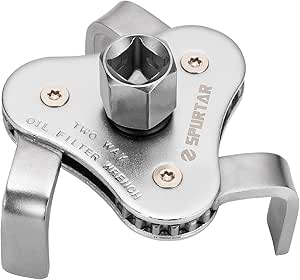
O2 sensors are a bloody nightmare (assuming you mean the exhaust lambda sensor). Depends where it's located, mines on top of the engine at the back under the bulkhead so can't get an impact driver over it. So it's going to need a breaker bar and a prayer it doesn't rip the thread out with it.
*assuming a canister filter, not a cartridge.
How on earth are people rounding off sump plugs, they're barely tight and soaked in oil. It's about the one bolt on the car that's surely impossible to sieze?
Unless the garage apprentice was left unsupervised with the rattle gun on a previous occasion.
What? Seriously, is that a thing now? The world’s gone mad.
Yup, I never trust it (although as note above, some car's don't have a sump plug anymore) and still park the car with the sump plug facing downhill to check that there's no metal down there. But it makes the whole process almost completely mess free.
Run engine for 5 minutes, suck warm oil out into can, remove plug to check for crap, plug straight back in, swap filter, fill with oil, away you go.
Is it essential, no, is it better than a catch pan, absolutely!
I do most jobs on the car, but anything heavy, then it's my local garage - e.g. suspension (that said my son does everything on his car). Certainly one for changing oil more regular than needed. My car only does 3000 a year, but I change it every 12 months.
As the OP is asking about an oil change in winter - erm it's no fun. Cold frozen fingers. Much better on a mild day when it's dry.
Euro 6 2.0 diesel wet belt my engine, as I type is here at a Ford garage getting oil changed and the belt checked for it's a Ford recall as it's just being explained to me all about the possible failure
It will be all documented and we're it to fail before it's booked in ie engine failure Ford will accept liability so they say 60000 miles on the clock
As the OP is asking about an oil change in winter – erm it’s no fun. Cold frozen fingers.
Run the engine for a bit, you'll appreciate it 🙂
A cassette chain whip thing makes a useful filter removal tool, if it's on too tight
You’re renting cars from Enterprise?
Deserved more recognition.
It's a whoosh from me. Care to enlighten?
I’ve got all three (a chain wrench, a strap/lever and this thing)
This sums up the entire thing for me. You either want to do this sort of work, gather all the tools together and do it regularly over years, along with other routine servicing items, and it becomes, in effect, just another household chore that you just get done like sweeping up the leaves, or clearing out the gutters. Or you stump up for a garage to do it for you. It's the folks that fall in between those two options who think "How hard can it be?" that generally come a cropper.
In theory I could do this, I used to build kit-cars, and restore old bangers, and do all my servicing. Do I want to do this? No, not really.
Putting your trust in garages to get things right is rather misplaced, even main dealers get it wrong or don't pay attention to updates. I'm averaging an oil change twice a year, that's more overtime than it would take for me to just do it myself (including my own time).

How on earth are people rounding off sump plugs, they’re barely tight and soaked in oil.
In my experience, and something worth noting, when you embark on your DIY car mechanics journey with a limited selection of tools, nothing ever fits perfectly. There'll be 10 spanners in the box passed down several generations that almost, kinda fit. 4 hours later you'll have the molgrips out.
The tools you have available to you make a big difference.
I know this should go without saying but, please don’t go crawling around under a car which is balanced on a scissor jack. Ramps / axel stands aren’t expensive and are generally preferable to your widow cashing in the life insurance.
Took that as common sense, plus it's been said further up the thread. I use a trolley jack and axle stands for the record, have two jacks and 6 stands.
Where to and how much did it cost?
I use Millers Oil Analysis Kit, costs £40. Not worth doing it for something relatively new but perfect for high mileage cars you intend to keep, trackday cars and classics.
As for the suction pumps? They're fine as long as you know that the oil has always been changed on time and never shown any sign of sludge or metal filings. As soon as there is solids in the oil you need the flow of the oil leaving the drain plug to get it out. Even on a healthy engine that's been looked after you can still find stuff in the sump pan when it's removed.
If your car has an undertray , its a bit of a knack/pain to get back on again.
A clip normally breaks/ get lost and over time you end up breaking all the clips and raiding the bike tool kit for zip ties.
Its been a while since I did my own now , as its now just the yearly service/ (aka safety check) and oil change with local independent, and I cover very few miles now compared to before.
I did extra oil changes (myself) back in the day , circa every 5000 miles , my thoughts are that long oil intervals are a sales thing so its still good to change it regularly, also depends on use a bit as well.
I think the undertray had to come off to reach oil filter from below I forget now.
I've been working on cars since I was a teenager. My dad was a mechanic so I learned to do my own spannering.
I bought a Mazda CX5 last year with the 2.2 diesel engine. Recommended service interval is 12k but thanks to the widgets on Euro 6 engines plus some Mazda specific problems, the owners' groups recommend doing it every 6k.
Did my first change on it earlier this year. Owner's handbook said the oil capacity was 5.1 litres. I have a 6 litre tray for catching the oil.
Car up on the ramps, run the engine for 10 minutes to warm the oil up. Nice removable panels on the undertray to get to the sump plug and oil filter, this'll be easy.
I remove the sump plug and some very smelly oil starts filling the tray. After a minute or so, the oil is still pouring out rapidly and the tray is close to the brim. Panic sets in as I realise the tray is about to overflow with no sign of the oil stopping. I manage to stick a finger over the sump plug and then with my other hand I have to start fishing around in the catch tray, which is full of hot oil, for the sump plug that fell into it when I removed it!
Eventually find it, and manage to get it back in and stop the oil. There's now oil all over my nice monoblocked drive despite putting a huge sheet of cardboard down. I have to tentatively drag the full to the brim tray out from under the car and drain that into my big barrel, then go back under to remove the plug and drain the rest.
I reckon there was at least 7+ litres of oil that came out an engine that was supposed to hold 5.1. Turns out that the reason there was so much oil was due to far too frequent DPF regens, thanks to some knackered injector nozzles, resulting in poor combustion and the ECU triggering the regens every 30 miles rather than the typical 200 miles. DPF regens will cause some diesel to enter the oil and dilute it but under normal conditions it's not a problem as even the standard oil change intervals will be enough, but with me getting 7 regens in the period you'd normally expect 1, my dilution was happening far too quickly.
The next job was changing all four injectors which was thankfully an easy job and the oil has been perfect since!
For those advocating garages.
My brother took his A3 to an indy for a oil and filters service.
They stripped the thread on the sump plug .
£390 later , new sump , new gasket , new oil plus labour , he got his car back .
He just took it on the chin and paid up . But what else can you do . You need the car back , working so you pay up.
Another garage I know put in double the oil , on a petrol engine and it blew the core plug out of the block .
Skilled technicians my aris
@boardinbob Aaand that's a war story supporting the 'don't touch it with a very long spanner unless you know what you're doing' theory. You obviously do but still knackered the drive etc from something that, on the face of it, is quite a trivial job.
I do oil changes on my motorbikes and have done cars in the (very) distant past. I'm not sure I would recognise 7l of oil in a 5l capacity system as failed regen. Lucky you caught it as diluted oil is not doing its oily job properly is it?
My Ford 2 litre Duratorq engine3 has a plastic moulded sump and a plastic quarter-turn sump plug + R clip.
The good news is its can't be over-tightened by an eeejit with an air gun.
Bad news is that there is no magnetic end to draw out any iron particles.
From an earlier post.
"DPF regens will cause some diesel to enter the oil and dilute it... under normal conditions..."
I am quoting it out of context of that post. But its a really good point - with modern diesels, the Regen mode for the DPF puts more fuel into the cylinders , and inevitably some passes the rings and gets into the sump, diluting the oil. Short journeys can exacerbated this, and the need for the control system to regen the DPF repeat itself if the regen cycle is interrupted worsens it too.
DPF regens will cause some diesel to enter the oil and dilute it… under normal conditions…
Only some implementations, I think. To deliver hydrocarbons to the catalyst that heats up and burns off the soot IIRC some cars inject fuel into the exhaust stroke, and others have a fifth injector in the exhaust manifold. The former option is what can end up diluting the diesel because fuel is going straight into a cold(er) cylinder and not being burned, but in the latter option the extra fuel never goes near a cylinder.
However that information is only anecdotal so happy to be corrected.
This thread just goes to show what a bodge internal combustion is. I can't want for all cars to be EVs 🙂
Youre completely correct.
What I don't know is which vehicles have the extra manifold injector. My suspicion of Ford is that they are cheapskates so will do it via the cheap option = squirt into the cylinders - as a bit of software is cheaper than an extra injector, wires and pipes)
What I don’t know is which vehicles have the extra manifold injector.
A quick browse through Google results suggests it's Toyota, but also Dacia and Nissan (so Renault) which surprises me because Nissan are the biggest cheapskates I've ever had to deal with.
Mazda inject it in the exhaust stroke in the cylinder, hence why some will get into the oil. Their dipstick has two dots for min and max oil levels, and an X further up to show the max level that dilution could hit before it became a problem. It'll also throw up a dash warning apparently if it gets too diluted, but i wasn't seen one despite the huge amount of oil/diesel that came out
and shouldn’t be.
Perhaps, perhaps not.
The simplistic view is that modern synthetic oil just doesn't degrade like old mineral oils did. In ideal conditions the oil will last a LONG time.
Cars are built better these days, it's not the 80's anymore, you're not on the forecourt of Delboy's motors weighing up the relative merits of the 100k escort on +20 shells Vs the low mileage allegro on it's original bottom end. It might not be sensible on a turbocharged, wet belt, diesel, but it's not a death knell if all it's done is motorway miles and the bores don't pass oil/diesel.
On the other hand if you've thrashed it from cold every morning doing journeys you really should have walked/cycled. Then just like the 80's your car is probably getting knackered whatever you do with the oil.
In my experience, and something worth noting, when you embark on your DIY car mechanics journey with a limited selection of tools, nothing ever fits perfectly. There’ll be 10 spanners in the box passed down several generations that almost, kinda fit. 4 hours later you’ll have the molgrips out.
The tools you have available to you make a big difference.
I think the correct way to think about it is: £50 on parts AND £50 on tools is better than £100 at the garage, because then next time it's £50.
Same with bike jobs, it's probably cheaper to get your LBS to change a cassette and chain than it is to buy a chain whip, lockring tool, and chain splitter. But if you buy them once you can do it on all your bikes forevermore.
My suspicion of Ford is that they are cheapskates so will do it via the cheap option = squirt into the cylinders
Fords, at least the transits, have the 5th "injector". They can clog and be the root cause of dpf blockages (no active-regens).
Another thing to consider is that there's not that much labour in an oil change, and it's the labour you pay for at the garage and what you can do for free. Some jobs are labour intensive but not that much for parts. Like that time I changed the camshaft position sensor on the Passat. According to the procedure you're meant to remove the timing belt which means refitting and re-setting everything back up, but I managed to loosen it off to reveal the sensor just enough to change it in 10 mins.
On the other hand, when the inlet manifold needed changing on the Merc I took one look at where it was situated and how much stuff was in the way and had the garage do it. The warranty claim really helped that decision mind.
Fords, at least the transits, have the 5th “injector”. They can clog and be the root cause of dpf blockages (no active-regens).
Only the 2.2.
Ecoblue engine relies on the normal injectors.
If you do DIY, don't cross thread the sump plug and use the correct torque setting when tightening 🙂

