UPDATE: Reviews section refreshed, redesigned, searchable: Go take a look
How - on a road sign - do you then distinguish between something thats 100m away and something thats 100m away? 🙂
If you can safely stop from 70mph (96m according the HC) then we're good.
No I meant in notation on signs - Miles are denoted as 'm' and meters are denoted as 'm' so how do you distinguish between something 100 meters away (100m) and something 100 miles away (100m) ?
If somethings really far away it'll be really small, unless it's really small, then it might be a lot closer
Born in the 60s, I went metric in the 70s for two reasons.
OS maps went metric
In road rallying 1:50000 OS maps are used so plotting grid references is metric, but distances (e.g. length of a section) are in miles.
4 laps of a standard 400m running track is pretty close to a mile, 400m 1/4 mile and so on. I have found this useful on occasion.
But really, we are crap at judging things in any unit, we just feel more comfortable being crap in our favourite one. Lakh, million, crore - conceptually it all boils down to "a **** of a lot".
We also tend to think in relative units, a km of nice flat road is shorter than a km of up down rocky muddy trail, as we all know.
Thought this would be about the car sharing platform in Europe....
Best thing about that is taking a cutter knife to the vinyls and turning "MILES" into "MILFS".
I'm a simple creature at heart.
Men's height:
It seems to be a bit of a thing* in the UK and the US for women to want to date a man who's at least 6ft tall.
About 15-20% of UK adult men fall into this category, meaning its a fairly achievable (if shallow) relationship goal for a woman to have.
However its an entirely arbritary height that just happens to be a round number in one particular unit of measurement. Do other countries who generally express height in cm have an equivilent?
*ok it might just be a bit of a social media joke, but still.
6ft tall.
About 15-20% of UK adult men fall into this category
Under 15% - 6' is about 85-88th percentile.
Farenheight is bloody useless whatever the yanks say.
In the olden days, it made it very simple to make and calibrate a thermometer. If you take pure water and freeze it, it always melts at the same temperature, so you can reliably calibrate one point on your scale there. If you add ammonium chloride, the freezing point drops, so you can use that as another reliable point on your scale. Then you can halve the distance between them five times and you have a 32 point scale that can be replicated anywhere on earth with very simple lab equipment. The lower point is set as 0 degrees and the upper point as 32 degrees.
If you extend that scale four times, the maximum is 96 degrees, which is approximately human body temperature. 75 degrees is comfortable for humans, below 50 and above 100 degrees is difficult for humans.
How - on a road sign - do you then distinguish between something thats 100m away and something thats 100m away? 🙂
If you can safely stop from 70mph (96m according the HC) then we're good.
No I meant in notation on signs - Miles are denoted as 'm' and meters are denoted as 'm' so how do you distinguish between something 100 meters away (100m) and something 100 miles away (100m) ?
Gotcha! And yes, I agree with your point
Rule 1a: Metres/metric aren't used for distance notation on approved UK signs.
Rule 1b: Signs are all in yards, miles and the abbreviations yds and m, which is the confusion, especially when yds and m are mixed on the same sign.
Rule 2: If in doubt refer to Rule 1a
If you're struggling to sleep, see Table A1 (Schedule 18 Part 3)
In the olden days, it made it very simple to
I refer you to the John Finnemore sketch I linked to 🙂
That's another can of worms, since the USAn pint is different from a proper pint.
https://singletrackworld.com/forum/postid/13759254/
Countdowns to disappearing lanes (e.g. four lanes to three) and roadworks are in 200 YARD increments and are numbered, e.g. 600yds, 400yds, 200yds, preceded by a 1 mile triangular "roadworks" warning sign
The distance between temporary signs, cones, etc is otherwise measured in metres on plans by the traffic management company, just to confuse matters (yes, roadworks are sometimes planned!)
Yeah, I mentioned this on my Threadreader post (but didn't copy it here).
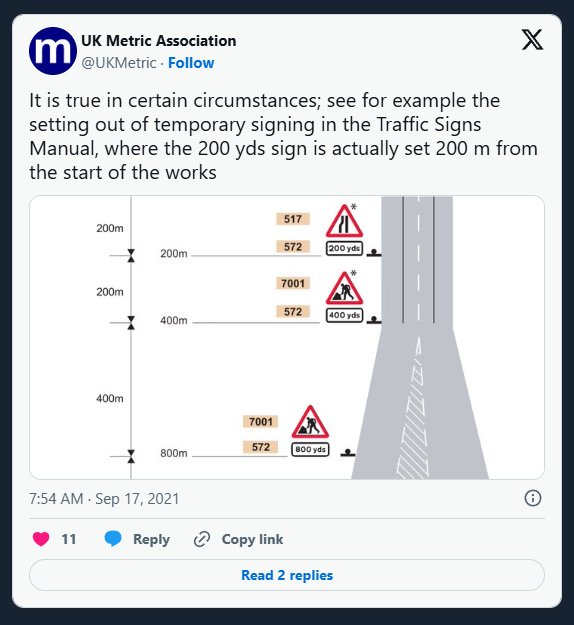
https://xcancel.com/UKMetric/status/1438758350561452032
Farenheight is bloody useless whatever the yanks say.
In the olden days, it made it very simple to make and calibrate a thermometer. If you take pure water and freeze it, it always melts at the same temperature, so you can reliably calibrate one point on your scale there. If you add ammonium chloride, the freezing point drops, so you can use that as another reliable point on your scale. Then you can halve the distance between them five times and you have a 32 point scale that can be replicated anywhere on earth with very simple lab equipment. The lower point is set as 0 degrees and the upper point as 32
Seems like a lot of effort when you could just use a thermometer instead!
Seems like a lot of effort when you could just use a thermometer instead!
Yes, but what was that thermometer calibrated against?
I like the logic of metric but as I've got older and learnt more about the history and origin of the imperial system I quite like it.
I can work in larger imperial units but not easily inthe fractional sizes around tools
A proper centegradius one of course.
So, how was that calibrated? The melting point of pure ice water is stable but the boiling point varies by atmospheric pressure. How do you calibrate the 100 degree point on the scale?
I can work in larger imperial units but not easily inthe fractional sizes around tools
I was talking to an American about this. I asked how he coped with increasing precision, like you can't use 13/37" surely to christ. He said "oh no, we use the thou."
"What on earth is a 'thou'?" I asked.
"It's a thousandth of an inch."
You've... METRICISED THE ****ING INCH?!
You've... METRICISED THE ****ING INCH?!
Imperial units have been based on metric units since 1959. One inch is defined as being 25.4 mm.
A proper centegradius one of course.
So, how was that calibrated? The melting point of pure ice water is stable but the boiling point varies by atmospheric pressure. How do you calibrate the 100 degree point on the scale?
compare it to a known to be good faraheightamometer obvs
"What on earth is a 'thou'?" I asked.
"It's a thousandth of an inch."
Yes, I know all about thou from metalwork in school. The micrometers were in thou, there were various gauges in thou. Then of course there were feeler gauges in thou for adjusting the tappets on your car.
I worked in an ironmongers when I was younger and a large chap had to be weighed but the hospital scales just didn't cope. So he came in we weighed him. The owner sent his weight back in hundredweight, stones, pounds and ounces.
It would have been 1987.
I don't know what a miles is a certain number of yards I suppose, but what is a yard, a bit more than a m.
Think of a metre as roughly 3’ 3”. I use metric and imperial interchangeably, a pub still sells me a pint of beer, but car engines are in litres or cubic centimetres, I think of distances in miles, but I can really only use metric for measuring short lengths, due to working in the print industry for many years, and I use yards and feet or meters for longer lengths. Temperature is always in Centigrade.
What I can’t understand is why Americans still use mostly imperial, and then do something really dumb like take International Standards and change them, like A-sizes for paper - American A-sized paper is in imperial! It’s no longer an international standard then! 🤬
What I can’t understand is why Americans still use mostly imperial,
The US was actually quite an early adopter of metric systems - they had metric money long, long before we did for instance and a lot of the imperial units they use are validated against metric stands - so in the US an 'inch' is defined in centimetres. The USA were among the first to signed up to the Metric Convention in the late 1800s and prior to that Jefferson legalised decimal measurements.
The US still proudly clinging to its use of Imperial It actually boils down to something incredibly subtle. They failed to make a change when the rest of the world was doing so and people there sort of post-rationalise that as them proudly maintaining something when really it was just a bit of cock up.
All that happened was: When we've made shifts from imperial to metric its on the basis that, from a certain date, businesses 'must' switch from offering goods in imperial units and offer them in metric instead (not all the changes we've undertaken have been driven by government - its was fuel retailers that made the decision to switch from gallons to litres simply becuase the cost of fuel was reaching £1/gal and many forecourt machines at the time we're configured to meter fuel at more than 99p. Switching to litres basically saved lots of forecourts from having to replace their pumps)
In the US - when they tried to make the same move to metric - its was phrased as from a given date retailers 'should' change to metric. And basically a sort of tragidy of the commons happened. Businesses would have needed to reprint price lists, menus are so on and didn't want to simply becuase they suspected their competitors wouldn't and that would somehow disadvantage them if they did. So the US government was trying to convert the nation over to metric before we did - theres a 1975 'Metric Conversion Act' which makes metric and decimal the preferred system for US commerce and trade. They just total bungled the application of it
Imperial units have been based on metric units since 1959. One inch is defined as being 25.4 mm.
Yeah, I know. That wasn't the point. 😁
I give you Canada...a country that is nominally "metric" yet so much stuff is imported from the US that is sold in freedom units.
And food item labelling which switches between metric and imperial (eg I've got a tub of protein powder which says to mix 35 grams of product with 6 fluid ounces of water..). When shopping for food products, it's impossible to compare prices by volume as different products will be sold in millilitres, fluid ounces and "cups" (or fractions of cups...FFS).
Those nutrition value statements written on the side of food products which tells you how much sugar, fat and calories are in each portion? Yeah, more inconsistency - I've seen two tubs of plain, Greek yogurt from the same manufacturer (one 2% fat, one 5% fat) using different portion size (one 115g, one 175g). So, unless you're very good at maths or get out your calculator, you can't directly compare.
I don't know whether all of this just stems from incompetence or just from lack of political will to fix it or whether it's deliberate obfuscation by manufacturers in an attempt to save money or gain some marginal advantage over a competitor.
Also, everything is in both French and English and a lot of foodstuffs have French on one side of the packet and English on the other. And it's pot luck whether the supermarket shelf-stacker orientates the French or English side outward so it's easy to miss stuff on the shelves
I've also been offered "pints" of beer which have varied from 16oz to 20oz, depending on which brew you want, in the same pub!
However, the biggest offender is their date system.
There is absolutely no uniformity between dd/mm/yyyy and mm/dd/yyyy and most data entry forms don't bother to specify which system to use. I can't remember exactly which form it was, but I once had to fill out a VERY IMPORTANT FEDERAL IMMIGRATION form which switched between dd/mm/yyyy and mm/dd/yyyy as you progressed through the form.
The conspiracy theory part of my brain wondered whether that was deliberate so if someone got dates wrong on the form and they were wrong UN's, they could be accused of lying of the VIFI form and kicked out the country 😆
I'm 62 and my preferred units are:
Speed: mph
Distance: km
Temp: C
I like km as I can pretty much envision meters and how far 1km is (thanks to my girls' old school bus stop being exactly 1km from our house) - but I struggle slightly with km/h.
That said I switch the car speedo over to km when in France and then it all makes sense.
I love switching my speedo to kph when on the continent, it seems to make the miles fly by.
in the US an 'inch' is defined in centimetres
It has been defined in cm in the UK since 1959 too.
They failed to make a change when the rest of the world was doing so and people there sort of post-rationalise that as them proudly maintaining something when really it was just a bit of cock up.
I think it's related to not liking French people.
There is absolutely no uniformity between dd/mm/yyyy and mm/dd/yyyy and most data entry forms don't bother to specify which system to use. I can't remember exactly which form it was, but I once had to fill out a VERY IMPORTANT FEDERAL IMMIGRATION form which switched between dd/mm/yyyy and mm/dd/yyyy as you progressed through the form.
ISO 8601 FTW.
I can do most conversions in my head - pint/litres miles/kilometres, but have no internal visualisation of the metric volume/distance until I convert it.
Having just driven home from Brindisi to South Shields, I feel I can say with some authority that KM are better than miles, you can cover a hell of a lot more KMs than miles in the same time 😉

In Europe TVs and monitors are measured in inches!
Tyre measurements amaze me:
Car tyres the diameter in inches, the width in mm.
Road bike tyres metric.
MTB tyres imperial.
Americans also call the thou a mil 🤣
which begs the question… what colour are kms?
Kylie Minogues?
Davis was 5'6" and a Minogue is 5'0" meaning you'd need to multiply a distance in Miles by 1.1 to get the distance in KMs
The post up there mentioning crank length made me wonder...
If i had been making 'levers' back in the day standardising them at six-and-a-half and seven inch would make sense.
But if i were making a mechanical item to best mesh with an 'average' humanoids bio mechanics, the chance of it being a nice round number would, id guess, be slim.
Selling cranksets in either 165 or 175, at least looks like they are sized for the cyclists benefit.
Other thoughts;
Would it matter if cranks were actually precisely 165.1 or 177.8mm? No, not in the slightest, i never need to messure them let alone add or multiy them.
Is this an arguement to keep sheet timber at 1220 and 2440mm dims? No, setting out studs at fractions or multiples of this is a pain in a metric world.
Maybe this is why many tape measurse have the additional increments of 'twelvon-senters' (diamonds) and 'fortinian senters' (triangles)?
Oh! Hang on...Plasterboard?
Bearings on my daughter's wheel chair? 12.7mm id.
I like some of the derivations of the old units.
A mile comes from the Latin mille which is 1000 and is the distance a centurion would walk in 1000 paces.. But hang on you say, a thousand paces isn't anywhere near a mile? Except a roman pace was a L-R combination, so 2000 steps and for a generally shorter population carrying armour and shields, etc. that gives the mile.
A furlong is derived from 'furrow long' and is the distance a team of oxen can plough before needing a rest. That's not an exact thing to calibrate against though, but then for convenience that works out as about 1/8 of a mile so they said a furlong was hence 220yards.
But then for tax purposes a graduation of 220 yards is to inexact so in the 1600's a mathemetician called Gunter (maybe Gunther) decided to split a furlong into 10 (I bet the 1600's reformers hated the metrification) and created a chain that was the right size which could be copied and distributed for the purposes of measuring field sizes. So a chain, or properly a Gunter Chain is 1/10 of 1/8 of a mile.
And an acre = 1 furlong by 1 chain (= 10 square chains or 0.1 sq furlongs) which is the amount of field a team of oxen could plough in a day. Making a square mile 640 acres.
At work on one of the walls of our Outreach office is some of the more esoteric measurements, a bit like the barn on the previous page, I'll post some of them on Monday as they're quite creative.
There's a mostly bogus, but interesting story about the space shuttle rocket booster diameter being based on the track width of Roman chariots. The idea is that chariots had a wheel spacing determined by the width of two horses and roads developed ruts at that width. This became a de-facto standard gauge because the ruts essentially became like rail tracks and wagon wheels needed to match that width. Then, when railways were developed and used existing wagons so the same gauge was used. This became standard railway gauge. The space shuttle rocket boosters had to fit through existing rail tunnels, which were sized for rail wagons based on standard gauge, so there's a long, tenuous link between the width of two Roman horses butts and the diameter of the space shuttle rocket boosters.
And an acre = 1 furlong by 1 chain (= 10 square chains or 0.1 sq furlongs) which is the amount of field a team of oxen could plough in a day. Making a square mile 640 acres.
An acre can be any shape though - the original chain by furlong gave a rectangle which was handy for medieval field layouts when you were handing land to peasant farmers because the short side of the acre would be the riverbank (fertile land) and it meant that lots of farmers could all have a section of land up against the river and then plough inland from there.
It's fairer than turning the rectangle around so the long side is against the river and only a couple of farmers can access riverside while others are stuck inland.
In the UK it's only used informally now, like when describing a house with half an acre of land. Very few people actually know what that is but it sounds impressive!
55 here and brought up with a bizarre mix of ancient and modern units.
There is absolutely no uniformity between dd/mm/yyyy and mm/dd/yyyy and most data entry forms don't bother to specify which system to use.
Slightly related, but maybe a "thing that makes you disproportionately cross" - data entry forms that demand a postcode(*) and then complain if you leave a space in it.
(*) or, worse, a ZIP code.
I love switching my speedo to kph when on the continent, it seems to make the miles fly by.
Driving around the Irish border, you need that setting on a shortcut button !
An acre can be any shape though
As indeed can a square mile.

