UPDATE: Reviews section refreshed, redesigned, searchable: Go take a look
richmtb, when I wrotethe gravity at the poles and equator is the same
I wanted to write "almost the same" but didn't want to confuse more.
The earth is slightly squished, right? So yes, gravity would be slightly stronger at the poles, but look at this
Distances from points on the surface to the center range from 6,353 km to 6,384 km
31km in it. That won't have any noticeable effect, especially over the difference in reaction force caused by the earth spin.
Yes but you've still got your forces backward. Centrepetal force has no effect on people standing at the equator (unless they are tied round the ankles by a piece of rope connected to the centre of the earth)
Centrifugal force due to their angular momentum decreases the apparent gravity
Due to the Earths rotation, it has formed into the shape of an oblate spheroid. It is flatter at the poles and bulges at the equator. This affects the oceans even more. Effectively the oceans bulge by up to 5 miles at the equator. If the world stopped spinning then the oceans would redistribute themselves into a northern and southern ocean separated by a huge new continent that circles the Earth at the equator.
Have a look at this.
http://www.esri.com/news/arcuser/0610/nospin.html
Have a look at this.
That was very interesting and pretty cool
Based on futon river crossing's no spin means one day = 1 year scenario, the effect on the tides would be substantial.
The tides are predominantly caused by the sun, not the moon. The moon only causes the monthly variation in tide height and times. You would therefore have only two high tides and two low tides per year.
Just thought some people might be interested in this
[img] 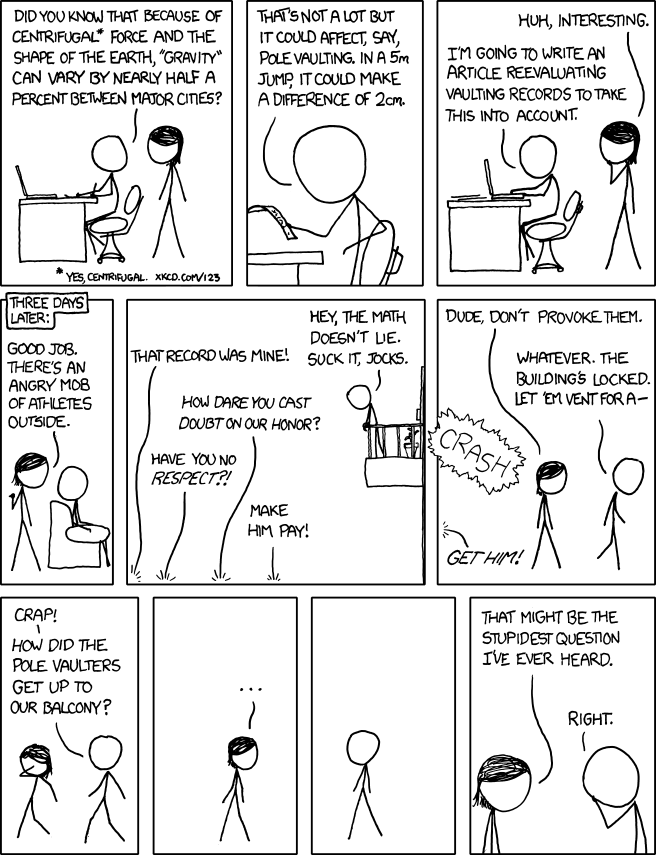 [/img]
In Rio de Janeiro in 2016, the same jump will get an athlete 0.25% higher (>1cm) than in London four years prior.
And richmtb,
Centrifugal force due to their angular momentum decreases the apparent gravity
Centrifugal force doesn't exist lol.
GPS wouldn't work because you wouldn't be able to have geo-stationary satellites.
Centrifugal force doesn't exist lol.
[img] 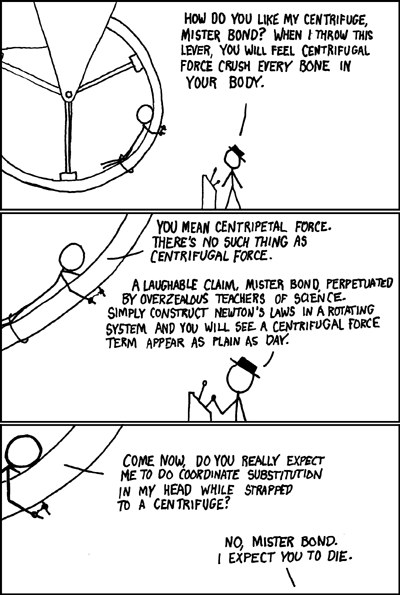 [/img]
If there was an aeroplane on a west (east?) facing runway and the world suddenly stopped spinning would it take off?
What if a plane was flying at 700mph east (west?) and the same thing happened? Would it suddenly drop?
depends how high the second plane was. and depends how suddenly you mean by suddenly. It's all about yer atmospheric boundary layer innit
What if a plane was flying at 700mph east (west?) and the same thing happened? Would it suddenly drop?
If the earth stopped spinning suddenly, would all the air stop spinning as well?
[i]GPS wouldn't work because you wouldn't be able to have geo-stationary satellites".[/i]
GPS satellites aren't geo-stationary.
So if centrifugal force doesn't exist why does the Earth bulge at the equator?
So if centrifugal force doesn't exist why does the Earth bulge at the equator?
'Cos da Earf is 4.5 billion years old an' it's middle aged spread blud innit.
Oddly enough, this (and 5 other Alternate Earth scenarios) are outlined in this week's New Scientist
http://www.newscientist.com/article/mg20927960.400-what-if-the-earth-stopped-spinning.html
Not sure if you need to be a subscriber to see the full article though.
Everything on the surface would continue moving at up to 1667 kilometres per hour, the rotation speed at the equator. People outdoors would be flung outwards to an altitude of about 11 kilometres, then fall and hit the ground at more than 1000 kilometres per hour. Buildings would be ripped from their foundations, while the oceans would engulf the land. Such a catastrophe could extinguish all life on Earth. 😯
Wacky stuff, love it.
@ RealMan - no, you'd get to see the Coriolis Effect big time then.
So if centrifugal force doesn't exist why does the Earth bulge at the equator?
😀
Everything on the surface would continue moving at up to 1667 kilometres per hour, the rotation speed at the equator. People outdoors would be flung outwards to an altitude of about 11 kilometres, then fall and hit the ground at more than 1000 kilometres per hour. Buildings would be ripped from their foundations, while the oceans would engulf the land. Such a catastrophe could extinguish all life on Earth.
Oh no...that'll be the premise of another Emmerich disaster movie then.
Oh joy, another 2012 - what a hoot!
The article does make the distinction between 'stops suddenly' and 'stops gradually' - the latter being where hoodoo's (very cool) ESRI link comes in.

