UPDATE: Reviews section refreshed, redesigned, searchable: Go take a look
I can’t imagine anywhere in audio where that matters and I say that as someone who used to design the front ends for ultrasonic scanners where the signal levels are rather low. Doesn’t mean I’m right though – just means it doesn’t make any sense to me
I have wired together studio installs where the screen is disconnected at one end on balanced interconnect cables between pieces of gear. E.g. screen disconnected on all outputs. That makes each cable assembly directional if you follow it throughout the install (which you need to in order for the scheme to work).... but the xlr cable assemblies are 'directional' anyway due to input and output plugs being different
I'd agree with that actually although it's slightly different in that case as you have 4 wires (hot/cold/earth/shield) and the objective of the screen disconnect is to prevent earth loops rather than a simple two wire system in HiFi where you can only be avoiding noise injection
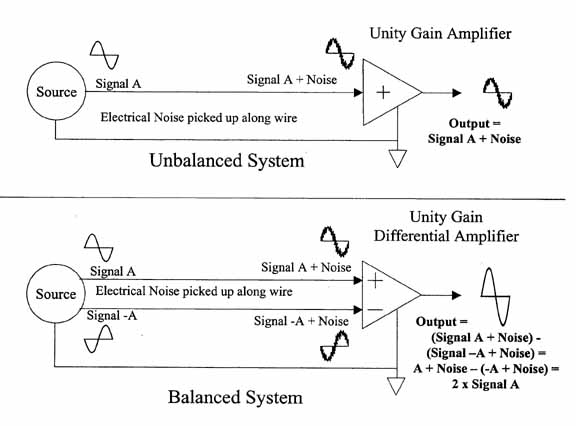
Yes, it wasn't for speaker cable and was for preventing ground loop hum. A balanced audio cable is a pair of cables inside a screen. Each cable carries an inverted version of the audio signal to the other, then a differential amp is used at the input to reject any noise added on its journey between units
I'm a sceptic regarding cables but here's my experiences 🙂
My first job was at BBC research dept, in a section next to the sound section that designed all the BBC monitors. I bought my first LS3/5as with my staff discount.
I had a Quad 34/306 amp and the LS3/5as wired with either mains cable or something else cheap.
A mate had some Exposure amps and Ruark loudspeakers, and Cable Talk interconnects and speaker cable. He brough the cables round to try.
Surprisingly I found a difference when using the cables. I wired it up, so not at all blind, but I switched back and forth a lot and was obviously not expecting to hear a difference at all.
I am well aware of limited audio memory, expectation bias and all the rest of the problems that might make me think there was a difference. I didn't want to hear a difference as I didn't want to spend money on something as stupid as cables, for one thing.
I also found that if I left my bog-standard interconnects between the pre/power amp then the new speaker cable made no difference, and if I used the interconnect but my old speaker cables, also no difference.
Flummoxed and surprised I refused to spend out on those cables and bought some reasonably priced coax interconnect and some Quad speaker cable, at about £8 a metre. The speaker cable was 4mm stranded. Also some nice coax RCA plugs from Maplin, fairly cheap but well made, and bog standard banana plugs.
I got the same difference in sound - much wider band and more solid, with more bass depth.
[I think differences are often more noticable with small speakers as you are already missing a big chuck of bass response, so if you get the slightest bit more or less, the rest of the spectrum is affected a lot.]
I then got some AB-1 bass extenders for the speakers - which work in series and have a band-pass to the LS3/5as.
When I connected them they sounded very dull and muffled.
I went to my favourite and trusted hifi shop and he recommended trying some Nordost flatline cable, an unusual cable with the conductors all arranged flat.
When I used this all the muddiness went and it sounded 'right' and balanced again.
I changed the 306 for a 707 amp, with twice the power. Sounded pretty similar.
I then bought some external crossovers for my speakers, designed by Derek Hughes who used to run Spendor. Some people would argue that there are not many people who know passive crossover design better.
These were single-wired from the amp to the crossover and then biwired to the drivers, obviously as there was no crossover in the speakers.
I was using the original Quad 4mm stranded speaker wire, but it sounded massively phasy and just wierd (and definitely not wired out of phase...).
I wasn't using the flatline cable as it sounded very sharp and unbalanced.
I bought some Kef cable from ebay, also something like £8 a metre, which was maybe 1.5mm stranded. Using that everything was good again. Also used some blue van damme 2.5mm cable and that was the same as the Kef (but looked rubbish). (Also used Van Damme interconnects).
I have also tried some 4mm stranded Van Damme, which has a clear coat and is reportedly what PMC and Bryston recommend/use. I found that also sounded phasy, just like the 4mm stranded Quad cable.
Along the way I had a discussion with the guy from my favourite hifi shop and he said they always used some particular cables (can't remember which ones) because they were the best bet to work reasonably well with whatever they were demoing.
So I think SS amps are susceptible to the whole 'network' presented to them, and cables with difference impedance characteristics can change how the amp sounds, and it doesn't take much of a change to make it seem like there is a big audiable difference.
I think that small speakers cause this more - the bigger the speaker I have tried the less the cables seem to make a difference.
And the tube amps I have had have seemed much more agnostic to speaker cables.
Indeed some famous amp designer I think once said he could make any ss amp sound like a tube amp by playing around with speaker cables - I just can't find the link now. Maybe something to do with Hafler?
Regarding the £500 speaker cables - if you get them made up with the plugs all put on it is easy to add a lot to the per metre price.
And don't Naim amps have something funny about that requires particular speaker cables - a quick google found this :
"Naim amplifiers do not have extra inductance networks in the output, Naim prefer to use the speaker cable to provide the correct inductance and capacitance."
See, that actually sounds credible when you start talking about real and measurable things like impedance. And badly designed amps that can't just output to a standard.
My experience is that cables can make a difference but it's very small and more a case of crap cables making things worse than really expensive cables improving a system.
I primarily use Naim amps though, and with them most agree it's best to just stick to the Naim speaker cable which isn't expensive. I've got some non-Naim interconnects (moderately expensive ones - certainly a lot more expensive than the Naim ones - that came with some 2nd hand kit I bought) but can't discern any difference in sound quality with them fitted.
This is one way I test cables, supports etc.
Please feel free to try it yourself.
On the Cornershop album When I Was Born For The 7th time there's a track called 'What is happening?'
It has a particularly deep repeated tabla sample.
With some cable, I can hear much more detail in this sample than with others. It's that simple.
There's something about the sample that is obvious with some cables and not with others.
It's that simple.
I've demonstrated this to lots of people. The vast majority can hear a specific difference.
Try it. I'd love to know how you get on and what differences you hear.
I'll not say what the specific difference in the nature of the sample is that I hear until someone else has tried it.
Any takers?
Anyone?
surely some sort of placebo effect? like, $10/m vs $100/m you'd expect the sound to be better, so that's what you hear?
If someone was to blindfold you and switch cables and listen to the same track.....?
Not tried double blind, but I'd like to.
Ime, the cost is irrelevant. I've tried various types of cable including demoing some very expensive stuff at home in my modest system. The type seems to be of more import than the cost.
I like experimenting with this kind I thing and trust my own ears.

