UPDATE: Reviews section refreshed, redesigned, searchable: Go take a look
Sleep tight.
Sleep is something I'm dreaming about!
Whoever came up with the idea of turning harmless pdf documents into "SmartForms" needs rodgering sideways with a baseball bat wrapped in razor wire.
Then they should be shot to death, repeatedly.
He is from Bolton area originally but was driven from these fine shore by the drastic cuts in science
He is indeed in Oz.
Yours
Stalker 😉
I've been spending a little time reading some of the internet info on this subject (nothing too taxing for my tiny mind so sorry to the better informed in advance.)
It is widely accepted that the Ice Core data is our best indicator of natural cycles over the last 400 thousand years [img] 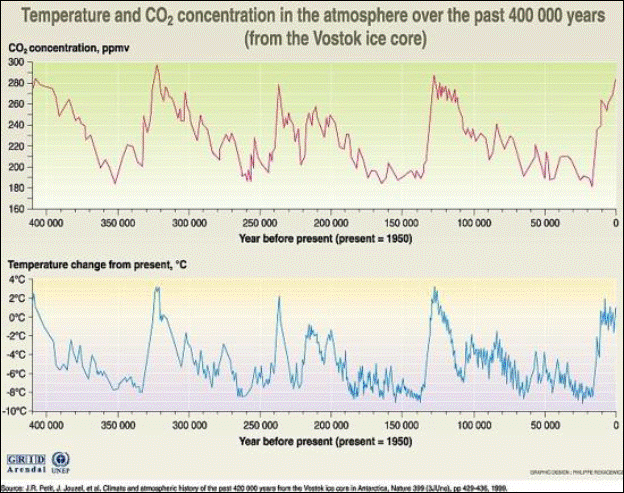 [/img]
It is widely accepted that the current short term but accelerated rate of warming is due to man made climate change due to the earth being sensitive to very small atmosphere changes (It looks as though there is still debate to be had on how much we really know abut the earths atmosphere, how sensitive it is and how the Earth will cope with these changes.)
Some of you seem to be suggesting that we should do everything we can to get the cooling going again.. Why?
Some of you seem to be suggesting that we should do everything we can to get the cooling going again.. Why
Not really sure I understand your question tbh
Do you mean why do we think Global warming is a bad thing?
As for the "cooling going again" what exactly does this mean?
theocb - Member
Some of you seem to be suggesting that we should do everything we can to get the cooling going again.. Why?
Junkyard - Big Hitter
As for the "cooling going again" what exactly does this mean?
i think theobc is referring to the chart/s he posted, from that it looks like we're due another slow slide into an ice age.
(in a similar way: we're due another north/south pole reversal. It might not happen, but they've been spookily regular and reliable upto right now)
theo: i'm an idiot, my understanding of these things is limited by own stupidity.
here's how i grasp it:
life as we know it has evolved/survived within the temperature range shown on the chart/s you posted.
and, as is suggested, the temperature range is at least partly affected by the CO2 content of the atmosphere.
it's one thing for the earth's life-forms to slowly re-adapt to an atmosphere/temperature range their ancestors survived relatively recently (in evolutionary terms).
it's quite another asking them to quickly adapt to an atmosphere/environment not seen for many millions of years.
maybe everything will be fine.
maybe things could get a little tricky.
is caution such a bad thing?
On theobc's graph, the present = 1950. How much warmer than the 1950 temperature did the natural cycle take us? How much higher are we now predicted to get?
The post glacial climatic optimum ended about 5000 tears ago. Overall it was 1 or 2°C warmer but some areas benefited more than others with northern continental ares being several degrees warmer. If you Google "climatic optimum" you'll find lots of info.
In terms of CO2 were now up to 330ppm which is off the graph. Again Google will be more accurate than my memory.
Yes, we were heading for another ice age which according to some was overdue. Clearly that wouldn't have been a good thing. Getting above the range that we know gives the best growing conditions over the greatest land area isn't a good thing either even if Britain feels a bit chilly most of the year. Back in the climaitic optimum it was very wet and humid as the peat bogs testify.
So, you're actually disagreeing, or saying I'm wrong? or just relying on passive-aggressive faint praise to try and dismiss an argument which is factually correct?
I was using sarcasm.
I think the CO2 levels are over 390ppm now but I don't think the temp has followed quite as sharply just yet.
Yes as ahwiles (and Edukator) said. The graphs show a natural cycle over the last 400 thousand years and it appears as if we should now be rapidly heading for a much cooler climate.
I was just asking why one way is perceived to be better than the other?
I do appreciate and understand the side of not knowing how the Earth and fauna/flora will respond if we go over it's (short term) historical limits but we know that living things began in much harsher environments in the distant past so why try to maintain the current living things as if they will be the last or the best?
What are we actually trying to achieve by reducing our impact? Are we trying to reverse or prolong the process?
What I'm thinking in Basic terms:-
If we continue to have an effect on warming then the world will become hostile then population will decrease, CO2 will drop sharply and we will head for hostile icy times
If we reverse our impact on the climate then it looks as though we should be heading for hostile icy times
If we try and control climate at a level that suits humans then the Earth is doomed because we will devour it.
Sh1t the bed I'm off for a drink, it don't look good.
Seriously though what are the options on the table and their outcomes?
If we continue to have an effect on warming then the world will become hostile then population will decrease, CO2 will drop sharply and we will head for hostile icy times
Once in the atmosphere CO2 is extremely persistant. Levels won't drop sharply in response to a drop in human activity. What we've already released will affect climate for the next thousand years or so - or longer depending on the model.
My point wasn't a fully fledged theory as I'm sure you can see. 😀
Sharply on a long term scale. A significant drop over 10000 years is sharply on a scale of hundreds of thousands of years. VOSTOK data shows potential for a significant drop over this time frame and also shows potential for natural temp swings of 20 degrees in the same time period. Temperature will reduce much quicker than the CO2
I see 3 options and none of them are perfect. How do we know what's best?
Temperature will reduce much quicker than the CO2
Again, not so. Google it;
Hang on, this time I'll Google it myself.
Edit: no I won't it'll take me ages to find a reference anyone here would accept. Google something about the same buffers that slow temperature response to increasees in CO2 also slow the temperature response to falls in CO2. Then consider you have turned over the oceans and changed ocean circulation patterns and things could take a very long tiem indeed to mend.
no I won't it'll take me ages to find a reference anyone here would accept
Chuckles
your not wrong on either point
(in a similar way: we're due another north/south pole reversal. It might not happen,[b] but they've been spookily regular and reliable upto right now)[/b]
Shenanigans!
@Edukator; I disagree 😉 my source is basic historic ice core data so where did you get your info from. (you bleeding google it if you want to say I'm wrong, I think that is the STW way :D) It's really not important but feel free to carry on because I'm happy to learn.(email me some links)
Regardless of that what are you saying the options are? Don't all the options come with baggage? Is one clearly the favourite?
Surely anyone who has a basic understanding of this Global Warming problem will be able to tell me in simple terms what the options and perceived outcomes are.
I completely understand if you have had enough of explaining basic stuff to the ignorant but this all seems a bit odd, people all over the web can argue till the cows come home about the facts of manmade climate change but no one has any info on the outcome of our master plan.
The master plan is simply to limit the extent and impact of changes we have already made and will continue to make. The consequences that we are currently experiencing being considered negative for far more people than they are positive. Googling "consequences of climatic change" gives [url= http://climate.nasa.gov/effects ]NASA[/url] as the first result and plenty of reputable organisations follow.
See if you still disagree about how long man-made climatic change will last after reading this (feel free to slag off the reference guys, it's just the first Google result)
[url= http://www.climate.unibe.ch/~plattner/papers/solomon10pnas.pdf ]Carbon dioxide displays exceptional persistence that renders its warming nearly irreversible for more than 1,000 y. Here we show that the warming due to non-CO2 greenhouse gases, although not irreversible, persists notably longer than the anthropogenic changes in the greenhouse gas concentrations themselves.[/url]
All this is very troubling, hopefully I'll have kicked the bucket before the worst arrives 🙄
If this stops happening or if the oceans become a source of carbon then we are well and truly ****. The trouble is we have no real idea of when or if this will happen.
I heard 2040 as a conservative estimate? No doubt we're totally ****ed when it does.
@Edukator. I wasn't disputing that the timescale for CO2/temperature reversals might be thousands of years (that is very quick when looking at the big picture as shown in Ice core data records which is where I got my info from).
I've read about the predictions of what might happen if we continue at this rate but the alternatives are not perfect. The other options also have their predictions that don't look good (deeper ice age or Human population increasing at a rate that sustainable living alternatives cannot keep up with; population has more than tripled in 90 years from 2 billion to 7billion)
If you compare the 3 options which one is best? It doesn't seem too clear to me.
Some interesting debating points. I will go away and look into it some more. Cheers for entertaining my ignorant views.
Which three options?
Clearly population is the biggest problem and one that the only government to do anything about has got slated by the human rights mob. In France we're still actively encouraged to make more babies.
The current option is "maximise fossil fuel production to fuel economic and population growth, and to hell with the consequences".
Even the most sustainable options/solutions currently available to us will take us far beyond the climate of the last 400 000 years your graphs show. Any other option will take us further.
I've read about the predictions of what might happen if we continue at this rate but the alternatives are not perfect.
Life is not perfect but I am unsure as to why you want us to start to attempt to artifically control the global temperature via pollution - do we think we know enough to be able to do this? The law of unintended consequences suggest it would be an unwise move to mess with our only home in the hope it pans out as we expect
Its a fair point that an Ice age would be bad but it is some twenty thousand years away , of slow cooling, that we would need to adapt to rather than th edevades or centuries we are discussing here
As for population its a different issue though I believe Malthaus has a plan for how to deal with that one
I would agree none are "good" but 2 are natural [ pop reduction and cooling], 2 are about us being sustainable[ stoping warming and pop growth].
Folk have tried to present global warming as good thing but it is not due to the land loss and the changes to what can be grown and habitat loss etc
Could reforestation of areas, e.g. uninhabited parts of Scotland make any difference to atmospheric CO2?
Wow, this is a long thread...
For those of you who say it doesn't matter what the UK does as our pollution is insignificant when compared to China/India etc. What about
1) Our position in the worlds top 10 economies?
2) Our permanent seat on the UN Security Council?
3) Our position within the EU (as 1 of the top 4)
4) The amount of money we give in foreign aid
5) Our membership and influence within the Commonwealth
As much as the press (and most of the population) like to say the UK is declining, crap, insignificant or all three we are actually in a very strong position to influence other countries. Either as a lone voice or as part of the EU - which has a combined population and economy far larger than the USA.
For those who support the argument that it doesn't matter if the science is not settled and we should just tow the line about trying to build a better world without question: Hitler and most other dictators liked to think they were going to build a better world... I note that there are a few posts about population being a problem - think about the implication of that line of thought and, the types of governments who have tried to control population growth in the past.
Could reforestation of areas, e.g. uninhabited parts of Scotland make any difference to atmospheric CO2?
No we would need to plant circaa 13 billion trees per annum assuming 1 tonne per tree which is generous for a sapling
There are some carbon capture plans but it just makes us become some sort of feedback mechanism for the planet
I dont think we could actually acheive this even if we did it with the best of intentions
Also, planting trees is a short term solution, we need carbon sequestration that locks away the "excess" Carbon for millions of years. Turning it into a tree for 25/50/100 years doesn't really help us!
Nuclear fusion is a possible solution. The science and theory is there, we just need technology to catch up.
The energy that could be potentially gained from this is simply enormous - fusing produces millions of times more energy then simply combusting natural fuel.
I think that some European countries are currently building the first tokamak (fusion reactor) that will "breakeven" in terms of energy input - If I remember correctly it'll producen 10x over the input energy.
The problem is that converting this energy into anything useful is very difficult as I think it only lasts for a fraction of a second (If A level physics serves me correctly)
I prefer the more ecologically friendly idea of green energy and sustainble building materials and development, but I suspect that this romantic idea will not be enough to supply enough energy, even in the very long term.
I've been folowing the fusion saga since the 70s and noted that each time the researchers get a new accelerator the results they get show they need one ten times bigger with even stronger fields to contain the reaction. And even if they manage to contain a continuous fusion reaction they haven't worked out how to transform the energy into a usable form such as hot water. I'm convinced I won't see a commercial fusion reactor in my lifetime.
Yes i dont think we will either
I think we like to think our technology will save us from AGW or the lack of oil or the too many mouths to feed
I fear we are going to be rather disappointed
Maybe we will slowly run out of raw materials and energy, there will be a huge war, mass starvation and huge population loss. Then much less people will populate the Earth and they can start afresh like re-evolution, and nature can repair itself - that's an inevitable solution if we do nothing 🙂
Population will radically fall at around 2100 if trends continue due to a food shortage - this seems like a larger short term problem, and yet again, would partly solve the energy problem - less people = less energy.
How bleak.
Food shortage my ass.... gmos will solve that and the increasing power of computers will solve fusion by 2100.
Malthusian Doomers.
Oh and after a quick gander.... according to some oxford researchers....fusions viable now....it's just that as with many industrial breakthroughs things only get done once it's economically viable to do so.
The french appear to be building a powerplant size reactor ready for 2020.
Fusion the fusion problem has nothing to do with computers - its a mechanical engineering problem - as in there is no physical way of using vast amounts of energy that lasts nano seconds to heat water or do anything useful.
Part of me agrees with you on the food shortage - but it'll happen at some point, plus global warming will probably reduce crop productivity because of weird growing seasons.
Wasnt it an issue with keeping the reaction going? From what id heard a few years ago, they were saying that would be sorted by running better and better simulations etc
I dont believe for a second we will hit carrying capacity.
@Bwaarp
Yeah I think that's ITER?It's a joint European effort, I think it's just built in France probably - the fusion itself works - it can produce 10 times the input energy - but the problem remains as to how to make the reaction sustainable - it only lasts for 300-500 seconds at the moment.
Whoever came up with the idea of turning harmless pdf documents into "SmartForms" needs rodgering sideways with a baseball bat wrapped in razor wire.Then they should be shot to death, repeatedly.
Nice expression, I'm appropriating that! 😀
Could reforestation of areas, e.g. uninhabited parts of Scotland make any difference to atmospheric CO2?
Yes and no. Yes it would reduce CO2 but only very slowly after the trees are all full sized. But unless it's tropical rainforest the reduction in CO2 is not enough to counteract the warming caused by the fact that forest cover absorbs and re-radiates a lot more heat from the sun than grassland.
Hitler and most other dictators liked to think they were going to build a better world
Yes but they acted unilaterally, with a great deal of opposition. In other words, it was obvious they were raving mad to the rest of the world. In this case, the world agrees, but everyone's making excuses to try and avoid having to make the effort.
I find it sad, that while most people feel strongly that we need to do more to protect the environment and produce renewable energy, we as individuals do very little ourselves.
Partly because I think most of us feel our small changes have such a minute effect that it isn't worth it.
And also because any drastic measure cannot work, because of the way society works - we need electricity to heat our homes and run our technology, which in turn we now need to communicate, learn and work. And we of course need to travel long distances so vehicles are a nessecity.
We could of course as individuals become wandering hermits, or go and live in huts - but why would we want to do that?
It is up to Government to spread the message as to how to move forward - but I think they are too worried about keeping inflation down, employment up and seeing another 4 years in power.
I think we need a slightly insane, conscientious, pro green, tree hugging lunatic with morals as a dictator, forcing everyone to grow a veggie patch and install solar panels 😉
Nice expression, I'm appropriating that!
It was said with feeling. Even though I've now finished it, I still have a very real feeling of malice towards that form's author.
As for there being a food shortage, that's cobblers. We grow plenty, we're just very poor at making sure it gets to the right places.
Provide people with the right incentives and you don't need a dictator. My home produces nearly double the electricity it consumes and I don't use any gas (the car is a greedy thing if I use it though).
Compare ITER objectives with the JET objectives. They're exactly the same except that JET has proved they were too optimistic and now realise they need something much bigger. I reckon ITER will just prove they need something even bigger again. If as much had been spent on alternative energies and reducing energy demand as chasing the fusion dream we'd be a lot nearer a solution.
They probably had a similar situation with particle colliders - until they built the LHC - they made several small accelerators before.
@Edukator - Good on you! Nice to see someone doing something proactive.
Compare ITER objectives with the JET objectives. They're exactly the same except that JET has proved they were too optimistic and now realise they need something much bigger. I reckon ITER will just prove they need something even bigger again. If as much had been spent on alternative energies and reducing energy demand as chasing the fusion dream we'd be a lot nearer a solution.
1) I'd rather listen to the Physicists. JET was conceived in the 70's and ITERs design is much much different.
2) Fossil Fuels were subsidized by 400 billion dollars in 2010. ITER cost 13.5 Billion dollars.
The US alone subsidizes renewable energy by about 5 billion a year. Indirectly, renewables are also being funded by research into materials such as Graphene. So your argument that fusion is somehow eating up the resources of other renewable seems to me, to be invalid.
Provide people with the right incentives and you don't need a dictator. My home produces nearly double the electricity it consumes and I don't use any gas (the car is a greedy thing if I use it though).
This is fantastic, how do you do it, any chance of a explanation of how you do this.
Cheers
You mean a tiny part of the tax raised on fossil fuels was given back in subsidies, bwaarp. The fossil fuel industry is a cash cow for governments, and rightly so.
Resources have to be allocated and I beleive too much is allocated to dream projects and not enough to solutions we know work. Look at the impact of subsidised/free cavity wall and roof insulation, lots of homes have been insulated. Almost none of them have insulation under the floor though. Transport uses masses of fuel but one occupant in a Range Rover in London is still affordable.
Scientists should have learned enough from JET to go for a commercial, energy-producing fusion reactor. Going for anything less is an admission they can't do it and probably never will be able to using current thinking. The quantum leap if ever it comes will be pataphysical; someone that thinks up an entirely new approach on the back of an envelope.
So cheekyboy, may solution is a bonus-malus tax and subsidy system to discourage energy-greedy activity and raise money to subsidise more repsonsible behaviour:
Remove all taxes from the most energy-saving products and tax the most energy-greedy to the hilt. Halogen bulbs should cost more than the equivalent LED.
Tax property on the basis of m2/accupant on a rising scale.
An electricity and gas supertax on consumption above a given level per person.
Tax lanlords on the inefficiency of their property. Anything less than passivhaus is taxed with the most inefficient property being compulsory purchased if the owner won't invest.
Want more?
So cheekyboy, may solution is a bonus-malus tax and subsidy system to discourage energy-greedy activity and raise money to subsidise more repsonsible behaviour:Remove all taxes from the most energy-saving products and tax the most energy-greedy to the hilt. Halogen bulbs should cost more than the equivalent LED.
Tax property on the basis of m2/accupant on a rising scale.
An electricity and gas supertax on consumption above a given level per person.
Tax lanlords on the inefficiency of their property. Anything less than passivhaus is taxed with the most inefficient property being compulsory purchased if the owner won't invest.
Want more?
You do not appear to have understood my question.
Your quote :"My home produces nearly double the electricity it consumes"
My question is: How do you do this?
Solar?
Hydro?
Wind?
AD gas plant ?
Do you have the actual figures of what you generate, I assume you export any superfluos power ?
I am genuinely interested.
Thanks

