UPDATE: Reviews section refreshed, redesigned, searchable: Go take a look
There are far better ways of improving sustainable transport than spaffing billions up the wall uprooting all the roads to install wireless charging. Imagine how many bike lanes we could build!
Can you imagine many people finding a charging point a few streets away for a fast charge, and then bothering to go back an hour later
Just back from picking ours up from the free charger, nice little walk in some fresh air to collect the car. Got home just as the wife was plating tea. Where’s the effort and hassle?
3k miles now it’s cost me nothing to charge. I filled the work Kodiaq up today £69 for 470 miles that’s about 3 chargers maybe a little more in my E-Tron pretty much identical cars, even on an expensive charger 39p locally that would be £45.
Fast charging will become part of the problem not part of the solution. And will be stunningly expensive.
Even Graeme Cooper privately admits they expect 85-95% of charging to take place at work or at home.
An EV takes about the same amount of power as a house. And about the same energy.
Slow charging done right is less time consuming than fast charging.
The best time to charge an EV is ivernight at the moment - but in 20 years time it’s likely to be early afternoon.
I can get EVs onto my distribution network relatively easily. Graeme knows nothing about distribution networks and really shouldn’t talk about them.
And will be stunningly expensive.
What's that in real numbers? You have a point, the fast chargers on the autobahns work out at about the same as buying petrol for the same distance. If you call that "stunningly expensive" I agree with you. But that's only for weekend/holiday use for most people.
An EV takes about the same amount of power as a house. And about the same energy.
Now this is not so. My car uses about 1300kWh of electricity a year for 10 000km including charging losses. My all electric house uses 1800kwh. The solar panels produce 3400kWh which covers both.
I'd be very surprised if anyone else on this thread has a combined gas and electricity consumption for 2-3 people of less than 5000kWh.
Yes, because that’s literally what we do!
Just back from picking ours up from the free charger, nice little walk in some fresh air to collect the car. Got home just as the wife was plating tea. Where’s the effort and hassle?
Mrs Poly has an EV coming in April. There is a (currently) free (22kW?) charging point about 200-300m from here. Looks like you can almost always get connected to it - I think there's 3 or 4 and rarely more than 1 occupied. I was planning to get a 7.5kW house charging point installed. Are you saying you wouldn't bother? I think she'll probably only need to charge completely once a week - but she is the type who would be happier if it was left "full" as much as possible.
Now this is not so. My car uses about 1300kWh of electricity a year for 10 000km including charging losses. My all electric house uses 1800kwh. The solar panels produce 3400kWh which covers both.
How do you store the solar-derived electricity? Or are you on some sort of feed-in-tarrif?
but she is the type who would be happier if it was left “full”
Keeping a batery full results in more rapid deterioration. I only charge mine over 90% if I'm doing a long journey immediately after charging.
I have a 3KW charger at home and a 22kW 200m up the road if I get home empty and need to go out again immediately (used three times in three and a half years IIRC). A 7.5kW charger would just put unnecessary load on the grid in my case, 3kW overnight covers nearly all my home charging needs.
Or are you on some sort of feed-in-tarrif?
This, in a region with lots of hydro the people best placed to balance consumption and store surplusses are EDF.
I had a home charger installed but so far used it just to check what voltage I’d get. Off peak it will cost me about £6 or so for a full charge. I’m very lucky with the 50Kw charger free on my doorstep but that could easily end tomorrow. We have a new charging Station being built now which will have 6 chargers, they won’t be free.
I’m happy to have the home charger for convenience if I needed it as a top up.
Why isn’t it law for new developments to have a charging point for every car parking space
Don’t know about Manchester, but it is a planning condition for most of the Local Authorities down here, that each house must have a charging point and for flats, one double charge point for every 10 bays (so 1 in 5 bays supplied).
I’m having a charger installed on Monday, at home, but I’ve gone PHEV for the minute, because I want to give the public charging infrastructure time to mature before I dive in to full EV.
Edukator - my apologies. I was referring to present electrical power and energy use in a house - typically around 10kWh per day with a diversified max demand of circa 1.5-2kW, and typically not including heating today. That’s in line with using a 7kW charger at home and in the UK the average mileage leads to around 8-10kWh per day in UK conditions.
Now that is averaged across populations and will be very different for individuals - I commend you on your low usage by the way, but averages may be different in France anyway for a variety of reasons, I don’t know.
Fast charging has its place on long journeys but general use (ie using fast charging like a substitute petrol station) will tend to concentrate demand at key times - not a problem today but as EV penetration grows it will lead to a need for significantly more generation and/or fixed storage facilities being installed, plus the network to serve them. Because of the way the UK pays for its networks that’s not really a financial issue for the network companies, but it is a logistical issue.
If it helps I’m involved in putting the investment plans together for a network company with particular emphasis on decarbonisation, innovation and whole systems approaches. Happy to argue the toss, chew the fat etc, but I’m doing it with my thumb on a mobile which is getting to be a drag. PM me a phone number and I’m happy to gas - in a low carbon way of course.
PS - Edukator, the way you describe your setup sounds spot on and I doubt I could go it better. That said I’m busily trying to get everybody else on to low carbon vehicles, while driving a diesel myself. In my defence, I did about 3000 miles last year - the 29 miles into the office was almost exclusively on a gravel bike with panniers for my laptop and clothes.
PPS - was it a Zoe you have? 7.7km/kWh is impressive. In the UK the figures for the Zoe are suggesting one might expect 5.6km/kWh, which would bring the EV back to 1787kWh against your home at 1800kWh (or rough equivalence - though I accept your home is also not in the UK which might change things).
Still, nice driving. Like I said people aren’t average and you're getting good figures.
@poly:
I was planning to get a 7.5kW house charging point installed. Are you saying you wouldn’t bother?
We haven't bothered with a home charging point yet. We probably will at some point but it's not a priority due to the convenience of having a local public charger.
We've only had the car for a few months but we've only charged at home once (using the plug-in slow charger) and that was because the public charger was being repaired.
One non-obvious advantage of a home-charger is that you can set the car to defrost and warm up at a set time in the morning (or on demand via the app) which is a really nice feature in winter, but obviously makes a lot more sense if it is plugged in instead of draining the battery to do this.
One non-obvious advantage of a home-charger is that you can set the car to defrost and warm up at a set time in the morning (or on demand via the app) which is a really nice feature in winter, but obviously makes a lot more sense if it is plugged in instead of draining the battery to do this.
Right - you’ve sold me - I’ve usually just gone back to sleep when she starts scraping it outside the bedroom window and wakes me up!
I mean we do it anyway just on the battery, because who doesn't like getting into a nice warm, defrosted car with heated seats and steering wheel, but it makes a lot more sense if it's plugged in.
What's your car GrahamS out of interest?
A week ago I became an EV owner. Just bought a little electric Kangoo for my business. Very impressed so far.
It's a pretty ideal situation in terms of charging because the daily mileage is low and it's always parked in the same place. Even on a 3 pin plug we've got plenty of time to charge it when not in use.
Bristol is supposedly introducing an emissions charge for the city centre (possibly next year) so we'll be ready for that. I hope a lot of businesses like ours will follow suit as I expect it'll be way more economical,
I quite fancy an EV for home use but haven't seen the right car for us yet. Charging at home would not really be possible but in a busy city we'll have other options.
Where you have to pay to charge up, how does the cost compare to charging at home?
8-10kWh per day
Average mileage in the UK in 2019 was 7400 miles or about 12000km according to the first Google result. If you use 10kWh a day that's 3650 kWh. So a simple division gives 30.4kWh per 100km. That's about double what I consume with Zoé even on the worst jouneys I do, up and down to a ski resort in Winter and allowing for charging losses.
The display on the Zoé currently says 11.9kWh/100km, add about 15% for charging losses and I'm still at less than half the consumption you base your calculations on.
All EVs are not equal but those that sell best are remarkably economical. I suggest 10kWh per day is an overestimate.
I agree there's not much point in chaging your diesel prematurely at that annual mileage, the embedded energy in a new car would make a change counter productive in terms of CO2. However in terms of health of the population EVs eliminate the major source of air pollution in European cities. Early deaths from air pollution are about 3.4 million a year worldwide, compared with 2.2 million for the whole Covid period to date. And that's just deaths, how many people (like me) can't live in large urban areas or suffer every day due to air pollution. The only winners are the pharma companies selling inhalers.
Well I’ve learnt something. Mileage per car is lower than I thought. Flip side is that there are more 2+ car households than there used to be. Interesting and needs thinking about numbers wise. Remember as a power engineer I’m interested in the cumulative effect not the individual, but either on your figures or mine I’m not that worried about EVs.
In terms of emissions, on NOx and CO2 I agree entirely - beware on particulate. What percentage of particulate emissions of a modern diesel do EVs have? I’ve seen 40-60% bandied about. This mainly is brake dust and tyre wear and these tend to be worse in heavier cars. So while EVs are a step in the right direction they aren’t a complete solution to air quality.
I’m still generally in favour though. When an EV becomes available that takes 4 people and 4 bikes (occasionally plus luggage, but on a weekly basis just the people and bikes) with a good range, I’m interested. Price will still be an issue though.
As an aside, hydrogen hybrids (yes I know they’re all really hybrids) with a day-to-day EV capability and a long distance fuel cell capability are starting to be mentioned in decarbonisation and EST discussions. We’ll see.
(Still impressed by your km/kWh - that’s off the scale compared to the road test data for the Zoe in the UK. Not questioning your experience, just impressed)
but what happens if a major generator goes bang, or a cold snap in all those electric homes at the same time, and not forgetting most new railway rolling stock locps and emus are now electric, as well as a lot of buses boris wants to be electric, all recharging overnight.
There's a good example of it going on right now. It's been regularly cold for quite a few weeks, it's been unseasonably unwindy for quite some time, so wind generation has fallen, Calon Energy has closed a turbine, Hinkley B and Dougeness have 2.2Gwt turned off, Haysham 1 has been off line since September, the line between the UK and the Netherlands is massively reduced for unplanned maintenance. The result is that the wholesale prices have gone sky high, anyone on Agile Octopus or Tracker V1 leccy tariffs will have experienced the results in real time first hand. And that's your answer to a generator going bang in the future I would imagine. The base load will just be on a bigger scale.
You can do all the what-if-ery you want about EV's , pretty soon you'll have to do something as economics will drive it. Currently the cost of buying new is held up as an obstacle, but you get it back on very reduced running costs. Given the drop in battery costs (Leaf batteries have dropped 83% over 10 years and <100$ per kW/hr is out there) new EVæs are going to cost less than an ICE car, and then have the reduced running costs on top. So if you can't afford a house with charging at home for conveniance, tough luck , you're forced to carry the significant extra cost of an ICE car as a 'poverty tax'. That won't be very popular.
If you want to get rich, get into EV charging as an industry.
Hydrogen hybrids are very difficult when reality comes into the picture. Much more difficult to engineer that ICE cars. As an ICE owner the inconvenience, expensive engineering in the car and horrible amount of cash required to build infrastructure makes it look regressive
This mainly is brake dust
So long as it's not freezing, the gradient is less than 10% and you don't have a full battery it's quite possible to drive a Zoé without ever using the service brakes above 10km/h. With a bit of anticipation the only times I use the brakes are stop signs and traffic lights that change when I'm close to them. Our first Zoé was traded in with as new original brake pads at about 20 000km.
Tyre wear on the EV specific tyres on our first Zoé was rapid, fronts 2/3 worn at 20 000km, but they've put different tyres on the latest ones which are wearing very well. If you look at the front tyres on Zoés they are often in tatters as flooring the thottle on take off gives the tyres a hard time, I don't.
In terms of emissions, on NOx and CO2 I agree entirely – beware on particulate. What percentage of particulate emissions of a modern diesel do EVs have? I’ve seen 40-60% bandied about. This mainly is brake dust and tyre wear and these tend to be worse in heavier cars. So while EVs are a step in the right direction they aren’t a complete solution to air quality.
I've hardly touched my brakes in 12 months, sometimes i only touch them because I'm worried about them seizing up thru lack of use 😉 . Also tyre wear is surely something for the tyre manufactures to be brought to account on, nothing to do with EV vs Diesel IMO?
Don’t disagree with either of Edukator or B.A.Nana’s comments, save that vehicle weight will affect braking and tyre life so keeping weights low will be important.
For what’s worth, I’m generally proEV and enjoyed driving them when I’ve had the chance.
As pointed out a good EV will use engine regeneration more then the brakes, despite their weight they’ll produce less. They’re not 100% green but they’re better than the current options.
The IET and Birmingham Uni aren’t quite so clear on that Drac.
I don’t have strong opinions myself.
I agree they are an improvement on the status quo.
I’m worried about them seizing up thru lack of use
Provided they aren’t Avid Juicys you’ll be OK😉
@petefromearth:
What’s your car GrahamS out of interest?
It's a Nissan Leaf Tekna (on a ludicrously cheap salary-sacrifice tax-free lease scheme 😁).
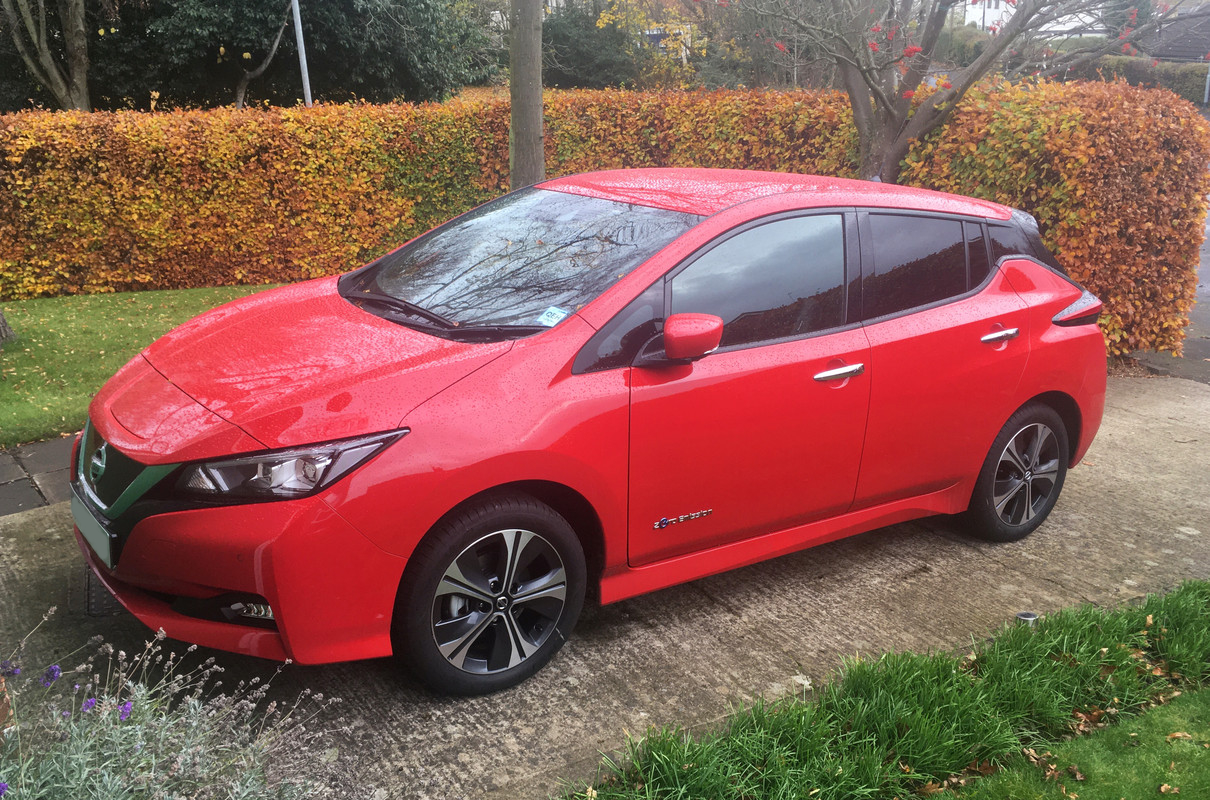
We like it a lot - but we'll be going for the extended range e+ version next time.
Standard range version is 40KwH (~160 miles), extended is 62KwH (~227 miles).
Cold weather drops those ranges significantly due to battery efficiency and having the heaters on.
It's an every day commuting vehicle for us. We still have a big diesel C-Max Grand for longer journeys.
Audi are pretty clear on it.
Linked the wrong one. This one.
And agreeing with the previous comments, the Leaf is driven as a single-pedal vehicle.
There is a brake pedal, but I consider it a personal failure if I have to use it.
Interesting that the learned bodies, universities and I see OECD now are saying something, that a car supplier and your own experience doesn’t tally with.
What am I missing? I can see Audi might have a vested interest, less so the IET and universities, but I am quite willing to accept your experiences. Are you driving through typical stop start traffic? If so even stranger.
You need to also consider how new technologies like autonomy will combine.
Your car could go off and charge itself.
If your car can drive to you do you need it park on your drive or even on your street? That's one of the ways you could solve the issues with EVs in areas with no off-street parking
Imagine designing housing estates with no traditional roads. EVs huddle together a small distance away and are summoned as you need them.
Interesting that the learned bodies, universities and I see OECD now are saying something, that a car supplier and your own experience doesn’t tally with.
Any link to this the only one I found they said the opposite?
Yes - let me see if I can find it.
A few here. Some older, some newer, some more or less straightforwardly vested. Read with appropriate pinches of salt.
Google “ev particulate emissions” - I can’t copy the link on a phone.
Are you driving through typical stop start traffic? If so even stranger.
Ah, something I hadn't considered TBH. As GrahamS says, it's a personal failure if you have to use the brake, however in stop start traffic and many other circumstances you probably engage autopilot or equiv and let the car take over, I've no idea whether or when the car is regen braking or pedal braking.
There may also be a learning issue. Some folk might just be better at anticipating issues and adapting to regen braking, while others might brake harder and later. (There’s a Hope vs Shimano thread on this somewhere 😉)
Edukator for example does seem to be thinking ahead even in the way he is describing his car journey. And the very high km/kWh does suggest more regen less friction braking than people are getting in UK magazine tests of the Zoe - over 11 vs less than 6.
By the end of the decade charging will be managed by aggregators balancing the need of the local networks with the generation on the system and the needs of drivers. Smart charging. Already seeing this in parts of NL. You will be rewarded for off peak charging
Not sure anyone has nailed on street yet, needs to be some kind of plug and charge solution for residents and probably some hefty policy intervention to enable infrastructure roll out and ease of use for residents
How will the likes of utilities and telecoms charge their van and equipment on the go. If all home chargers were ISO15118 compliant we could let these workers charge at our homes and get the cash back
There may also be a learning issue. Some folk might just be better at anticipating issues and adapting to regen braking, while others might brake harder and later.
With the E Tron you just brake as normal it will decide if the discs are needed.
I almost never use the brakes on my model 3, it really is rare, maybe once or twice in the average mixed journey. It takes 5 minutes in an EV with regen set to high for you to click and think, 'one pedal driving is SO much better'. You could quite easily commute daily and never brake. Even using the accelerator downhill to maintain speed the car is just balancing coasting and regen.
You WILL almost sail straight over the first junction when you get back in an ICE car. Luckily the 33" mud tyres on the hilux act like a regen system
Had a quick flick through the OECD report on vehicle particulates. Not got time to read it all at the moment but this paragraph stuck out:
Several estimates of the impact of RBS [Regenerative braking systems] on brake wear PM emissions exist in literature.
The Platform for Electro-Mobility (2016[13]) claims that RBS reduce brake wear by 25-50%. Van Zeebroek and De Ceuster (2013[7]) assume that regenerative braking should reduce the PM emissions associated with brake wear by 50%. Timmers and Achten (2016[9]) assume a zero brake wear emissions from RBS-equipped vehicles, and Barlow (2014[14]) also suggests that regenerative braking produces virtually no brake wear.
Hooftman et al. (2016[10]) state that EVs require about two-thirds (66%) less braking activity than ICEVs due to RBS. Their analysis is based on the service times of brake pads on Teslas, BMW i3s, and Nissan Leafs, which demonstrates that on average, the brake pads of these EVs last roughly two-thirds longer than those on diesel/petrol vehicles. They note that this outweighs the additional wear due to the vehicle’s mass.
Ligterink et al. (2014[15]) assume regenerative braking reduces wear by up to 95%. Del Duce et al. (2016[16]) report that brake wear emissions fall by 80% for EVs, based on a report by Althaus and Gauch (2010[17]). Nopmongcol et al. (2017[18]) estimated a 25% reduction of brake wear.
VERY mixed numbers and assumptions there, but they generally seem to agree that regenerative braking helps.
Non-exhaust particles from road traffic are certainly a bigger source of pollution in the UK than tailpipe emissions and, as traffic volumes continue to grow, it is worrying that there is no regulation in place to govern NEE particles," comments Professor Harrison. "We have a UK target of switching entirely to electric vehicles – in terms of new sales – by 2035. The aim of this is to reduce CO2 and air pollutant emissions, but there is currently a debate around electric and internal combustion vehicles regarding NEE particles. Battery-driven cars are heavier but generate power under braking and should emit fewer particles as regenerative braking does not rely on frictional wear of brake materials."
https.://www.birmingham.ac.uk/research/quest/sustainable-environments/brake-dust-and-brown-carbon.aspx
Likewise I can’t find anything that says they use more. Just that they still do and they feel needs addressed.
Drac
With the E Tron you just brake as normal it will decide if the discs are needed.
Agreed. Except that if you brake late will it not decide to use more disc (not necessarily less regen)?
I also agree I think that regen braking will help (I can’t see how it wouldn’t) my point is that good driving will help - both in minimising braking and maximising the proportion of braking that is regenerative.
On might EVs emit more particulate...
https://www.oecd-ilibrary.org/sites/4a4dc6ca-en/index.html?itemId=/content/publication/4a4dc6ca-en
Note that the also state it’s the PM2.5 they are most worried about.
Electric vehicles are estimated to emit 5-19% less PM10 from non-exhaust sources per kilometre than internal combustion engine vehicles (ICEVs) across vehicle classes. However, EVs do not necessarily emit less PM2.5 than ICEVs. Although lightweight EVs emit an estimated 11-13% less PM2.5 than ICEV equivalents, heavier weight EVs emit an estimated 3-8% more PM2.5 than ICEVs. In the absence of targeted policies to reduce non-exhaust emissions, consumer preferences for greater autonomy and larger vehicle size could therefore drive an increase in PM2.5 emissions in future years with the uptake of heavier EVs.
Agreed. Except that if you brake late will it not decide to use more disc (not necessarily less regen)?
I also agree I think that regen braking will help (I can’t see how it wouldn’t) my point is that good driving will help – both in minimising braking and maximising the proportion of braking that is regenerative.
Of course it will they weigh over 2 tons but it’s incredible how quick they stop. Yes bad driving will but that’s the same for combustion engines too.
1. There are capacity issues on a local level especially in old cities and at a generation level. There are some ways of managing things e.g. charging overnight when other power demand is low but overall lots of infrastructure work does need to be done facilitate widespread use of EVs.
2. In theory - charging posts near the kerb would service electric charging for sites that don't have off road parking.
3/4. Although some people pretend otherwise, people don't have any special rights to the bit of public road outside their house - with the exception to areas of dropped kerb for driveways. Spaces are reserved only if they get an individual designated permit bay, or can defacto be reserved if they have a disabled bay.
You can designate parking areas for electric vehicles which would seem like a reasonable way to deal with areas serviced by charging facilities.
charging overnight when other power demand is low
Remember that only works with the present generation fleet. If we move to a more heavily renewable fleet then we may need either significant fixed storage or potentially more network. However a bit of legislation about workplace and home charging would pretty much ensure the network is ok. The network companies are not overly concerned. Heat is more concerning.
charging posts near the kerb would service electric charging
Remember that many councils just finished moving street lights away from kerb edges for safety reasons. The splutter and swear at me when I make suggestions like that.
@Drac - I don’t think we’re disagreeing.
On might EVs emit more particulate…
Yeah it's a bit of an odd paragraph that: "light EVs emit less PM2.5 than ICE, but heavy EVs emit more., and in the future people might want heavier EVs."
Well yeah, okay, but they might want heavier ICE vehicles too. 🤷♂️
Also that is non-exhaust particulates, which kind of ignores that the ICE vehicles have exhausts.
Section 3 of the report is better for some actual detail.
I don’t think we’re disagreeing.
No, I don’t this we are any a Graham points out it’s a bit unclear as it mentions heavier EV use more than average but mentions nothing of ICE. I drive a Kodiaq at work which is the same size and pretty much a Q7 so a good comparison to my E tron. It needs a lot to stop it too as it’s a monster but only have discs and be regen. I wonder if the Cooler brake temps that some EV pads work at will also reduce the particles. It’s something needs addressed but it not a reason to stop EVs coming in as planned.

