UPDATE: CLASSIFIEDS section refreshed, redesigned, searchable: Go take a look
ooOOoo
Thats because Huhne has cancelled the government backed project at longgannet
again not quite sure what you mean.
1)no money in it, well no. it is not a cash crop, it has no value. the purpose is to remove carbon. we are not wanting to sell the charcoal, dont want a penny for it. we are going to put it in a big hole.
2)old quarries, mines. storage is a bit of an isue though.
3) huge, total f'ing huge. lots of waste ground, disused farmland etc around the country that could be used though
1) "we", who exactly, this is going to need more than a 1 man voulenteer organisation.
2) Ok, basicly into the landfill sites? Where does the landfill go, to the incinerators as they're the current least-bad option. And coal fired stations probably burn somethign the size of a landfill tip in a matter of weeks/months.
3) Any figures? I seem to remember reading that if we planted enough trees to be carbon neutral, we'd run out of UK to plant them on sometime in the next decade.
I'm sory, that idea just has no legs at all.
The greenest government ever Cameron promisedLongannet power station in Fife was intended to be the UKs first carbon capture plant. Now cancelled from Westminster - ( holyrood has little power over energy policy) controversial and possibly not viable - but it was a huge opportunity and once again we have failed to take a chance to gain an significant advantage.
Longannet has been knocked on the head, I'm struggling to see anywhere in the articles that says CCS is being knocked on the head. The OP is slightly (very) misleading in that Longannet is not viable as opposed to CCS. And the 1 billion is still set aside for other CCS projects. But hey, we don't want to break with tradition and allow the odd fact to get in the way of our bitching, do we?
There's plenty of CCS development in the UK and all of the power station manufacturers are working on it (and I'm working on part of that), it's hardly being knocked on the head. More sensationalist headlining as usual.
Don't forget that CCS is fairly power hungry (reduces overall plant efficiency a LOT and that's just the capture stage) so it does have a long way to go. Without knowing the details of why it was cancelled I guess it's hard to complain either way. Won't stop people though.
and in other news: tidal / wave research gets more money.
(at least, that's what the bbc told me)
Isn't the Longannet plant ultimately owned by a Spanish company and if the proposed CCS was a success any intellectual property discovered ultimately the benefit of the Spanish company and Spain, rather that Britain?
Ian - not if it was done as a government backed project - or at least not if I wrote the contracts 🙂
Iberdrola own Scottish Power, and are not interested in coal (SP's operations account for the majority of their coal stations), hence were probably not interested in flexible enough to reduce their costs as part of the FEED study. The government are, unfortunately, too short-sighted to stump up the extra £200m required, citing some ridiculous reasons for the project being uneconomic (e.g. pipeline length).
I think the point TJ was making in his OP was that [b]Scotland[/b] is potentially going to lose out on a lucrative industry, by losing the first-player advantage. Although given half of Europe's CO2 storage will be in Scottish waters, I'm sure there'll be plenty of revenue in the future.
Kit, Please don't confuse things with actual facts - this thread has kept me amused all afternoon! 😆 All I'll say is don't believe everything you read in the press and certainly don't believe anything an MP says!
I think the point TJ was making in his OP was that [b]Scotland[/b] is potentially going to lose out on a lucrative industry,
Got you, my mistake. And Peterhead is where?
[/url]In May, Decc submitted seven UK-based CCS projects for European funding, including the Peterhead gas-fired power station in Aberdeenshire in Scotland, although it will apparently take longer to get the CCS technology up and running there than in Longannet.
Interesting as natural gas with capture can cost 40% less than coal. Not really Cameron's lack of investment in either Scotland or CCS, is it?
I nearly corrected someone about the cool liquid CO2 but thought better of it 😉 Actually, speaking of facts, the [tiny] article in the Scotsman today was a shocker! Good to see the Herald though giving it space on three pages today, with two front pages in a row.
And if you think this thread is amusing, you should check out the Guardian's comments section 😀 http://www.guardian.co.uk/environment/2011/oct/19/david-cameron-longannet-carbon-capture?commentpage=1#start-of-comments
And Peterhead is where?
Did you read the "...is potentially..." bit?
Did you read the "...is potentially..." bit?
So, just adding to the sensationalism and hyperbole then?
So, just adding to the sensationalism and hyperbole then?
If you say so!
Lots of good information here (Cameron advisor, but don't let that put you off):
[url= http://www.withouthotair.com/ ]David MacKay's book[/url]
While CCS might be useful as a short term stop-gap, it is in no way a panacea. I think that the public attitude to fission power is the biggest problem we have in terms of energy.
[b]SCOTLAND DOOMED[/b] maybe.
[b]CAMERON CANCELS GRANT AID FOR CCS[/b] in one part of Scotland keeping it available for other Scottish projects.
😆
David Makay - the apologist for nuclear - supported by the big power generation companies - a load of hot air indeed.
No choron - the public have a very sensible objection to fission.
I reckon it's a great read too choron.
TandemJeremy - Member
what about the methane formed by the rotting willow?
no rotting willow it is turned to charcoal.
It's a silly idea, it's the single most expensive carbon technology by a huge amount. The opportunity costs of not building renewables or nuclear instead are huge too (why bother burning all the coal and CCSing it if you can replace it with nuclear (which is mega in terms of economics and co2)).
[img] 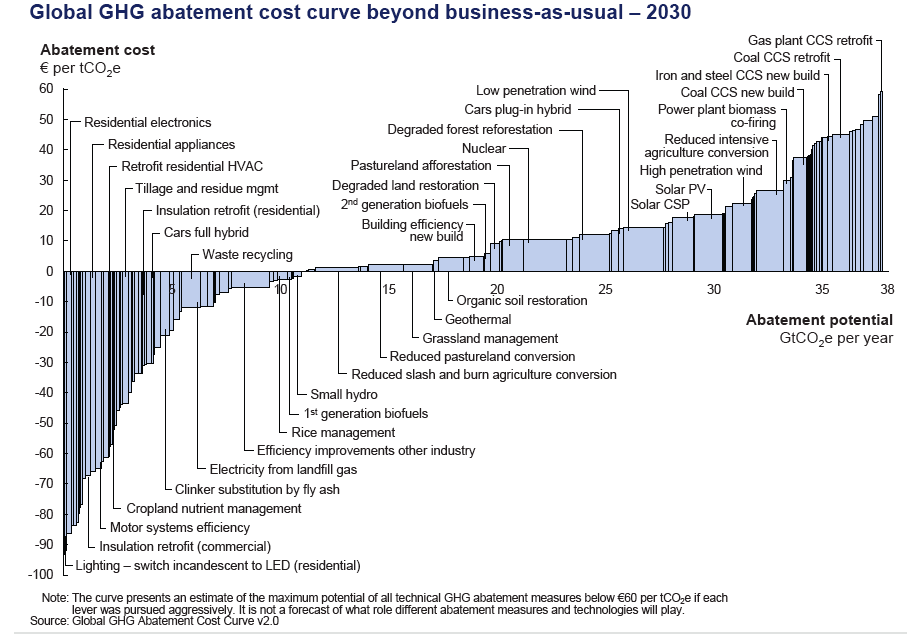 [/img]
Not sure I would agree with you there TJ. While there are undoubtably some people out there like James Delingpole, Nigel Lawson etc who are essentially advocates for the big fossil fuel concerns, MacKay is not one of them.
Unlike most writers on the topic of energy/climate change, his book is fully sourced and he provides basic 'back of the envelope' maths to convey his message to the layman.
Not sure how he's supported by the power generation companies: he's actually a physics professor at Cambridge [url= http://www.inference.phy.cam.ac.uk/mackay/ ]website here[/url] (I would really recommend his book on information theory), along with being being a bit of a lefty-environmentalist type.
Would recommend that anybody interested in the subject read the book (free online). Quick synopsis (of questionable accuracy): fossil fuels of various kinds are running out quickly; we don't have space for sufficient amounts of generation capacity via renewables; fusion requires amounts of tritium and deuterium that will run out quickly; there is a huge amount of fissionable material on earth, but we need to figure out how to best harvest it, make better reactors and improve waste management.
He is quite clear that a variety of generation techniques are required and does not suggest the entire world just relies on fission. Do you really believe that the UK could survive beyond the next couple of hundred years without some kind of fission?
Do you really believe that the UK could survive beyond the next couple of hundred years without some kind of fission?
I know it can. We simply do not need the expensive dead end of fission and we have no possible way of dealing with the very nasty waste produced. We don't have a couple of hundred years woth of fuel anyway.
So what will you do with the waste? how are you going to stop environmental contamination? where are you going to get fuel from?
McKay is obviously a Cameroon stooge, after all he was appointed by that arch Cameroon, Ed Milliband.
(why bother burning all the coal and CCSing it if you can replace it with nuclear
Because nuclear is expensive, unreliable, and we have no answer to the waste and only a small supply of fuel.
nuclear (which is mega in terms of economics and co2)).
Really? That's why the last estimate had UK decommissioning costs for existing nuclear facilities to be significantly above £73 billion (in 2008). Unsurprisingly, there isn't a more up to date estimate as its no doubt risen since then. Remember that's just for decommissioning - we have no real idea of how much storage will cost or how to do it.
http://news.bbc.co.uk/1/hi/7421879.stm
BP tied and failed with injecting carbon into a North Sea well few years back.
Insulate first (domestic, commercial and industrial property) then worry about producing the energy needed, which won't be much.
I suspect that this may be opening a can of worms, but:
-We do have large supplies of fissionable material. Breeder reactors can reduce the amount of waste produced, and reduce the amount of fuel required by reprocessing fissile waste. Also, huge amounts of Uranium exists in the oceans.
-Current commercial reactors are almost exclusively uranium based, newer reactors are likely to utilise liquid salt fuels like Thorium. These materials are far more abundant and are easier to make safe.
-It is important to realise that currently used technology was driven by the need to produce weapons grade materials, not to generate power. Once this constraint is removed (and it is being, if you look at fission reactor development plans around the world).
Much of the currently used tech is a cold war hangover, as is the public attitude to "nuclear". Anything with the word nuclear in it scares the shit out of people, why do you think it is never used for medical treatments?
Never? My biking buddy had prostrate cancer cured by tiny radioactive (nuclear) beads inserted which destroyed the cancerous material. That was enough years ago to say it cured him.
choron - MemberI suspect that this may be opening a can of worms, but:
Indeed
-We do have large supplies of fissionable material. Breeder reactors can reduce the amount of waste produced, and reduce the amount of fuel required by reprocessing fissile waste. Also, huge amounts of Uranium exists in the oceans.
Large amounts that are accessible by current methods? Fast breeder reactor are a failed tech - see super Phoneix in France and they produce vast amounts of waste. reprocessing creates further waste .
-Current commercial reactors are almost exclusively uranium based, newer reactors are likely to utilise liquid salt fuels like Thorium. These materials are far more abundant and are easier to make safe.
More unknown and unproven tech - and not going to be online in time
-It is important to realise that currently used technology was driven by the need to produce weapons grade materials, not to generate power. Once this constraint is removed (and it is being, if you look at fission reactor development plans around the world).
really - its still the same basic tech with th e same basic problems. Difficult to control, slow to react, creates huge amounts of waste and not insignificant amounts of CO2
Much of the currently used tech is a cold war hangover, as is the public attitude to "nuclear". Anything with the word nuclear in it scares the shit out of people, why do you think it is never used for medical treatments?
Nuclear is used a fair amount - and the public reaction is reasonable given the lies we have been told about nuclear, the dangers it actually represents and the unknowns surrounding it.
I ask some questions.
where are you going to get the fuel from using known tech?
What are you going to do with the waste?
What are you going to do to get the control needed - ie the ability to turn it on and off?
BP tied and failed with injecting carbon into a North Sea well few years back.
Well, Statoil have been managing to do it since 1996:
Stu +1
Why anyone would say that this is any sort of new technology is beyond me. It's just a bit of gas separation, compression, subsea pipelines and some injection wells. It's not new and it's not especially novel, and it's not untested. Now granted there are probably a few tricky bits of thermodynamics to contend with but injecting gases into oil reservoirs has been going on in the North Sea for decades.
From a technical perspective this sort of thing is doable, whether it represents the best use of resources and money is another matter.
When cost per kWh per pound is considered, nuclear power is cheaper than any fossil fuel (including decommissioning costs) (this is in every country save the USA, China and North Korea without carbon taxes/trading and extraction incentives/tax breaks come into effect). It's also lower in co2 (including decommissioning and extraction) per kWh than many renewables (Tidal and PV for example). We can store the stuff easily it's just that people get paranoid about it. It's low activity stuff (hence such a long half-life) so isn't nearly as dangerous as some might say so long as it's not too concentrated (if we had an oil spill scenario it wouldn't be much of a problem at all).
It's also an economical fuel as it isn't very sensitive to increases in fuel price. Uranium price increase has a much lower proportional increase on unit price of electricity than fossil fuels.
Of course far better than doing this is to implement efficiency measure as it's much cheaper and co2 efficient in many cases.
I think that you might have misunderstood the tenor of my post TJ, I'm not suggesting that all we need to do is get building and everything will be ok. It's also important to be clear on the difference between a technology (fast breeder reactor) and an implementation (Phoenix).
A particular implementation of a technology not being good is not a reason to write off the technology as a whole. The point that I'm trying to make is that while fission might not be a panacea at the moment, there is huge potential (unlike fossil fuels for example).
The problems that you point out are a reason that we should put considerable resources into R&D, in order to achieve a degree of sustainability using fission which is not possible with fossil fuels. Essentially, we need better implementations of fission, the fundamental physics of the situation indicates that we might get thousands of years of energy if we do. The same thing cannot be said of fossil fuels regardless of implementation, this can only be a stop-gap.
The question of whether renewables can become a sustainable source of energy is much less clear. The problem is that the densities of energy available for renewables are incredibly small, and we therefore need to devote huge land resources to generate significant amounts of energy.
The current power industry strategy for filling the capacity gap seems to be either throwing up gas plants which are cheap to build and come online quickly, or to convert gas to biomass which is economically viable only due to subsidies.
I don't pretend to have a solution to the current squeeze on capacity, and I don't think that anyone else does either. What I do think is that over the next couple of centuries we need to put some serious engineering into this, or we will find that living standards decline drastically due to the cost of energy.
Also, regarding safety concerns, compare the death tolls for [url= http://en.wikipedia.org/wiki/Chernobyl_disaster ]Chernobyl[/url] and [url= http://en.wikipedia.org/wiki/Banqiao_Dam ]the Banqiao Dam[/url]
renewable is not inherently safer.
I like this bit "Scotland's NHS is safe from Tory privatisation plans, our students have been protected from tuition fees for their higher education, and we are maintaining the 1,000 extra police officers on our streets while they are being cut south of the border."
mafiafish - MemberWhen cost per kWh per pound is considered, nuclear power is cheaper than any fossil fuel (including decommissioning costs) (this is in every country save the USA, China and North Korea without carbon taxes/trading and extraction incentives/tax breaks come into effect).
Id like to see some real figures on that as its the most expensive energy in every analysis I have seen. Its subsidised heavily in the UK to make it competitive without the costs of decommissioning being added.
Choron =- and as usual you avoid the awkward questions, you assume new tech will come along that somehow magically will mean all the issues of nuclear will be solved.
To me nuclear is the waste of resources and R&D effort that should be going in to energy conservation and clean power.
I ask you again
Where will you get eh fuel from? - known sources will be used up in a few decades. What will you do with the waste? How will you get the control? are you going to share nuclear tech with the world? How will you counter the terrorist threat? How will you prevent radioactive contamination of the environment?
Chernobyl death toll - a million from your link.
Nuclear is an expensive, unneeded distraction. We need energy conservation, we need energy efficiency, we need renewable and we need clean fossil fuels.
All nuclear? Or just the kinds we've tried so far?
Actually.. why don't the govt just ask TJ what to do on everything? He apparently knows.
Molgrips - what do you mean - are you wanting our future energy security to depend on some untried tech?
Its very noticeable that different countries are following going nuke free - when they look at the numbers and realise what an expensive dead end it is.
so tell me molgrips - what new nuclear tech do you want to base out future on? we have ten years to get this sorted.
Chernobyl death toll - a million from your link.
Tut Tut, you're cherry picking estimates there. The range of deaths in that Wiki link is 31 to 1,000,000
Stop being disingenuous.
Its very noticeable that different countries are following going nuke free - when they look at the numbers and realise what an expensive dead end it is.
I suspect that that is more to do with a quest of political survival more than the economics argument.
That's two logical fallacies there.
gonfishin - just cherry picking in reply to the cherry picking 🙂
As for it being political expediency - you mean governments doing what the people want?
you see the vast majority of the population have seen right thru the nuclear con. we have been lied to many times over and there is still no answers to the awkward questions.
Where will you get the fuel from? - known sources will be used up in a few decades. What will you do with the waste? How will you get the control? are you going to share nuclear tech with the world? How will you counter the terrorist threat? How will you prevent radioactive contamination of the environment?
I'd like the person wha asserted nuclear was cheaper even after decommisioning costs to back that up.
are you wanting our future energy security to depend on some untried tech?
Seems you are prepared to consider placing some of it on untried CCS
uponthedowns - not energy security no - but as a part of reducing greenhous gas emmisions You can still generate the power even is CCS does not work -
TJ, apologies if I appear to be dodging the question, I'm merely trying to make a point. The R&D money needs to be spent on something to improve our low-carbon generation capacity, fission scales up in a way that other things simply don't.
As I said, I don't have the answers to your specific questions about implementation, that is a question for large teams of nuclear engineers to puzzle over. Uranium is relatively abundant in the earths crust, and Thorium even more so. The cost of fuel is actually very low for fission power, which is one of its most attractive features.
Energy conservation and green power are all well and good, but you still need to get the power from somewhere. Are you aware of the amount of rare earth metals that are required for large-scale PV/wind generation? The price of rare earths alone might kill these technologies, when compared to nuclear.
My point is that there is nothing fundamentally wrong about getting a thousand or so years of energy from fission, while fossil fuels (clean or not) will run out much sooner.
I'm not sure about the problems that you cite with the abundance of Uranium, the world nuclear organisation says there are 5.5m tonnes of accessible reserves @$130/kg while global usage is about 60k tonnes using exclusively once-through reactors. This might only give us a hundred years or so, but as price goes up or efficiency goes up (ie FBR) this time will get much longer. I think I've seen a figure somewhere that FBRs will give us ~1000 years of energy at current global consumption levels using terrestrial Uranium, while using fuel from the sea extends this by a factor of 50?
Thorium is in my opinion a much more likely candidate, as it seems to produce far shorter lived waste. Also this is far more abundant, and produces no weaponisable isotopes, so yes this technology should definitely be shared globally.
New tech doesn't come magically from nothing, it comes slowly from the hard work and long hours of many thousands of scientists and engineers. This work needs to be done and we have little time to waste.
I'm surprised you're advocating for 'clean' fossil fuels though, when these fuels are inherently less clean (vast amounts of mining waste etc) and less sustainable in that at current rates of consumption, cost per unit energy is exploding. I very much agree with conservation efficiency and (limited) renewables though.
Interestingly, I hadn't seen the reference to the 1 million casualties study of Chernobyl. I did read the book though: not peer reviewed and some fairly serious methodological flaws in my opinion (e.g. assuming that any increase in mortality over the entire former USSR was due to radiation when incomes and access to healthcare were collapsing). Most studies that I'm aware of come out in the region of 10-100k casualties, broadly similar to the Banqiao dam disaster.
Cost comparisons
[img] 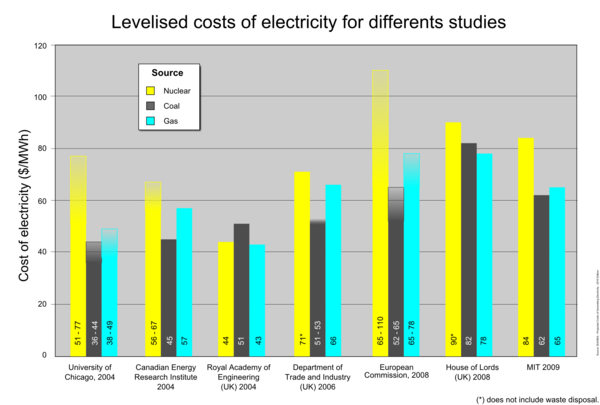 [/img]

