UPDATE: CLASSIFIEDS section refreshed, redesigned, searchable: Go take a look
Fact is some parts of the world eat too much, other parts starve. Redressing that balance, and dealing with consequences such as war and famine, is the one thing our global leaders refuse to do.
What do you suggest our global leaders do ? That's a serious question btw.
I don't think our global leaders are refusing to redress the balance between those with those who have too much to eat and those that don't have enough.
The issue is caused by the global distribution of wealth, unless you can come up with a solution to that then I can't see how the problem can be resolved.
Good reasoned debate here bySTW standards!
I pretty much agree with everything Shackleton said.
As a food chemist and organic gardener, I think I have a fair grasp of the issues.
Few bits of info to throw into the debate pot:
If you eat chicken then you are already eating indirectly Food which has GM in the supply chain, most chicken you can buy is fed on GM feed, even small scale farmers of chicken find it virtually impossible to guarantee no gm feed in their chicken.
To repeat again, its not GM per se. Its the application of it that is key. With climate change we need more crops that can fix nitrogen, resist fungi, rusts and other climate fueled diseases . The rise in climate volatility and increase in warmth and average humidity has meant that pests and plant diseases are getting worse every year.
Lastly its bacteria and viruses that scare me. GM modify them and we are in trouble. GM modify a sheep and if you get it wrong then you can point at it in the field and turn it into lamb kofta.
Generally I believe that we need to research the science on this, but ensure big companies dont abuse positions.
The rise in population is another issue, no easy fix.
But one further issue that hasnt been added so far is availability of fertilisers.
Current agriculture relies on fertiliser (fantastic BBC article published last week on Nitrogen and the Haber process).
Fo current fertilisers we rely on fossil fuel based petrochemicals (running out sometime), and phosphur mining, which again is a finite resource. Cheep food has been porpped up by cheap feriliser. Fertiliser will be much more expensive in a few decades time.
Now much can be done to improve fertiliser application (prevent run off into rivers etc), but we still need to have crops that use natural fertiliser and need less NPK.
Fact is some parts of the world eat too much, other parts starve. Redressing that balance, and dealing with consequences such as war and famine,
I think we're well into the realms of over simplification to list war as a consequence rather than a causative factor!
we still need to have crops that use natural fertiliser and need less NPK.
If only someone could develop some sort of "rotation" system to allow land to recover nutrients between crops
/enters thread
I have no problem with the basic premise if GM. It's is what people(mainly big business) do with it that concerns me.
\exits thread
we still need to have crops that use natural fertiliser and need less NPK.
If only someone could develop some sort of "rotation" system to allow land to recover nutrients between crops
Used extensively, still in use on plenty of farms but in the end the drive for quantity and yields (hence lower food prices) means adding more fertilizer to the land.
robust, science-based safety assessment,
Absence of proof is not proof of absence and real world trials are still risky. We cannot really say for sure what will happen over a long time scale either as we know the environment will react and we cannot assess that without doing it and then gathering data. We had no data smoking caused cancer till we started having dead folk for example.
I have considered it and I still do not want human beings, led by profit focused amoral companies, to enter the evolutionary race.
Once we start doing GM crops we will do them everywhere [ they will yield more so we wil] then we have some serious risks using a monoculture and having a small gene pool etc.
Nature will respond to this and then we have to respond etc. We cannot in theory or practice predict what these will be as evolution is random in nature.
In essence we cannot know what the consequences of it going wrong will be and,like nuclear power, it is probably very low yet pretty severe if it does. I therefore err on the side of caution as there are other solutions to this problem.
I am not sure why you wish to call this unscientific and my view wont be changed so [ rather than TJ] I shall leave
Like Junkyard says, it's like nuclear power and very divisive.
If trialled properly I see no problem with GM, if you could use it to breed varieties that grow well in a low powered greenhouse then great, means we need to import less and save on emissions. Likewise if you can get crops to grow on otherwise useless land in 2 years rather than however long it would take to do naturally again, all good.
It needs to be used as part of an overall strategy, we clearly need to import less and the more we can do t cut down on this ridiculous situation where we send food all the way around the world at all times needs to stop. Fossil fuel use is only going up and the absolute crap that a ship uses is barely better than bitumen. There is no real alternative unless you start mass building commercial ships with PWR's but that's a whole new ballgame I really wouldn't like to get into (I'm pro-nuclear but I wouldn't trust commercial shipping operators as far as I'd throw them). The more stuff we can grow locally the better.
Absence of proof is not proof of absence and real world trials are still risky. We cannot really say for sure what will happen over a long time scale either as we know the environment will react and we cannot assess that without doing it and then gathering data. We had no data smoking caused cancer till we started having dead folk for example.
This is the problem. There is no evidence that GM crops are more harmful than conventional crops yet they are treated as if they are. All most GM scientists are asking for is for a level playing field in terms of testing, not carte blanche to release whatever they feel like.
Why do you think GM is inherently more dangerous and risky?
I have considered it and I still do not want human beings, led by profit focused amoral companies, to enter the evolutionary race.
Too late, every crop we grow is a result of humanity interfering with evolution through selective breeding. More recently this has been done by companies, not all of whom are evil. I'm no more in favour of Monsanto's take on GM than you are.
Once we start doing GM crops we will do them everywhere [ they will yield more so we wil] then we have some serious risks using a monoculture and having a small gene pool etc.
Actually the main issue with conventionally bred crops right now is a small gene pool leaving no room for breeding to improve things and most crops are already monocultures. GM could actually alleviate both of these problems as your gene pool essentially becomes unlimited (within reason), spraying and fertilizing could be reduced leading to increased ecological diversity, etc.
Nature will respond to this and then we have to respond etc. We cannot in theory or practice predict what these will be as evolution is random in nature.
In essence we cannot know what the consequences of it going wrong will be and,like nuclear power, it is probably very low yet pretty severe if it does. I therefore err on the side of caution as there are other solutions to this problem.
I'm not entirely sure what you mean by "nature will respond" or exactly what it will respond to. Any newly bred plant, GM or conventional, will never have been seen in the environment before. It would be an entirely unique genetic entity. Everything that interacts with it will therefore adapt to the change. For example, pathogens will evolve to overcome resistance strategies, GM would allow us to make this less likely or at least slower.
What are the problems that you envisage happening in your nuclear meltdown equivalent scenario? I personally don't think that there are other solutions on a global scale. There are a combination of strategies, of which GM is one, that need to be combined to develop a solution.
I am not sure why you wish to call this unscientific and my view wont be changed so [ rather than TJ] I shall leave
Well, refusing to be open to the idea of changing your view is unscientific, and some of the views you have put forward (assuming I have understood what you have written) aren't supported by any evidence I am aware of or are maybe a result of misunderstanding. Science is rational scepticism and the scientific method acts on data not gut instinct or feelings. So, on balance, I would say that your views and stance are unscientific. Sorry.
If we are going to be struggling in the future to feed the world's population then birth/population control would be the logical answer.
Yeah. Good luck with that.
My natural hippie inclination is to be anti GM but as far as I'm aware there has been extensive testing and there is zero evidence it's any different to selective breeding.
However, anything being championed by Owen Paterson should probably be treated with suspicion. And I think claims that it's use is about 'feeding the world' are probably highly disingenuous. We could easily 'feed the world' now if there wasn't such ridiculous economic disparity.
We could easily 'feed the world' now if there wasn't such ridiculous economic disparity.
Oh. Is there a part of the world that's not being "fed" right now?
no it was ended by internet trolls skillful use of pithy comments
THANKS
Well, refusing to be open to the idea of changing your view is unscientific
We disagree and neither of us is going to change our view. That is data led so hardly unscientific 😉
How open are you to creationism and how long would you want to discuss it ? My objections are scientific it is just that we disagree about risk.
I'm not entirely sure what you mean by [b]"nature will respond"[/b] or exactly what it will respond to. Any newly bred plant, GM or conventional, will never have been seen in the environment before. It would be an entirely unique genetic entity. [b]Everything that interacts with it will therefore adapt to the change. For example, pathogens will evolve to overcome resistance strategies[/b], GM would allow us to make this less likely or at least slower.
You are answering your own question there and explaining how nature responds.
Science is rational scepticism and the scientific method acts on data not gut instinct or feelings. So, on balance, I would say that your views and stance are unscientific. Sorry.
Can i see your data that proves that i have said my gut or my instinct influence me? 🙄
Straw men ad homs are not convincing arguments
I am being rationally skeptic you are being hopelessly optimistic if we must do name calling 😕
We wont agree and it is not unscientific to state this.
Straw men ad homs are not convincing arguments
Is that a GM straw man or a conventionally selectively bred straw man?
Junkyard - I am sorry if I caused offence. I am entirely open to having my view changed on the basis of evidence presented and do so on a daily basis as experimental results come in. I'm not even pro all GM as I've already stated. I just have yet to see any evidence that [u]all[/u] GM is bad. You state that you won't change your view. That in my mind is unscientific.
I'll happily debate creationism or any other topic.
You are answering your own question there and explaining how nature responds.
Good, I'm glad I understood what you were getting at. My point was that a response will happen regardless of whether something is GM or not.
Can i see your data that proves that i have said my gut or my instinct influence me?
Okay, I don't know what your background is, and I apologise if what you say is based on hard scientific data, but your arguments do not tally with any publicly available data that I am aware of on the assessment of GM crop safety. As far as I can see I think you have given the matter thought and that is more effort than many make, but I don't think, from what you have said, that you (or anyone for that matter) have a broad enough understanding of the technology and biology behind it to be totally opposed or for it.
Agnosticism is really the only scientific way until absolute proof is found. Hence being 100% either way is being unscientific. You may not like it but I and every other scientist have to think like that to fulfil our roles properly. To close your mind to something, however distasteful you may find it leads to missing answers and false assumptions. In the same vein chasing an idea because it seems appealing and ignoring evidence to the contrary is just as bad.
Mr Woppit - MemberIf we are going to be struggling in the future to feed the world's population then birth/population control would be the logical answer.
Yeah. Good luck with that.
Luck doesn't really come into it. The suggestion was made that with "the current rate of global population growth" GM food would be necessary "to feed the world".
GM is not the solution to the current rate of global population growth. In fact there are no solutions other than birth/population control - that is the [i]only[/i] solution.
Because even the most effective means of farming the world has ever seen doesn't change the fact that the planet we all live on is a specific size.
like a lot of things the majority of the people don't actually understand the process of GM and sadly believe rubbish that is printed, what their numpty friends tell them or the negative propaganda machine.
Amazing poah you have convinced me with your insights!
The simple fact is Shackleton the ecological impacts of gm crops might not be seen for 20 years. The impacts of pesticides were not noticed for many years after their introduction. Although I accept this agrees with your point that all changes made to agri ecosystems meed to be treated with caution not just growing GM crops.
steady now there is no data to support that so its unscientific to say otherwise
That is the problem once we know it would be too late to do anything about it and we all agree nature will respond.
Some are happy with the risk and some are not.
the majority of the people don't actually understand the process of GM and sadly believe rubbish that is printed
That GM is the future, or that GM isn't the future ? Which printed rubbish are you talking about ?
Nature wont respond, it may however be affected......
GM is the future for some things yes
Wow insightful
GM is the future for some things yes
Have you got some evidence to back up the claim that "the majority of the people don't actually understand the process of GM and sadly believe rubbish that is printed" ?
Okay, so what are the risks? I know this is a bit of a tricky one, and it could be argued impossible to answer, but conceptually what is your worst case scenario assuming that say, rust resistant wheat or Phytophthora resistant potato, was grown in this country? What about terminator soy beans? Round up ready anything? This genuinely isn't a facetious question, in your mind what is the absolute worst case scenario and how would it come about through GM?
I'm trying to divorce the ethical issues I have with what I consider to be inappropriate and often corporate profit driven use of GM (round up ready, terminator, etc) from the potential benefits provided by reduced pesticide usage, increased yields, reduced fertilizer use, etc. I think this is a major point often untouched by the media and it needs to be made clear. A blanket ban on GM in my mind is like banning chemistry or the internet because you can make ricin or look at illegal porn. Never mind that you can make beneficial drugs or transmit information globally in seconds. Regulate the use of the technology.
GM such as Round up ready crops risk reducing the local environment to a desert apart from the farmed crop. Obviously not good.
However, moving a resistance gene agains Phythophthora (Irish potato famine pathogen) from wild potatoes into cultivated potatoes provides resistance and also reduces the need for spraying with chemicals to control Phytophthora. So the only organisms that would be hit would be the pathogen, all other Oomycetes and fungi in the ecosystem currently affected by spraying would be unaffected, In this case GM could actually make the ecosystem richer and more "natural" and may even boost yields as the natural soil ecosystem makes nutrients more available.
All of this also needs to be put in the context of the ecosystem. Intensive farming and the british farming landscape is so far removed from nature that the concept of the wild ecosystem no longer exists. With the right kind of land management plans this could be partially restore but no so long as we rely on artificial fertilizers, pesticides, fungicide and herbicide. GM in my mind offers one part of the solution by allowing us to maintain yields while reducing chemical inputs into the environment.
Have you got some evidence to back up the claim that "the majority of the people don't actually understand the process of GM and sadly believe rubbish that is printed" ?
In nearly 10 years of scientific engagement with the public I can remember a handful of conversations where people understood what GM genuinely was or had views that were unclouded by media presentation of GM.
None of these events were even vaguely about GM, but it is the topic that comes up most often and the number of misconceptions or just plain wrong opinions held (on both sides of the for and against fence) is staggering.
I dont disagree with you, but the inter connectivity of the below ground and above ground ecosystems make predicting consequences almost impossible. Years ago I was involved in some research on plant soil feedbacks and the effects of growing even the same species of plant but different ecotypes on other trophic levels is large. When you consider the introduction of completely different genes the consequences could be massive.
http://onlinelibrary.wiley.com/doi/10.1111/j.1365-2745.2006.01158.x/full
I was unaware that the UK, or the EU for that matter, had a food shortage. So we don't need to increase production to feed our populace. If other countries have a food shortage problem let them grow GM crops. I really would not want to have GM food forced on me.
ernie_lynch - MemberHave you got some evidence to back up the claim that "the majority of the people don't actually understand the process of GM and sadly believe rubbish that is printed"
are you being serious?
. I really would not want to have GM food forced on me.
why?
I was unaware that the UK, or the EU for that matter, had a food shortage. So we don't need to increase production to feed our populace. If other countries have a food shortage problem let them grow GM crops.
the idea that making GM crops so people can feed themselves in other countries is a pretty big reason to carry out research is it not?
In nearly 10 years of scientific engagement with the public I can remember a handful of conversations where people understood what GM genuinely was or had views that were unclouded by media presentation of GM.
fasternotfatter - Member
I really would not want to have GM food forced on me.
😆
I dont even understand what you mean by "people dont understand the process of gm"
Is it going to be any tastier than non GM? Will it be considerably cheaper than non GM? Probably not and the only person to benefit will be the farmer. No benefit to me means I am better off sticking with what I already eat.
In nearly 10 years of scientific engagement with the public I can remember a handful of conversations where people understood what GM genuinely was or had views that were unclouded by media presentation of GM.
To be fair you weren't even aware that it was official UK government policy to support the introduction of GM crops until I pointed it out, so please forgive me if I remain skeptical concerning your expertise on the issue of public opinion and GM crops.
There is some evidence to suggest that the British public have some understanding of GM crops and are prepared to cautiously support its introduction. And more so than some other countries.
fasternotfatter - Member
Is it going to be any tastier than non GM? Will it be considerably cheaper than non GM? Probably not and the only person to benefit will be the farmer. No benefit to me means I am better off sticking with what I already eat.
healthier, less soaked in pesticides and fertilzers though?
conventional crossbreeding by crop companies and farmers has already altered the food you eat from ancestral varieties eaten by the original paleo dieters
To be fair you weren't even aware that it was official UK government policy to support the introduction of GM crops until I pointed it out, so please forgive me if I remain skeptical concerning your expertise on the issue of public opinion and GM crops.
Happy to forgive but I'm not sure where the link between your statements is. I spend lots of time with the public and know a lot about GM, plant and crop science, I don't spend much time reading the news. Maybe I should in future. Anyway, I am grateful that you drew my attention to it.
There is some evidence to suggest that the British public have some understanding of GM crops and are prepared to cautiously support its introduction. And more so than some other countries.
I agree. If you look at what I wrote I said
My point is that more public education is needed before an informed and collective decision by the public on if and how GM should be implemented in this country/EU can takeplace.the number of misconceptions or just plain wrong opinions held (on [b]both sides of the for and against fence[/b]) is staggering.
Shackleton-Member
Wrote.= Why do you think GM is inherently more dangerous and risky?
Well its basically like this. Man made Radioactive material we cannot be exposed to it.
Where as natural Radioactive material we can, such as properties built on natural
Radioactive material in places such as Cornwall, all the people have to do is keep there
properties correctly vented and your OK.
All GM to me is Business Profiteering and basically will be the push for over pricing of
the lower Grade land below Grade 3-4-5 and possibly 6 in which would cause a further problem
for Cattle Farmers for they will need grazing land, in which Grade 3-4-5-6 is.
Have to say thanks for your input and answers to questions on this Top Man
grantway , your radiation analogy is quite confused!
what about going for an x-ray, having radiotherapy for cancer, taking a high altitude flight etc
CHB - Member
Good reasoned debate here bySTW standards!
I pretty much agree with everything Shackleton said.
As a food chemist and organic gardener, I think I have a fair grasp of the issues.
Few bits of info to throw into the debate pot:
If you eat chicken then you are already eating indirectly Food which has GM in the supply chain, most chicken you can buy is fed on GM feed, even small scale farmers of chicken find it virtually impossible to guarantee no gm feed in their chicken.
To repeat again, its not GM per se. Its the application of it that is key. With climate change we need more crops that can fix nitrogen, resist fungi, rusts and other climate fueled diseases . The rise in climate volatility and increase in warmth and average humidity has meant that pests and plant diseases are getting worse every year.
Lastly its bacteria and viruses that scare me. GM modify them and we are in trouble. GM modify a sheep and if you get it wrong then you can point at it in the field and turn it into lamb kofta.
Generally I believe that we need to research the science on this, but ensure big companies dont abuse positions.
.
Interesting I was lead to believe that Chicken Farmers actually use Fish as a feed to beef them up faster than normal type of feed. And the Chicken Farmers have to be careful on how much Fish is given, as to much Fish will make the Eggs taste of Fish.
The above is not the Organic Chicken Farmers.
There is some evidence to suggest that the British public have some understanding of GM crops and are prepared to cautiously support its introduction. And more so than some other countries.I agree.
So why were you backing up poah's unsubstantiated claim that "the majority of the people don't actually understand the process of GM and sadly believe rubbish that is printed" ?
Kimbers if you can prove there wont be an evolutionary reaction to an environmental change and/or you can predict what it will be then i will retract my objection.
All human activity and advancement causes environmental change. I found your post funny to begin with and then I realised that you were actually being serious.
Shackleton has single handily refuted every one of your assertions. It's luddites with this attitude, who despite all evidence contrary to their own opinions, will carry on retarding the advancement of human technology in an almost religious fashion.
kimbers - Member
grantway , your radiation analogy is quite confused!
what about going for an x-ray, having radiotherapy for cancer, taking a high altitude flight etc
Kimbers both of your comments are Man Made !
sorry the tangent here, but grantway, its not necessarily they type of radiation you receive (though that is important) its the dosage
[img] 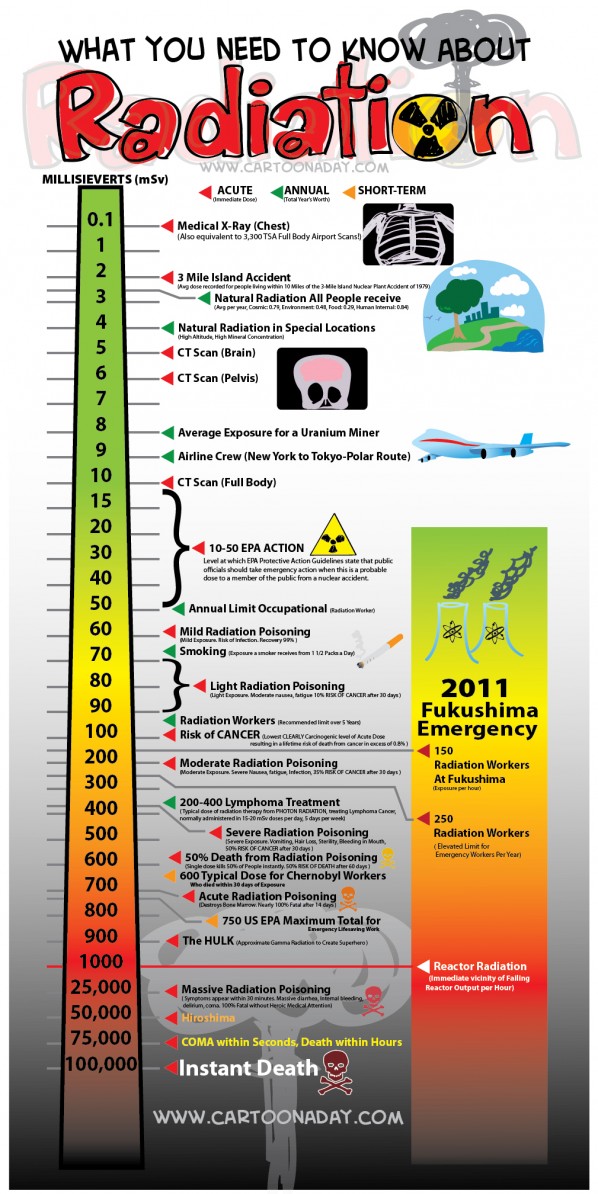 [/img]
[b]a_a [/b]- Interesting paper, nice work.
Or inconsequential. You don't know until you look. That is what I am in favour of.When you consider the introduction of completely different genes the consequences could be massive.
It could be a case where growing GM desiree potatoes with resistance to blight behave much more similarly to normal desiree than growing non-GM maris piper. Which would be "better" for the soil ecosystem?
An entirely new variety of potato could be much worse for the soil ecology but would have very little in the way of checks done under current legislation.
What is also starting to happen to get around GM legislation is using chemicals to mutagenise seed to screen for new traits of interest. This doesn't count as GM as mutations happen all the time, all that is hapening is it is being sped up. It doesn't have to be declared as far as I am aware and so you would never know if it was being grown, eaten, etc. but has the potential (although ultimately unlikely) to disrupt or alter every gene in an organism. Is it better to speed natural selection on this way? I think there is much more potential here for really screwing things up.
[b]Grantway[/b] - I agree, some GM is business led. Much of the research where I work is not. I think the arguments here can be viewed in a similar light to the Pharmaceutical companies vs generic drugs. It all depends on who owns the IP and how that IP is used.

