Forum menu
Anyone else excited? http://www.bbc.co.uk/news/uk-politics-17710598
Want one.
In fact, I want them all but that would be greedy.
I'll take two. 🙂
I'll take a few of them, to add to the others I have. Might have to move the Squadron of Lightnings and the pair of Vulcans around in the hanger to make room though.....
Wow, would love to be there when they opened the first crate up if they find them 🙂
96 Spitfires on a conveyer belt
[img]  [/img]
Anyone got a metal detector that I could borrow? Looking at costs of flights now...
That is genuinly exciting!
Not sure I can understand why they were buried in 1945 to stop them falling into Japenese hands as I though we were on the front foot at that point, but the fact they are there is great. I know little of what models fought in the pacific, I assume a 'jungle' equivelent of mk9 / mk14?
[quote=nickjb said]96 Spitfires on a conveyer belt
Ah, the £1 a bottle offer! I had a couple last night, pretty nasty ale as it turns out.
pretty nasty ale as it turns out.
this.
bit like sucking cold hop tea through a used bar towel.
Not sure I can understand why they were buried in 1945 to stop them falling into Japenese hands as I though we were on the front foot at that point
I'm confused by that too, I was fairly certain that Burma fell to the Japanese well before 1945, and in fact Japan surrendered in August 1945 😕
Be nice if they find them and they can be made air worthy again.
Fantastic if this turns out to be real.
But legends of buried Spitfires in crates are rife for lots of former airfields - closely followed by buried Harleys, in crates.
There is a bit more info on the telegraph website, but again it refers to them being buried in 1945 and them being Mk II's, which just does not ring true.
I would put the date of burial (if true) at some point in 1942.
this sound a bit suss to me couldn't have been 1945 as the japs were well and truly on the back foot by then and why would yanks be envolved in digging the trench that these "spitfires" were put into?
the dates and info doesn't tally up also i belive it was commom to blow up/set fire to planes and vehciles if possible during any kind of retreat so something tells me hes going to dig up a load of old tat maybe the odd spare part if hes lucky.
bit like sucking cold hop tea through a used bar towel.
That passes as quite a sophisticated night out for some of us.. 😳
96 Spitfires on a conveyer belt
They'll never take off.
"The Spitfire is arguably the most important plane in the history of aviation, playing a crucial role in the Second World War."
Nope, that would be the much simpler Hurricane. Without it, we'd never have had enough planes to win the BoB. Do your homework, (Ca)moron
It's definitely odd. Even had the Japanese raided the place they were kept it's not like they'd have had the time to assemble them, get some pilots and then attack before they got overrun again. My guess is they were buried during the first retreat and someone has their facts wrong.
Zokes, agreed, in the BoB, but the spitfire was still going very stongly in 1945, so over the war, I'd say had more impact (given the fact they'd top making them in 1940 without the more numrous hurricane).
It is however, the aircraft that a nation believed in, and even now, the nation still loves them. I'd say it'll be like that in another 50 years. That's got to say something, no one seems to rememeber the Sopworth Camel....
burying surplus equipment was standard practice at the end of wwii. i know of a pretty extensive american burial on dartmoor.
it seems an odd thing to do now but at the time it probably just made sense to ditch what was probably an obsolete weapon rather than build it up and ship it home just to decommission it or worse still have them built up just to fall into the wrong hands in an era and an area of looming decolonisation and nationalist independence.
i think the japanese thing is just a lazy soundbite to avoid going into more lengthy or potentially embarrassing detail.
There are similar [url= http://www.theaustralian.com.au/business/aviation/fact-or-fable-hunt-is-on-for-buried-spitfires/story-e6frg95x-1225995654752 ]stories [/url] to this of planes being buried unpacked in Australia, they still like to bury planes down there, with their [url= http://www.couriermail.com.au/questnews/ipswich/raaf-base-amberley-f-111-fighter-jets-end-up-on-swanbank-landfill-site-near-ipswich/story-fn8m0yo2-1226204896564 ]F-111G's[/url]
The issue of the Mk for the Burma one is off, as noted the Mk.II was an early war BoB version, would be nice, but this will probably turn into another legend never to be proven.
I actually like spitfire beer. But it costs me almost 5 quid a bottle here in Norway
[b][i]"advances in technology and the emergence of more agile jets meant they were never used"[/i][/b]
[b][i]"They were waxed, wrapped in greased paper and their joints tarred. They will be in near perfect condition."[/i][/b]
They went through a lot of trouble preserving aircrafts they didn't want to assemble because they were "obsolete" 😕
Zokes, agreed, in the BoB, but the spitfire was still going very stongly in 1945, so over the war, I'd say had more impact (given the fact they'd top making them in 1940 without the more numrous hurricane).
It is however, the aircraft that a nation believed in, and even now, the nation still loves them. I'd say it'll be like that in another 50 years. That's got to say something, no one seems to rememeber the Sopworth Camel....
But, if we'd only had the Spit, as beautiful as it is, we'd have lost the BoB, and probably the war. So it's hard to look past the downtrodden hurri, otherwise we wouldn't have had chance to make it obsolete with the later models of the sexy spit 🙂
Not sure the Camel's really in the same league - WW1 wasn't won in the air. The SE5a probably fills the Spitfire role here - far superior to the Camel in everything apart from turning with the torque, but not enough of them.
They went through a lot of trouble preserving aircrafts they didn't want to assemble because they were "obsolete"
They were shipped like that, to preserve them on the sea journey.
hmm after a little digging it seems that they were far from obsolete and more than a little useful in the area.
In 1947, six Spitfires flew from Singapore to Hong Kong to test the feasibility of reinforcing the colony. Two years later, with China in the throes of civil war, No 28 Squadron moved to Hong Kong from Singapore to be joined by No 80 Squadron which arrived by sea. No 28 Squadron relinquished its FR.18s in January 1951, while No 80 kept its F.24s until December of the same year.When the Malayan Emergency was declared in May 1948, the RAF had Nos 28 and 60 Squadrons available with FR.18s and No 81 Squadron with some PR.19s. The first strike of the campaign was carried out on 6 July by two of 60 Squadron's aircraft which virtually destroyed a terrorist camp. Ten days later, an attack was mounted against a hut which was particularly difficult to reach at ground level and ten terrorists were killed. However, old and faulty wiring leading to an accidental ground discharge of a rocket towards the end of August led to a ban on the carriage of rockets by Spitfires. On 28 February 1949, Spitfires carried 20lb fragmentation bombs for the first time and, in conjunction with Beaufighters, killed at least nine terrorists. In April, six attacks in 12 days accounted for 37 terrorists; and, on 21 October the largest attack to date involved 62 sorties by a variety of aircraft including Spitfires and Seafires. Twelve Seafires of No 800 Squadron also supplemented other aircraft between July and September 1950.
Compared to results achieved during the Second World War, operations against terrorists who could not be seen and whose location was in doubt might seem to have achieved little. Yet, they were effective, if not so much in causing casualties as in forcing the enemy to move and hide and in lowering morale. Over 1,800 operational sorties were flown against the terrorists by Spitfires. Age and climate took their natural toll and, in the year before they were withdrawn, the serviceability rate could only average 50%In 1947, six Spitfires flew from Singapore to Hong Kong to test the feasibility of reinforcing the colony. Two years later, with China in the throes of civil war, No 28 Squadron moved to Hong Kong from Singapore to be joined by No 80 Squadron which arrived by sea. No 28 Squadron relinquished its FR.18s in January 1951, while No 80 kept its F.24s until December of the same year.
When the Malayan Emergency was declared in May 1948, the RAF had Nos 28 and 60 Squadrons available with FR.18s and No 81 Squadron with some PR.19s. The first strike of the campaign was carried out on 6 July by two of 60 Squadron's aircraft which virtually destroyed a terrorist camp. Ten days later, an attack was mounted against a hut which was particularly difficult to reach at ground level and ten terrorists were killed. However, old and faulty wiring leading to an accidental ground discharge of a rocket towards the end of August led to a ban on the carriage of rockets by Spitfires. On 28 February 1949, Spitfires carried 20lb fragmentation bombs for the first time and, in conjunction with Beaufighters, killed at least nine terrorists. In April, six attacks in 12 days accounted for 37 terrorists; and, on 21 October the largest attack to date involved 62 sorties by a variety of aircraft including Spitfires and Seafires. Twelve Seafires of No 800 Squadron also supplemented other aircraft between July and September 1950.
Compared to results achieved during the Second World War, operations against terrorists who could not be seen and whose location was in doubt might seem to have achieved little. Yet, they were effective, if not so much in causing casualties as in forcing the enemy to move and hide and in lowering morale. Over 1,800 operational sorties were flown against the terrorists by Spitfires. Age and climate took their natural toll and, in the year before they were withdrawn, the serviceability rate could only average 50%
They were shipped like that, to preserve them on the sea journey.
😀 Didn't think of that..... durr !
Yes, that makes sense - thanks.
Hmmm.
Battle of Britain, Spitfires, Dave Cameron, I wonder why my 'Patriotism is the last refuge of the scoundrel' alarm is going off...
They are reported as being Mk 14's on the guardian...
http://www.guardian.co.uk/world/2012/apr/14/david-cameron-spitfires-buried-burma?newsfeed=true
This is starting to sound like a late April Fools or the old rumours about decommissioned steam engines being stored in tunnels in the late 1960's to form a 'strategic reserve' in time of war. That was utter BS too.
some raf penquin probably sold them to a Burmese scrap dealer after the war.
I wonder why my 'Patriotism is the last refuge of the scoundrel' alarm is going off...
He'll probably deploy them to the Falklands.
Here's a bit more info from 11 years ago, reposted on here: http://forum.keypublishing.com/showthread.php?s=e5b963fd2e8bc6dba447d8b4caeb023e&t=116104&page=2
Race is on to find buried ‘treasures’ – Spitfires worth £6mENCASED in containers for 56 long years they have quietly decayed away, their once shining propellors and wings gathering mould in their underground tomb. Outside the temperature is in the 90s as passenger jets take off in the shimmering heat.
The scene is Mingaladon airport, Myanmar, formerly Burma, and according to farmer and inventor David Cundall hidden 6ft under the airfield are 12 brand new Spitfires, abandoned in 1945 and now worth a cool £6m.
Mr Cundall’s dream is to excavate the crates, restore the Spitfires, and finally see them fly again.
The farmer and inventor first heard stories about the aircraft 20 years ago, but only started researching them in earnest after a friend and former Spitfire pilot met some American veterans who described digging a trench for the aircraft during the Allied withdrawal of Burma.
Through his own work at the public records office at Kew and by placing advertisements in specialist magazines Mr Cundall, who invents farm machinery for a living, has been able to contact seven eyewitnesses, who have confirmed the story.
The aircraft were abandoned on the orders of Louis Mountbatten, the head of South East Asia Command, two weeks before the atomic bombs were dropped in August 1945, ending the Second World War.
Knowing exactly where to dig is the problem when work could undermine the stability of the adjacent international runway.
Another snag is that an Israeli competitor is on the case and has been given permission to make a search.
Mr Cundall, 51, who lives in North Lincolnshire, has been out to Burma six times and has worked closely with the military authorities. He said: “We have an agreement with the military that we have our share and they have their share.
“What we really want to do is restore them and have them flying again.”
Mr Cundall – who describes his hobby as “digging up crashed aircraft” – is working with Dr Roger Clark, the head of earth sciences at Leeds University to analyse data from a ground penetrating radar which has been used to survey the 10-acre site. The radar has shown up “boxed shape images” which Mr Cundall believes are the outlines of the containers.
He added: “The story I originally heard was that in August 1945 a group from a construction battalion were passing through Rangoon on the way to Singapore and they were asked to bury 12 planes – they actually questioned the order as it was so unusual.“When I heard this many years ago Burma was a closed country. I advertised extensively and come up with seven eyewitnesses and 20 who know about the burials.
“Seventy per cent of the area has been searched, and another eyewitness who came along last year is positive he knows where they are and has sent me maps and an outline.
“However, the Burmese say we need more eyewitnesses to exactly pinpoint the place otherwise they’re not going to let us dig. They’re worried about undermining the foundations of the airfield.
“We also have a competitor, an Israeli pilot, who has paid a substantial amount of money to gain the contract to excavate the Spitfires. But his contract expires this month – and with a bit of luck we might be going back out in a week or 10 days.’’
Principal keeper of archaeology at North Lincolnshire Museum Kevin Leahy said the wings and fuselages were made out of thin aluminium and could have crumbled away – but if they were covered in grease and oil, or wax paper ready for a sea transit, they could be all right.
Mr Cundall needs more letters from eyewitnesses spelling out the exact location to convince the military. Anyone who can help is asked to contact him via the Yorkshire Post Hull office at Regent House, Ferensway, Hull, HU1 3PT or by e-mailing alex.wood@ypn.co.uk.
http://www.yorkshiretoday.co.uk/View...ticleID=192571
09 May 2001
It would nearly double the amount of aircraft the RAF currently have!
BigEaredBiker - thanks!
[i][b]"The allies had driven the Japanese out of Burma in April of that year. But Mountbatten feared that the Spitfires could provide the Japanese with a great advantage if they captured them after a successful reoccupation."[/b][/i]
That really makes no sense at all. Two weeks before the bomb was dropped on Hiroshima it was absolutely certain that Japan had lost the war. Indeed that was, and is, one of the criticism concerning the use of nuclear weapons on Japan - it wasn't necessary to win the war. It is reckoned that Hiroshima shorten the war by about 6 months, the US government argued that the American lives it saved as a result of this made it justified, but they have never suggested that the war wouldn't have been won.
I really can't believe that Mountbatten thought two weeks before Hiroshima that the war might turn in Japan's favour and that the Japanese would get a significant advantage if they could assemble 20 Spitfires, arm them, and train their pilots to fly them. If Japan's fortunes had really changed so dramatically, then them getting their hands on 20 "obsolete" aircraft would have been the least of Mountbatten's worries. Presumably they would have had something far more awesome up their sleeves. IMHO
I have no reason to doubt the existence of the Spitfires, although I do doubt the reason given for their burial.
Perhaps the British were afraid that they would fall into the hands of Indian nationalists or other anti-colonial forces?
Edit: http://en.wikipedia.org/wiki/Indian_National_Army
Hadn't Britain already promised to grant India independence after WW2 ? As I understood it that was the reason why 2 million Indians volunteered to help Britain win WW2. Covering up a procurement cock-up sounds more plausible, although I don't know how likely.
The Indian National Army (INA) was formed by the Japanese and consisted of Indian Army deserters and POWs. They were the first to fly India's current flag. They continued to fight the British in Burma in 1945. It would make good sense to prevent them getting their hands on any weapons.
Edit: They numbered 40,000 in 1945.
Mountbatten was a navy man - he would not have had much compunction about dumping aircraft if that seemed like a good idea. Although they were state of the art they don't compare with modern aircraft in terms of cost and so it could have been a straightforward decision to dump them, if that is what happened.
Dunno about the Spitfires but I always thought it was common knowledge that the Americans buried loads of hardware in the pacific rather than ship it all home again. I suppose that's the sort of common 'knowledge' that often turns out to be BS but still, the Spitfires don't sound totally implausible to me.
I'm with ernie though- some of the justifications for how they might have ended up there [i]aren't[/i] very plausible.
Perhaps it could be a Time Team special dig...and just three days to do it! Please, let it be true.
Remember this http://englishrussia.com/2006/09/17/russian-tank-recovered-from-the-lake-after-50-years-been-there/ ?
My old chap was on a carrier in the Far East during WW2 most of what they carried went over the side afterwards, and they were then tasked to repatriate POW's and displaced civilians. I think dumping of kit is pretty common post hostilities. It was certainly done by the Yanks after Vietnam and defo in the Gulf. Came up against similar stories in Russia in the late 80's. Didn't believe them either until we were in a factory that covered 4 square miles in Chelyabinsk, and realised the scale of went went on and how much stuff was simply stashed away after the war.
Lots of US kit from GW1 was stored in Oman and mainted by civilian contractors - just in case... It's interesting that the Spitfires were stored rather than destroyed...someone clearly wanted to keep their options open.
So they're buried, lost it seems. Who buried them? Ahhh the RAF.
No one asked them where they are buried.
Nahhh.
Thought not.
Typical.
No one asked them where they are buried.
Yes in Burma apparently.
You could pop over to Iraq and grab yourself a Mig 25 if you've got a big enough shovel. Sadly not in the original packaging so there may be some dust ingress.
[img] 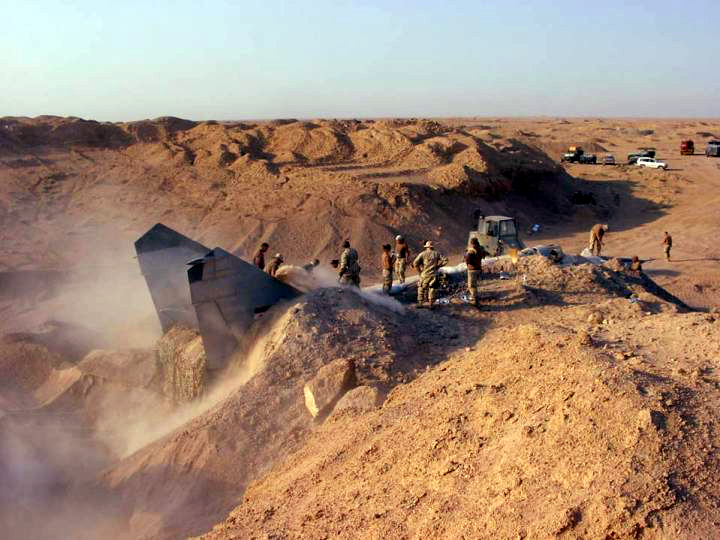 [/img]