Are there any bat ecologists here?
We need some work done on the front of our house. This is covered in 1950's tiles, which will be removed and rendered after the work is completed.
I have in the past spotted a bat crawling onto the very tight opening between 2 tiles, also spring last year there were 3 droppings below.
As we are nature lovers, we've done the correct thing and contacted bat surveyors. We've been quoted £800 (not including VAT) for the initial survey, then there will be another visit possibly a further third (not easy to say) visit. This could end up costing quite a lot of money.
Can anyone recommend a bat surveyor or is a bat ecologist to come out (near Stockport), where we won't have to take out a second mortgage?
Thanks TJ, we started with them and they are - being honest - about as much use a chocolate fireguard, if you want to do anything. "There might be bats, so we need a full survey" is the outcome - initial visit to see "can bats potentially roost here" (yes, we've seen them) then maybe check if the potential sites are in use (any sign of droppings, is the opening blocked by cobwebs etc), potentially folowed by evening visits to check for activity - but that would be in May, and our work is scheduled for April...
Our neighbours went down the same route and reported costs similar to what you've been quoted. I think, as when using any accredited expert, the price is the price.
You need to think what the outcome is here.
We need some work done on the front of our house. This is covered in 1950's tiles, which will be removed and rendered after the work is completed.
That sounds like you are committed to removing the structures that the bats are using?
A consideration is that it might only be being used as a maternity roost so may not have bats now. If you can crack on and do the work there will be minimal impact - they'll find somewhere else. If you leave it a month or 6 weeks, you'll then have to leave it until they've vacated the roost.
I would either crack on quickly before they start to use it, or leave it until Autumn and if possible look to provide some alternative roosting locations (bat boxes etc) nearby.
You need a mitigation licence if your work will have an impact on bats that would otherwise be illegal, such as:
- capturing, killing, disturbing or injuring them (on purpose or by not taking enough care)
- damaging or destroying their breeding or resting places (even accidentally)
- obstructing access to their resting or sheltering places (on purpose or by not taking enough care)
Find out how bats are protected.
The difficult bit is confirming that it's a maternity roost - hence the survey I suppose.
Licensing stuff here: https://www.gov.uk/government/publications/bats-apply-for-a-mitigation-licence
We have a friend that does bat surveys within his firm (down south though). He says that if you want to find bats it'll cost you about a grand, if you don't want to find bats it'll cost you more 😉
My son is an ecologist and regularly carries out bat surveys, and I sent him your original message.
His company would - for H&S reasons - double up on surveyors for nocturnal surveys. And, as you've seen evidence of bats, it would indeed be 3 visits. Freelancer ecologists may, of course, do them solo.
He thought the price you'd been given was about ball-park.
Interesting bat survey related fact of the day!
The only reported death from Rabies in the UK in the past 100 years was for a bat surveyor in Dundee who was bitten by an infected Daubenton's bat
http://news.bbc.co.uk/1/hi/scotland/2509375.stm
Danger money!
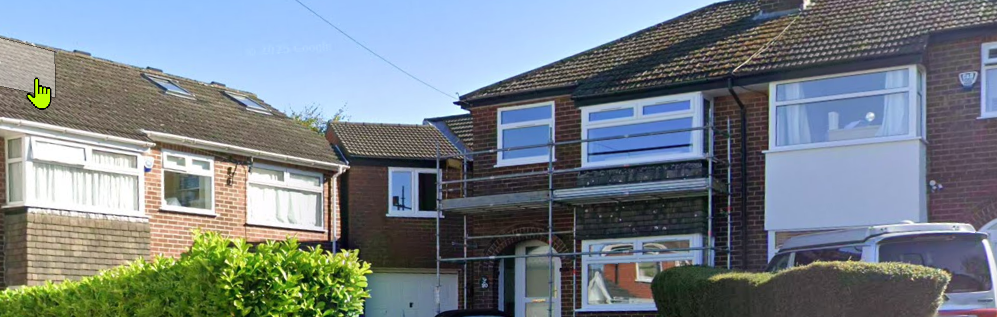
Our house on the left there, with tiles under the window. We're planning to have the front rendered like the house on the right - but even if we were planning to refit tiles, the guidance is "you can't do anything if there are bats unless you have a license"
A consideration is that it might only be being used as a maternity roost so may not have bats now. If you can crack on and do the work there will be minimal impact - they'll find somewhere else. If you leave it a month or 6 weeks, you'll then have to leave it until they've vacated the roost.
This is the nub. if there's no bats there now we can get it done. The issue is finding out IF there are any. The approach seems to be "see if it's POSSIBLEfor bats to roost, and if so wait till May to have a look-see". Ideally we could use an endoscope style camera to check the crevices? I don't suppose that a hibernating bat behind a tile would show up on a thermal imaging camera
Bats use different roots throughout the year - if they've been there in summer they won't necessarily be hibernating there now. With that in mind, is it possible to get a ladder up and have a careful look between the tiles? Presumably they're not accessing a cavity - it's just a small space behind the tiles?
Also, bear in mind that April is a good time to be doing the work - bats won't yet have young, but they will be flying by then so if you disturb one it's not the end of the world - it will just fly off. If the tiles have got to come off then there's no way round it. They will have young in summer so you wouldn't want to be disturbing them then.
There might be an economic justification for not doing the survey.
4.1 Show the standard survey is disproportionate
To show a standard survey is disproportionate, you’ll need to explain the:
- cost of a full survey, relative to the scale of the project and the scale of the potential impact
- time delay for a full survey
- level of survey that’s possible - for example, if you discover bats near the end of the survey season, you might be able to carry out a proportion of the standard survey requirements
The cost of surveying can be much less than providing compensation. By carrying out even limited survey work, you could reduce the amount of compensation you need.
It's probably worth a conversation with someone from Natural England.
The bat people mostly work on commerical projects, so that's where their rates are set. That ~800 quid is nothing for a property developer.
We understood about the roosting (maternity times), this is why we wanted the work done out of their season. I'm ordering a bat box to go right next to the tile where the bat has been (on the brick work). We had a bat box in the back garden, but time, bad weather and the attack by nuthatches destroyed it.
Thank you for all the information
Surely we can't discuss bats without posting this 90 seconds of pure, unadulterated lyrical genius?!
Sorry Bunnyhop, its very sweary, but it is very funny 😀
Have a look for a woodcrete box - they're a bit more expensive but worth it. Better insulation too.
You're not applying for planning or anything* so don't really need a survey by a licensed bat worker. you can quite easily sit outside your house at dusk and see if any come out, if none come out ove a couple of evenings great, crack on but make sure your builder can start right away if using one (it's no good leaving it even for a couple weeks, particularly as they'll soon be moving out of their winter roosts and looking for breeding roosts). If some do emerge you at least know it's worth paying for the bat johnny to come up with a mitigation.
*are you?
PS I'm an environmental johnny.
I don't suppose that a hibernating bat behind a tile would show up on a thermal imaging camera
Correct, it wouldn't. Thermal imaging cameras work by measuring surface heat* so a bat behind would have to warm the tile up enough to see the difference in temperature. No chance an inactive tiny animal would generate enough body heat to have a measurable effect on a thick wall tile.
*Before any pendants jump in here yes, you're right they actually measure the infrared emissions from the surface and infer the temperature from that, but for non-thermographers my explanation suffices.
We knew that there were likely to be bats in the house that we were planning on knocking down and rebuilding, as we had seen them flying about. They were in the tiled side of a dormer window.
Paid someone about £600 to tell us in a report "yes, there are likely to be bats, so we need to do a full bat watch"
Then paid them about to have three people watch all sides of the house overnight to watch for bats. Over three separate nights.
They then produced a report which we had to include within planning.
We then had to get a licence for the works to commence which took an absolute age to do.
We then had to pay someone to sit and watch us knock the dormer down (the rest of the house had already been demolished by then, with just the dormer standing whilst we waited for availability of the bat watcher.
Our mitigation measure was to put up two bat boxes that cost £10 from Amazon so that if the bats returned the following year they could nest there instead.
I proposed doing this to the bat man when I first spoke to them, but rather than just spending £10 on bat boxes, we had to spend nearly £2500+£10, and it delayed our house build by several months.
I understand the importance of protecting wildlife, but bat surveyors are in a role where they are incentivised to find bats and once they have found them they have the power to keep you paying them for surveys, reports and licenses if you want a project to proceed legally. There should possibly be some separation in there.
I'd say a common sense approach could work here, if you're willing to go up a ladder. You know where you saw them, so start carefully removing the tiles there. If no sign, crack on. If there is evidence, go down the 'official route'.
But then, there are flippin hundreds of bats around us, roosting/hiding/partying in all sorts of places.
You’ve stated you’ve got a roost - observed a bat using it, plus evidence in the form of droppings.
At this stage you don’t need a preliminary survey to work out roost potential, you need roost characterisation survey work.
Mitigation and roost compensation should be straightforward given it’s most likely to be Pipistrelle bats.
There’s a lot of dodgy advice in this thread that’s well worth ignoring.
Bat roosts are protected by law regardless of whether bats are present or not. To remove the tiles and destroy the roost would be reckless given you’ve seen bats using them to roost.
To remove the tiles and destroy the roost would be reckless given you’ve seen bats using them to roost.
Seen A bat, once, a year ago.
Not sure why strikethrough
“Seen A bat, once, a year ago.”
Care to share your working out on this one?
“Seen A bat, once, a year ago.”
Care to share your working out on this one?
Lol, the same logic you used in your post! Sure, there may be more bats but there's no evidence - just like there's no evidence that there's a dodo's nest in there!
I'll thank the OP for this post as this is something I'll remember to close my eyes to when commissioning work on my house. Out of interest, what is the range of penalties for pretending the bat (singular!) wasn't seen? 😉
This is all a bit crazy isn't it!
Neighbour had hundreds of bats living in the loft but needed a new roof. Bats didn't care, they just stayed and watched the work. Once one side was finished they moved across. Existing access holes that they used were obviously preserved for when the roof was finished. I get the impression that problems occur when bats are turfed out and the door is locked behind them.
It's quite sweet if you go in the loft there and hundreds of little faces turn and look at you.
thestabiliser is correct - I saw one bat several years ago. Then last summer 3 tiny droppings. None since. I think the cost of this is outrageous and no we don't need planning permission. The new bat box will go within 10cm of 'the tile'. In fact when the work to rebuild the front of our house has finished, I can even put the box where the tile was.
You’ve stated you’ve got a roost - observed a bat using it, plus evidence in the form of droppings.
At this stage you don’t need a preliminary survey to work out roost potential, you need roost characterisation survey work.
Thanks Dave, that was my take too. As mentioned above, we saw droppings (probalby) last spring , and saw the bat itself the year before that, so we know there's POTENTIAL for bats to roost, the question is whether they're there now
Of the three firms I contacted yesterday for pricing etc, the only to respond said "roost potential survey will cost £800+vat and lead to others if there's potential."
when I suggested going straight to the actual survey they replied
I see where you're coming from but this is the approach NE will want. With it being a few years a Phase 1 Scoping Survey will need to be done in the first instance. If potential is still low-high then emergence surveys required from May onward.
At the moment, if a client came to me telling me what you’ve stated so far, I’d be expecting a bat roost to be present. The fact you’ve gone to the trouble to contact BCT for advice would reinforce that.
Cobwebs aren’t necessarily evidence of absence given that the roost might not be suitable for hibernating bats, or that hibernating bats have been present long enough for spiders to spin a web below them.
I’ll just reinforce the fact that in the eyes of the law a roost is protected whether bats are present or not. Absence would have to be proved by emergence surveys and there is national guidance in place as to what survey effort is reasonable to ascertain absence.
My advice is to find a licenced Batworker with a Low Impact Class Licence, which would give you the best legal way to proceed.
evidence like cobwebs over the entrance hole and the like
TBF to spiders you can remove a web and it will be back the next day.
(unless you mean that if there's evidence of a spider there isn't a bat nearby)
The cobweb thing is not "cobwebs mean no bats" - more that if there's no cobwebs you should consider why
When bats roost in old trees, and the tree falls over, outside of the roosting season, don't they find another roost - hence bat boxes? What are the implications if it's proven to be a roost - boxes up and timing the work to avoid certain months?
I'm not agitating for habitat destruction, just asking. We had bats in the old school building I taught in. With a new academy build on the way, lots of time and money was spent on surveys, even though the cleaners regularly got spooked by them flapping about after dark. Result was a big bat box up and a 5 month delay to demolition. Nothing else changed and the habitat was gone.