I could do with some advice / guidance really..
Saw a home brew kit in a shop called "the Range" bucket, with various starter kit stuff inside for £20. Also they did home brew bags with things like IPA, Mild, Stout etc in them. They also do coder and Pilsner and Nut brown beer. All for £20 a bag (40 pints)
Just add sugar and water.
Looks tempting but is it any good?
I think you still need to have a couple of goes before you nail it but yes, some of those kits can produce some excellent tasting beer.
There's a few homebrewers on here. Homebrew in general is now really good. What brand are the kits?
I've pretty much stuck with Coopers kits (make 5 gallons) and Brupaks Beers of the World (make 2 gallons) and think they taste great.
At £20 it can't hurt to give it a go, it'll be a slippery slope from there though. Only thing I'd suggest is instead of plain sugar (which can leave the beer a bit 'thin') use a kilo of spraymalt or a tin of malt extract instead which gives more body to the beer. Though there's nothing wrong with using plain sugar.
Also, check if the barrels have a tap on. If not, then you'll need a siphon tube which is a bit of a hassle doing 40 points. And you'll need something to put them in - either start collecting brown glass bottles, or use plastic fizzy juice bottles.
[url= http://www.jimsbeerkit.co.uk/forum ]Jim's Beer Kit[/url] is a great place to gather information. There's a dedicated 'kit' part to the forum.
Get one to suit your tastes and see if you like the results, then go here [url= http://www.hopandgrape.com/public/catalog.asp ]beery goodness[/url]for first class goods and very quick postage .
HTH .. CHEERS ! 😛
Bothing to add except that my wife wants to brew her/our own ale.
How I love her. 😳
The make of the kits I saw are these
[url= http://www.makeyourowndrinks.co.uk/ ]make your own drinks.co.uk[/url]
I make loads of homebrew.
This is the sort of gear I use
http://www.the-home-brew-shop.co.uk/acatalog/Beer_Starter_Kit_With_Barrel_Equipment_Only.html
And I make tins of this.
http://www.the-home-brew-shop.co.uk/acatalog/Wheat_and_Scottish_Beer_Kits.html
Just add sugar and water. Follow the instructions and it should turn out good. Make sure its kept warm (comfortable room temperature) when brewing and store it in a cool place once kegged. I keep mine in the outhouse.
The only problems you should encounter with the brewing will be if you haven't sterilised the equipment properly, or rinsed it off properly. After some use the kegs might need seals replaced so its usefull to have some spares kicking around but they are cheap as chips.
Go for it, you'll have good beer and you'll save a fortune. I have around 120 pints of various stuff in the shed that cost me around 40 quid to make.
That kit you've got looks fine. I'd buy a pressure barrel for storing it in as its easier than bottles.
Something like this.
http://www.the-home-brew-shop.co.uk/acatalog/5_Gallon_Plastic_Barrel_S30_valve.html
Bottling is a load of hassle, use a keg this time of year and keep it in the garage. Bottles are useful in the summer when the ambient temperature is higher, they can be stored in the fridge.
IME kit beer is pretty ropey but a good way in to brewing.
Well thats just sorted my christmas present out from the other half! This is going to be fun 😀
kit beer used to be ropey but the stuff that's available now is excellent - in particular the 2 can kits that contain all the malt you need - no extra sugar required. Coopers kits are excellent too.
I brewed a Coopers Australian Pale Ale a few weeks ago with additional hops; had one of those the other night followed by an Everards Tiger & I preferred my own brew.
Pressure barrel is fine for ales & stouts but lager really does suit being bottled - more fizz.
Believe it or not, even Tesco Direct are getting into the game.
Coopers do 500ml PET bottles in dark brown that are ideal, nay designed, for beer/lager. box of 24 for around £12 but you only need to buy them once. unless you get into the habit... I've got about 6 boxes plus a load of glass bottles.
Bottling is easier if you have a bottling stick - long slim hard plastic tube with a needle valve on the bottom. Weight of beer keeps it closed until you put it into a bottle & press down. Lift up, it stops flowing. much easier than a tap on the end of your siphon tubing.
You'll also need a hydrometer to measure (a) the Original Gravity and (b) the final gravity; subtract one from the other, divide by approx 7.5 and there's your ABV% content.
Another recommendation for Jim's Beer Kit here too.
Finally, no matter how quickly the instructions say it'll be done, IGNORE that bit. It's ready when it's ready and not before. Your hydrometer will tell you when that is.
The hassle I find with bottling is the cleaning and sanitising, did 40 the other night (used the stick) as I fancied knocking a few out for mates. Forgot how much I hate it!
Tip for kit beer, use mineral water or at the very least treat your tap water with a Campden tablet to knock the Chlorine out before you brew.
indeed with the treated water. If you buy 5L bottles of supermarket water, you can also keep the bottles & use them for demijohns when doing wine
I did 33 bottles today. cleaned, rinsed 4 times, then bottled a Coopers European Lager. Took about an hour, maybe 2 hours at most. Should be ready for NYE, luckily I'm not a lager drinker & mrs_drummer has plenty of stock...
Thinx I like to give it a go
Whats are the best home brew kits to buy?
So from start how long does it take to taste ones rewards
Coopers are pretty good with their recommended sugars.
I'd start with one of these http://direct.tesco.com/product/images/?R=213-7435 if you don't have a decent homebrew shop near you. This contains the fermenting bin, 40 PET bottles, 1 pack of Beer Kit Enhancer (malt extract plus dextrose) and a beer kit. Obviously everything other than the kit & sugar are reusable
My father in law uses Geordie kits with granulated sugar - not the current best practice but he likes them so who am I to argue 😉
Brupaks - two can kits, Linthwaite Light & Fixby Gold are nice
St Peters' IPA & Golden ales are nice too - again, two-can kits.
The two can kits seem to mostly be made by a company called Muntons, and a lot of people have had problems with the fermentation "sticking" at around 1020. I've not yet experienced this problem, but the method of getting it going again seems to be raise the temperature a little and give it a GENTLE stir
Coopers were the best of the bunch from my kit days.
The Fixby Gold is well spoken of but unfortunately both mine turned out gash, so bad that I never managed to finish the keg off.
Welcome to another hobby, if you're still enjoying it in 6 months I'd strongly recommend going all-grain. It's easy and forgiving enough, more time intensive but it really does produce far better results.
And it's another chance to continuously buy new and better kit in the search for the perfect brew.
wasn't a problem with the keg was it?
I've kegged 5 different brews this year & ended up pouring all of them away. My bottled stuff is fine.
One brew I bottled 10 bottles & kegged the rest. Bottles were fine, keg was sour. not vinegar but bad enough.
Turns out I'm not doing things right with the keg, especially the rinsing rinsing and rinsing again. I was also recommended to fill it with gas straight away to stop the air already in the keg from getting at the beer.
Next brew is a Coopers IPA. 30 bottles & 10 pints in the keg to see if I've got it right yet, without wasting too much good beer.
And I'm planning to go All Grain some time in the new year...
So from start of making your brew, just how long till you can taste your rewards 😉
depends how clear you like it 😉
seriously though, it takes from 4 days to 2 weeks to ferment out, depending on ambient temperature. If doing a lager with lager yeast at lower temperatures, even longer.
Then there's the secondary fermentation in the bottles/keg - I give it another two weeks in a warm place.
Then there's the bottle/keg conditioning - basically, clearing as the remaining yeast settles to the bottom of the bottle/keg. I give mine at least two weeks in a cool place, but some beers benefit from longer conditioning.
So realistically, about 5-6 weeks if you like it clear & bright.
[img] 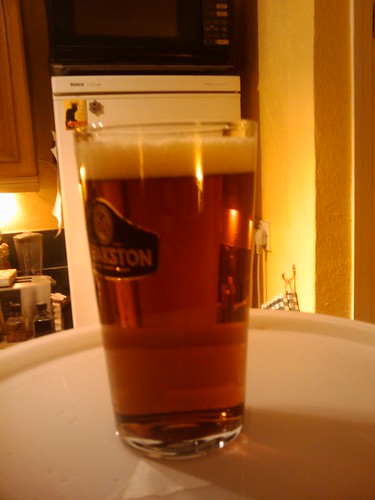 [/img]
This ^ is a St Peters' IPA I did in August. Still got a few bottles left
Another one for coopers here. Muntons connoisseurs is worth a look too.
The all malt kits are much better than the ones that require added sugar in my experience. Mind you, 'proper' homebrew is even better - i.e. boiling and adding hops according to a recipe. Kits are a great introduction though. It took me a while before feeling confident enough to do my own boil, mainly because the more you read the more you worry about buggering it up. As it turns out it's not that hard, it's only like cooking. As my mate and brewing partner says 'People have been doing it for thousands of years'.
My top tips are:
- be super clean and sanitary
- use good yeast and chose the right one for the style of beer. A basic kit is often loads better with posh yeast rather than the one supplied.
- Be patient, when they say 2-3 weeks in the barrel, leave it 2-3 weeks, rather than repeatedly sampling it 'just to see if it's ready'!
Do it! It's great fun and the only real way to get fresh beer at home.
st peters IPA is a good un!
Even cheap stuff is fine if you're not too picky. So far I've done Geodie bitter,St peters IPA and yorkshire bitter (from wilkos) all good!
2l pastic bottles are cheap and easy, screw top wine bottles are my favourite. I've got all my mates onto it now, planning a mini beer festival!
Not sure what it was to be honest, brews are generally fine but the Fixby was awful on the 2 separate occasions I made it. Strange as it always well recommended, suppose it could just be coincidence.
I'm making a Hobgoblin clone on Monday, followed in a couple of weeks by a Chimay White.
I think the Coopers IPA was one of my better kits, made it once with spray malt and once with enhancer.
the more you read the more you worry about buggering it up. As it turns out it's not that hard, it's only like cooking. As my mate and brewing partner says 'People have been doing it for thousands of years'.
My thermostat broke on my first grain brew, the mash temperature went way over what is considered healthy yet still ended up with very decent beer.
All in all I think it's a pretty forgiving process providing you get the cleaning right.
I've never screwed it up yet. pour kit into barrell, do what you're told. Leave it for a week ish in a warm enough place but not next to a heater. Wash bottles with milton (pour from bottle to bottle to save costs). add a half a tea spoon of sugar per pint to bottle then leave the bottles at room temp for at least a week, better 2, then start drinking it. Easy.
I'm making a Hobgoblin clone on Monday,
funnily enough it was my hobgoblin clone that was the 10 bottle / rest keg disaster.
I'd add to adsticks tips: rinse rinse and rinse again. then rinse one more time for luck 😉
Peracetic acid is your friend when it comes to sterilising kegs .
Plus a tiny amount of so2 if you are not refilling a keg instantly .
Strangely warming the beer up a few degrees in the keg will help shelf life . the yeast will mop up any oxygen present and produce co2 in the secondary fermentation .
Alternatively get a bottle of gas , fill with 1% PAA abd use the gas to blow the PAA out .
You now have a sterile inerted keg .
HTH
ps I have made 2 million gallons so i know what im. . . .
2 million gallons? Singletrack christmas party at yours then!
while I've been away from the keyboard I've put another batch on. 20L of Coopers' IPA as per kit instructions. no extras. but I might dry-hop with some cascade when it's finished fermenting
As mentioned above, cleanliness is crucial. Basically, the fermentation conditions which best suit yeast also suit bacteria (and random wild yeasts which may be present in the air), and these can lead to 'off' flavours in your beer.
Bottling is a bit of a hassle, as you have to clean, sanitise and rinse all the bottles, but it's a cheap way to get into home-brewing. You can always get into kegs later on - if you're going to get into it long-term then kegs are much less hassle (but relatively expensive to get set up with, hence the need for long-term use to get your money's worth).
You can get some very drinkable beer from kits. Ale is generally more forgiving than lager, so stick with that until you get more experience. Usually the yeast that comes with kits is a generic one that they chuck in with every kit, lager or ale. As a general rule, chuck out the yeast that comes with it, visit your local homebrew shop and buy some decent yeast specific to the type of beer you are brewing.
Avoid using table sugar if possible, buy the same weight of light unhopped spray malt (aka light dry malt extract, or LDME). This is also a sugar, but is derived from malted barley rather than sugar cane. Table sugar can add unwanted flavours, whereas LDMA will add extra malt flavour to your beer.
Finally, try to maintain a constant temperature during fermentation. Big fluctuations can often lead to various by-products which can affect the flavour of your beer. Usually 18-20deg C is good for ales, or about 10C for lagers.
Hey sorry just picking up on this but I've tried on of these kits before Christmas, having never homebrewed before. I tried the Premium Lager kit which was simple to make up, simple step by step instructions included, and tasted great (we drank the 40 pints worth in 2 weeks!). There's a website with more information on if you're still not sure www.makeyourowndrinks.co.uk I'm going to try one of the ciders this week so will let you know how that goes too.
I've now moved on to Brew In A Bag from kit beers. This way I choose what malts & hops, and even yeast, to use. I get a beer exactly the flavour I want.
So far I've done a batch of Old Peculier, a batch of Pilsner and a batch of Theakston's best bitter clone, the two Theakston's brews coming from recipes in Graham Wheeler's book "Brew Your Own British Real Ale". The OP is coming into condition about now; the best bitter needs another couple of weeks in the bottle, and the Pilsner is "lagering" in the cold greenhouse.
Aside from the cost of the extra equipment (i.e. a big pan and a mesh bag, £75 between them) an all grain brew in a bag can be done for less than a tenner a batch.
3kg of Pale Malt at £1.60 a kilo - £4.80
300g of crystal Malt at £3.20 a kilo - £1
20-40g of hops of your choice - £1-£2
Yeast - £2 odd
John
Trade rate for Pearl Pale Ale malt is approx 50p /kg crushed , and 60p a kg for Crystal and other adjuncts .
Obviuosly we buy tonnes , If you could get to 25kg your local micro should be able to do you a deal
I'm sure, but I don't know where to store 25kg bags of grain without attracting something for the cat to play with 😉
I tend to buy only what I need for each brew so I don't have to worry about storage, but I know I can get it cheaper by buying in bulk
Damn this forum...It's cost me another 70 quid. Ordered the Wherry premium kit and a box of 10 co2 cartridges.
Now any pointers to making my 1st brew the best it can be? Thinking of using bottled water (the cheap 20p stuff from tesco)???
Bottled water should be fine. Clean well and rinse three times
Thanks JD
For my second brew could I used the water bottles to condition the ale in provididing they are kept out of light? I've only ordered one cask for now.
Or am I better getting glass bottles and caps?
Much better with glass IMO . TEsco PET water bottles probably wont take much pressure and will most likely fail. It depends on the level of CO2 you want in your beer . A light dusting with 1 - 1 1/2' of attenuation and you should be OK . Especially if you can keep the beer cold (5 - 9'C) once conditioned .
Pop bottles would be better , glass or pressure keg best .
I use a mix of Coopers PET bottles designed specifically for home brew, and glass bottles that I bought from the supermarket. I did have to empty them of the beer they contained though 😉
I find Theakston's bottles the best for me as the labels come off really easily. Wychwood & Fullers London Price bottles have a big fat neck that I can't get my capper around (oo-er missus!) so they just get recycled.
I have tried to use a keg but every brew I've put in it has gone off in no time, so now it's gathering dust at the back of the shed. Don't let that put you off though, my father in law uses kegs all the time without a problem. I wish I knew how he does it.
If you don't fancy lugging 5x 5litre bottles of water around, tap water (unless it's really hard or chalky) is fine, but benefits from half a campden tablet crushing into the water to get rid of the chlorine.
When I do a brew, I have one fermenting bin filled with tap water (West Yorkshire, pretty soft water) and I crush a campden tablet & chuck it in. I then use this water to fill up my boiler if doing an all grain brew, or to make up the kit in another fermenting bin if doing a kit (which I will be doing this weekend, a Coopers European Lager. Mrs_d tells me it tastes a bit like Becks).
When fermentation is over - i.e. when your hydrometer reads below 1015 and the same reading for three days in a row, not a given number of days from starting that the kit makers usually suggest - I siphon it off the yeast into a clean fermenting bin & leave that for a couple of days to a week to clear. I then add my priming sugar (1/2 tsp per bottle, or about 7-8 tbsp for a 23l batch), leave it half an hour, then bottle. Keep the bottles in a warm place for 2-3 weeks for secondary fermentation - to carbonate the beer - and then a cool place for another 2-3 weeks for "conditioning"
Loads more information here: http://www.jimsbeerkit.co.uk/forum/index.php
[quote=john_drummer]unless it's really hard or chalky
Is chalky water no good then? We're supplied from a natural spring which tastes great so I was going to use that, but the surrounding area is very flinty/chalky...
yes, if brewing from scratch, it's too alkaline. Not sure if it has as much affect on kit beers though
[i]Generally speaking, malt extract beers* do not need water treatment because the critical mashing stage has already been performed. However, if you are living in a hard water area and you are experiencing clarity problems, then the high alkalinity of your water is probably affecting your beer. Water treatment can be limited to just boiling your water first and perhaps adding five grams of calcium to your wort boil** as an insurance measure[/i] - Graham Wheeler, Brew Your Own British Real Ale, 3rd edition (CAMRA) p47
* technically kit beers are hopped malt extract, or, in other words, wort. It's just been concentrated to get 23 litres worth of wort into a can (or two) weighing around 1.5kg
** with kit beers, the boil has already been done, and doesn't need to be done again.
There is a brilliant section on the Thornbridge brewery website thats worth a read .
Covers all the areas of beer production in an easy to understand format and is well worth printing off.
You need water with a P H of about 6.0 and a decent level of salts ideally . Hardness expressed as CACO3 gives an indication of calcium, wich is the most important thing.
We treat with acid solution , and a mix of Gypsum / CACL /Epsom salts
John , 1015 is really too high for bottling BCA's . You need to go a few degrees lower , then force test a sample at 26;C to see how far it will attenuate . Adding primings at 1015 is asking for grenades . If your wort wont go lower in your fv look at O2 additions or a tiny amount of yeast food / mash tun temp..
yes, I agree. But some of the Muntons kits allegedly stick at 1020 for a few days and need rousing, so I used 1015 as a ball park figure above which it most likely hasn't finished fermenting; chances are if it's 1015 on one day, it's still fermenting and unlikely to give the same reading three days running anyway.
The point I was trying to make is the kits often say "fermenting takes 4-6 days", when in fact it can often be double that. New brewers will assume that it's done when the instructions say it will be, but I'm trying to point out that it's only done when it's done, not when the instructions say it will be.
And the only way to be certain is to have steady readings three or more days in a row below a certain threshold. OK 1015 was too high, but if I'd said 1010 and a brew didn't go below 1010, they'd wonder if it had finished or not!
Although some of the recipes in the GW book quote a final gravity of 1010 - 1012 or even 1013.
None of my brews so far have failed to get below 1010, but there's always a first time
Having said that, I did a pilsner BIAB before christmas, OG 1050 and FG about 1004, so if I'd said check it at 1010, it would still be busy fermenting away!
I was passing the Range today so thought I'd dip my toe in the water by trying one of their [url= http://www.therange.co.uk/pws/ProductDetails.ice?ProductID=51085&redirect=true ]wheat beer kits[/url].. made it up with 10 litres of bottled water I had knocking around from Christmas and 13 litres (3 boiled) of straight from the tap spring water.
Simple and easy to make up and the OG came out at about 1045 which is in the right ballpark.. just the waiting now!
that's the hard part 😉
[quote=john_drummer]that's the hard part
As tick follows tock, follows tick...
8)
So, come on then, is it any good?
3 weeks isn't long enough 🙁
up to 2 weeks to ferment.
another 2-3 weeks in bottle for secondary fermentation in a warm place to give it some life.
then a minimum 2 more weeks for bottle conditioning in a cool dark room.
My Hobgoblin clone has come out excellent...
[img]  [/img]
Very happy 🙂
excellent.
I have, on the go at the moment:
just bottled: 36x 500ml bottles of Coopers European Lager (from a kit)
just bottled: 32x 500ml bottles of Old Heckled Spen (can you tell what it is yet?)
fermenting: 19 litres of "Something Peculier"
and finally, just started a 90 minute boil (mashed earlier today) of a hoppy pale ale to my own recipe, 20 litre batch. Bittering hop - 20g Challenger, 10g Cascade; aroma hop - 15g Cascade; dry hop - 15g Cascade
OG should be 1048, FG aiming at 1011, 4.8% ABV
Should be nice & citrussy 🙂
Just kegged up 40 pints of Ale, and started 40pints of nut brown ale (Muntons) wort.
Have had to buy beer to fill the gap, does not taste as good adn feels wrong 🙁
indeed it does. I'm aiming to become self sufficient, in ale at least 😉
Just had a cheeky sampler of a Cascadian Dark I brewed a couple of weekends ago. Needs a lot of maturing at 6.7% ABV but mmmm, tastes good 🙂
turns out I only have 16g Cascade left after the 10g in at 90mins, so the dry hop will have to be Bobek
Well, the wheat beer kit from The Range came out pretty good for a first effort.. And for minimal effort too! Was finished fermenting after about a week and seemed perfectly drinkable about a week later..
Next step - proper stuff with hops!
check out www.jimsbeerkit.co.uk - they have a forum just like we do here, full of sound advice, recipes, kit tweaks etc
I'm planning a nice citrus pale, have a healthy supply of [url= http://www.themaltmiller.co.uk/index.php?_a=viewProd&productId=204 ]Citra[/url] hops in the freezer - 15% alpha, should be a good tongue curler!
Been pretty happy using Bobek before John, never dry hopped but use a bunch at flame out for my usual.
Nearly got enough bottles for my first brew. IPA from The Range with my starter kit bucket etc... Thinking of using spray malt instead of sugar now already..
Looking at the bottles I bought and the 25 or so that I have drunk, it seems now like a right gaff to sterilise them all to perfection and I can't help wondering about a pressure barrel....
Could someone let me know the advantages and disadvantages of each please?
I've only used bottles - agree they're a hassle to clean and sterilise. Uncapping a nice homebrew and pouring it out cannae be beat, though 🙂
I could be wrong, but I think a drawback of a simple pressure barrel is longer term storage - they're not sealed to the same extent as bottles and there might be a decent headspace in there [do you need to fill this with CO2?] so the beer degrades quicker. Bottled brew will last ages by contrast.
It depends how much ale you're drinking - if you fully expect to tan 40 pints in a couple of weeks, or you're brewing for a party say, then the barrel might be the way to go. If you're looking to store over the longer term then bottles.
I'll be bottling 2gallons of brupaks beers of the world Old London Porter later, then it'll be the mighty Coopers Imperial Stout going on, a truly volcanic brew. Good times!
Thinking of using spray malt instead of sugar now already..
spray malt will definitely improve the finished taste compared to plain old sugar.
sterilising bottles isn't that bad. if you rinse them out as soon as you empty them, that's a start. Just make sure you rinse AFTER you've sterilised them 😉
For me, bottles win over pressure barrel every time. I have a Rotokeg which holds about 40 litres. If you only fill it with 23 litres (or in my case, 18-19), that's an awful lot of head space of oxygen to get at the beer. I've not managed a successful keg yet, 5 or 6 tries, every one went off before it was conditioned. Never again.
Old Peculier clone is now bottled & labelled up, 34x 500ml, mix of glass and Coopers PET bottles. The PET bottles are great for showing when it's up to pressure through the secondary fermentation.
John.
You have to redox a keg for a long shelf life .
Fill with a .5% peracetic acid solution, then fit a C02 canister on the top . Blow out all the PAA with C02 .
Keg is now ready for filling . Even if you only 1/2 fill it , and leave it a few weeks , it should be sound .
When sampling be sure to put a squirt of C02 back into the headspace to keep a positive pressure in there .
If you transfer to keg with 4-5' of fermentables and a reasonably high yeast count you might actually need to bleed off C02 to keep your DC02 levels in the ballpark .
Pretty much what Garry said as far as bottles go.
Just put a yeast starter on tonight for a Chimay White clone I'll be knocking out next weekend, I'll be bottling as I'm told it'll benefit from a bit more time conditioning.
Spray malt is certainly the way forward; sugar will thin the beer out whereas spray malt will give it a bit more body.
John, have you done the Old Pec before?
stm - thanks, I think you've mentioned that before. not sure I want to be playing with acid 🙁
Haze - yes, this is my second batch of the OP, from Graham Wheeler's recipe. I enjoyed it so much I thought I'd do it again 🙂
A very interesting thread, think i'm gonna have to get on this homebrewing lark.
Bottled 24 pints of my latest brew on Friday, it's a strong un so will leave to mature for a couple of months.
Through various means and favours we're in the final stages of hooking up our beautiful stainless steel 100ltr brewery in my garage. When my wife gets back from holidsay next Sunday she is going to be proper p1ssed off as her car , erm, won't fit now ! Has been assembled from some old kegs (water boiler, mash tun and boiling tun) and a proper stainless tank for fermentation courtesy of my friendly stainless tank maker who owed me a favour. All hooked up with food quality piping and pumps etc. total cost $750 so far which is not too bad. We ran a quick brew through two weeks ago on the part gear and it is fine. It's getting Malt just now that is the hard part...
LEARN FROM MY MISTAKE!!!
A word of caution to anyone planning on buying brewing supplies on the internet from a particular firm. I recently went 'Online' to buy 'Homebrew' supplies. I tried to 'brew It Myself' and hence not pay tax to the PM and his deputy.
I ordered some items from this site a month ago, a couple of emails from them stated that items were due in stock within 1-2 days. This was 2 weeks ago. I am still waiting. The website has no contact address or phone number. I have heard of orders dispatched, however I am not the only person to have had bad dealings with this firm. I urge you all to do your homework and check reviews for this company before purchasing!!
I think I know which company you are referring to.
http://www.jimsbeerkit.co.uk/forum/viewtopic.php?f=4&t=21760
I'm lucky in that I have at least 4 decent home brew shops within half an hour drive (in fact they're all en route between work & home), so I tend to buy my stuff in person.
Just ordered myself a Coopers Starter kit - looking forward to all those cheeky post ride beers this year 😀