After clean the bike and leaving in the garage for a few days the discs always have a small patch of rust where the discs lined up with the calliper. It got me thinking - why aren't discs made of stainless steel?
Is it a cost issue or is stainless steel an unsuitable material?
I always though the rust was from the pads rather than the disks?
they are made from stainless steel.
however, different grades of stainless have differing levels of ability to prevent rust.
Additionally (and I speculate a bit here) I imagine in sintered pads there are metals which corrode... which get spread all over the disc surface and can cause spots of rust... and like you describe, when static, the rust on the pads will discolour the disc around the caliper.
Why aren't discs made of stainless steel?
They are.
"Most bicycle brake rotors are made of stainless steel, although some lightweight rotors are made of titanium or aluminum"
From here
http://en.wikipedia.org/wiki/Disc_brake
Yep it's the brake pads leaving surface contaminants on the discs that rust. It's like the rust you get in stainless allen bolts. This comes from contamination from a non stainless allen key.
unless you drag your brakes enough to get the temperature high enough to release some of the iron content
+1 what they said ---^
But, cast Iron (a type of steel despite the name) has a higher friction coefficient than stainless, hence the use of Steel in car brakes, and (before the days of carbon/ceramic) cast iron disks on race cars/motorbikes.
I had some rotors that came with BB7's and they are cheerfully rusting around the cutouts and holes. Put it down to being laser/plasma cut from sheet of lowish chromium content stainless.
as far as I am aware, dics are made from a "Martensitic" grade of stainless steel, because martensitic grades can be machined to shape in a soft condition, and then be heat treated to a harder condition. The down side to martensitic grades is that their corrosion resistance is not as good as the Austenitic grades ( 3-4, 316 etc). Which is also why the blades on your kitchen knives, which are matensitic, will corrode long before the forks, which are 18/10 ( austenitic ).
some great material geekery guys 😀
I love singletrack sometimes.
[img]  [/img]
sorry guys, I sell stainless steel for a miserable living!
bristolbiker - Member
I had some rotors that came with BB7's and they are cheerfully rusting around the cutouts and holes
The discs on both sets of my avid brakes do this if I go on a wet ride & then forget to take the wheels out of the wheel bags when I stick them back in the shed.
The discs on both sets of my avid brakes do this if I go on a wet ride & then forget to take the wheels out of the wheel bags when I stick them back in the shed.
I think my bike should come and live with you!! Their road discs on my commuter. 5000 miles a year, year road, rain, snow, road salt... might get a wash and brush up once a fortnight if it's lucky... I'm sure it dreams of wheelbags when its lurking in the shed at night 😉
Avid and Hope rotors rust like crazy if left somewhere damp, as do cheap Shimano rotors, but XT/XTR rotors don't rust at all...
some great material geekery guys
And Martensitic steels have different thermal properties to the Austenitic steels which is beneficial for discs. Martensitic will tend to expand less and conduct better.
I read somewhere that higher end rotors have a stainless braking surface and aluminium carrier to make them lighter and conduct heat better.
I think my bike should come and live with you!! Their road discs on my commuter. 5000 miles a year, year road, rain, snow, road salt... might get a wash and brush up once a fortnight if it's lucky... I'm sure it dreams of wheelbags when its lurking in the shed at night
The wheelbags are to try & stop my car getting covered in muck......seems stupid to have them sat in the loft with my bike bag, when they could be put to use.
See here:
[IMG] 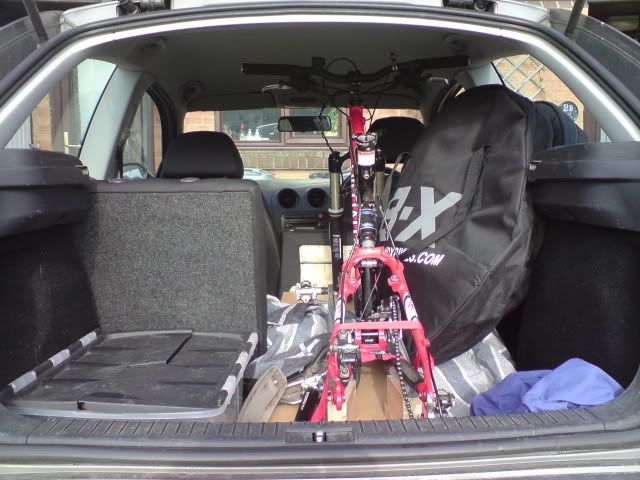 [/IMG]
You are welcome to deliver your bike to me though for safe keeping if you want..... 🙂
I read somewhere that higher end rotors have a stainless braking surface and aluminium carrier to make them lighter and conduct heat better.
See Hope floating rotors and Shimano centrelok. I thought the main aim was to allow the disc to expand and contract around it's diameter without getting warped through the tension in the disc's "spokes"
GordonB - love that insight! Seriously.
Perhaps you can comment on this then. I actually managed to crack one of the arms on Formula rotor; this wasn't an aluminium carrier version, just a regular stainless steel one. If you see in the picture below there are spiral like arms that carry the outer braking surface. One of these cracked at the base near the bolt hole.
[img]  [/img]
I've never seen this happen before.
Yea, 2 part disks will be worse for conduction as the interface between the two wont be very conductive relative to a solid disk.
New XTR has an option for an aluminium/stainless composite with a stainless surface and aluminium core which will be more efficient.
From Shimano:
[i]"The disc brake rotor requires the best balance between heat radiation, strength, weight and stability. Higher end rotors are constructed of two pieces; the stainless steel braking surface and the aluminum carrier. The use of two different materials allows for quicker heat radiation and a weight savings over one piece stainless steel rotors. The addition of holes in the rotor braking surface allows for greater heat radiation, weight savings, pad contact surface cooling and rotor stiffness."[/i]
GeeTee1972 - sorry bud, just a dumb-ass salesman, not a metallurgist. I know the very basic principles, but that's it... but sometimes metals crack due to heating/cooling, and stress, so heat the brakes up on a descent, splash through deep puddles etc...
With motorbikes, you can get ductile iron rotors but I've never seen any for pushbikes. The benefits are supposed to be better braking, the downside is having to savagely kick your brake calipers every morning all winter because the pads have rusted onto the rotors and the bike won't move.
Ask anyone who rode an early 70's japanese motorbike with disk brakes about disks that don't show up any rust. May look good but terrifying when you actually want to stop. As stated if memroy serves one of the hop ups for disk brakes was to fit cast iron disks that actually did allow you to slow your machine down.
Ask anyone who rode an early 70's japanese motorbike
Agreed - my 400/4 front brake was appalling. And it got worse once the calliper sized up. 🙄
Only Iron rusts, everything else corrodes