UPDATE: CLASSIFIEDS section refreshed, redesigned, searchable: Go take a look
I have to call BS on the whole axle path thing (within reason, I didn't like how my Nomad climbed but it still got me up climbs) My Heckler rode fine and didn't slow me down - sure another design might have been slightly faster downhill but it's the smile/£ ratio that I am concerned about.
I wonder if there's another market on the planet in which folk get so duped into buying the latest thing which makes **** all difference.
Something to bear in mind with true single pivots is that the bearings will wear out quicker than a similarly built multi pivot because of the extra loads and reduced stiffness. But not four times as fast!
Don't be daft!
Having had both I've replaced more bearings more often in my multi pivot bikes.
More pivots usually means more lateral flex and torsional movement as you rely on the bearing itself to resist the twisting. This kills bearings. Then if one bearing wears this accelerates the death of the rest.
It's not an exact science though as there are so many factors at play.
I like a single pivot. I grew up on em.
IMO axle path isn't [i]that[/i] big a deal but other things are. The amount of anti-squat in my Trailfox, frinstance, ****ed it. I'd still have it if the suspension worked properly when I was pedalling. And my Herb had a single pivot-with-linkage that gave it absolutely ludicrous traction, if you jumped on it after riding other bikes you'd always check the rear tyre for a flat, it was just so reactive. Which was awesome but made it weird to ride when you came off your other bikes.
Meanwhile my Orange's issue wasn't axle path, it wasn't even really brake input, it was the falling rate suspension. And [i]that[/i] was a limitation of single pivot. "Oh I see you're almost bottoming out the suspension? I'll make it softer. You're welcome."
Junkyard - lazarusYou dont own a turner 5 spot then
$150 + postage + import taxes
Sure but that's not a criticism of multi-pivot bikes, it's a criticism of Turner. It's not too hard to avoid companies that treat you like a milk cow.
True my santa cruz only cost about £120 to replace them all - granted the linkages were worn and it was 8 years old and the first change [ but i am keeping that secret as it supports your point]
Junkyard
Agree that does take the piss a bit, but can't be that often. I'd pay that price to be able to run the bike I wanted to.
Zippykona
Fair point on changing the bearings in the freezing cold. Sounds more of an excuse to just ride your fatty anyway, which is totally your perogative. I wouldn't have more than one bike, but that's just me.
Something to bear in mind with true single pivots is that the bearings will wear out quicker than a similarly built multi pivot because of the extra loads and reduced stiffness.
Not necessarily. The main pivot bearings are huge on Oranges compared to all the little piddly ones all over the back of a four bar frame.
+1 on the Turner bushing cost / availability.
My Flux has tore through another set of bushes and after a conversation with Dave Turner, there is a 3 week lead time before stock arrives and probably 10 days delivery after that.
Needless to say that my last Turner is now retired and I'm now rocking a Transition Scout, running on readily available bearings.
Gee Atherton didn't do too badly on his GT Fury which is a single pivot. Ok it has the I drive but that doesn't affect suspension performance.
Not necessarily. The main pivot bearings are huge on Oranges compared to all the little piddly ones all over the back of a four bar frame.
I posted earlier to say that the lower bearings on my short link four bar bike are the same OD as on an Orange 5 (also 140mm travel) and slightly wider whilst the upper ones are about 25% smaller. No piddly little bearings!
More pivots usually means more lateral flex and torsional movement as you rely on the bearing itself to resist the twisting. This kills bearings.
Does not compute?!? If you twist the rear axle then you put the same twisting load through a single pivot. If you do that to a short link design the reaction fork at all the pivots is not just twisting, there’s also lateral and vertical components. The vertical displacement of the pivot points effectively crossbrace each other.
I ride single pivot because I like it. I’ve tried plenty of fancy pivot bikes and didn’t like them as much. I’d buy the Hope bike because it looks nice and I like Hope stuff.
Meh.
Dilwyn - MemberGee Atherton didn't do too badly on his GT Fury which is a single pivot. Ok it has the I drive but that doesn't affect suspension performance.
Um, yes it does.
@Northwind,
ok it does improve pedalling performance according to GT.
There certainly are no issues with the suspension performance in terms of impact absorption or problems with brake Jack, axle path etc. The latest Furies that the team raced on didn't have the I-drive at all.
Science officer, don’t be so aggressive and insult me. There’s no need. I’m not biased, and if you listened to your own advice and read my posts properly you’d see I said that suspension design would be low down my list nowadays. My next bike is unlikely o be an orange or starling, but not because of the suspension design. Anyway if you can’t engage in a debate politely without insulting I’ve got better things to do with my time. Again if you read my posts properly you’d see that my view echoes Chief’s (as you say yours does) about all designs being a set of compromises for the consumer to choose from. It’s just that the buying public have been convinced that single pivot are crap and outdated.
Northwind, yes I think the falling rate was a bit crap, but have they not resolved that now with a new shock placement?
Northwind, yes I think the falling rate was a bit crap, but have they not resolved that now with a new shock placement?
Yes, that’s why the downtube is now pierced for the mount. Makes a big difference:
[img] 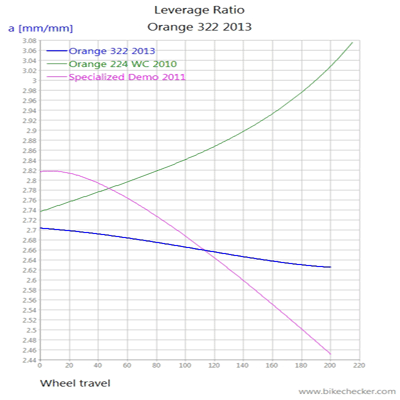 [/img]
I posted earlier to say that the lower bearings on my short link four bar bike are the same OD as on an Orange 5
Yes, the main ones maybe, but I have seen some piddly little ones in the other links.
My Trek Superfly looks to have well species bearings, let's hope they last!
If its good enough for KTM to win multiple world supercross events on, it's good enough for Orange.
only a tiny bit of difference between a Tom and an orange too
I posted earlier to say that the lower bearings on my short link four bar bike are the same OD as on an Orange 5
Yes, the main ones maybe, but I have seen some piddly little ones in the other links.
I have some little piddly bearings in my bike, however it is the biggest ones that have needed to be replaced. The 26mm chainstay main pivot bearings which are almost as big as the 28mm ones in oranges. Bearings in this location seems to take the most abuse, physically and environmentally.
All other bearings on the bike checked at the same time and all fine, so just a regrease to freshen them up. Anecdotally amongst the owners group the middle size linkage bearings wear out next. The smallest bearings in the horst chainstay link very rarely wearout. It's almost as if the bearings have been sized by the frame designer to take the loads experienced in each of the different locations.
Northing specifically against single pivot bikes, even though I wasn't that impressed with my old Patriot. Think modern shock technology has made single pivots more viable. In general I'm happy with 10 quid to replace the main pivot bearings every year or so, and another 40 quid to replace the lot every few years (estimated on current usage/wear), so don't see bearing costs as a major factor, spend more than that on tyres.
I absolutely love my Patriot in its slacker setting, despite it being 10 years old. Some of it has ended up reasonably modern, and with modern bars and stem it seems to really work. I can honestly say that the suspension action has never been an issue descending. There is a lot of pedal feedback on climbs in certain situations, but it doesn't bother me, I just work with it. Same as we all do with fork dive.
I absolutely love my Patriot in its slacker setting, despite it being 10 years old.
Mine can legally vote next year 🙂
We may have the same one. Patriot LT from 2001 (I think).Mine can legally vote next year
Did the LT have 6" of travel, pretty sure mine is a 5" 2001 frame. Used it as a trail bike, not ideal for that really. Still have the frame, not built up as it was stripped to provide parts for Dialled PA build.
Different supsension systems have different compromises.
With a true single pivot, design practicalities mean there's some compromise between leverage ratio or pivot postition for anti-squat/chain forces. My Starlings have gone for a linear leverage ratio with optimal pivot position. With modern air shocks the linear leverage ratio is no longer the issue it was in the past. The benefits of single pivot are less parts to go wrong and less opportunity for weird behaviour.
Personally with modern shocks I believe the single pivot is more than capable. If done properly, other factors such as geometry, frame stiffness, wheel size are much more important than suspension system.
What complicated suspension systems do is give manufacturers the ability to differentiate their designs. Brand Ys BLX suspension system is 13% better at small bump compliance than Brand Zs. This would be very difficult if all companies made single pivots. People buy into manufacturers bullshit!
Finally, very interesting to hear comments that the Starling's good reviews are only because I'm matey with Steve Jones. I must be a very nice chap then, as I've got good reviews from lots of different places.
The reviewers pride themselves on being unbiased.
It's just more proof that people cannot believe something is good without a load of marketing bullshit. No FXG suspension system, no 184mm wheels spacing, no OD headset size, must be shit then. Or maybe it's just plain good, wihtout the need for bullshit technology acronyms.
I respect Orange for standing strong and making great bikes that pepople continue to buy. I respect riders who shun technolog bullshit!
Littleman - Member
Science officer, don’t be so aggressive and insult me.
I did wonder if my plain speaking would get a rise from you. It's not my intent to insult, but if you want to be a wall flower about it, be my guest. Your response has done nothing except validate my opinions. Sorry about that, but, you know, other people think different stuff and that.
That aside, analogies to motorcross SP design and the best riders in the MTB world are pretty pointless. One has orders of magnitude more power and suspension design characteristics can be easily over come, and let's face it, people like Rowan Sorrel and his ilk can ride shopping trolleys better than most of us.
No rise, just didn't take to your tone. I'm not fussed either way but more imprtantly it's a bike forum thread about suspension design ffs, about as pointless / nerdy a discussion topic as you can get so not worth getting in a lather about. I will iterate one last time that I'm not biased but if you don't believe me then whatever. Happy to continue the discussion in a positive tone with you.
on the plus side and because we are on page 3 and no one has mentioned brexit yet
orange will be the only company whose prices can't possibly in a month of Sunday's be affected
I respect riders who shun technolog bullshit
honestly some of us don't actually give a shit been there worn the t-shirt heard the bollocks.
Littleman - MemberNorthwind, yes I think the falling rate was a bit crap, but have they not resolved that now with a new shock placement?
Aye, they managed to build around it after about 15 years. Though it's still pretty restricted and added a ton of complexity to the design
I thought the 225 was an interesting move tbh but nobody bought it because it was ugly and not a "proper" orange.
As usual with any suspension system based discussion a huge amount of incorrect information and poorly formed opinion is put out as fact.
There are a number of factors that will determine the performance of a suspension system and despite how much many will argue otherwise a single pivot can offer very similar performance in almost every area if engineered correctly (read similar) People say 'I prefer XXX suspension to XXX, it feels 'plusher' etc? - I imagine a lot of these comments come from people who cannot genuinely set a rear shock correctly or are drawing comparison from very old to new designs, different shock standards / spring rates etc.
In reality, there are a number of factors that used to determine suspension performance (aside from reliability, shock side loading, frame stiffness etc which is a different issue entirely)
- Anti Squat; when we all used 3x9 single pivot or IC location for multi pivots was a compromise to optimise anti squat between the varying potential chain locations. Now we all use 1x systems this has been optimised and a single pivot can attain high levels of anti squat which does not drop too much throughout travel.
The multi-pivot approach here allows tuning of the bikes IC position to give a desired level of anti squat at different points in the bikes travel. e.g. DW does this to great effect his bikes obtain around / a little over 100% anti squat until late into the travel when it drops dramatically thus reducing pedal feedback later into the bikes travel, something single pivots cannot do and therefore may feel a little 'harsh' later into the travel.The 'harsh' feeling is caused by 'pedal kickback' which is only really removed by bb concentric designs or high pivots and concentric idlers, the former having terrible anti-squat so only good for a slopestyle bike and the latter having packaging / marketing issues for many. Don't be fooled though as many multi link bikes have very average anti-squat values / curves - almost identical to single pivots, so no benefit there
- Anti Rise; The whole 'brake jack' myth - Modern bikes do not 'jack' or extend under braking, they compress, again multi pivot bikes offer a greater ability to tune this effect but many many multi link bikes are hardly better than modern single pivots (starling etc) Now of course this can make the bike feel harsh under braking / cause a loss of traction but you can use it to your advantage by setting the bike into its travel before steep corners and it helps to counter some of the forward pitch in mass under braking that will naturally remove weight from the rear suspension - Nobody liked floating brakes whey they were experimented with years ago, Fabian actually used one to increase brake squat.
Leverage ratio - Suspension leverage ratio can be tuned much more effectively by using linkages than a simple single pivot. But yet again, what do you want to see here? Personally I like a linear progressive system, early VPP digressive - linear - progressive systems were pretty horrible imho and I wont buy any bike with a strange 'shape' to its suspension curve, I want a predictable, progressive bike that can provide easy adjustment via the shock - Funnily enough Santa Cruz and others agree, look at the new lower link driven Nomad, its leverage curve is linear progressive now, nothing like the previous 'n' shaped curve which caused fast riders to dislike the bike.
Before people jump on a bikes design to praise or criticise remember that there are a huge number of variables available to the designer. Ruling out single pivot A because you tried one years ago / a different brand is foolish, so is buying a multi link bike because you liked your last one - there are many many multi link bikes that have horrendous characteristics by design (Norco with 150% anti squat throughout travel, older oranges with pivots that are too high leading to huge anti squat and pedal feedback, older SC / Intense with bizarre leverage curves and suspension so progressive they are almost impossible to see full travel)
Nowdays most bikes are pretty damn good, designers are in the ballpark and there are not many completely terrible bikes - Choose what you like but at least do it with your eyes open rather than believing the marketing hype.
After that rant, my choice for a suspension system would be a 160mm version of the antidote darkmatter with a slightly lower pivot position, it has brilliant anti-squat throughout its travel and due to the idler you get zero pedal kickback, it has better than most braking performance and a very nice leverage curve, it isn't a single pivot.
Rant over, I needed something to do while I mope around with man-flu.
crankrider - Member- Anti Rise; The whole 'brake jack' myth
I think we might have spoken about this before, but this is the wrong way to think about it. People feel something happen and they've heard the term "brake jack" so that's what they call it. Most people don't think "jack = up" The terminology being wrong doesn't mean they're not feeling a genuine input.
I just say brake feedback because it explains it without having to get more technical than people want to.
Oh and
crankrider - Member- Anti Squat; when we all used 3x9 single pivot or IC location for multi pivots was a compromise to optimise anti squat between the varying potential chain locations. Now we all use 1x systems this has been optimised
Again with perspectives and definitions, "optimised" here I assume you just mean "does exactly what the designer wants" but that doesn't mean a thing if the rider doesn't like it. From our perspective there's no such thing as optimum anti squat and never can be
Northwind -
People often think a single pivots suspension 'locks up' while multi link bikes do not and many do believe they 'jack' I have spoken to enough that do. Anti rise is not as simple as single v multi link bikes, many have very similar braking performance.
Onto anti-squat, I think your incorrect, there is indeed an optimum amount of anti squat and it can be mathematically described. Perfection would be a level of anti squat that precisely counteracts mass transfer and therefore the suspension system is entirely bob-free. (that is a mathematical model though, the system is not this simple) This would however cause pedal kickback issues which is where the compromise is introduced but in terms of its actual value, I am sorry but you are incorrect there, its one of the reasons I love the antidote design, just over 100% anti squat throughout travel and almost zero pedal kickback due to the idler.
crankrider - MemberOnto anti-squat, I think your incorrect, there is indeed an optimum amount of anti squat and it can be mathematically described
I think this is just wrongheaded to be blunt. Mountain biking isn't a mathematical problem, rider taste is far more important- almost the only thing that matters in fact. There's no right geometry, no right antisquat, no right brake feedback, no right bar width or brake mechanical advantage, no best tyre, the only bit that can ever be right is the rider and we never are anyway. Flyup 417 sell the best burger though.
I don't mind bob that much, I don't worry about pedal kickback but I [i]hate[/i] suspension that doesn't do what I expect and that's antisquat in a nutshell. I liked strong antisquat, til the first time I pedalled through a rough bit, then I quickly grew to hate it. Give me bob and a lockout so I can control it myself.
You could put me on your mathematically perfect bike and I almost certainly would put it on the classifieds 2 months later with a description saying how optimum it all is, then I'd go and buy an Alpine or something. And you'd tell me I'm wrong because maths.
You could put me on your mathematically perfect bike and I almost certainly would put it on the classifieds 2 months later with a description saying how optimum it all is, then I'd go and buy an Alpine or something. And you'd tell me I'm wrong because maths.
What he said! ^^^
So many experts on here telling other people why their bikes are wrong, should start a bike design business!
My 2011 Fiveling Cabinet is still awesome.
I don't mind bob that much, I don't worry about pedal kickback but I hate suspension that doesn't do what I expect and that's antisquat in a nutshell. I liked strong antisquat, til the first time I pedalled through a rough bit, then I quickly grew to hate it.
I’m pretty certain that any design which manages 100% antisquat with zero pedal kickback will feel the same when pedalling through the rough as no antisquat, bar the reduced bobbing of the former. Anti-squat doesn’t lock suspension up, it balances out forces to remove unwanted motion. The way you perceive the negative effect of antisquat is through kickback, and if your legs resist that kickback then they’ll stiffen the suspension more.
And with a normal chain path anti-squat and kickback are proportional but that Antidote’s idler system manages to achieve anti-squat without kickback which is damned near magic!
So many experts on here telling other people why their bikes are wrong, should start a bike design business!
I don’t think any of us have really been saying that - just exposing some myths and confusion about how suspension actually works.
And in another sector I did start a business after various discussions* on forums and this is our tenth year making innovative and very well reputed gear. I’m a bit too busy with that to start a bike company - though I did almost get a run of hardtails made a few years back... 😉
*aka arguments
Are you the next dialled Mike?
chiefgrooveguru - MemberI’m pretty certain that any design which manages 100% antisquat with zero pedal kickback will feel the same when pedalling through the rough as no antisquat, bar the reduced bobbing of the former. Anti-squat doesn’t lock suspension up, it balances out forces to remove unwanted motion. The way you perceive the negative effect of antisquat is through kickback
I don't think this is true- I'm perceiving the negative impact of antisquat as changes in suspension reaction (not locking out, just reacting less well when there's also force coming through the pedals/chain). Kickback in itself doesn't bother me, it's easy to filter out/adapt to. I got a chance to speak to a couple of pro racers with the same bike as me and they considered it an acceptable compromise for better pedalling, which I can definitely understand- It's totally possible it made me faster but I'm not a pro so I couldn't care less.
I don't think the bike has any way of distinguishing between me pushing it down (bob) and the ground pushing it up. I've not ridden any idler bikes so perhaps that changes it but for normal bikes I'm pretty comfortable that this is the case.
TBH chiefgrooveguru, you do seem to know what your'e talking about, I don't.
Manufacturers are going to make what will sell. Lots of single pivot bikes sell, as do multi's. Also, as I've said in loads of other threads, 'It's a matter of taste'. So some people like one or the other, some people like both, some people can just ride a bike without being that bothered! Some people wouldn't have an Orange no matter how many pivots it had!
Northwind - Memberchiefgrooveguru - Member
I’m pretty certain that any design which manages 100% antisquat with zero pedal kickback will feel the same when pedalling through the rough as no antisquat, bar the reduced bobbing of the former. Anti-squat doesn’t lock suspension up, it balances out forces to remove unwanted motion. The way you perceive the negative effect of antisquat is through kickback
I don't think this is true- I'm perceiving the negative impact of antisquat as changes in suspension reaction (not locking out, just reacting less well when there's also force coming through the pedals/chain). Kickback in itself doesn't bother me, it's easy to filter out/adapt to. I got a chance to speak to a couple of pro racers with the same bike as me and they considered it an acceptable compromise for better pedalling, which I can definitely understand- It's totally possible it made me faster but I'm not a pro so I couldn't care less.
I don't think the bike has any way of distinguishing between me pushing it down (bob) and the ground pushing it up. I've not ridden any idler bikes so perhaps that changes it but for normal bikes I'm pretty comfortable that this is the case.
I think you need to read up on anti-squat, what it does and how - you are referring to suspension 'locking out' and cant see the difference between bump input and the movement of the riders mass causing a suspension reaction so you are pretty far off the mark, also 100% anti squat is not considered high, I'm not sure if this figure is throwing you off maybe?
You will notice Norco have moved to an idler / high pivot system as Sam did not like the higher anti squat design used on the previous DH bike so experimented with an idler to reduce it, by moving to the idler / high pivot system they now have likely similar anti squat as the previous bike (due to the higher com of of the high pivot) but pedal feedback is now isolated, win win.
I also challenge you to find a very high or very low anti-squat modern bike, literally all manufacturers aim for at least 100% at sag, that Alpine you used as an example has 140% anti squat at 50mm of travel, it actually gets higher further into the stroke..... DW link bikes are very nice in this regard as I say having 100% until 3/4 of the bikes travel then dropping steeply to remove pedal feedback on hard hits.
essel I do think a lot of riders avoid Orange because they’ve bought into the multipivot propaganda from almost all the other brands! Thankfully they don’t seem to have a problem selling enough bikes to remain profitable and you do see a lot of them around the UK - particularly Llandegla! A rider I loosely know recently changed his white Orange for an orange Whyte, which was confusing... 😉
Northwind - you may be right but I think you were comparing the Trailfox and Remedy 29 from a similar era and they have near identical antisquat figures at sag.
The weird thing about antisquat calculations is they’re not based on you stomping on the pedals and the reaction to that causing bob, they’re based on you sitting on the saddle and the bike accelerating when you push a pedal down and then decelerating in the dead spot before you push the other pedal.
100% antisquat will barely bob at all if your CoG is at the same height as that of the model and you’re sitting down pedalling in a nice balanced fashion. Taller or shorter, or different distribution of mass and it changes - stand and stomp and it goes haywire. But when you’re used to bike you know where to stand when stomping (get lower and more forward and the back bobs less) etc. And the fork sag changes things especially if it starts bobbing too.
Some downhill bikes have huge amounts of antisquat at sag so they sprint well out of the gate when you’re standing and powering and then it falls away fast for hitting the rough. And some had a moderate amount which barely changes through the travel. And some have none!
I think you need to read other people's posts a bit more carefully tbh, you said "I think you need to read up on anti-squat, what it does and how - you are referring to suspension 'locking out'" but I said exactly the opposite "Anti-squat [b]doesn’t[/b] lock suspension up"
(you've actually done it twice on this page, saying "it doesn't lock up" as if refuting someone else's point, but nobody's said it does)
I've also never referred to 100% anti-squat or whether it's high or low, so I've no idea where that comment comes from.
It just seems like the brake-jack comments, you seem to be looking for ways to dismiss other people's experiences rather than actually engaging with what they're saying.
chiefgrooveguru - MemberNorthwind - you may be right but I think you were comparing the Trailfox and Remedy 29 from a similar era and they have near identical antisquat figures at sag.
Yup, and imo that kind of proves the point- what counts is how they ride not how they graph. Throw in the Remedy's clever shock and the 2 bikes ride very differently- to the point i ditched the geometry of the BMC, which I much preferred, to get the fantastic suspension of the Trek. If I could have welded the two together I would. Every so often the Remedy throws a slightly wobbly- landing while pedalling makes it choke and make horrible noises- but it's an exception.
(the Trailfox numbers in Linkage have the rear travel wrong at 140mm btw, so that might skew it if it's working from the same model, I can't remember)
TBH chiefgrooveguru, you do seem to know what your'e talking about, I don't
Quick Alex sell this man some bass cabs!
Just ride what you like. A decent shock is more important on some designs than others and transforms bikes.
In fact I would buy a lower priced frame and a higher priced shock than the other way around.
Most really fast guys I know (chief will admit he doesn't fall in this category) don't care about their frame much. They do get their suspension tuned though!
Just ride what you like. A decent shock is more important on some designs than others and transforms bikes.In fact I would buy a lower priced frame and a higher priced shock than the other way around.
I'd always prioritise great geometry (which seems to be independent of price bar the very cheapest bikes) and good suspension. And all the other stuff matters way less to me, especially carbon bits and bling. Cane Creek DBair on now my four year old alloy frame remains brilliant!
Most really fast guys I know (chief will admit he doesn't fall in this category) don't care about their frame much. They do get their suspension tuned though!
Indeed. Even at my very best I struggle to attain moderately fast! 😉

