I’m watching the world triathletics on bbc2 just now.
All of them have their road shoes pre-clipped into their bikes then spend what seems like ages on the first lap trying to do their shoes up while pedalling. Same thing as they come back in to transition.
I realise they don’t want to run through transition with road cleats on but I can’t help thinking it would be quicker to put spd shoes on in transition. Once they mount their bikes then they could put the power down straight away.
Anyone got any real time experience of why they do it this way?
I’m sure they know this is the fastest way to do things but it puzzles me when you see them faffing with shoes while riding.
I have a mate who does triathlons - he's doing the European Middle Distance Champs in Romania today - and he used to use road shoes. I always ride my road bike with mtb shoes; he saw how easy it was for me to move around and now he uses them too.
I've always wondered why they don't just use flat pedals and running shoes. Yes, they would lose a small amount of power, but I assume they have to cruise the cycling stage anyway to save energy for the run. Obviously, I know nothing about triathlons other than I have no desire to do one.
If you're good then shoes on bike, open and with elastic bands holding them in place, run through transition bare foot and jump on bike then since they're triathlon shoes they have one big strap and you're away. Taking them off easy as well as only one strap.
Because they are triathletes. And weird.
At that level, I'd imagine the 5 seconds lost at the start and end of the bike section could well mean the difference between 1st and not 1st. If you can be moving while putting on/taking off shoes then I don't see the issue.
There was one chap who was ahead of the group but lost his advantage cos his shoe wasn’t sorted and he had to stop pedalling.
I guess they’re just weird 😉
I know they practise their transitions and bike mounting, etc. to get their times down.
I remember watching my sister in a world cup race (Jess Harrison if anyone's interested 😉) and she lost a shoe when someone barged her in the transition area. She did the whole bike section with a hard foot on the pedal!
I assume they have to cruise the cycling stage anyway to save energy for the run
Assume away! But they're doing a sub 1 hour 40km. Not exactly soft pedalling.
The transition areas can be quite long, easier to run in barefoot than with stiff soled shoes, with tread or not. Most of the problems arise form novices trying to copy the practiced pros, here you will see the footering and wobbles.
There should be a default 2 minute transition. So that they have time, whether they like it or not to towel down, change their clothes and then get on the bike - and those poor women wouldn't need to cycle in their swimming cossies.
I speak from experience.
Its quicker to run barefoot, jump on your bike, then sort your shoes out while moving, than it is to stand still in transition while putting cycling shoes on, then run in stiff soled cycling shoes with your bike to the mount line, then get on your bike and clip in and get moving.
Might only be 20 or 30 seconds but at the pointy end of a tri that can be 20 places, which can be the difference between qualifying for a certain event or not. Which for pros can be a pay cheque, or for amateurs it could be making the GB age group squad, or just beating your club mates for bragging rights.
It's a huge advantage to put the shoes on in motion
Because they are triathletes. And weird.
This
Triantelopes are the oddest of the odd.
Its quicker to run barefoot, jump on your bike, then sort your shoes out while moving, than it is to stand still in transition while putting cycling shoes on, then run in stiff soled cycling shoes with your bike to the mount line, then get on your bike and clip in and get moving.
I suspect this has evolved from people trying to run in cycling shoes with road cleats rather than MTB shoes with MTB cleats. It might be uncomfortable but running in stiff soled MTB shoes (though doesn't seem to bother cycle cross riders) but wouldn't slow you down compared to barefoot running so it boils down to how quickly you can get your shoes on at the Transition point vs. getting your shoes on and done up once your on the bike. Clipping in with MTB cleats is basically zero time.
besides its Durianrider approved so is as good as fact!....
I like him!
He’s saying what I was thinking...but with experience...
Clipping in with MTB cleats is basically zero time.
Clipping in may take ‘zero time’, but standing still while you put your cool MTB shoes on isn’t as good as rolling along at 25mph while faffing with your hopeless triantelope shoes.
These guys are professionals. Paid to win. I’m sure some of them will spot the error of their ways. Then win. Or not.
One of the comedy highlights of my year is watching the bike mount point at Leeds ITU triathlon. It's on a hill. The pros mount on the flat at the bottom and usually one or two of them fluff it and don't get their feet in before climb. Earlier in the day it's the amateur race and the transition area is in a different place, so they have to mount on the hill. Shoes on the bike and bike in the wrong gear means a lot of them fall off because they don't have the momentum to get their feet in their shoes. At least two lost about 5 minutes this year due to jamming their chains in the process. I'm meant that be racing it next year and it will definitely be MTB shoes!
I'm impressed that Durian rider must have worn his bike shoes for the swim, or did we skip that bit where we see him faffing trying to get wet feet into a regular MTB shoe?
Triathletes: why don’t they use mtb spd shoes and pedals?
They'd have to wear baggy shorts too... and baggy shorts rub.
Also Tri shoes tend to be designed to be worn barefoot as putting socks on wet feet is very slow, mtb shoes tend to have seams etc that rub.
And once you've saved all that time in transition, you can lose it again when you do something called "going round a corner".
https://www.bbc.co.uk/sport/av/triathlon/48894160
And once you’ve saved all that time in transition, you can lose it again when you do something called “going round a corner”.
Very perceptive. I've never once seen a road race peleton go down after someone near the front has their front wheel wash out around a wet corner. Never. Not a single time.
I might be slightly biased/touchy here! When racing triathlon relatively seriously I used to get grief from chippy little 4th cats about the fact I probably could not ride for toffee as I was known to be a triathlete first and foremost. What they didn't know is I did a bit of road racing to keep me sharp and a change of scene (and a bit of mtb racing too for the same reason - hence the 'convert' user name) and held a 2nd cat licence. I'd play along about being a clumsy oaf on a bike then leave them for dead on the next descent or climb.
Re the OP's question - what you were watching was a sprint relay. Probably where usual tactics make the least sense. One of the big reasons in pro triathlon you'd want to have your shoes on the bike is because the racing is draft legal. Getting into the/a pack is crucial. You are much better off saving time in transition to get into the pack and riding along at only 90% efficiency until you get a chance to put your feet in your shoes rather than waste 5-10 seconds putting shoes on in transition and missing the group which is almost impossible to rejoin. At that point you might as well climb off as you will either drop minutes behind out of the draft or you'll blow your running legs trying to limit the damage away from the fast boys.
The other thing that is not obvious until you have done it at a high level is the state of your body in transition. You have swum super hard to make sure you get into an early bike group with your body horizontal with blood pooling to all the wrong places. You are then standing up and running hard then trying to do fiddly things like sorting a bike and helmet. Your heart rate will be very close to maximum (especially in shorter races), you'll be feeling a bit dizzy and probably a bit sick. Not having to do something dexterous like putting shoes on and sorting straps whilst stood bent over in that state is a good thing.
I’ve always wondered why they don’t just use flat pedals and running shoes. Yes, they would lose a small amount of power,
Small amount? Given it takes a lot of training effort to gain ten watts of FTP I don't think they'd be willing to lose it so easily. And besides, as said, you'd have to actually put running shoes on whilst stationary which would cost you time.
Plus, pedalling in flats is crap for even amateur racing, never mind pros. Why do you think most of not all XC pros use SPDs?
but I assume they have to cruise the cycling stage anyway to save energy for the run.
Hah. They are on the limit all the time, no cruising involved. That's why they are pros.
Because the tri shoes are more expensive.
In my experience, triathletes much prefer to spend money to try to go faster.
Why do you think most of not all XC pros use SPDs?
Much easier to control the bike on XC courses when your feet aren't slipping around on the pedals and when you need a burst of power, they do allow higher peak power. However, for endurance events, the power benefits are grossly overblown AFAIK because you can't sustain that sprinting power output for very long.
They are on the limit all the time, no cruising involved. That’s why they are pros.
Most triatheletes aren't pros. Several friends train semi-seriously for triathlons. None of them have ever beaten me on a Strava segment when they've been on an MTB. They are moderately fit cyclists, but nothing amazing and their bike handling offroad is hilariously bad (not that the pros have anything to fear from me, but I was quite shocked to see how abysmal the triathletes were). Even pros can't perform on the limit for hours on end. They will cruise very quickly, but they are cruising along below their limit nevertheless. If they were on the limit for the cycling stage, they would, by definition, be too exhausted to complete the run.
However, for endurance events, the power benefits are grossly overblown
But there's still a benefit?
They will cruise very quickly, but they are cruising along below their limit nevertheless. If they were on the limit for the cycling stage, they would, by definition, be too exhausted to complete the run.
I think your definition of 'limit' is different. Obviously not sprinting flat out because that's only possible for a few seconds. I mean the limit as in what's possible over the required duration. I still wouldn't call it cruising though.
Anyway. Whilst flats might not be a disadvantage slogging up a big fire road hill on an MTB (although I think the softer soles are, personally) they are shite for the kind of spinning you need to do on a road bike and even more so on a tri course.
The comment about pros was with reference to the fact that those at the top level of a sport usually have been through and evaluated every possibility in search of maximum efficiency.
I tink the perfect Tri footwear has been about for a long while:
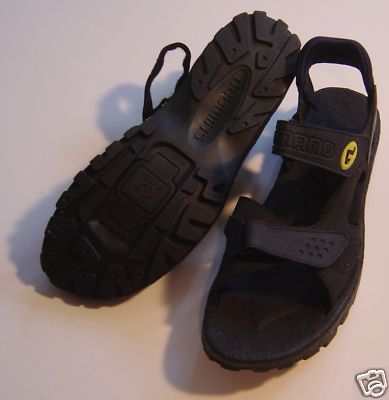
You could swim in em, and after a few squelchy steps/pedal strokes and they'll be dry enough for a run. No need to waste time with any footwear changes on any transitions...
The comment about pros was with reference to the fact that those at the top level of a sport usually have been through and evaluated every possibility in search of maximum efficiency.
I'm actually skeptical of this. There are too many variables to properly evaluate every possibility so the safest thing to do is to follow the herd. Even if it's sub-optimal, it still puts everyone on a level playing field so the top people will do the same as everyone else and rely on their fitness to make the difference. Trying something different is risky, so nobody near the top level will want to take that risk.
A different environment, where technology greatly outweighs the difference between drivers, but if you look at Formula 1, where budgets of 200 million are commonplace, everyone just copies whatever Adrian Newey (the Red Bull design chief) does on the assumption that he's probably right and it's much cheaper than actually researching new ideas. The exception to this are the Mercedes team, who have dominated for the last six years:
https://www.bbc.com/sport/formula1/47838557
hols2
Member
I’ve always wondered why they don’t just use flat pedals and running shoes.
I was thinking that too, but with good fashioned toe-straps.
Would save time in the second transition.
@hols2 - There is the herd mentality but I was reading an interview with Paul Oldham who's won the last N Three Peaks CX races* where he noted that you tend to get one person winning it for a number of years until someone comes up with a different strategy/tactic and they then win it for a number of years.
*Can't remember if he won it last year or not.
I was thinking that too, but with good fashioned toe-straps.
Would save time in the second transition.
These were a thing in the world of duathlon (run-bike-run). You shoved your running shoe in there like a massive stiff flat pedal and toe clip get up.

I've not really kept up but I think they have all but disappeared. Never tried them myself but apparently naused up the handling and bike fit a bit as the effective pedal stack height was significantly bigger than what you'd have with a normal pedal/shoe setup. Hols2 will probably disagree but there is a chance folk at the pointy end tried it both ways and worked out it was not the quickest way to get from A to B. Most duathlons are not draft legal which obviously makes quite a difference to tactics.
I think we have to bow down to those in the know assuming they've tried everything to hone their times. I've done a couple of tri's but not at any level...just for fun and I didn't get on with the putting shoes on while on the bike thing and chose to put them on at the transition. And that was on a normal road bike, I can't see how it is beneficial in anyway to be trying to handle a TT bike with one hand whilst leaning down fiddling with shoes while trying to lay down any reasonable level of power. Had no issues with wet feet and was much quicker mounting the bike and 'laying down the power' immediately.
I agree with Hols in that it is often an incorrect assumption that pro's have fully explored every possibility and arrived at the best method. My suspicion is that a lot of this is just accepted wisdom that has been passed down from coach to coach and it hasn't actually been tried or considered....people tend to adopt the methods they're taught and trained with and therefore are closed minded to new and different ways of doing things and innovation in general. Who's got the courage to question the methods of a seasoned professional coach with countless victories to their name? People just tend to believe what they're told without question. How many people have actually invested any time and effort working the method through to see if it could work? Everyone thought they had track cycling down to a fine art then along came a Bipolar Scotsman from nowhere with his home made bike and superman position and blew the established field apart and made them look like a bunch of chumps. Sometimes it's these left of field ideas that turn out not to be as bonkers as they first seem.
There is also a niche sport call swimrun that is getting increasingly popular. Multiple swims and runs one after another crossing between islands or multiple laps of the same course, normally as a team of two. You wear the same clobber throughout - so you swim in trainers and run in a wetsuit. Swimming in shoes is a bitch so they are allowed to use paddle and floats to counteract. Specific runners and wetsuits have evolved at silly prices (this is multisport after all). If my hip had not killed off all athletic capacity and means I'll never run again I'd love to have a go...


I agree with Hols in that it is often an incorrect assumption that pro’s have fully explored every possibility and arrived at the best method. My suspicion is that a lot of this is just accepted wisdom that has been passed down from coach to coach and it hasn’t actually been tried or considered….people tend to adopt the methods they’re taught and trained with and therefore are closed minded to new and different ways of doing things and innovation in general.
In this I'd say you are way off the mark, spend any time on forums or sites, slowtwitch in particular and you'll see people trying and analysing to the nth degree. Aerodynamics and power training are a couple of things I saw triathletes doing a long time before roadies for instance and you are never short of seeing someone trying something utterly bizarre. I'd bet a pound that someone with the resources has looked at T1 times....and to add another point possibly missed above I'd imagine a xc set up would weigh a bit extra too, which when you have to actually pedal with would slow you down too.
One of the problems with stuff like this is that you really need to do long-term tests with multiple athletes to get any sort of reliable data. If someone has been training for years with clipless pedals, they will probably need a year or so of serious training with flats to adjust fully. Plus, you may need other adjustments to the bike setup (saddle height, etc.). What you would really need is a group of top athletes who had trained on clipless and a reasonably matched group who had trained on flats, measure their performance on what they were used to, then have them switch for a year and compare the results.
This video, for example, is interesting, but the methodology is so weak that you can't draw any conclusions other than the riders preferred what they were used to.
I agree with Hols in that it is often an incorrect assumption that pro’s have fully explored every possibility and arrived at the best method. My suspicion is that a lot of this is just accepted wisdom that has been passed down from coach to coach and it hasn’t actually been tried or considered….people tend to adopt the methods they’re taught and trained with and therefore are closed minded to new and different ways of doing things and innovation in general.
Oh I absolutely go with this - cycling at pro level is *incredibly* conservative. That's why doping was so prevalent for so long, it's why there's still this received myth and wisdom around leaving tyres to age in a dusty cupboard for Paris-Roubaix and disc brakes are bad and weight is important and...
It took Sky to come along with a big research budget and blow all that to bits and the resistance from mechanics on particular to any new innovations is still there. And it's why you still get people at time trials (in particular) with the "back in my day" mentality. I remember when downtube shifters were gradually being replaced by the early STI and the resistance from some of the older roadies in the club was incredible. "It's served me well for 40 years, I don't need that extra weight and complexity".
Training methods are the same - revered words of wisdom passed down from elder club statesman to newbies (at amateur level) but it was very much the same in pro circles for years.
And it's why stereotypes about triathletes not knowing how to corner persist although my comment was more tongue in cheek than factual statement.
you swim in trainers and run in a wetsuit
it's a no from me
And it’s why you still get people at time trials (in particular) with the “back in my day” mentality. I remember when downtube shifters were gradually being replaced by the early STI and the resistance from some of the older roadies in the club was incredible. “It’s served me well for 40 years, I don’t need that extra weight and complexity”.
I turned up at a local TT years ago, with semi-deep section wheels, bladed spokes etc. The starter looked at them and said something along the lines of 'I don't see the point of those at all.' 😀
I can’t see how it is beneficial in anyway to be trying to handle a TT bike with one hand whilst leaning down fiddling with shoes while trying to lay down any reasonable level of power
Because you really don't have to put down a lot of power to make it better to do when moving.
Doing some rough maths, suppose you can do 18mph whilst fiddling with your shoes, and 25mph otherwise. Even if it takes you 40s to sort your shoes out on the bike, you'd have to be able to get your shoes on in 11s whilst stationary. The difference at the end of the bike is going to be even more pronounced if you've got a flattish finish as you can do it when coasting in from race pace.
Because they were all using proper deep section fronts with disc rears...?
Durianrider a cockwomble, probably took him 10 minutes to put his shoes on.
Tri shoes used to have a bigger heel loop to pull the shoe on. They also used to be open design to let water out. And the final piece was a single strap/velcro closure - sometimes set up reverse, to make it easy to close. They've kept some of those - predominantly the wide opening & simple closure - but the design has moved more towards general road shoes.
The soles are far stiffer meaning your power transfer is better. MTB shoes have a somewhat flexible sole as in MTB, there are times you need to hike-a-bike and a super stiff sole would cause you to fall very easily on slippery wet rocks or muddy trails. Road shoes have very stiff soles as you shouldn't need to walk much if at all in them.
Cleats are trangluar and larger so that the power transfer is greater. You spread the power out over a larger surface area thereby avoiding hotspots. In MTB cleats, that area is super small so you're pushing and pulling on about 2 square centimeters. Road cleats are about 20 square centimeters so the load is distributed over 10 times a larger area. Meaning your feet aren't pushing and pulling on 1 tiny spot.
Compared to a significant advantage of road shoes over approx 1hr of riding, the small benefit of MTB shoes to run in for approx 30 seconds is quite small.
Durianrider wears mtb shoes to avoid slipping on banana peels I imagine.
The soles are far stiffer meaning your power transfer is better. MTB shoes have a somewhat flexible sole as in MTB, there are times you need to hike-a-bike and a super stiff sole would cause you to fall very easily on slippery wet rocks or muddy trails. Road shoes have very stiff soles as you shouldn’t need to walk much if at all in them.
Cleats are trangluar and larger so that the power transfer is greater. You spread the power out over a larger surface area thereby avoiding hotspots. In MTB cleats, that area is super small so you’re pushing and pulling on about 2 square centimeters. Road cleats are about 20 square centimeters so the load is distributed over 10 times a larger area. Meaning your feet aren’t pushing and pulling on 1 tiny spot.
Those two arguments have never sat well together for me. Taken to its logical conclusion a perfectly stiff sole could be resting on a pin head or a cleat the size of the top of a tin of beans and you would not be able to discern the difference. Whilst no shoe sole is perfectly stiff I'm pretty convinced I can't tell the size of the cleat area through a top end carbon road shoe. The only real different would be that any play in the system felt as 'wobble' would be accentuated by a smaller cleat.
I’m quite amused at the spectacle of a whole load of people on a mountain bike forum slagging off other people’s closed minds for not using mtb cleats.