Swinley In Bracknell forest is a good example of this. Loads of people used to ride crown estate land (all unmarked trails), some complete numpties sued crow estate because they hurt themselves. Crow estate responded by creating the blue / red one way motorway. Which attracts more numpties who think they can fly, break themselves and then try compo route again. I blame America.
The IMBA has advice for landowners
[url= http://imba.org.uk/trailbuilding/mtb-jump-spots/ ]http://imba.org.uk/trailbuilding/mtb-jump-spots/[/url]
essentially "user beware" this has been tested in the courts recently. I was reading about one case (though I can't find the link at the moment) where the biker complained about the lack of warning signs on a trail he had an accident. It boiled down to he was experienced so should have been aware of the danger, and that trails were not going to be shut for other users enjoyment just because he crashed. I think the defendants were the crown estates.
There was this case a few years back where someone sued the forestry comission.
http://www.northern-scot.co.uk/News/Moray-man-sues-after-horror-jump-6700.htm
I don't know what the outcome was though (google's not been much help)
I worked for a company that was on the receiving end of a legal action brought about by the family of a rider that suffered life changing spinal injuries at a bike park (Esher Shore).
The rider was experienced, signed a waiver and wore protective gear. He fell off a low trail and broke his neck, causing permanent paralysis to all limbs and requiring constant medical care.
Within months of the accident we receive notice of the legal action.
Our solicitors fought off a number of different false claims made about the cause and outcome of his accident, ranging from:
-the rider being unsupervised (his buddies were 20 feet behind him on the trail, and actually served as key witnesses during our defence, in addition 2 volunteers were building trails in the bike park less than 100 feet from the accident)
-that assistance had taken 1/2 hour to arrive which made his injuries more severe (he received 1st aid within 1 minute of the accident and a local 999 ambulance was on site within 5 minutes, which saved his life due to breathing difficulties)
-that assistance in removing his helmet made his spinal injury more severe (this was done by paramedics as he was going into cardiac arrest)
-that he had been lent a rental bike (he was riding his own Norco DH bike, and we did not have rental bikes)
-that the trails were slippery from rain (the MET confirmed no rainfall that day, and all trails were chicken wired)
-that the risk had not been made clear (liability waiver, and warnings signs all over the park and at every trail entrance, with all trails colour coded).
Each claim cost £1000's in solicitors fees to overturn, eventually after 6 months they gave up the action as they realized it was a rider error and not negligence on our part. This had cost nearly £12,000 in legal fees to fight.
I completely understood the POV of the injured rider; despite not agreeing with his claim - we knew it was rider error all along. What we understood what that this guy was facing a life time of medical care costs and loss of earnings, and wanted to try and put himself in a better financial position.
Ultimately we knew the legal action was fruitless as the bike park was setup as a "not for profit" entity with no assets, all takings were reinvested into the bike park.
nor do you pay (at point of delivery) for healthcare
The trouble is you do pay for social care (or get very little) which is the majority of the cost after the acute phase of a spinal injury has passed.
At that point it can come down to balancing discomfort over doing something that's not right and what could be a lifetime of much greater discomfort and social exclusion (including a much greater burden for family). I hope I never have to make that choice - I'm not going to judge someone who does and takes the legal recourse option.
So if there was a six foot wide hole in the road, that the council knew about but didn't do anything - and you drove your car into it without seeing it, then its your fault for driving faster than you could see?
Yes that would be negligent
But that example doesn't apply to a bridleway. I'm not saying anything goes on a Bridleway but its not reasonable to expect to be able to ride a bridleway at a speed where you can't stop in the trail that you can see. If you go round a blind corner you might find a water bar, a pedestrian, a cow, a sheep, a fallen tree, a rock, a child. Some might hurt you, others you might hurt
We already discussed clearly the forseeability of the accident.
Just like the hole in the road - the council only become responsible when they are aware (or should be) of a problem, and the forseeability of accidents/further accidents develops into a duty of care.
A bridleway, like a road, is still a highway. If there was a record of previous accidents there, then it lends itself towards further accidents being foreseeable.
(Technically we could get into discussions regards whether a duty of care overrules limitations in s30 of the 68 act as to maintenance of bridleways for cycle use, but it's an unnecessary diversion away from the key principles of the discussion)
There are more direct occasions where a decision could amount to negligence in the face of clearly foreseeable risk that would not require previously reported accidents to create a duty of care, for example the erection of black painted bollards and chains or gates across cycle paths without signage or reflectors.
So if there was a six foot wide hole in the road, that the council knew about but didn't do anything - and you drove your car into it without seeing it, then its your fault for driving faster than you could see?
What has that to do with a bridleway?
They are both highways maintainable at the public expense, subject to the same duties under HA'80
The duty of care for a private landowner would be a bit different, but subject to the same broad concepts of duty of care and foreseeability of accidents, with further differences dependent on the exact status of the user (invited, paying customer, trespasser, exercising access rights etc.)
If were an unsanctioned trail on private land where the incident occurred, then I wouldn't sue unless I were facing a difficult future. Likewise if it were a traditional trail centre.Wouldn't sue unless...
FFS take responsibility for YOUR actions, and please go find a 'safer' hobby - or at least one where you won't go and **** it up for the rest of us!
That does make me sound like I'm not good at accepting responsibility for my own actions.
I was really considering a situation where I ended up needing 24 hour care or I'd die and not wanting to burden my family with that responsibility because they probably wouldn't pull the plug. Though, in such a situation, it would be an insurance company that would sue.
In practice and having responsibilities and not wanting to banjo myself, I would be sure I knew what I was riding before riding it and if I thought I'd cripple myself on a trail, I wouldn't ride it.
does this shed light
[url= https://www.gov.uk/guidance/public-rights-of-way-landowner-responsibilities ]link[/url]
It suggests all you have to do is keep it unblocked and that they leave the surface alone
this sheds some light on it
Landowners Liability on rights of wayIt is often difficult to establish what duty of care one person owes to another and will often depend on the individual case. It is important for landowners to be aware of their duty of care and it is advised that landowners take out public liability insurance.
Where a highway is maintained at public expense the highway authority has liability for users who are injured because the route is in disrepair. However, a highway authority can take action against a landowner who had created any source of danger or failed in their responsibilities towards maintaining the highway. Landowners can also be liable where the path is privately maintainable for example permissive paths or toll rides
- See more at: http://www.outdoorswest.org.uk/Home/activities-and-info/information-for-landowners#sthash.zaIIcHuk.dpuf
[img] 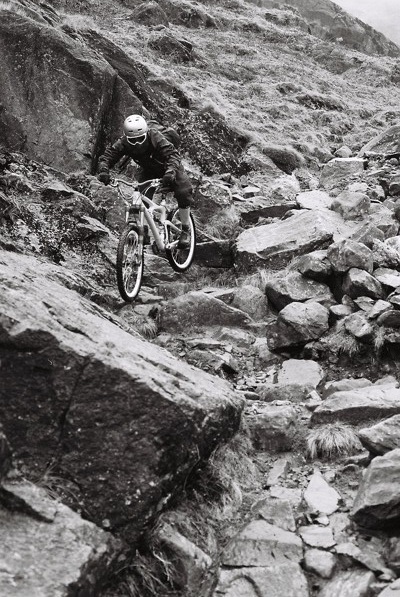 [/img]
Are we suggesting that if people keep falling off in Rosset Ghyl they can sue the land owner for not making it safe?
Whether a drainage bar would count as a source of danger would be down to case law. My gut feeling is a jury or judge is unlikely is unlikely to see an injury associated with riding fast or on steep rocky terrain as something that was beyond could be reasonably expected for the land owner to anticipate or prevent. I think that in the case of Rosset ghyll the defence would be that the land owner acknowledged your right to access the trail by bike but expected that you dismounted and walked.
If that isn't the law then trail sanitisation is coming to us all
Ninfan what makes you think Bridleways are maintained at the public expense. Do you have a source for this?
Not all, but most - s38 Highways Act '59 and s36 HA '80. See also chapter 6 of govt ROW circular 1/09 and the blue book.
Are we suggesting that if people keep falling off in Rosset Ghyl they can sue the land owner for not making it safe?
No, because a rider could clearly see the condition of the trail, which would largely displace the duty of care and indicate that they had elected to ride it in the knowledge and acceptance of that risk - however there would still be a duty to keep it in a fit state for use by the ordinary class of use (excluding any duty to facilitate cycling under s30 CA '68) so if it is unsafe for passage on foot/found rouse to horses then the LA would be in breach of their duties under HA '80
Whether a drainage bar would count as a source of danger would be down to case law. My gut feeling is a jury or judge is unlikely is unlikely to see an injury associated with riding fast or on steep rocky terrain as something that was beyond could be reasonably expected for the land owner to anticipate or prevent.
I did qualify the waterbar example carefully that the duty of care would likely only develop if there were previous complaints or accidents or a similar reasonable knowledge that it created a risk. The black bollards/chain across the path example would clearly tip towards the other end of the evidential burden.
I think that in the case of Rosset ghyll the defence would be that the land owner acknowledged your right to access the trail by bike but expected that you dismounted and walked.
As pointed out, for bikes alone this would fall into s30 CA '68, but not dispence the duty if it were foundries for horses.
Ampthill
The Government document you have linked is almost certainly correct (I can't be bothered reading it).
Landowners have no responsibility to maintain rights of way. They can only be liable to someone using a right of way if they do something which creates a new danger.
Highway authorities are responsible for maintaining public rights of way that are 'maintainable at public expense'. They will be liable to users lawfully using the ROW who are injured due to the dangerous condition of the ROW, unless they can establish the defence provided by the Highways Act.
Pretty much all bridleways are highways maintainable at public expense, and therefore 'maintainable' by the highway authority. Note that Ninfan said 'maintainable'. That is a legal term and not the same as saying that they are actually 'maintained' in fact.
Rossett Ghyll is a bridleway, therefore a public ROW and almost certainly maintainable at public expense. The landowner can therefore never be liable to someone injured on it if the landowner does nothing. The highway authority however could be.
Anyone can sue whoever they like, the crux is whether they will succeed. A mountain biker who falls off on Rossett Ghyll should not succeed, on the basis that the condition of the route is obvious, and reasonably safe for its intended use in its setting, and attempting to ride it is undertaking and accepting an obvious risk.
Whether a drainage bar would count as a danger will not be down to 'caselaw'. That question will be decided by a single judge (negligence cases do not involve juries) applying the principles derived from caselaw, which is a very different thing.
I agree entirely that in many cases a judge would be unlikely to consider an injury sustained riding at speed down steep ground to be due to the negligence of the highway authority (or landowner if not a highway) however those of us working in this field know never to underestimate the capacity for judges to find ways to justify a finding of negligence in order to make local authorities or insurers pay compensation to catastrophically injured claimants. It's normal human instinct to do so. It is for this reason that very high value claims are often compromised before trial.
I agree entirely that in many cases a judge would be unlikely to consider an injury sustained riding at speed down steep ground to be due to the negligence of the highway authority (or landowner if not a highway) [b]however those of us working in this field know never to underestimate the capacity for judges to find ways to justify a finding of negligence in order to make local authorities or insurers pay compensation to catastrophically injured claimants. It's normal human instinct to do so.[/b] It is for this reason that very high value claims are often compromised before trial.
if I remember correctly, the case between an injured individual and ATB Sales (Marin distributor) after his handlebar snapped was found in favour of the claimant. It could not proven whether the handlebar (4 year old bike) failed causing the accident, or if the accident caused the handlebar to fail.
However, as this was a severely injured private individual vs. a company with insurance, the judgement was for the first party.
Following this, many distributors and manufacturers sharply revisited their insurance agreements