Any one done it or tried
Unless there was massive negligence ie a a wooden platform collapsing etc. causing you to plummet to impending doom
how about you tell us your tale, off for some biscuits
I suggest a FOIA request to Lancashire County Council will give you a good idea, the number of lemmings at Lee Quarry wanting a trip in a helicopter is incredible
Chances are that it will be an insurance company "doin' the suein'" rather than an individual.
Chances are also that most incidences are settled out of court with no public knowledge/record.
LCC will have records of claims, getting a quantity and breakdown of "reasons" should be possible
Moron in wanting to sue for own inability and being judged by forum bellend shocker.....it was inevitable.
Land owner or trail centre?
If were an unsanctioned trail on private land where the incident occurred, then I wouldn't sue unless I were facing a difficult future. Likewise if it were a traditional trail centre.
If it were a place I'd paid to ride and I'd incurred an injury as a result of the business's negligence, yes, I probably would If the injury left me out of pocket.
fallsoffalot - MemberAny one done it or tried
There it is, right there, you just killed Christmas.
Noooooooo i am sueing no one or would i consider it under almost any circumstances. just wandering why some people think they have any rights to if they fall off a mtb
They might sue because they think the landowner had been negligent.
Let's say, for example, there was a kerbstone deep waterbar placed right where you wouldn't expect it, just around a bend on a fast stretch of at marked trail or bridleway, That had been hit by several riders previously, and reported, but the landowner had done nothing about
What if a popular and well used public bridleway was covered in loose deep gravel?
*cough*Rushup Edge*cough*
But no, it's not my default thought process.
Any rider that sues for falling off their own bike is lowlife. Even if we're talking woodwork that fails, or an obstacle on a trail that shouldn't be there, it's up to you as a rider to handle yourself. All that happens is things get ruined for everyone else.
I've heard plenty of people complaining about certain features not being ridable on some local trails, but lots of others saying that they are perfect. These are tricky/challenging elements on parts of black trails... Yes, they are not ment for all abilities, so don't ride what you can't handle, if you crash when trying to clear a big double just suck it up and learn your limits.
"I've heard plenty of people complaining about certain features not being ridable on some local trails,"
Dear me, some people need to get a grip. If it isn't a trail centre, there are no "features", just "countryside". 🙂
Easy to take the moral high ground on a forum but if it really happened to you can you say for sure? Not talking about a broken collar bone but life changing injuries. Say a broken back, can't walk, can't drive, can't ride a bike, can't do your job, needing loads of physio, modifications to your house. Your choice is waiting for nhs care and disability living allowance or a payout from the landowners insurance which will make you far more comfortable. Theoretically you should only get a payment if they have been negligent. Pretty rubbish situation to be in and a tough choice to make it understandable in certain circumstances imo.
Pretty rubbish situation to be in and a tough choice to make it understandable in certain circumstances imo.
Why?
If it's not someone else's fault why should the taxpayer pay for their accident/incompetence/lack of judgement?
Those immediately railing against mtb-ears for even considering legal action probably aren't considering that we might be talking about someone facing life as a paraplegic because of another person or company's actions or inactions.
Being found to be negligent has a pretty high bar, if my law lectures from many years ago have been remembered correctly:
1. Does the other person owe you a duty of care?
2. Has that duty of care been breached?
3. Has there been actual damage?
The high bar comes from number 2. In the example a previous forum member has given, it's possibly not enough simply for the water barrier to be dangerous in itself and positioned in a position that makes it difficult to miss, but needs:
i. Riders to have hit it in the past and fallen
ii. The problem to have been reported
iii. Nothing to have been done
Imagine you hit that barrier, fell, and hurt yourself so badly you couldn't continue to support yourself. Then imagine you find out that a number of people had done the same in the past, reported it, but the landowner had done nothing. Can you really say you wouldn't sue?
Obviously this example is miles and miles from a rider going too fast into a corner, loses it, and heads off the trail and hits a tree, or countless other examples that might happen if you chose to ride your bike off road. In most of those situations the duty of care will not have been broken and any solicitor worth their salt will tell you that. Even the 'no win, no fee' companies ought not to be pursuing frivolous claims as their time is better spent on cases they can actually win.
So, in reply to the OP, I'm pleased to say I've never found myself in a position where I've considered it, but I wouldn't ever rule it out.
huh!? If it is not someone else's fault then they won't be found liable also suing may mean the insurer pays rather than the nhs/taxpayerIf it's not someone else's fault why should the taxpayer pay for their accident/incompetence/lack of judgement?
Read this: http://www.ornjournals.org.uk/stories/managing-off-road-cycling-is-a-risky-business-or-is-it/
[i]If were an unsanctioned trail on private land where the incident occurred, then I wouldn't sue unless I were facing a difficult future. Likewise if it were a traditional trail centre.[/i]
Wouldn't sue unless...
FFS take responsibility for YOUR actions, and please go find a 'safer' hobby - or at least one where you won't go and **** it up for the rest of us!
Good article, chiefgrooveguru - thanks for the link.
I like this bit
i. Riders to have hit it in the past and fallen
ii. The problem to have been reported
iii. Nothing to have been done
It seems to sort of say it isn't enough that you as an organiser think something is ok. If people who are riding it are having problems and you aren't dealing with them then you have a problem. Maybe you need to change the feature or put better warnings up but you have to do something
and good article. Added to reading list
I think part of the problem is that if people get those types of life changing injuries, or even substantial ones causing time off work and loss of earning for the self employed, then many have insurance that would cover it. But then it might be the insurance company in turn looking to pass on liability and recover their costs.
I suspect the number of private cases are tiny, and I'd be all for more of them to be submitted AND TRIED (not settled out of court) - with the courts then telling the claimant to sod off because they know the risks, etc. We know the risks and we know that sometimes it goes wrong. Don't like that - take up knitting.
If we think it's such a risk, how many of us are insuring before that life changing injury?
Interesting question, I assume coming from the Lee Quarry thread. Do charity-funded air ambulances really sue to cover costs?
How many of us would object to a system whereby you get a big bill for mountain rescue or air ambulance, but you could cover it with a small annual premium?
I'd be happy with that if it helps ensure the service would be there if needed.
I have insurance that covers me for accidents that results in life changing injuries.
I agree might be more prudent isf we all take out a wee insurance premium of say £30 er year to cover the ambulance and thos unfortunate enough to get a serious life altering risk
I am unlikely to sue but if say i was 20 foot up a wooden platform and it broke plummeting me to the ground and breaking my kneck i think i probably would.
Falling off because my confidence exceeded my skill is just my fault.
[i]I have insurance that covers me for accidents that results in life changing injuries. [/i]
But you don't live in the UK.
We live in a country where you don't get charged to be taken off a mountain, nor do you pay (at point of delivery) for healthcare - consequently there is less of a need/want to pay for premiums.
Also, when I last looked at money-covering insurance, it was upwards of 10% for the premium and would only cover for a maximum of 12 months.
Somebody tried suing Oulton Park after they ran out of talent and their motorbike ran off the circuit and then cartwheeled to destruction on a track day. They wanted damages as the grass was too bumpy causing the bike to cartwheel. FFS!
Fortunately they lost.
Let's say, for example, there was a kerbstone deep waterbar placed right where you wouldn't expect it, just around a bend on a fast stretch of at marked trail or bridleway, That had been hit by several riders previously, and reported, but the landowner had done nothing about
This must be a toll. It's a bridleway. You go as fast as you can see. It's not up to the land owner to place drainage in respect to "fast sections".
How many of us would object to a system whereby you get a big bill for mountain rescue or air ambulance, but you could cover it with a small annual premium?
A little off topic, but... My Dad got lost up a mountain in Spain, bivvied himself up for the night and waited for first light. During the night he could see that he has being searched for, but was missed, despite using his whistle etc..
When he made it back to the village in the morning, the police went through his kit to make sure he was adequately prepared for his jolly jaunt in the hills. All the right kit so no fine was imposed.
A very sensible system, making sure people are able to deal with the situations they may come across. Not a bad idea.
I have insurance that covers me for accidents that results in life changing injuries.But you don't live in the UK.
We live in a country where you don't get charged to be taken off a mountain, nor do you pay (at point of delivery) for healthcare - consequently there is less of a need/want to pay for premiums.
And when I lived in the UK I had cover, check out something like bmc membership. It covered for things like disablement loss of limb etc.
I smell troll in the OP
Would you claim on it though? There's a good chance the insurer would sue the land owner to recover their costs.I have insurance that covers me for accidents that results in life changing injuries.
This must be a toll. It's a bridleway. You go as fast as you can see. It's not up to the land owner to place drainage in respect to "fast sections".
So if there was a six foot wide hole in the road, that the council knew about but didn't do anything - and you drove your car into it without seeing it, then its your fault for driving faster than you could see?
This topic is great for letting me know who's morally superior.
b r winning so far.
What negligence would that be? For something like climbing it's hard to blame the landowners for some bodies mistake. Going on what was outlined before how you would manage to prove that it was a landowners fault would be a great effort.
any sensible risk based health insurance system would impose higher charges on people who do no sport/exercise
I think we need to forget about things like built infrastructure failing, and suing over things like that. If a poorly maintained bridge that the public have access to collapses people will sue. Doesn't matter whether your on a bike, walking or driving a car.
Suing because you've fallen of your bike, without direct and clear recklessness or negligence of a third party is very wrong IMHO. It's something I hope I'd never do.
But if your in a wheelchair and your family is facing poverty and a lifetime of struggle, then some lawyer say "it wasn't your fault,I can get you £xxxx". I'd like to think I'd pass the moral high ground test, but in all honesty I don't know whether I would 🙁
Nipper, why a troll. Was interested to know why people think they have a right to sue after reading the post about lee quarry. I have crashed loads but never entered my thought to sue, i take chances and live with the consequences. I have also crashed avoiding other mtbers, dogs and objects on the trail, again never entered my train of thought to sue.Every time i have come off for any reason i can apportion some if not most and nearly allways all of the blame on myself. Does that even make sense?
The personal stuff has gone down but the public liability is still good for about £18/year
I have also crashed avoiding other mtbers, dogs and objects on the trail, again never entered my train of thought to sue.
Most pet insurance covers public liability, objects in the trail doesn't really come down to anyone as you really need to work out who put it there
I believe a few years back a lawyer contacted the BMC with regard to a climbing accident that happened at Horseshoe Quarry - part of which they own. It wasn't clear if the accident occurred due to a mistake by the climber or due to a bolt failure. I believe the BMC told the lawyer where to go - it is made very clear that climbing is a dangerous sport, that rock faces can be unstable and that landowners are not responsible for bolts placed by others.
Unfortunately there are plenty of lawyers out there who will take up this sort of claim and hope to get an out of court settlement even though there little legal basis for the claim. There are also going to be plenty of landowners who will take the easy option - settle and then ban access to avoid a repetition.
As for someone bringing the case, it could well be an insurance company or next-of-kin rather than the cyclist or climber themselves. So even if you have personal accident cover, your insurers might try to recoup some of their loss by going after a third party. (Not sure if that applies as much in the UK as it does in the states - see the case of a woman who sued her nephew for an over-enthusiastic hug, there was a lot more to that story than first reported)
Bizarre that so many people have assumed the OP was intending to sue someone, or trolling.
My assumption would be that he (or she) is looking at it from a defensive point of view - i.e if a local group were to take over Lee Quarry, or reassuring a public landowner that a crowd-funded trail wouldn't be a liability.
Swinley In Bracknell forest is a good example of this. Loads of people used to ride crown estate land (all unmarked trails), some complete numpties sued crow estate because they hurt themselves. Crow estate responded by creating the blue / red one way motorway. Which attracts more numpties who think they can fly, break themselves and then try compo route again. I blame America.
The IMBA has advice for landowners
[url= http://imba.org.uk/trailbuilding/mtb-jump-spots/ ]http://imba.org.uk/trailbuilding/mtb-jump-spots/[/url]
essentially "user beware" this has been tested in the courts recently. I was reading about one case (though I can't find the link at the moment) where the biker complained about the lack of warning signs on a trail he had an accident. It boiled down to he was experienced so should have been aware of the danger, and that trails were not going to be shut for other users enjoyment just because he crashed. I think the defendants were the crown estates.
There was this case a few years back where someone sued the forestry comission.
http://www.northern-scot.co.uk/News/Moray-man-sues-after-horror-jump-6700.htm
I don't know what the outcome was though (google's not been much help)
I worked for a company that was on the receiving end of a legal action brought about by the family of a rider that suffered life changing spinal injuries at a bike park (Esher Shore).
The rider was experienced, signed a waiver and wore protective gear. He fell off a low trail and broke his neck, causing permanent paralysis to all limbs and requiring constant medical care.
Within months of the accident we receive notice of the legal action.
Our solicitors fought off a number of different false claims made about the cause and outcome of his accident, ranging from:
-the rider being unsupervised (his buddies were 20 feet behind him on the trail, and actually served as key witnesses during our defence, in addition 2 volunteers were building trails in the bike park less than 100 feet from the accident)
-that assistance had taken 1/2 hour to arrive which made his injuries more severe (he received 1st aid within 1 minute of the accident and a local 999 ambulance was on site within 5 minutes, which saved his life due to breathing difficulties)
-that assistance in removing his helmet made his spinal injury more severe (this was done by paramedics as he was going into cardiac arrest)
-that he had been lent a rental bike (he was riding his own Norco DH bike, and we did not have rental bikes)
-that the trails were slippery from rain (the MET confirmed no rainfall that day, and all trails were chicken wired)
-that the risk had not been made clear (liability waiver, and warnings signs all over the park and at every trail entrance, with all trails colour coded).
Each claim cost £1000's in solicitors fees to overturn, eventually after 6 months they gave up the action as they realized it was a rider error and not negligence on our part. This had cost nearly £12,000 in legal fees to fight.
I completely understood the POV of the injured rider; despite not agreeing with his claim - we knew it was rider error all along. What we understood what that this guy was facing a life time of medical care costs and loss of earnings, and wanted to try and put himself in a better financial position.
Ultimately we knew the legal action was fruitless as the bike park was setup as a "not for profit" entity with no assets, all takings were reinvested into the bike park.
nor do you pay (at point of delivery) for healthcare
The trouble is you do pay for social care (or get very little) which is the majority of the cost after the acute phase of a spinal injury has passed.
At that point it can come down to balancing discomfort over doing something that's not right and what could be a lifetime of much greater discomfort and social exclusion (including a much greater burden for family). I hope I never have to make that choice - I'm not going to judge someone who does and takes the legal recourse option.
So if there was a six foot wide hole in the road, that the council knew about but didn't do anything - and you drove your car into it without seeing it, then its your fault for driving faster than you could see?
Yes that would be negligent
But that example doesn't apply to a bridleway. I'm not saying anything goes on a Bridleway but its not reasonable to expect to be able to ride a bridleway at a speed where you can't stop in the trail that you can see. If you go round a blind corner you might find a water bar, a pedestrian, a cow, a sheep, a fallen tree, a rock, a child. Some might hurt you, others you might hurt
We already discussed clearly the forseeability of the accident.
Just like the hole in the road - the council only become responsible when they are aware (or should be) of a problem, and the forseeability of accidents/further accidents develops into a duty of care.
A bridleway, like a road, is still a highway. If there was a record of previous accidents there, then it lends itself towards further accidents being foreseeable.
(Technically we could get into discussions regards whether a duty of care overrules limitations in s30 of the 68 act as to maintenance of bridleways for cycle use, but it's an unnecessary diversion away from the key principles of the discussion)
There are more direct occasions where a decision could amount to negligence in the face of clearly foreseeable risk that would not require previously reported accidents to create a duty of care, for example the erection of black painted bollards and chains or gates across cycle paths without signage or reflectors.
So if there was a six foot wide hole in the road, that the council knew about but didn't do anything - and you drove your car into it without seeing it, then its your fault for driving faster than you could see?
What has that to do with a bridleway?
They are both highways maintainable at the public expense, subject to the same duties under HA'80
The duty of care for a private landowner would be a bit different, but subject to the same broad concepts of duty of care and foreseeability of accidents, with further differences dependent on the exact status of the user (invited, paying customer, trespasser, exercising access rights etc.)
If were an unsanctioned trail on private land where the incident occurred, then I wouldn't sue unless I were facing a difficult future. Likewise if it were a traditional trail centre.Wouldn't sue unless...
FFS take responsibility for YOUR actions, and please go find a 'safer' hobby - or at least one where you won't go and **** it up for the rest of us!
That does make me sound like I'm not good at accepting responsibility for my own actions.
I was really considering a situation where I ended up needing 24 hour care or I'd die and not wanting to burden my family with that responsibility because they probably wouldn't pull the plug. Though, in such a situation, it would be an insurance company that would sue.
In practice and having responsibilities and not wanting to banjo myself, I would be sure I knew what I was riding before riding it and if I thought I'd cripple myself on a trail, I wouldn't ride it.
does this shed light
[url= https://www.gov.uk/guidance/public-rights-of-way-landowner-responsibilities ]link[/url]
It suggests all you have to do is keep it unblocked and that they leave the surface alone
this sheds some light on it
Landowners Liability on rights of wayIt is often difficult to establish what duty of care one person owes to another and will often depend on the individual case. It is important for landowners to be aware of their duty of care and it is advised that landowners take out public liability insurance.
Where a highway is maintained at public expense the highway authority has liability for users who are injured because the route is in disrepair. However, a highway authority can take action against a landowner who had created any source of danger or failed in their responsibilities towards maintaining the highway. Landowners can also be liable where the path is privately maintainable for example permissive paths or toll rides
- See more at: http://www.outdoorswest.org.uk/Home/activities-and-info/information-for-landowners#sthash.zaIIcHuk.dpuf
[img] 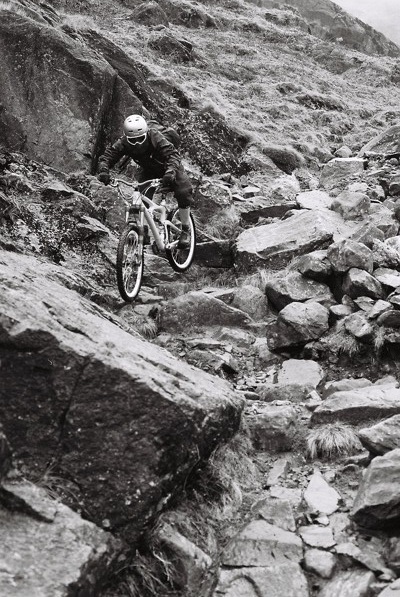 [/img]
Are we suggesting that if people keep falling off in Rosset Ghyl they can sue the land owner for not making it safe?
Whether a drainage bar would count as a source of danger would be down to case law. My gut feeling is a jury or judge is unlikely is unlikely to see an injury associated with riding fast or on steep rocky terrain as something that was beyond could be reasonably expected for the land owner to anticipate or prevent. I think that in the case of Rosset ghyll the defence would be that the land owner acknowledged your right to access the trail by bike but expected that you dismounted and walked.
If that isn't the law then trail sanitisation is coming to us all
Ninfan what makes you think Bridleways are maintained at the public expense. Do you have a source for this?
Not all, but most - s38 Highways Act '59 and s36 HA '80. See also chapter 6 of govt ROW circular 1/09 and the blue book.
Are we suggesting that if people keep falling off in Rosset Ghyl they can sue the land owner for not making it safe?
No, because a rider could clearly see the condition of the trail, which would largely displace the duty of care and indicate that they had elected to ride it in the knowledge and acceptance of that risk - however there would still be a duty to keep it in a fit state for use by the ordinary class of use (excluding any duty to facilitate cycling under s30 CA '68) so if it is unsafe for passage on foot/found rouse to horses then the LA would be in breach of their duties under HA '80
Whether a drainage bar would count as a source of danger would be down to case law. My gut feeling is a jury or judge is unlikely is unlikely to see an injury associated with riding fast or on steep rocky terrain as something that was beyond could be reasonably expected for the land owner to anticipate or prevent.
I did qualify the waterbar example carefully that the duty of care would likely only develop if there were previous complaints or accidents or a similar reasonable knowledge that it created a risk. The black bollards/chain across the path example would clearly tip towards the other end of the evidential burden.
I think that in the case of Rosset ghyll the defence would be that the land owner acknowledged your right to access the trail by bike but expected that you dismounted and walked.
As pointed out, for bikes alone this would fall into s30 CA '68, but not dispence the duty if it were foundries for horses.
Ampthill
The Government document you have linked is almost certainly correct (I can't be bothered reading it).
Landowners have no responsibility to maintain rights of way. They can only be liable to someone using a right of way if they do something which creates a new danger.
Highway authorities are responsible for maintaining public rights of way that are 'maintainable at public expense'. They will be liable to users lawfully using the ROW who are injured due to the dangerous condition of the ROW, unless they can establish the defence provided by the Highways Act.
Pretty much all bridleways are highways maintainable at public expense, and therefore 'maintainable' by the highway authority. Note that Ninfan said 'maintainable'. That is a legal term and not the same as saying that they are actually 'maintained' in fact.
Rossett Ghyll is a bridleway, therefore a public ROW and almost certainly maintainable at public expense. The landowner can therefore never be liable to someone injured on it if the landowner does nothing. The highway authority however could be.
Anyone can sue whoever they like, the crux is whether they will succeed. A mountain biker who falls off on Rossett Ghyll should not succeed, on the basis that the condition of the route is obvious, and reasonably safe for its intended use in its setting, and attempting to ride it is undertaking and accepting an obvious risk.
Whether a drainage bar would count as a danger will not be down to 'caselaw'. That question will be decided by a single judge (negligence cases do not involve juries) applying the principles derived from caselaw, which is a very different thing.
I agree entirely that in many cases a judge would be unlikely to consider an injury sustained riding at speed down steep ground to be due to the negligence of the highway authority (or landowner if not a highway) however those of us working in this field know never to underestimate the capacity for judges to find ways to justify a finding of negligence in order to make local authorities or insurers pay compensation to catastrophically injured claimants. It's normal human instinct to do so. It is for this reason that very high value claims are often compromised before trial.
I agree entirely that in many cases a judge would be unlikely to consider an injury sustained riding at speed down steep ground to be due to the negligence of the highway authority (or landowner if not a highway) [b]however those of us working in this field know never to underestimate the capacity for judges to find ways to justify a finding of negligence in order to make local authorities or insurers pay compensation to catastrophically injured claimants. It's normal human instinct to do so.[/b] It is for this reason that very high value claims are often compromised before trial.
if I remember correctly, the case between an injured individual and ATB Sales (Marin distributor) after his handlebar snapped was found in favour of the claimant. It could not proven whether the handlebar (4 year old bike) failed causing the accident, or if the accident caused the handlebar to fail.
However, as this was a severely injured private individual vs. a company with insurance, the judgement was for the first party.
Following this, many distributors and manufacturers sharply revisited their insurance agreements