I'm going to start building some wheels as I cant seem to buy what I want. Is a spoke tension gauge a worthwhile investment?
IMO no (as someone who has access to them).
Once you know what the right tension feels like you don't need one.
Learning what the right tension feels like? Then it's useful 😆
I got one of the Park ones for my first go at wheel building. I think it helped me get the tension right first time and also relatively even.
Can't recall the advised note that a spoke properly tensioned will sound if plucked - but a mate built some wheels, and got his wife to record the correct set of notes for his ideal tension, so he'd know the right tension..
He did borrow my gauge later, too. Can be handy and useful to lend out.
Yes.
I've been building for 20+ years and can do perfectly fine without one, but it just makes life a little bit easier. Not so much for the actual tension figure but evenness around the wheel.
As a novice it's great for getting even tension and making sure it's 'in range' for the the rim and spokes you're using.
You dont need one but they can be useful. Ive built a few wheels without and a few with. Without came out straight and lasted. With came out straight and lasted, quicker build but saved time lost in checking with gauge and tweaking.
Where it rally helped me was awkward builds with light rims and spokes, meant you could see where the tension was off rather than trying to feel it, which was not as easy as a beefy build (since rim flexed less). Also good for checking existing builds to rebalance after some use (again, on light builds). Im not a pro so i dont get enough practice to learn by feel as well as some.
i've built about 10 sets of wheels without one.
The only time i could have done with one was my first road wheels; the rims flexed a lot more more and the spokes came undone. easily remedied. I should have checked them after the first ride; but i'd got a bit blase with 6 successful sets of mtb wheels.
IME yes, my first set of MTB wheels were fine for about 4 months then started to go out of true about the same time I was building a set of light road wheels. The road wheels were much much harder to build evenly, so I bought the guage, did it with that and they've been perfect (as have the subsequently re-tensioned MTB wheels and my 2nd and 3rd set of MTB wheels). So it's possible without, but much easier and better with one.
I tried the tuning to an even note technique, but it didn't work as at best you're aiming to get all the tensions as close as possible as they'll always be slightly uneven. If they were all perfectly even you'd use a tension guage to build wheels not a truing stand.
I found the best method was to thread all the spokes into the nipples equaly, then work round the wheel untill they were all ~5 on the park guage, coarsely true it (not forgeting to release any wind up each time), then ~10, coarsely true it, ~15, true it , ~20, then finaly true it. doing it in stages seemed to build up a much better wheel than just adding a number of turns at a time untill it was upto tension then truing it.
What njee said.
They can be useful for eg stans rims with tension limits but mostly they are used by folk who aren't great builders or want to make themselves look good by using fancy tools
The chap I use to sort out my wheels has one.
Does it for a living, and mainly a roadie - whether this makes a difference I've no idea.
I have one. Never use it unless I'm building something with posh skinny spokes and alloy nipples.
If they were all perfectly even you'd use a tension guage to build wheels not a truing stand.
This is what I've never understood about a tension gauge. I've built a few wheels without one. Lace them up then adjust the tension to make the wheel true, round and dished correctly. So now if I go round with a tension meter and find the tension isn't even what am I supposed to do? Adjust the tension to make it even and end up with a wheel that isn't true? If not then what was the point of the gauge?
OK, I can see that it might stop you going too far and turning the rim into a pringle. But checking the note (using a free chromatic tuner app on your phone, for example) should stop that.
Not trying to be argumentative, just never worked out what the gauge was supposed to be for.
Yep, that's about it Roverpig.
Obviously you don't want a wheel with vastly uneven tensions, but you're never gonna get it perfectly even (and ridable), so assuming you can get it pretty close without a gauge, and you're not wildly exceeding rim or spoke limits (and I accept it gives you an idea of where you are on that scale), they don't really offer much!
I've built about 5 wheels now and I would like a tension gauge. I can never tell the sound by plucking them, i'll pluck the same spoke twice and it'll sound different to me, I think I'm tone deaf.
[quote=cynic-al]mostly they are used by folk who aren't great builders or want to make themselves look good by using fancy tools
What a crock! Weird statements that reflect more on your insecurities than on how to build wheels.
Being able to know the actual measurement beats guessing 100% of the time.
Your generalization about "mostly they are used by folk who aren't great builders" is bull.
And who the heck cares how they 'look' when building a wheel? I guess most people do it by themselves in the comfort of their own shed / workshop / home. They could be using pixie dust and dragons teeth for all anyone else would know or care.
🙄
[quote=roverpig]if I go round with a tension meter and find the tension isn't even what am I supposed to do? Adjust the tension to make it even and end up with a wheel that isn't true? If not then what was the point of the gauge?
The point is you will be able to find out the average tension of the spokes, so you can tension them to spec. There is going to be some variance for sure, but at least you will be in the ballpark. Without that, you could be building the wheel with too much or too little tension, and not know until you start riding and breaking spokes etc.
Without that, you could be building the wheel with too much or too little tension
But what is the 'right' tension? Yes some rims have a limit, but not all, or it can be very high, I'd not want to build a wheel to the maximum of many carbon rims. Do you get as close to the specified maximum as possible, or just enough that they're not flopping about? What is that tension?
I would say Yes and No.
It's nice to have one to know what the spoke tension is. Especially if you have something like Mavic rims which are supposed to be built at 90 KgF. But once you have a good idea of what that feels like you don't really need it.
I tend to use the spoke plucking method to do the final tension. I would suggest paying the £9 and getting the Wheelpro PDF [url= http://www.wheelpro.co.uk/wheelbuilding/book.php ]Wheelpro book[/url] It's wheel worth a read and will save you hours and hours of rebuilding and truing.
This is what I've never understood about a tension gauge. I've built a few wheels without one. Lace them up then adjust the tension to make the wheel true, round and dished correctly. So now if I go round with a tension meter and find the tension isn't even what am I supposed to do? Adjust the tension to make it even and end up with a wheel that isn't true? If not then what was the point of the gauge?OK, I can see that it might stop you going too far and turning the rim into a pringle. But checking the note (using a free chromatic tuner app on your phone, for example) should stop that.
Not trying to be argumentative, just never worked out what the gauge was supposed to be for.
Unwind it and start again.
I've got a hypothesis how the physics and engineering work, as when I was building my road wheels (Stans alphas, pre the reinforcements, so prety weak) it was possible to build a perfectly true wheels, with tensions all over the place, and no ammount of faff would sort it apart from starting again. I suspect it's because the rim is stiff(ish) so you could have 1 spoke doing all the work on one half of one side, and 7 loose ones (on a 32 spoke wheel), you could I suppose build a wheel with as few as 3 spokes on each side under tension, and the spoke on the other side wouldnt have to line up with it. Extrapolate that back to a more acceptably even tension and you can see how it's possible to build a perfectly true wheel with tensions all over the shop.
Same with my MTB wheels, they were perfectly true, yet still went wonky. The next pair (built with nigh on even tension) haven't moved a mm.
Based on that I'd say it's possible to build without one, and some people can probably build very well without one. But I'd also say that even the most hamfisted person in the world could probably build wheels on a par with any bearded man in a shed who's details you only get only after learning the secret handshake from the local cycling club, as long as he can folow the instructions. Because at the end of the day a perfect wheel is perfectly true with perfectly even tension, not much more to it than that.
The wheel build course I went on never mentioned their existence!
Well they definitely exist!
I've got one. I've not built *that* many wheels, so it's very useful from a confidence point of view, and also handy for Stans rims, which have a lower max tension than most other rims.
It's like most tools: yeah, you can build a perfectly good wheel with a spokey, a blob of bluetack and a biro, but it's much easier with a stand, a dishing tool, some sort of nipple driver, and a tension gauge (personally I'd get those tools in that order, too, but everyone's different).
If fairly new to it all (much as I am) then I'd say yes. I didn't actually use it during the build process (followed Musson guide) but it was good to go around after and check the tension was even and in the right sort of range. Gives me a bit more confidence that I'd done an ok job. Next time I'd probably use it a bit earlier in the process too to maintain an even tension throughout the build process.
I've built hundreds of sets in my time and used a Dt Tensio for the majority.
Spokes, rims and in some rare cases hubs have tension ratings for good reason.
I consider it a great tool for beginners but it takes out all the guess work from building wheels properly for those with experience.
The plucking thing doesn't work 100% of the time. I checked this theory once again last month to show someone. I plucked two spokes with the same tone but very different tension readings.
It is certainly possible to get a wheel round, true and dished with even tension (within +/- 5%) but this is made much harder with second hand rims or cheap parts.
And re the previous question regarding a wheel being true but having uneven tension, I would suggest you take more time to build the wheel next time and de-stress the wheel properly. It may take a year or so to build truly great wheels and reduce the time period in which you do but its all about being methodical and careful.
I've got one and I use it towards the end of my builds. Just for my own satisfaction, I like to get them as even as I can. I don't think they're any good for absolute values but great for checking one spoke relative to another.
I checked the last wheels I let a local shop build for me. The tension was +/- 20%. My builds are +/- 5%. Both were true enough for the job but I know which I'd rather take on a weeks riding holiday!
I've never used one, and I'm not sure what I'd gain from it. As others have suggested, if the wheel is round and true and dished and the spokes are tight....what then?
I'm not sure what I'd do if I found all my wheels were all over the place tension wise though. 😆
I like mine. It's makes for relatable builds and for me it's the easiest way to get even tension quickly
Reliable wheels esp with light rims are about even spoke tension as much as tightness imo
But I build a lot of wheels and like shiny tools
if the wheel is round and true and dished and the spokes are tight....what then?
What then? How tight [u]are[/u] they? Is it correct for the rim you're using, or the spokes?
DB spokes deflect further for a given tension then plain gauge, and Stans rims build to a lower tension than Mavics for example.
I use one every time, I've got my own, and I use one at work. IMO the Park one is cheap, easy to use and easy to read.
Yes I can build without one but I prefer not to these days. It's a tool that removes doubt, I know tension is correct if I've used one, but I don't get obsessed with it.
I've checked out a couple wheels built by experienced builders (I dunno if I count as that or not, I've probably built somewhere between 50 and 100 wheels) and one was dreadful. (That one came back for some extra work after the first ride) and the other was over tensioned.
To my mind it depends on a few things:
Do you build LOTS of wheels? Like thousands? If so I'd expect you'd get to know tension pretty well by hand. I don't need to use the reference table that came with the tension gauge any more most of the time. If you don't build LOADS of wheels than you're not gonna get that feel so easily.
Are you building wheels because you have to, or because you like to? I love building wheels! I get IMMENSE satisfaction from taking my time and getting a bit geeky with it, getting the spoking pattern correct (Symmetrical, reverse symmetrical, asymmetrical), getting the hub logo pointing at the valve hole, perfect dish, true and round down to 0.2mm (ish) and getting the tension even and right (1/2 turn extra on the inbound spokes chaps....) for the rim/spoke
Maybe I'm OTT because I love it, but my wheels don't come back to me so I guess I'm getting it right somewhere. 🙂
I think it's also worth mentioning that there are two priorities for building a good strong set of wheels.
1) Build the wheel with even spoke tension
2) Try and get it true and round.
It's "easy" to build a round, true wheel. It's harder to build a wheel that stays as true and round as when it was built. If you swap priotrity one and two you get nice true wheels that buckle really easiliy.
Another thought - has anyone tried using a guitar tuner to get spoke tension even?
From what you've written above Peter Poddy, I think we'd get on well!
So many other shops that build wheels without giving thought to where the logo sits relative to the valve or even building them with rim logos (h+son for instance) facing different directions.
the details count
Have one myself (Park tool) and whilst I tend to build by feel I'll always run the tension meter over any build before I consider it finished, a few times it's brought something up that was worth tweaking. It's like getting an independent second opinion.
Essential? No, useful and desirable for those who get satisfaction from a job well done? Yes.
The DT Swiss ones are serious tool porn as well.
And re the previous question regarding a wheel being true but having uneven tension, I would suggest you take more time to build the wheel next time and de-stress the wheel properly.
Nowt to do with making sure there's no windup (presume thats what you meant by de-stress?).
Think about it another way, a 16 spoke wheel and a 32 spoke wheel, take all the tension off half the spokes in the 32 spoke and you're still left with a perfectly true wheel, but with very uneven tensions.
Without a tension meter you're guessing at how even the tension is, it's not impossible, and some people are undoubtedly good at it, but with a gauge you can get it spot on every time.
Wheel building porn? - that has to include [url= http://www.pklie.de/index_eng.html ]P&KLie[/url] - i have absolutely no need for such equipment but it's very high on my list of wants.
I make do with an On-One Jobsworth dti stand and a park tension gauge, i have built without the gauge (built/repaired my own wheels since teenage years) but i prefer to use it, for repair of wheels i check tension beforehand then after repair, for new builds whether for myself or others i use it for my own piece of mind.
I mark the first spoke with tape, mark the rim with tape and an arrow to show direction of work round the wheel then attempt to build as true as possible with an even tension as possible whilst keeping a copy of the spoke tensions as i go along in my wheel building book that i've used for the past 20 years.
Probably overkill but i haven't built hundreds of wheels to get the [i]master intuative feel[/i] so it helps to follow a pattern that i've used for years - never had a failure due to my cack-handness yet so i'll carry on. 😉
What's the thoughts on a dishing tool. Required? Embarking on a first wheel build and have a tension meter ordered.
We have a PK Lie stand but I still prefer the good old Kestrel as it is less sensitive.
I've never used one, I've built 4 wheels so far and just doing the next pair this week. I'll maybe take one to the bike shop to see what tension I do end up with, but my wheels have been great and straight so far, did have a derp moment truing one once but soon figured out I'd turned a spoke the wrong way.
I pluck the spokes to compare relative tensions by pitch, but don't know how close I am to the rim limit of tension. I also go around plucking other people's spokes (!), which has reassured me that my tensions are really even and high compared to most wheels out there!
I've built close to 500 pairs of wheels and yes I use a tension gauge to get it right each time - its a really useful tool even for an experienced wheel builder
Just built a new wheel for my own mountain bike this afternoon : Roval Traversee 29'er rim with DT Swiss Super Comp spokes with brass nipples on DT Swiss 350 freehub
Used the wheel tension gauge to get it really nicely balanced, rode the bike home tonight with the new wheel and it feels just right
Yes use a dishing tool despite the fact a good jig should be centred.
But how do you know the dish tool is good ?
But how do you know the dish tool is good ?
How can they not be, they're very simple tools.
[quote=thisisnotaspoon ]Without a tension meter you're guessing at how even the tension is, it's not impossible, and some people are undoubtedly good at it, but with a gauge you can get it spot on every time.
Nope - I use the pluck and listen technique as described in the second last para of http://sheldonbrown.com/wheelbuild.html#tensioning and http://www.bikexprt.com/bicycle/tension.htm It may not be as precise as using a tension gauge, but the precision is certainly better than the amount of variation you get in spoke tension even in a perfectly built wheel. Not guesswork at all, and quicker than using a tension gauge. Seems to have resulted in reliable wheels.
How can they not be, they're very simple tools.
You say that, but have you seen the gorgeous Wheel Fanatyk wooden dishing tool?
[img] 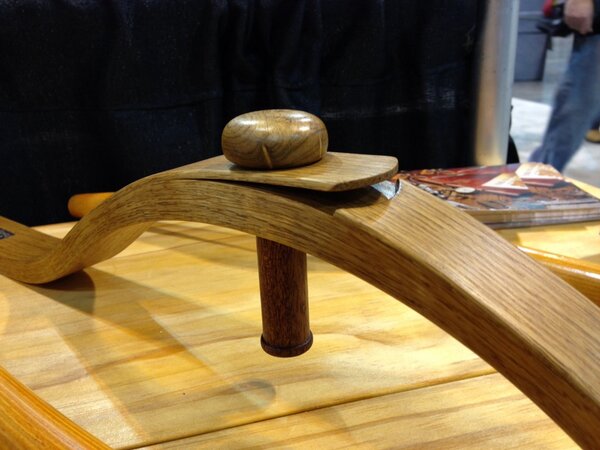 [/img]
I don't use mine much - the Park TS-3 is very good at centring - but it's a lovely object.
Lovely. Should get round to making myself a dishing tool (it should be fairly easy to bodge something, but flipping the wheel in the jig seems to work).
[i]So many other shops that build wheels without giving thought to where the logo sits relative to the valve or even building them with rim logos (h+son for instance) facing different directions.[/i]
[i]So many?[/i] Really? I'd honestly be very surprised if that were the case, I don't know many wheel builders who aren't just a little bit obsessive about it.
You say that, but have you seen the gorgeous Wheel Fanatyk wooden dishing tool?
That's still a very simple tool, just a beautifully made one. The only way a dishing tool can really be wrong is user error!
There seem to be more and more shops trying their hand at wheel building round suffolk Nick.
A quick glance at Facebook shows there are more than a few building them without actually looking!
Yes.
I've been building for 20+ years and can do perfectly fine without one, but it just makes life a little bit easier. Not so much for the actual tension figure but evenness around the wheel.
This.
As an occasional wheel builder mainly for my own use and amusement, I have used Musson's book and had no issues with getting the tension right without one but it does give reassurance that the wheel is even. Would find getting by without a dishing tool more difficult but Musson's book does give a design for an extremely cheap DIY version if you don't want to spring for a commercial one and there are plenty of other DIY designs on the internet.
A rule and a doorway provides an excellent dishing tool.
This is just another excuse for people to buy kit and convince themselves it's worthwhile.
eg:
esher shore - Member
Used the wheel tension gauge to get it really nicely balanced, rode the bike home tonight with the new wheel and it feels just right
It wouldn't have felt right without the use of the tension meter?
A good wheelbuilder doesn't need one.
To the OP:
If you like buying shiny tools and can afford it, go for it.
If you're trying your hand at this for the first time and aren't sure if you're going to ever build more than one wheel, save your cash.
FWIW I taught myself to build wheels when I was about 14, from reading Jobst Brandt's "[i]The Bicycle Wheel[/i]". Dismantle an existing wheel and put it back together to see how you get on. Very cheap experiment.
[i]A good wheelbuilder doesn't need one. [/i]
but most of the people on this thread aren't good wheel builders, they're amateurs having a go.
For people who haven't built many wheels or don't do it often a tension gauge is a useful tool.
Been building wheels for a long time and I still use my spoke gauge more on xc and road wheels than dh or bmx but still nice too too know what's happening and double checking your work helps ensure customers get exactly what they paid for. @mathewshotbolt I noticed that there are a fair few more people local trying there hand too there's two new guys over in norwich and few scattered about that have just started up and offering there services really really cheaply probably working from home.
amack23 - Member
What's the thoughts on a dishing tool. Required? Embarking on a first wheel build and have a tension meter ordered.
This is required less than a tension meter (which IMO isn't required). Just flip the wheel round. It's right when the rim's lateral position is the same either way.
"a good wheelbuilder doesn't need one".
How are we defining a good wheel builder? The wheels I build are more true and more evenly tensioned than anything I've ever come across. However, they're a labour of love. No one would ever pay for the amount of time I invest in them. I'm a great wheel builder but I'll never be a commercial wheelbuilder.
okay my turn to ask a dumb question - what is a dishing tool? I have always swapped my wheel around in the stand?
Slightly OT, what's decent truing stand? CRC have the X-tools (£100) and Park (£80). I'd only be building the occasional wheel.
I've built one wheel following the Musson PDF but I borrowed the stand for that from a work colleague at my last job.
Stevet1 http://www.chainreactioncycles.com/park-tool-wheel-alignment-gauge-wag4/rp-prod13252
Tool to check that the wheel is dished correctly rather than by flipping it in the jig.
I have just got the park Spoke tension gauge after building my own wheels for the last 10 years.
Checked the tension on my latest build to find the spokes were all within about 5% to each other BUT I had over tensioned the spokes which could of lead to a rim / hub failure ( not that I have had a failure in the past but it is a bit of peace of mind)
Was it worth £50 yes
Is it really peace of mind though? IME if you overtighten spokes, you (eventually) crack the rim around the spoke holes but while that eventually leads to failure it's rarely catastrophic (eg you DIE) and even that would only happen if you've ignored it for ages - ie it's not something that leads to failure quickly.
Building on (expensive) carbon rims may skew that perspective of course.