UPDATE: Reviews section refreshed, redesigned, searchable: Go take a look
The guy in shop it's the best because [s]of how it pivots the wheel up & down unlike other manufacturers where there rear wheel pivots towards the front thus on return throwing the bike forwards[/s] he sells it.
FTFY. 😉
Single pivot, for example, would probably have died out long ago if it weren't for modern shocks
Peddling a Horst Link or VPP bike......
Pro pedal off = tiny bit of bob + maximum traction
Pro pedal on mid setting = imperceptible bob + very good traction
Pro pedal on max = not required
Peddling a single pivot bike......
Pro pedal off = unacceptable levels of bob + maximum traction
Pro pedal on mid setting = tiny bit of bob + very good traction
Pro pedal on max = imperceptible bob + good traction
So you can dial it out but (In my opinion) its still inferior.
jacob46 - Member
.... unlike other manufacturers where there rear wheel pivots towards the front thus on return throwing the bike forwards.
Sounds fantastic. Free acceleration. And the rougher the ground the faster you'll go. 😀
roverpig my SP has a coil shock, no platform, rebound and comp is difficult to get to, forks are basic float R so no mid ride changes there either. Kind of relaxing never having to mess with the shocks (on the other FS I'm constantly lowering/raising the talas forks and swapping propedal settings) Bit bobby but I manage some big rides/hills on it ok and coil shock is soooo plush on the downs.
Peddling a Horst Link or VPP bike......Pro pedal off = tiny bit of bob + maximum traction
Pro pedal on mid setting = imperceptible bob + very good traction
Pro pedal on max = not requiredPeddling a single pivot bike......
Pro pedal off = unacceptable levels of bob + maximum traction
Pro pedal on mid setting = tiny bit of bob + very good traction
Pro pedal on max = imperceptible bob + good traction
My pedant-o-meter just exploded 👿
That's an absolutely massive generalisation though. Some single pivots ride perfectly well even without pro pedal, depending on their specific design and the application they're being used for and the rider's style/preferences. They may well not suit your riding.
Similarly, as I noted above, I don't like the way Spesh horsts tend to feel. They don't suit me. Doesn't mean there's anything wrong with them.
My pedant-o-meter just exploded
hows that pedantic - I am about to spend a months income on something.....
Shall I get something that kinda works or just works - for the same money in a lot of cases.
Peddling and pedal in the same body of text...
With the different amount of variables in a suspension bike it's impossible to generalise.
Instant centre, chain growth, axle path, damping rates, chainring sizes, shock rate, wheel rate... Far far more to it than single vs four bar.
That's an absolutely massive generalisation though. Some single pivots ride perfectly well even without pro pedal, depending on their specific design and the application they're being used for and the rider's style. They may well not suit your riding.
I spent two seasons guiding on a 2003 Five (and a short time on a 2003 Patriot). Open shock, single pivot, 140mm travel. It bobbed a lot if I pedalled uphill like I was stomping down garden turf, but otherwise it was never really a problem. Certainly seated while climbing kept bob to a minimum, and arguably no more than climbing with platform shocks I've since used.
For the record, I ran it with 1/3 sag and a medium-slow rebound, which seemed about spot-on.
Shall I get something that kinda works or just works
You should get what works best for you (which you seem to have worked out) without assuming that you're able to make absolute statements for how they work for everyone else.
the thing that is being pedaled the most is BS though 🙂
hows that pedantic - I am about to spend a months income on something.....
Shall I get something that kinda works or just works - for the same money in a lot of cases.
Get whatever you like best, but don't try to pretend that other people are wrong. It's all subjective. What you consider to be unacceptable may be fine for somebody else.
Personally I found my Maestro equipped bike was a good compromise with the pro-pedal off, but it was just that, a compromise, and it was a pain to reach the lever. With my SP bike I have 5 levels of platform to play with and can always get it to feel just how I want. But I'm quite happy that somebody else would hate it.
Best suspension system?
/end thread
[img]  [/img]
Pimpmaster Jazz - MemberThat's an absolutely massive generalisation though. Some single pivots ride perfectly well even without pro pedal, depending on their specific design and the application they're being used for and the rider's style. They may well not suit your riding.
I spent two seasons guiding on a 2003 Five (and a short time on a 2003 Patriot). Open shock, single pivot, 140mm travel. It bobbed a lot if I pedalled uphill like I was stomping down garden turf, but otherwise it was never really a problem. Certainly seated while climbing kept bob to a minimum, and arguably no more than climbing with platform shocks I've since used.
I was about to type something similar.
I wonder if complicated suspension platforms are just compensating for people pedalling like gorillas? 😛
I spent two seasons guiding on a 2003 Five (and a short time on a 2003 Patriot). Open shock, single pivot, 140mm travel.
Now, you see, that's a setup that I'm pretty sure I'd hate. But if I were fitter, stronger and not racing anybody it may be fine.
I wonder if complicated suspension platforms are just compensating for people pedalling like gorillas?
Could be, but in my case I think it's more a matter of not being fit or strong enough. It could also be partly an ex-roadie and hardtail owner thing too. If I'm on a fireroad type climb I just don't want any energy to be wasted in the shock, because I know I'm going to need it later in the ride.
Possibly but then so what? That may well be their style and/or what works best for them. That's the point really, we're all different, so there isn't a 'best' design.
hows that pedantic - I am about to spend a months income on something.....
Shall I get something that kinda works or just works - for the same money in a lot of cases.
I spent a tiny fraction of your months wages on a 10 year old frame - as I like the way the suspension "works".
To me, it "works" better than the 'equivalent' 2014 frame.
without assuming that you're able to make absolute statements for how they work for everyone else.
Peddling a bike ought to be the same for everyone... shouldn't it - unless your legs sprout from the side of your head - or you prefer to sit facing backwards or something?
Stop peddling your assumptions!
We don't all pedal the same. Some people spin, some grind, some like to move around the bike lots, others don't. Some stand lots, others rarely do. Some people are heavier than others, stronger than others, more or less circular in their pedalling, etc. etc. Some will compromise pedaling efficiency for better DH performance, others will be the other way around. Some poeple like their suspension to move loads and be really sensitive, others just want it to work well on bigger hits.
Stop peddling your assumptions!We don't all pedal the same
side saddle?
I forgot to list that one 🙂
and having tried plenty I still don't get on with SP that well for pedalling hard. Regardless of the shock it just doesn't play well enough for out of the saddle smashing it.
Happy with more efficient bikes
Peddling a bike ought to be the same for everyone... shouldn't it - unless your legs sprout from the side of your head - or you prefer to sit facing backwards or something?
You're new here aren't you. 😉
Now, you see, that's a setup that I'm pretty sure I'd hate. But if I were fitter, stronger and not racing anybody it may be fine.
I think that's the point I was trying to make. At that time I was fit, could spin seated (and keep upper body movement to a minimum - it all helps) or grind out of the saddle (which again seemed to help alleviate bob) but I wasn't racing, and most climbs were either short and sharp or long and gradual.
Would it work everywhere? No. Would it work for everyone? Again, no. But it's certainly possible to adapt to, and I actually like the simplicity of doing away for a lot of the more fiddley technology, and being left with a suspension system that gripped on the ups and was very supple on the downs.
I think it's a hard thing to be really analytical about. Like, in technical terms, the suspension on my Orange is a bag of assorted shit. Big forward axle path, falling rate in the end stroke, bags of pedal and brake feedback, and it pedals like a blancmange. But the bike as a whole is a brilliant laugh to ride so you end up going away thinking "I like this" even though there's quite a bit that's arguably wrong with it and some things that are completely ass-backwards. But if you put the same behaviour in a different bike you could easily find it's fit for the bin. And most people don't really have the capability to experiment widely, you can't move pivots much.
This thread needs more Vouilloz.
How about DW? I've been impressed at the grip, lack of bob and lack of fiddling. Leave shock fully open end of unless you particularly want to stomp on the pedals on a tarmac hill.
I really liked my coil single pivot, my first FSer, very plush but it weighed a fair bit and air shocks were becoming de rigeur so when I wanted a new frame my reasoning went coil shocks are plusher than air so I'll need a more elegant suspension design for an air shock to match it. No doubt flawed logic.I wonder if complicated suspension platforms are just compensating for people pedalling like gorillas?
IIRC lowey of this parish bought a DW turner and for the first few weeks he was convinced it was trying to kill him, tucking and bucking at various inopportune moments. He had a chat with Mr Turner, set the shock up as per his advice and now loves it.
Even though others have said (including a bike designer), get past the "layout" of the suspension, it tells you nothing. Yes a maestro will be optimised a certain way, fsr will be optimised in a different way, but they're variations on the same layout. However a maestro and fsr could perform identically if the designers had the same design beliefs. What is different is what the designer has CHOSEN to optimise certain trait based on THEIR design beliefs, whose beliefs may or may not syncronise with YOUR beliefs.
Plus that age old saying "you can't have your cake and eat it". It's all a balancing act of compromises, comprimises that are dictacted by the designer, not the general layout of suspension.
There's a lot of legal engineering involved, yes. It's interesting how well sealed most of the newer US ones are now, or become after a revision or 2. I think a lot of it is bllx and a SP has a lot going for it still.But it's always felt like a lot of "suspension innovation" is really just lawyer-avoidance.
Interesting. I do wonder how many people have actually ridden a lot of different designs. Of a similar era. Its easy to say that one is better than another but when you take the component into account then its a different ball game. I believe that the shock tune will effect the way it feels a lot more than the type of linkage its self. It is entirely possible to get a horst link with a cheap shock to feel rubbish compared to a sp with one of these new fangled super dooper socks. and visa versa.
However its different stokes for different blokes. Some people like 29ers, some people dont. its all in the individual. Personally (and riding a 2013 five) i think the horst link is a very good design. I also think half of them are made up marketing gimmicks.
I believe that the shock tune will effect the way it feels a lot more than the type of linkage its self.
I think that definitely plays a large part, especially in these days of platforms and double barrels.
I think it also depends on how much you like changing bearings. Worthy of consideration if you plan on keeping a suss bike for more than a year...
Going out with a mixed bunch of riders up and down stuff all on different pivot/suspension linkages tells me repeatedly that the differences are small these days and that the evolution and refinement of technology is such that they all work well.
The biggest variable factor on a bicycle (of a reasonable quality not an ASDA two for £99 special) is the rider.
The mathematics show this is the best design. You will be very happy to ride this bike.
The mathematics show this is the best design. You will be very happy to ride this bike!thank you!
best suspension bike I owned for trail riding and all round hooligan action was my Devinci Dixon with the DW designed Split Pivot suspension, Fox RP23 with Fox air volume tuning kit.
[img] 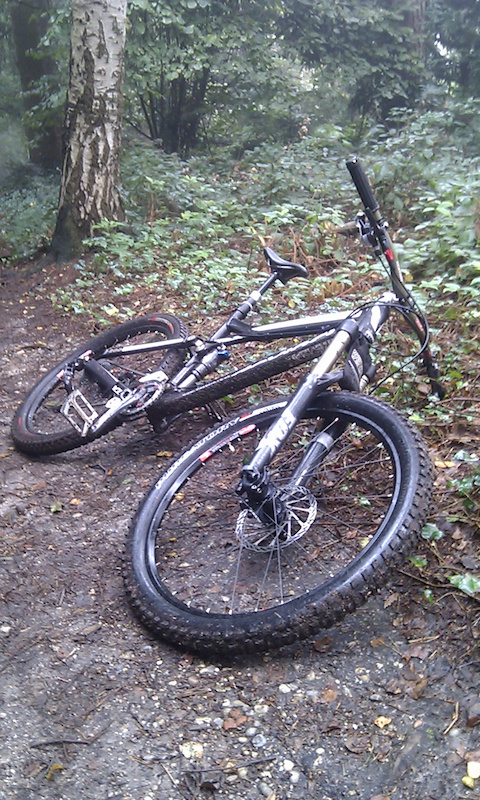 [/img]
Have owned lots of VPP, simple single pivots and FSR / four-bar (horst pivot) and faux-bar bikes, probably 40+ suspension bikes in total.
The Dixon had the balance of a bike that could be hammered under power without bouncing or squatting (an issue with my FSR's), whilst maintaining amazing traction on horrible terrain, especially when braking hard.
Don't claim to understand the science, it just plain worked. Rarely touched the pro-pedal level on the RP23 shock, unlike on my FSR where is was constantly used to increase compression damping and make the bike somewhat pedallable
the other thing I really liked about the Dixon is that each pivot had the same (large) sealed bearing and sensible hard wearing axle pivot hardware, which meant it rarely required any looking after!
There's no 'best' suspension design. I have a Horst link & a single pivot - both work brilliantly, but both were vastly improved with a shock tune (tuned to [i]my[/i] liking you understand).
Northwind touched on to earlier talking about his Orange - you ride the one that makes you smile the most. Try lots out and short list a few to try again once you've got an idea of what you like.
Split Pivot, as far as pedalling goes, is a single pivot. The only difference is it's difference in distribution of braking forces.

