UPDATE: CLASSIFIEDS section refreshed, redesigned, searchable: Go take a look
URT all the way!
Orange rider here, for 20 years. I pick my bikes for performance and fun first and foremost, but the reliability of single-pivot is a massive plus for me here in the Pennines, riding all year round. There may be marginally 'plusher' multi-link systems out there, but there's just something about the 'feel' of Oranges for me, and the geometry is always spot on. There's much more to a full-sus than just the kinematics of the system anyway. Besides which, the set-up on my current Five is actually super-smooth (36s and a Float X) - perfect for the Pennines and Lakes, where I do 99% of my riding. I'd happily hammer the Alps on it too (though not massive jumps). Also, the negative traits of single-pivots often come with positive flip sides too - in my experience they dig in and climb technical trails well, and are also nippy to accelerate on pedally flat sections. I do reckon that perhaps single pivots suit beginner riders a bit less, as they work at their very best at speed, with the back brake off. At the end of the day, some folk like them, some don't. There's no better or worse, just different.
Way too many variables involved even for a professional mechanical engineer to get their head around! All the various kinematic layouts have their pros and cons and I wouldn't like to say one design was clearly better than the rest. What I would say is that multi-bar links do give a little more scope for designers to fiddle about with the kinematics, but that's not necessarily any major advantage. Personally I look more at the overall design and geometry of the bike and ignore the marketing blurb.
Basically, demo a bike, if you like it buy it. You aren’t trying to eke out maximum performance (unless you’re a racer), so just ride whatever’s fun.
sound advice. Which is luckily what I did with the murmur, so I should stop worrying and buy the bike I tried and enjoyed!
Interesting reading with regards to all the other points people are making. I appreciate the time and energy people are putting into replying!
You do know the primary reason for the Horst link was when we all had cantilevers, and if you didn't put the brakes on the same link as the wheel, the pads would slide off the rim under compression?
You do know the primary reason for the Horst link was when we all had cantilevers, and if you didn’t put the brakes on the same link as the wheel, the pads would slide off the rim under compression?
^^This^^
It's also worth remembering the old AMP B2 while being an early "horst link" bike didn't have an upper link the seatstay member was clamped straight to the shock... The more interesting aspect of the whole beast being the linkage forks...
It would have behaved more like a single pivot than a modern day FSR and was designed to be a relatively simple suspension system.
Absolutely agree WL - did you read the review I linked yesterday?
I assume the Five is also a very fast bike and good company for big days out.
Read it just earlier, chaka. Interesting stuff, and thorough. The Five is amazing to be honest - fun, fast and trouble-free. I demoed a Stage 5 which was also great but opted for the smaller wheels in the end - just a personal preference as I found the regular Five got around very tight switchbacks with a bit less effort (not quite so quick over the rough stuff in a straight line though, as you'd expect). Demoed an Alpine 6 too, which was also mint, just a bit overkill for my regular riding. Had my Five for two years and it's perfect for big days, and in the Factory spec very capable indeed for a 140mm bike. Biggest day out so far was both sides of Nan Bield from Staveley. Around 30 miles, 2,000m climbing/pushing, took roughly 8 hours. Bike was awesome. Four Passes no bother either. My normal local stuff is 20-30 milers in Calderdale - natural trails with techy steeps and rough moorland singletrack. Toying with selling it soon...just to buy the updated Five.
You do know the primary reason for the Horst link was when we all had cantilevers, and if you didn’t put the brakes on the same link as the wheel, the pads would slide off the rim under compression?
I am struggling to see the relevance of this tbh.
I am struggling to see the relevance of this tbh.
Several brands have some cool aid you can drink which will make you believe it’s very relevant to modern bikes.
Ah right, the real reason vs marketing bullshit reason thing. Fair enough.
I am struggling to see the relevance of this tbh.
Also sounds a bit unlikely. Single pivot and URT both already had this feature so you didn't need to create a new design if that was your primary goal
I am struggling to see the relevance of this tbh.
Well these days everyone want to tell you their suspension design is imbued with axle path magic and the word "kinematics" is getting a bit overused...
The point of that factoid was that regardless of what SBC put in their marketing, their proprietary suspension uses a concept invented to solve a different issue at a much earlier point in the evolution of the MTB...
Bonus point question for you bicycle history buffs: who first bought 'VPP' to market? No Googling!
Ooh, me, me! - Was it Intense?
The rearward force from the ground to the rear tyre contact patch generates a torque that attempts to lift the rear suspension, thus squatting the back end of the bike downwards.
I said there's no [i]direct[/i] interaction. That to me is indirect, and it's inevitable as long as you have a rear brake. However I think it's minimal compared to the unweighting effect of the rider's weight moving forward.
Ooh, me, me! – Was it Intense?
No
With the advent of 1X transmissions the single pivot suspension system is more relevant now than it ever was .
The 4-bar link principle in mechanical engineering is about as old as the hills, whatever fancy name bike manufacturers give it. I first learned about it at uni back in the late 80s as a mech eng. undergrad and it was hardly a new concept then. It certainly existed well before full suspension mountain bikes ever became a thing. It does makes sense to utilise this classic engineering principle on a bike, but there is nothing glaringly wrong with a well designed single pivot either.
VPP is a trade mark of Santa Cruz. They use it on their suspension that incorporates some patented aspects invented by employees of Outland Sports Inc, which Santa cruz bought. "Virtual Pivot Point" on the other hand is free for anyone to use.
VPP, FSR, DW, etc, etc are all 4-bar linkages with fancy patented names. Their actual kinematics can vary wildly depending on the relative location of the pivot points. Stiffness of the linkage system will also greatly affect performance. As will the system's interaction with the shock and of course the shock spring/damping characteristics themselves. It adds up to almost infinite potential variations, but most of these systems seem well sorted today (which wasn't the case 15 years ago when I first started riding).
The Outland/ Santa Cruz patents (or one of them anyhow) is interesting in that its claims are limited by reference to a particular shape of axle path, rather than a particular linkage arrangement:
https://patents.google.com/patent/US5553881?oq=us+patent+5%2C553%2C881
"I said there’s no direct interaction. That to me is indirect, and it’s inevitable as long as you have a rear brake. However I think it’s minimal compared to the unweighting effect of the rider’s weight moving forward."
It isn't indirect at all. You use the brake, the momentum you're fighting against generates forces which create torques in the linkages. Whether you think it's minimal or not, it's a clear effect which can be modelled in simple software packages.
And it's pretty bloody obvious if you swap between two bikes with similar travel and geometry and similarly set up suspension, one of which has high anti-rise and one of which has low anti-rise. Throw in a hardtail which also has similar geometry and a similar fork and set-up and it's even more obvious.
I've had three bikes in the last year at the same time which tick these boxes. Brake squat / anti-rise exists. I prefer quite high anti-rise but my current full-sus has quite low anti-rise, so the rear suspension feels less harsh when braking but I have to shift my body slightly more rearward to stop it diving at the front.
Absolutely ****loads of anti-rise graphs here: http://linkagedesign.blogspot.com/
And here they are for a load of single pivot bikes vs others: http://linkagedesign.blogspot.com/search/label/Orange
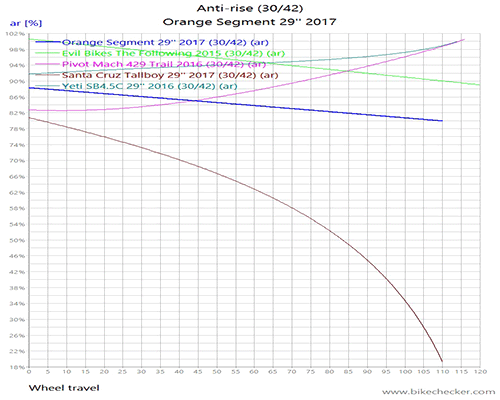
Highest brake squat (stiffening) at sag is the linkage-driven single pivot Evil, then the Switch Infinity Yeti, then the simple single pivot Orange, then the DW link Pivot (though that increases deeper in the travel, which is the opposite of most bikes) and then the VPP Santa Cruz.
Only noticing "brake jack" on single pivot bikes is placebo effect - most other bikes have plenty too, the FSR style 4-bar bikes / Split Pivot are the exception where it's lower.

Brake squat / anti-rise exists.
Yes, I was talking about brake [i]jack[/i]. Anti-rise is a thing for sure.
@chief
And it’s pretty bloody obvious if you swap between two bikes with similar travel and geometry and similarly set up suspension, one of which has high anti-rise and one of which has low anti-rise. Throw in a hardtail which also has similar geometry and a similar fork and set-up and it’s even more obvious.
As I noted above, I have done pretty much that switching between two bikes, and I didn't notice it. I am not a noticer.
"Yes, I was talking about brake jack. Anti-rise is a thing for sure."
I can't see how any modern MTB suspension design can suffer brake jack, all the linkages and pivots are in the wrong places!
https://www.bicycling.com/bikes-gear/a20022920/mountain-bike-feature-jacks-not-here-man/
"As I noted above, I have done pretty much that switching between two bikes, and I didn’t notice it. I am not a noticer."
Be glad, it's much less annoying not to notice! Although once I get the right bike dialled in, it is very satisfying... If I was 50% faster I'd be an awesome test rider! 😉
That's all well and good, but I could tell a single pivot from the stiffening under braking.
"That’s all well and good, but I could tell a single pivot from the stiffening under braking."
You think you can but the facts are that plenty of other suspension designs stiffen just as much under braking. So of the bikes on your (rather good) blog reviews, the Stage 4, Stage 6, FlareMax, RocketMax, Process 111 and Mega 290 all have high anti-rise (stiffening under braking) which are all single pivots (linkage driven or otherwise) apart from the Mega's counter-rotating four bar. The Radon Swoop has very low anti-rise as do the Enduro 29 and Smuggler (all four bar). And you haven't reviewed any short-link bikes, many of which behave like single pivots under braking.
Yeah, but I could tell from the stiffening un.... oh alright, I'll stop trolling you now.
But there is truth there. The Stage 6 has made me realise that the Konas did stiffen under braking to an extent that affected the ride, possibly the Mega too but that was shit in a few different ways so it was hard to tell.
The Cotic FS bikes I've ridden were much more subtle about it, whatever the graphs say. Like a very muted version of the Orange feel. Didn't punish you for brake-dragging anyway.
I've also owned Giant Maestro bikes, Mondraker "zero" bikes and a DW link and they all felt very composed in all situations - especially the Mondies. Are they "short link" bikes?
TBH I purposefully don't write about the physics-y side of suspension, there's enough of that everywhere else and I'm just not that into it.
“The Cotic FS bikes I’ve ridden were much more subtle about it, whatever the graphs say. Like a very muted version of the Orange feel. Didn’t punish you for brake-dragging anyway.”
The Cotics have quite a progressive curve so will be softer at the start of the travel which could make the difference. Also recent Orange bikes have moved the pivot quite high hence the sprightly but kickbacky pedalling.
“I’ve also owned Giant Maestro bikes, Mondraker “zero” bikes and a DW link and they all felt very composed in all situations – especially the Mondies. Are they “short link” bikes?”
Yes, they’re short link bikes. All depends on where the links point, the less far forward and higher they point, the more the brake squat.
Have you tried any of the new high pivot point idler bikes? They manage to have high anti squat for good pedalling with almost no kickback but have tons of brake squat, more than anything else.
I’ve only had one single pivot bike (a Univega Ram990 back in the early 2000’s), and that had a falling rate that meant it pedalled well, but then smashed through its travel / wallowed quite badly through compressions. Other than that I had some sort of urt with a linkage that made it look like a 4 bar (Kona U’hu) then Horst link bikes - a GT LTS back in the day, a Boardman Pro FS 2015, and now my Bird Aeris.
I’ve enjoyed all of them but it would be interesting to try a non linkage driven single pivot like an Orange with a modern shock in.
I have recently ridden a linkage driven single pivot (Kona Process 134) but it felt a bit like a hardtail back to back with the Aeris. That must be partly due to less travel / a worse quality shock - but also maybe the placebo of a load of chain noise as it still had a front mech on and don’t retain the chain like a 1x.
This is an interesting read:
https://www.bird.bike/2016/02/08/kinematics/
and that had a falling rate that meant it pedalled well, but then smashed through its travel / wallowed quite badly through compressions
This is where the shock comes in. On my now retro Patriot I have a Manitou Swinger x4 which has a piggyback chamber and I can turn a knob to set how much the rate rises. It's actually not particularly noticeable when riding except I suddenly start smacking pedals all over the place if it's too low.
Have you tried any of the new high pivot point idler bikes?
No, part of me would be very interested to obviously - but happy to hold off in case I liked it too much. I really can't afford to change the stable round again.
Acciording to Mr Bird:
When you see a bike company presenting a graph plotting axle path, ask yourself this: What are they trying to tell me? Is this axle path good or bad? Is it better than the other axle path on X’s bike? The truth is that it’s meaningless; What does mean something is how much anti-squat is present in the rear suspension.
Apart from the fact that a particular axle path (in a conventional bike) defines how anti-squat varies over the suspension travel. True, some interpretation is needed, but if someone is that interested, they can do that.

