Working on a trail at the moment with my local club, which is working out lovely bar one bit of soft, marshy ground that we have no choice but to cross. It's about 20m wide.
Interested in photos/ideas on how people have bridged similar sections without building an eyesore/death trap in the woods.
[img] 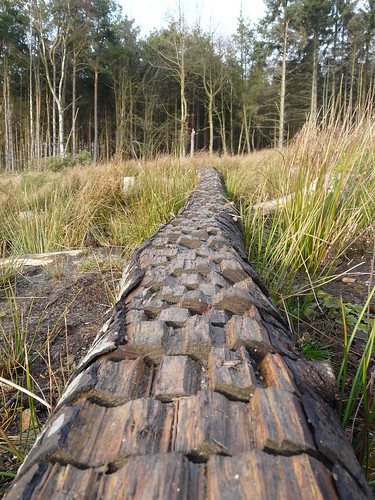 [/img]
or
[img] 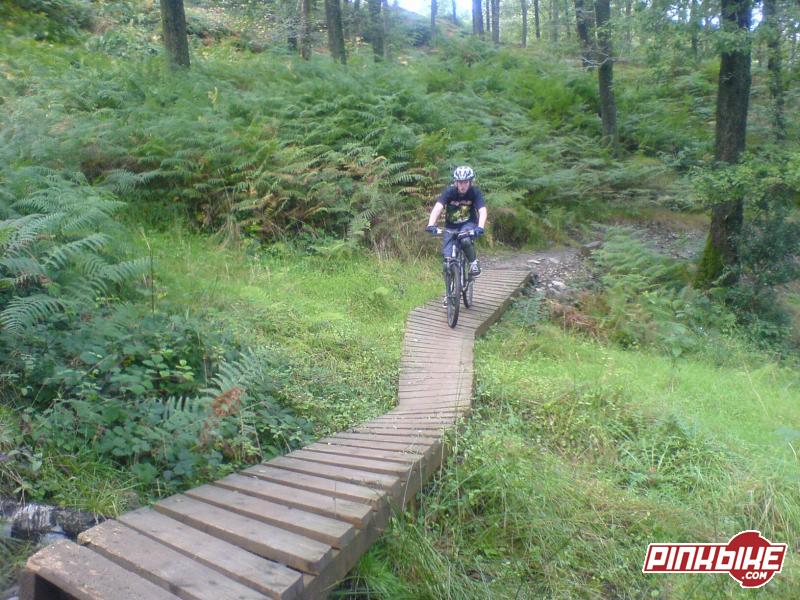 [/img]
Ok, so it's lots of work, but once it's done, it's going to be the best solution.
[img] 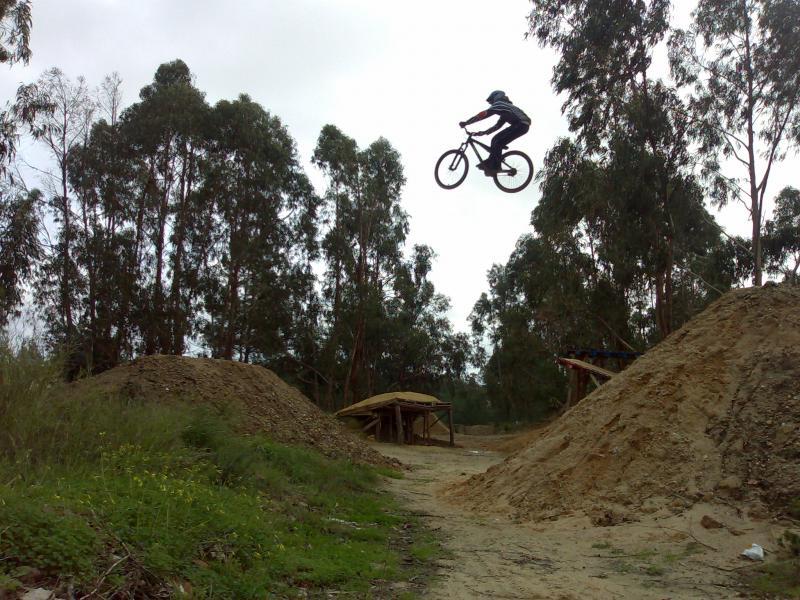 [/img]
and put some chicken wire on it? if you just fill in with earth, ur likely to create an "environmental impact"..
#1 looks really good - chainsawed out of big tree trunks? No trees of that size in our forest, unfortunately (not sure we'd cut them down if there were), but that's something I hadn't seen before.
It'll probably end up something like #2... just wondering if there are other clever ways to go about it.
@reggie - there'll be a little bit of that, for gapping some drainage ditches and the like. But on a scale more suited to 30-year old blokes who can't revoced form 20 foot falls any more.
@smiff - if we fill it with dirt, it'll be a bog again in an hour. Needs something solid.
No1 was chisselled by hand, no chainsaw involved.
Got any BIG ROCKS nearby? That's another solution that's been used at Stainburn to cover boggy ground.
Lots of limestone rocks, but wet, algae-covered limestone rock dumped onto soft mud isn't a great idea for a long, thin bridge.
Simon - Member
No1 was chisselled by hand, no chainsaw involved.
I further tip my hat to the chisellers, then. That's serious work.
Aye, it took a while!
if you look up 'stainburn uselessness' on vimeo by Chris Maloney you'll see me repeatedly falling off that chiselled log
I've heard numerous arguments against using chicken wire over woodwork, but find wooden board walks very slippery in the damp, as a solution how practical would it be to build a wooden 'tray' which can then be filled with rocks and earth, with an air gap below so allowing it to drain and not just become part of the bog?
Again, this is on Cannock Chase
[img]  [/img]
The caption underneath the photo reads
The first of three new boardwalk sections on Section 11 of the Follow the Dog mountain bike trail at Cannock Chase.The boardwalk sections were added due to wear on the trail, and also because these bits get extremely wet and boggy during winter.
Photo from here btw http://www.flickr.com/photos/williamhook/6208077589/
Oh, and as for how to make them less slippery in the wet, what you need is industrial grip tape.
http://www.heskins.com/griptape.htm?gclid=CM7EysHwy7MCFe_MtAod90UA-Q
hmm what's problem with chicken wire? need something for grip, bare wood with green slime is lethal.. unless some treated wood stays clear? perhaps you can texture the wood a bit but then it might not last. stones on top idea is interesting, sounds complicated though!
ah grip tape! hardly au naturelle but heh.
Instead of using planks use rough cut split logs.
Provides more grip & looks more natural
hmm what's problem with chicken wire?
It tears reasonably quickly, leaving bits flapping about and sharp edges. Loads and loads of U-tacks work well, though take forever to do.
hmm what's problem with chicken wire?
if you fall on it, it will do you some serious damage.
plus it doesnt actually last that long.
hmm good point, not chicken wire then.
the rough log idea is nice. anything like this needs maintenance as it involves nails. unless any master craftsmen out there can construct lovely things with just joints.
[img]  [/img]
pics above look fine but in shady areas over winter everything round here gets covered in slime.
better options for slippery decking:
inserts
varnish and sprinkle with sand while wet 🙂 (like free inserts )
non slip paint
better kinds of stainless mesh?
astro-turf?!
Instead of using planks use rough cut split logs.Provides more grip & looks more natural
Couldn't agree more. Can't find any good pictures of the boardwalk stuff at Gisburn, which is what I was really thinking of, rather than the smooth finished stuff, which does need grip tape in the wet.
Anyone got any ?
Hi,
I am very involved in trail building at Bedgebury where we have a LOT of boggy ground to cover (about 14km of it...). Is this trail going to be open to the public? If so be very careful about what you build. If you build a bridge and it collapses then you are liable. Whereas if people crash on a jump which is solid and visible then you have a good defence (a bit of a generalisation but fundamentally sound).
Wooden structures will need regular inspections and generally only last for 3-4 years before needing replacement. For the FC, chicken wire is no go as it breaks up leaving sharp bits of wire sticking out. Additionally if you crash on it, it effectively "grates" you causing horrific injuries.
The best thing we have found is a bed of crushed concrete (large chunks so it doesn't sink) and then type 1 on top of that. Make sure it's raised well above the adjacent land so water runs off it and ideally dig drainage ditches next to it to funnel the water away. The important thing is to keep water from lying on the trail surface as that will break up the surface very quickly. If you can, putting a geo-textile under the crushed concrete will help significantly as well.
Hope that helps, feel free to email me if you have any questions.
Boris
Those split logs are the grippiest bits of wood I've ridden. No idea what the wood actually is, though I'm sure one of the Gisburn guys will be along tell us soon.
I'd second tape over chicken wire for the wood. I've seen a lot of ripped up chicken wire and you go from grip to no grip in about a tenth of a second.
The trailbuilders at Glentress have tried a few things as replacements for rabbit netting (which is a different gauge to chicken wire, I believe). The problem they found with grip paint-type solutions is that the wood needs to be properly dry when it is applied. This can be hard to achieve on brand new constructions, but almost impossible when planks need new coats of grip paint due to wear.
The technique currently being used at Glentress is to attach grip tape to thin Alu strips, which are then screwed into the woodwork. When a strip's grip tape wears out the strip can easily be removed and a spare strip put in its place. The removed strip can then be taken back to base and re-taped with fresh grip tape.
No expert but the raised wooden sections at Gisburn are just rought cut angled wood and offers plently of grip.... ok only just when covered in snow 😯
varnish with sand mixed in...?
Gisburn boards are fine when dryish. A mate went flying when it was snow/icey though.
recent ride on very wet boards at Gisburn and looked deadly but were
surprisingly grippy .
around 1 min in this video nothing rad Sorry .
[img]  [/img]
[img]  [/img]
[img]  [/img]
[img]  [/img]
[img]  [/img]
I think the latest thing we're going to be trying is a layer of geo-tex with material on top. I'm told this is what the professional trail building companies use to cross boggy ground.
How does that hold up in the longer term? I did some building with the national trust a long, long time ago and they were ripping out similiarly finished woodwork as it was rotting incredibly fast- they reckoned the roughed surface retained too much water. Ironically we were replacing it with pine planks, which also got ripped out about 5 years later as they were pure 100% slippery death.
approx 10 years, I think. The FE have an abundance of trees, so the presumption is that they can reasonably easily be replaced. Not sure what will happen with the big log ride at Gisburn above^ in 10 yrs. It would take quite some effort to replace that.
Not bad at all then, cheers!
All the timber used on Cannock Chase is rough sawn and either Larch (un treated) or treated lesser softwood. The rough sawn finish is nice and grippy for quite a while although does become become less grippy in the end.
a cheapish retro fit solution is waterproof pva glue with sand mixed in a bucket and then brushed on.
I've got a section (on the Cannock downhill site) where well be trying a non slip paint so time will tell.
chicken wire is a no no ( although it can be found in some locations around the country)for the reasons already. Mentioned. It does tear leaving spikes which are hazardous to both users and local wild life
there are quite a few examples on Cannock Chase and in the past it has been noted by national FC bods that Chase Trails work is some of the best quality boardwalk on FC land :o)
Was on follow the dog this after - it was very wet, very muddy but the boardwalks were absolutely fine. Whatever they do at Cannock - copy it. 8)
The boardwalk at Gisburn is split not sawn. Geo textile can work, we used it on some boggy sections when I was working for Climbs. Can fail spectacularly though, some trails near me have flooded under the textile, it now pillows when you ride over it which is very weird. Another option we've used at Gisburn is to lay a thick layer of pine branches over the bog, use logs either side of the trail and then build the riding surface up. The Gisburn boardwalk is held together with threaded rods through the log sub structure which makes it pretty strong. Needs a big drill though, ours is petrol driven.
rough sawn timber is going to be the cheapest and least maintenance intensive option
failing that, as suggested find some big stones
hmm i tried to introduce geotex (membrane) at QECP and it got turned down as not natural.. pretty funny considering what else we do up there. it does look shit if it shows though!
Also, imho, but membrane+scalpings makes for a pretty boring looking trail, ok for a blue maybe, but i'd rather ride some nice boards any day as they make a nice feature 🙂
the pine branches thing is interesting, doesn't that bounce all over the place?
I've always wanted to try a "tar and chip" sort of treatment like they use on roads. I planned on using roofing cement and 1/2" crushed limestone to make some pressure treated lumber bridges slip resistant. A local environmental nazi was such a PITA about the bridges in general that the municipal parks guy wouldn't go for the tar and chip and was sort of reluctant to approve the bridges.
Also, you might find some ideas in [url= http://www.fs.fed.us/t-d/pubs/pdfpubs/pdf07232804/pdf07232804dpi72.pdf ]this.[/url]
[img]  [/img]
smiff - Memberhmm i tried to introduce geotex (membrane) at QECP and it got turned down as not natural.. pretty funny considering what else we do up there. it does look shit if it shows though!
We've used it a bit at glentress but for subtraildrain lining only rather than tray construction... Very clever stuff. And no less natural than taking a hill, dynamiting it, crushing the bits then pouring it into a hole and compacting it, really.
Put a foot of material over the pine branches, that'll keep them down, the more pine needles / twigs on the branches the better. The picture on that guide above shows the floating trail concept quite nicely. I don't like geo textile and gravel much, when the gravel wears through there's nothing but mud underneath, plus if it's on a slope water can wash all the gravel off very quickly. We use Wallingford stone below the gravel at Gisburn. Once the initial smoothness wears off you get an interesting and sustainable riding surface.
Those split logs at Gisburn were slippery this morning with a layer of ice on them!
Liked the new swoopy section BTW.