So when it comes to Boost and forks I thought the increase in spacing was being marketed as being more capable of taking a wider "plus" tyre set up.
Today I was looking at a Giant XTC(?) carbon in my LBS. Lovely looking bike.
The bike comes with a Boost fork, well it sort of .....
The fork in question, a Fox, was spaced at the axle for Boost, but not at the brace or crown. There was no additional clearance at all or a tyre and the clearance still only looked good rather than great for the tyre fitted. Fox seem to be able to "get around this" by adding cut outs to the insides of the lowers.
[img] http://www.pinkbike.com/photo/13370548/ [/img]
Apart from cost cutting/re using tooling/existing CSUs why do this? Why not use a 100mm spaced front hub?
I can only see this being beneficial from a paper review as it embraces a new std.
Convince the pessimist in me this is not so 😀
If what you're saying is correct then definitely sounds like a bodge to "accommodate" a new standard rather than actually utilise it for the positive*.
*If you consider Boost as a positive is upto you of course. 😉
It's a step cast fox, wider and therfore stiffer hub fitted to a lighter non-boost chassis.
XC racers that the fork is aimed at don't want plus tyres, but do want stiff wheels and light components.
Boost standard was originally intended to make 29 inch wheels stiffer by spacing the flanges further apart. + wheels and tyres didn't really exist then so the fox fork is fulfilling boosts original purpose.
Wow ..... The marketeers got to you guys good ...... **dons tinfoil hat**
Boost standard was originally intended to make 29 inch wheels stiffer by spacing the flanges further apart. + wheels and tyres didn't really exist then so the fox fork is fulfilling boosts original purpose.
This, boost was about before the plus trend. It's about spoke angles, innit.
[img]  [/img]
Stiffer wheels? Stiffer forks? More tyre clearance? Which one is it? Or is it all of these?... Probably just depends which comic you're reading...
Only I don't really remember anyone actually demanding that their wheels be made marginally stiffer, 3" tyres given slightly more clearance or their fork be made imperceptibly stiffer, and that they had to be compelled to buy new wheels all at the same time... Was the MTBing world crying out for "Boost"?
Or is it simply to help the OEMs sell you a new bike, by bolloxing backwards compatibility?
The fork in question, the step cast Float 32, was made like this for reduced weight without too much loss of strength or stiffness by making the whole chassis narrower to the point that the lowers need cutting away to fit the axles and disc in.
Nothing to do with Boost, though doubtless they've updated it for the new standard that's taking over.
http://m.pinkbike.com/news/fox-32-step-cast-fork-first-look.html
[img] 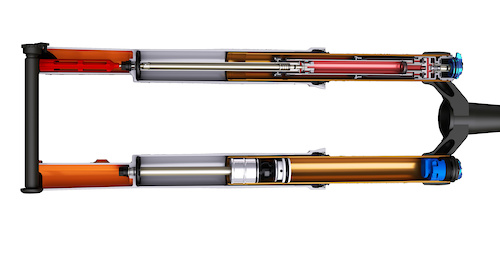 [/img]
So old it's new...
Go back twenty odd years and essentially the early bombers were constructed the same way. The bottom of each lower leg was hollow with the lower fixings recessed a couple of inches inside...
not even trying
[img]  [/img]
not THAT's a slimmed-lower Marzocchi fork.
The fork in question, the step cast Float 32, was made like this for reduced weight without too much loss of strength or stiffness by making the whole chassis narrower to the point that the lowers need cutting away to fit the axles and disc in.Nothing to do with Boost, though doubtless they've updated it for the new standard that's taking over.
This. Yes I get everyone hates boost (not fussed either way personally) but half the arguments above aren't relevant.
TBH since the Elders of Bikedom have decreed that Boost is the new "standard", it makes sense for all forks to switch to it, even if they don't go for wider arch widths or similar.
Also, the stepcast forks are all designed to be essentially XC race, now that the 34 has taken over trailbike duties, and you'd have to be some sort of incredible div to make a Plus XC race bike... They'll probably suffer a little for accomodating the wider axle but it'll not be much.