UPDATE: CLASSIFIEDS section refreshed, redesigned, searchable: Go take a look
Our new (v. old) house has the thermal retention properties of a soggy cardboard box. It's a solid sandstone construction and goes cold very quickly once the heating is turned off (you can see your breath).
As a starting point I would like to at least make the bedrooms warmer, and so was wondering if installing internal insulation on the exterior walls is easy / advisable to do? Or should l get the pros in?
Our bedroom has a cold spot on one wall, with condensation, so l need to bear that in mind. Other than that, the walls are already plastered - would this have to come off before mounting battens to the wall? Lastly, what brand of board would you recommend?
Thanks!
Its a DIY if you've some knowledge and basic tools.
Imagine making a timber frame inside your current room (not touching the stone), and then insulate within (and behind), then plasterboard.
I built my wife a tackroom, inside one of our outhouses. Hard to get a picture, but:
[IMG] 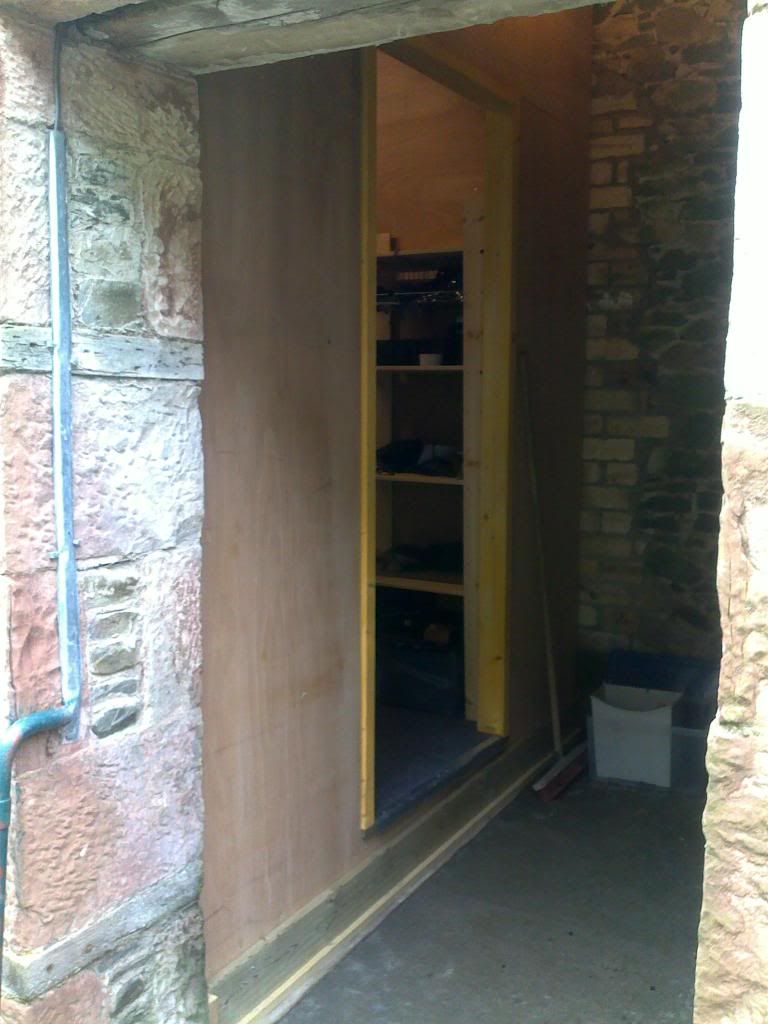 [/IMG]
I'd be worried about causing damp in the wall. That's not to say a "professional" would do any better a job than a competent DIYer, you just need to do it right. Not sure where I'd head to get info on doing it right.
Not sure if that post helps or hinders!
in our bedroom:
i built a thin (40mm) stud-wall 'frame' up against the external wall - bonded to it at a few places with expanding foam, the whole structure is very solid.
each 'window' in the frame has a piece of 25mm celotex cut to fit.
9mm plasterboard on top.
toasty warm 🙂
(i could have used insulated plasterboard bonded to the stonework to save a bit of space, but the wall was all higgledy-piggledy anyway, the new frame provides a much flatter surface)
UrbanHiker - MemberI'd be worried about causing damp in the wall.
the space between the frame and the stonewall is very drafty, there's plenty of air movement over the cold surfaces, - i'm more worried about the damp patches of condensation on the walls i haven't 'done' yet (in the kitchen).
i will win the war against the cold!
Insulated plasterboard on timber battens on strips of dpm is the way to go (see kingspan insulation technical PDF) this works fantastically well. The timbers line and true the wall. If you just bung insulation behind plasterboard without a foil back or vapour check you are likely to get condensation issues from the inside (think single glazed windows on a cold day) also key to damp penetration is external ground levels, make sure the external level is at least 6'' below the internal level.
^^ +1
insulated plasterboard, built onto timber frame. We did this upstairs when we built into the loft and it works well. Makes the wall thicker by ~60mm-ish but it's a small price to pay.
ahwiles, how did you stop the drafts in between the wall and insulation getting into the room? Just sealant round the edges? What flooring do you have? Genuinely interested, as have been thinking of doing my DIY for years, but never had the courage.
it took a bit of time...
i used 4 pieces of 15x15 batten to make a lip in each 'window' for the celotex to fit up to.
(25mm celotex + 15mm batten = 40mm frame)
then i made each piece a snug fit, then i glued it up against the lip.
i'll stick up a photo later, if i can find a good one...
Something to think about - If there is a leak on your roof at the gutter area, or indeed from the gutter, you would normally see it manifesting itself on the wall. Would this not go unnoticed if you had what is effectively a false wall inside?.
If you just bung insulation behind plasterboard without a foil back or vapour check you are likely to get condensation issues from the inside
Thanks - l can see this being an issue to watch out for. My question would be, should the DPM just be behind the battens, or should it be a sheet covering the entire wall?
Also, if l board the wall up, how does the wall behind it breathe? Should there be a gap at the bottom of the insulation boards and the floor?
Those guys who have done this with a vapour check, what do you do with the barrier at the interface with the floorboards/ceiling? I'm wondering how you stop the potential moisture reaching the end of the joists.
Plastic sheet between the plasterboard and insulation/studwork.
I just bought 4mx25m, about £25.
http://www.natural-building.co.uk/systems/renovation/pavadentro
Speak to these chaps, well worth the cost from a performance, simplicity and avoiding interstitial damp issues.
b r, where does the plastic sheet go when you reach either the floor or the ceiling though?

