I just blogged that! 😀
Interesting film, a goverment that listened to its people 🙂
I got it off facebook from a mutual friend so probably from you 🙂
The Dutch, mad as hatters, but in a conformist kind of way...
sadly there will never be the public will to make it happen here 😥
Fascinating stuff.
400 kids killed in a year... you just know that this country still wouldn't act.
Typical cycle paths -
NL:
[IMG]  [/IMG]
UK:
[img]  [/img]
I nicked it from Dagmara , shows you how quickly things can spread though
those dutch cycle paths look dull.
thank god for British potholes, glass, burnt-out mopeds, and scallies with air-rifles!
who needs coffee? - i get to work more alert than an alert thing after a refresher seminar on 'how to be alert'.
🙂
400 kids killed in a year... you just know that this country still wouldn't act.
Yes we would. But we'd act by banning kids from cycling. 🙁
Interesting video; I just sort of assumed that Holland had always been groovy and bike friendly.
thank god for British potholes, glass, burnt-out mopeds, and scallies with air-rifles!who needs coffee? - i get to work more alert than an alert thing after a refresher seminar on 'how to be alert'
Hahaha. You read my mind!
I believe the dutch always had more cycling than the UK - but from the 70s onwards policy was designed to encourage cycling as usage was declining.
sadly there will never be the public will to make it happen here
I think there could be. I live on the outskirts of a medium sized city and try and avoid driving at all costs. Last time I had to drive across the city centre at rush hour, my average speed was less than 1 mph. Most of my workmates have changed their working hours due to traffic and journey time. Fuel and parking costs are eye-watering, despite the government's efforts to paper over the cracks. Something's gotta give.
A lot of that rings true with what's happening today... overloaded roads, high oil prices etc.
Car Free Sundays - what a great idea though.
Not to mention 2,500 children killed or seriously injured in road accidents last year.
http://www.dft.gov.uk/statistics/releases/reported-road-casualties-gb-main-results-2010
It's OK though, apparently our roads are safer than ever. 🙄
A car free Sunday was attempted here in Stavanger a month or so ago.
It was apparently the heaviest car traffic ever recorded in the area. Unfortunately, there was also a bike race (that i did) that finished in the city centre. Because almost every driver ignored the car free directive, the race in to the city centre turned in to a battle with hundreds of irate car drivers. It was a shambles.
I was a bit unsure about some of the Dutch cycle paths as they don't always follow the roads. Great for me as a touring cyclist but having tarmac cycle lanes going through fields seemed to make the countryside a bit less rugged so not so good for ramblers. But maybe they have so little rural space there's not much to spoil?
Having a country so completely flat it's virtually downhill helps with the uptake of cycling.
And the reason they have room for their cycle paths is because they systematically knocked buildings down to expand roadways, something they could afford due to an incredible economic boom.
When the same conditions exist here, it'll happen here.
The same process has happened in Germany, starting in the 80's. now quite an extensive cycle path network, although not up to the standard in the Netherlands. Now virtually every new road includes a separate cycle path alongside, and many more are being build alongside existing roads.
Train stations and tram stops have facilities to lock up bikes, as do supermarkets, public buildings and they are also scattered around town centres. Through summer nearly everyone cycles for some of their journeys, whether that's commuting, popping to the shop for milk or a Sunday morning bimble with the family.
I think that without the political will to create the facilities then the situation would be the same as the UK, Germans do after all love their cars.
the reason they have room for their cycle paths is because they systematically knocked buildings down to expand roadways, something they could afford due to an incredible economic boom.
You think the same thing hasn't happened in the UK? The difference is more in the way streets are laid out, not to mention the way the on-street parking is catered to in the UK like it was a fundamental human right:
http://hembrow.blogspot.com/search/label/notenoughspace
Having a country so completely flat it's virtually downhill helps with the uptake of cycling.
It's not all like that, and even the flat bits have headwinds and reliably sh!te weather. Also from the blog above:
http://hembrow.blogspot.com/search/label/hills
wow.
a 70m climb? (with a maximum gradient of 11%)
hardcore.
Not likely as the government in the UK does not actually want to make any decisions. Fantastic for quality of life though being able to cycle/walk without worrying about cars or other traffic.
Klumpy - even in the mediaeval bits with narrow streets the bikes get provision. Its about how you divide up the space
if there is say 15 m width between buildings here we would have a 2 m pavement, 11 m road, 2 m pavement. In the netherlands you would have 2 m pavement, 2m cycleway, 7 m road, 2 m cycleway 2 m pavement
fascinating.cheers.
I lived in the Netherlands for several years. Provision for cyclists is fantastic there but I have to say that it is all about utilitarian transport and consequently a lot of the riding is really rather dull. Off the cycle paths (they don't go everywhere) the level of tolerance for cyclists by drivers is really not much better than here. The other thing to point out is that the geography of the Netherlands is particularly suited to building a decent network of cycleways. Apart from being flat, a significant proportion of the network is built around the polders and drainage canals. It's an artificial landscape anyway so folk aren't as sensitive to planning decisions and the structure of the canal system really lends itself to overlaying cycle paths. We can certainly learn a lot from the Dutch model but it'd be really difficult to apply in most of the UK.
I live in a Suffolk town where cycling is common place. Not just kids although more of them go to school by bike than anywhere else in the UK but also commuters , shoppers etc. Very rare that someone doesnt own a bicycle.
This is due to the provision of a large network of cycle paths when the housing was built. Its not perfect but well ahead of most places because cycling feels like a safe option.
The other thing to point out is that the geography of the Netherlands is particularly suited to building a decent network of cycleways
Germany has just as much challenging geography as the UK, and have made much much more progress in creating proper cycle paths, its about the political will, nothing to do with geography.
Indeed. Dutch also have a worse climate than the uk for cycling - lots of wind and rain and colder winters.
Its purely policitcs / social pressures.
With the political will we could easily go down the same road
wow.a 70m climb? (with a maximum gradient of 11%)
hardcore.
You can get between many places in the UK without having to ride up anything steeper. Cycling in the UK is hilly and slow because we use quiet roads or cobbled together cycle paths. In the Netherlands it seems like the paths tend to be built on the same route as main roads, so they're quicker and flatter.
+1 on policitcs / social pressures 🙂
Germany is also planning to build new coal burning power plants, as there is plenty coal left,
While here we are trying to cover our hills with inefficient wind turnines 🙂
I see about half a dozen cyclists a year Commuting here in East lothian (never the same cyclists daily),
Look at the train stations here and lucky if there are a dozon bikes parked, why?,
I get buzzed by lots of big shiney motors going far too fast on hedged country roads when cycling, and a lot of folk say to me that they wont cycle because of this having happend to themselves,
too many folk are just too wrapped in there own lives and selfish to care, guess peoples attitudes need to change here as well,
It's an artificial landscape anyway so folk aren't as sensitive to planning decisions
The Dutch blueprint seems to be making cycle routes next to, but separate from, major road routes. These are usually the most direct and the flattest route so it makes sense to send the cycle paths the same way.
If you're making a cycle path next to a major road, who the hell is going to object on aesthetic grounds?
It's lack of will, plus the feeling that all available space needs to be allocated to cars.
I'm pretty sure that at present there is no requirement for UK transport infrastructure to cater to cycles - one simple change at policy level could revolutionise this.
I think they did meet stiff opposition when it came to making town centres car free. Dutch urban planning seems to have quite a "top down" approach which must have helped.
In Wales, the Government is taking forward a Cycling Bill which will make it a legal duty for local authorities to provide cycle routes:
http://www.goinggoingbike.com/blog/welsh-cycling-bill-will-make-it-a-duty-to-provide-routes/
Obviously the devil will be in the detail, but it's an important first step in showing some political will. The more support for this from cyclists the better, as the cultural apathy, or even at times resistance, in the UK towards cycling initiatives is one of the greatest barriers to improvements.
It's not all bad here. The cycle path beside the Cambridge Guided Busway is a thing of beauty that could stand comparison with anything in Holland. It can get very busy around 9am during term time.
The other thing to point out is that the geography of the Netherlands is particularly suited to building a decent network of cycleways
Germany has just as much challenging geography as the UK, and have made much much more progress in creating proper cycle paths, its about the political will, nothing to do with geography.
Did you actually read my post? Of course practical / political will is a factor - but it's ridiculous to say that geography, planning sensitivity and more to the point, existing infrastructure isn't a factor. It's far easier and cheaper to run a new cycle path over say a disused railway line or drainage dyke, or alongside a brand new road than it is over virgin countryside or to apply it retrospectively to a city centre built around a pre-Roman model.
Both Holland and Germany took the decision to start afresh when rebuilding after WWII in most of the large population centres and a lot of their large cities were already built on the grid model anyway. This gave them much better opportunities to build an urban infrastructure that could accommodate different modes of transport at a later date. In most cases we took the opposite route and built up everything as it was before (just look at London).
I'm not arguing that it shouldn't happen - I'd love to see it happen here, but I think that we have to be realistic about some of the challenges.
Both Holland and Germany took the decision to start afresh when rebuilding after WWII in most of the large population centres and a lot of their large cities were already built on the grid model anyway. This gave them much better opportunities to build an urban infrastructure that could accommodate different modes of transport at a later date. In most cases we took the opposite route and built up everything as it was before (just look at London).
Holland started building cycleways in the 70's Germany the 80's, German cities have grown just as organicly as UK cities, there is no grid pattern in Darmstadt where I live and work, or Frankfurt just up the road.
I think you're missing the point completely. It's always easy to quote an exception but on the whole, post WWII rebuilding in Europe gave far better opportunities for future provision of mixed mode transport than it did here.
Agree with many points that a totally segregated network is not practical in the UK. One point that we need to consider - whilst many other N.European countries followed the netherlands; the reason Britain buried it's head in the sand was that we were sheltered from the oil crisis to a degree by north sea oil & gas and therefore continued the 'predict & provide' for growth in motorised traffic.
It would be absolutely impossible for the UK to replicate this kind of change for just one simple reason - local politics. Local government does not have the power, money or political will to implement any such radical change. The political will is the most important; until local elections follow a similar pattern to national elections (i.e. only held every 4-5 years) then local councillors will continue to make decisions which are rooted in their awareness of the short term impact on their political survival. Council elections are often annual or, at the most infrequent, every two years. This is simply not conducive to strategic change.
(just look at London)
Central London roads underwent massive widening before and after the war. Lots of historic buildings were demolished. Park Lane is just one example.
Britain has thousands of miles of canal and thousands of miles of disused railway. And that's just one way of putting in new cycle routes.
On David Hembrow's blog (again) he cites the example of Maastricht - a hilly medieval area. About 30% of journeys under 5 miles are still made by bike, because they have the right infrastructure. It's not "exceptional", it's an example of how journeys by bike can still massively increase with proper planning.
http://hembrow.blogspot.com/search/label/maastricht
I think you're missing the point completely. It's always easy to quote an exception but on the whole, post WWII rebuilding in Europe gave far better opportunities for future provision of mixed mode transport than it did here.
I totally disagree, as mentioned Germany didn't start building cycle paths to any degree until the 80's. Its taken nearly 30 years to get where they are today, but they made a start and now have a pretty good cycle network, which they are continually adding to. Going into any German city you really wouldn't notice any great difference to layout to British cities, the differences that you think exist just don't.
Local councils in most of Europe have more power then in the UK, where centralisation would actually make it easier to create such changes.
I feel i should stick up for the UK just now
I have now worked for a local authority for 2 years and every working day of that time I have been designing and building cycle routes and infrastructure, to the extent that we are now spending more on new copenhagen style cycle routes than ever before
granted we are 30 years behind the rest of the EU but we are working very hard at catching up
Britain has thousands of miles of canal and thousands of miles of disused railway. And that's just one way of putting in new cycle routes.
Er.... I think we're in complete agreement on that. See earlier post.
Right! So why would building better cycling infrastructure in the UK involve running cyclepaths over "virgin countryside"?
local councillors will continue to make decisions which are rooted in their awareness of the short term impact on their political survival
I think that in practice this means "they listen to the group that shouts the loudest". A cyclist/parent alliance along the lines set out in that video could be that voice.
Not just the car-bike segregation, but the bike-pedestrian segregation. In UK they just paint a white line down a pavement and call it shared use... put all the bikes in the "kids not looking when they open the car door to go to school" zone, rather than in the road with the "school mums not looking when they pull in/out" zone.
In Netherlands a "shared use" bikepath/footpath is often clearly marked, different surfaces, small kerbstone between the two. Pedestrian bit paved, bike bit in orange tarmac. And then often something (hedge etc.) between cycle lane and road.
Not sure how easy it would be to change the mindset of Brits either, with regards to bikes having RoW to cross T-junctions. And then roundabouts... having to give way at exits to the crossing cycle lane. That'll never happen in UK.
Right! So why would building better cycling infrastructure in the UK involve running cyclepaths over "virgin countryside"?
Jeez... I'm not saying it should, although in some areas it would have to. The point I was trying to make (badly obviously) is that the existing built and natural geography of a country are a factor as well as the political will.
I think I'll just get my coat now... 😕
Jeez... I'm not saying it should, although in some areas it would have to.
why would they have to?
Perhaps it would also depend on if you classify farmland as "virgin countryside" or as agricultural factories.
I am all for protecting "virgin countryside" bit there are only small pockets of that in the UK, and I wouldn't see decent cycle paths alongside existing roads in those areas as having any real impact.
What we need to do is as the dutch did - take a bit of space away from the cars and give it to the cyclists,
If you wanted the same density of fully segregated cycleway provision as you have in Holland, I don't see how you could avoid it. Canals and old railway lines are great as trunk routes but they don't go everywhere. Sure you could upgrade existing rights of way and add in cycle lanes to existing roads, but in some cases there's no room and you'd have to either widen or forge new routes.
sproketjockey - no - you need to take some space from the roads to build the cycleways - same total width of tarmac. but inste4d of a 12 m wide road you have a 10 m wide road and a 2 m wide cycleway - and if that makes the road into single track then so be it.
Its about rebalancing the use of space
If this link works it should be an example - this is common in the Netherlands - the road is used as a single track road and the cars pull over onto the marked cycle lane to pass each other
What to do with narrow rural lanes: http://waronthemotorist.wordpress.com/2011/10/27/on-country-lanes/
TJ - I understand completely. As I said, I lived there for several years. But that's a two lane road reduced to single lane to allow for cyclists. The fact that the cars pull over into the cycle lane to allow passing means that it's not fully segregated. I agree that's a model which would work well in a lot of places but what about if it's single lane already? - that's the case with most of the roads where I live.
You'll have probably have seen on your trip that a lot of Dutch towns and villages have dedicated cycleways connecting them which follow the lines of drainage canals, dykes and polders and are pretty much independent of the road network. To recreate that sort of thing here you couldn't avoid building new routes or encroaching on green belt.
Actually, our roads have had room for cyclists, and so cycle lanes, for ... ever. 30 yrs ago they could've been put in pretty much everywhere easily enough but cars got very wide (why!?) and the roads stayed the same. There's a mint mk1 escort (I think) in Wells, it's a saloon car, and it's smaller than what we now call a mini. Mental.
Personally in the countryside I cant see why you cant knock down the hedgerows and just make the road wider. To allow cars and bike and Pedestrians.
Presumably you could regrow the hedgerow.
I reckon everytime a road is upgraded or retarmaced it should be widened to include all three transport methods.
The only reason not to is the cost as far as I can see.
but cars got very wide
This is so true !
you'd have to either widen or forge new routes
There's photo on the Hembrow blog of them [i]diverting a canal[/i] to put a cycle route in! I realise we're not going to get to that stage overnight but it puts your concerns over road widening into context.
The reasons it's not happening over here have little to do with climate, infrastructure or geography. It seems to be a mix of historic failure to provide for cycling, rejection of segregated cycle routes by a hard core who feel happier on the roads (CTC actively campaigned against cycle paths at one point), little to no provision for cycling at a policy level, and just utter ignorance of the benefits that mass cycling could bring.
There's photo on the Hembrow blog of them diverting a canal to put a cycle route in!
I love that example. It was in order to avoid having a bridge over the canal and then back again later on. IIRC, they moved the canal sideways by 5 metres.
I anot in favour of cyclepaths everywhere - I like a whole range of solutions as they have in the netherlands.
The one I really like is in urban areas - 20 mph speed limit, no road markings and priority to pedestrians first, then bikes, then cars.
If you like Dave Hembrow, he features in a documentary film called [url= http://www.bikebeauty.org/New_2011_Edition_BATB/Home.html ]Beauty and The Bike[/url]. (There's a showing in Newcastle on Friday.)
(Very) short version:
There's also a beardy cargo bike-riding ICT teacher in it too 🙂
The one I really like is in urban areas - 20 mph speed limit, no road markings and priority to pedestrians first, then bikes, then cars.
I really like that "Naked Streets" idea too - they also get rid of all the street furniture. There's a couple of trials happening in the UK already. I like the idea that the motorist, in the absence of any familiar reference points has to slow down and is forced to interact with other road users. Again, horses for courses though.
Yep, again that's quite popular here in Germany, but I think that it has to be a slow move to that in the UK.
I really like that "Naked Streets" idea too
Second (third?) this.
There was a great book my parents got about a guy who did this all over the world. His work reduced maximum speed, increased average speed, and reduced accidents. The blending of vehicle and pedestrian space makes everyone (EVERYONE, it's not just the motorists) take more care, the lack of space makes everyone more courteous (they had to be) the lack of directed priority makes everyone more careful.
Basically, if there are no rules, you have to interact cooperatively.
[url=
rules driving[/url]
And yes, it even works in the UK.
I really like that "Naked Streets" idea too - they also get rid of all the street furniture. There's a couple of trials happening in the UK already. I like the idea that the motorist, in the absence of any familiar reference points has to slow down and is forced to interact with other road users. Again, horses for courses though.
They supposed to have done this on exhibition road London, but to honest it just looks like it going to be a normal road.
What has really annoyied me though is they have put these lights in the centre. but mounted them in these massive circlar rises which really reduce the width of the road.
No, I think that's something completely different, naked streets are residential areas, no distinction between pavement and roads, no traffic markings or signage.
we can do it in the UK.
look at the this road:
B7078 - used to be the dual A74 when the M74 open they turned the road back to single carriage way and used the old bit of dual for a bike track...
only seems to be useful to Lejogers though (which is was!)
see streetview
[img] 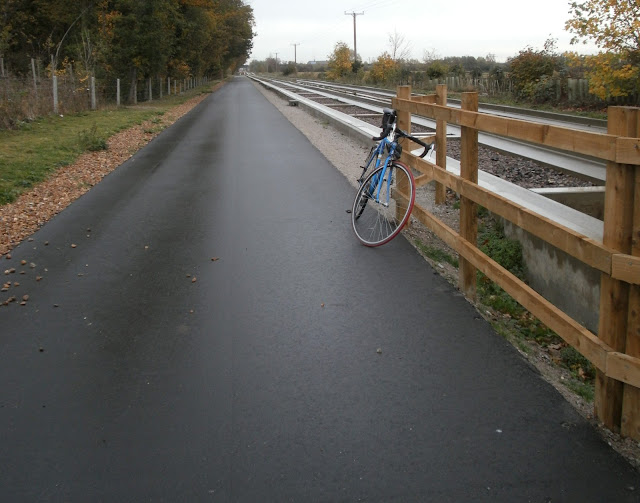 [/img]
Cambridge Guided Busway. Would be the best cycle path in the world if the blacktop went all the way to St Ives. As it is, it gets all bumpy and gravelly for the last 5 miles or so. Still pretty good though.
[img]  [/img]
hey, we've got some great cycle paths in the UK, just look at this one, it even has a shelter to rest in half way along its length.
[img]  [/img]
I love the way yo can almost guarantee any cycle path in the UK will disappear when its actually needed - like on narrow bits of road and at junctions
some beauties on here
http://homepage.ntlworld.com/pete.meg/wcc/facility-of-the-month/index.htm