I understand where the measurements are taken from.
Surely reach & toptube length have similar traits?
With reach, it doesn't account for seat tube angle?
How do i best update my aging grey matter to the newer concepts???
[img]  [/img]
Reach is going to be much more relevant to DHers for example than road riders due to time spent out of the saddle. It's just a different way of measuring that'll suit some riding (or styles) more than others.
It also gives a better indication of weight distribution (more reach = more front wheel load)
this explains it better than your picture from 1987
Reach is going to be much more relevant to DHers for example than road riders due to time spent out of the saddle.
I'm a definate XC kinda rider, but do now own a droppa!
clicks tranny link
As the link says, you really need to consider both unless you're going to spend almost all your time either in the saddle or off it.
It also gives a better indication of weight distribution (more reach = more front wheel load)
Other way around.
The other thing about reach is it doesn't vary much with stack height, whilst ETT varies a lot - so a 29er with a tall stack height and slack seat angle will have a much longer ETT than a smaller wheeled bike with a steep seat angle which has the same reach.
More reach means you move the rider forward so you get more front end load.
Unless you then shorten the rear of course.
EDIT - actually I'm not 100% on this - trying to think of a theoretical bike and extending the reach, whether the rider moves forward or just straightens their arms more - suppose it depends on the starting position to some extent. Also, for out of the saddle, I'd expect the result to be more likely to move the rider's weight forward than when sat in the saddle which I reckon means a more likely straightening of the arms, lowering of the back to compensate. Given that reach is all about out of the saddle, that kind of goes with my original point.
I find the best way to measure a bike is to look at the wheel base and the chainstay length.
If you subtract the chainstay from wheelbase it gives you a good front length - compare it to a bike you previously owned and liked and you are onto a winner IMO.
More reach means you move the rider forward so you get more front end load.Unless you then shorten the rear of course.
EDIT - actually I'm not 100% on this - trying to think of a theoretical bike and extending the reach, whether the rider moves forward or just straightens their arms more - suppose it depends on the starting position to some extent. Also, for out of the saddle, I'd expect the result to be more likely to move the rider's weight forward than when sat in the saddle which I reckon means a more likely straightening of the arms, lowering of the back to compensate. Given that reach is all about out of the saddle, that kind of goes with my original point.
You've definitely got this the wrong way around. Default weighting of a bike when standing up is basically 100% through the BB. Thus the weight distribution between the wheels is the inverse of front-centre/wheelbase for the front, and chainstay/wheelbase for the rear.
Front centre measurement = reach + fork offset + ((fork a-c length + headtube length)x sine head angle)
I'm struggling with this, from the point of view that up till now my previous bikes have been large but with 70/80mm stems and set back seatposts..
New frame manufacturer suggests a 50mm stem and obviously droppers don't come with setback options.. so do I go up a size?
..But then I've ridden/tested other 'large' frames with simliar reach/ETT & short stems and they have felt fine.
Very confused
(my current bike is a medium.. don't ask)
Default weighting of a bike when standing up is basically 100% through the BB
"Through the BB" doesn't mean anything unless the rider's CoG is directly over the BB which I don't reckon it is - otherwise you'd never have any weight on your hands which you definitely do...
So given that riders do have weight on their hands (when standing), the CoG must be forward of the BB. And the more you extend the reach, the more weight they'll have on their hands, so the CoG is moving forward.
"Through the BB" doesn't mean anything unless the rider's CoG is directly over the BB which I don't reckon it is - otherwise you'd never have any weight on your hands which you definitely do...So given that riders do have weight on their hands (when standing), the CoG must be forward of the BB.
If your body is in the correct position you should have almost no weight on the bars except when you choose to load them.
But your body position will be determined by reach to some degree at least - take it to the extreme and make the reach longer by a foot for example and you'll have more weight on your hands/less on the pedals.
FWIW, I'm not sure that there is a fixed 'correct position' is there? Some riding styles or setups may work better with more weight forward than others for example
And if your correct position is right, then you'd agree that by extending reach beyond that correct position will add weight to your hands so it will move the weight distribution forward.
And if your correct position is right, then you'd agree that by extending reach beyond that correct position will add weight to your hands so it will move the weight distribution forward.
Generally increased reach results in a lower stance on the bike, so torso becomes flatter as hips shift further back to balance shoulders coming down and forwards. Lower is better, hence the shift towards bikes with longer reach.
If your bike is so long that you're tipping forwards to reach the bars and thus leaning on them at all times then I don't see the bike riding very well! Watch any DH race footage and you'll see what I mean.
I agree with that theory but I wonder if in the real world that's actually how it works. Especially with middle aged chuffers with guts, dressed up as storm troopers who aren't world class DHers 🙂
hence the shift towards bikes with longer reach.
Oh so we have come full circle have we ? 😆
Whats wrong with sitting on a bike and riding it, thats how I find out if a bike is right for me.
I'm struggling with this, from the point of view that up till now my previous bikes have been large but with 70/80mm stems and set back seatposts..
New frame manufacturer suggests a 50mm stem and obviously droppers don't come with setback options.. so do I go up a size?
Simple answer
Large is a word not a measurement, 2 manufacturers can't agree what large is so don't expect it to be constant.
You can do the maths or sit on the bike, it's the only 2 ways to size it.
Whats wrong with sitting on a bike and riding it
I've never been able to get a bike in my size to test ride. I always go by the numbers. I'm definitely not the only one and in these days of online sales, it makes sense to understand what the number mean (or may mean 🙂 )
Default weighting of a bike when standing up is basically 100% through the BB
seriously? I don't think you should go around telling people that.
OP - I have two bikes, one has too short a reach for my height and the other is OK. When I ride out of the saddle on the one that is too short, in a good riding posture with elbows bent etc, my weight is too far back on the bike because of the short reach, to bring it forward to get good weight on the front wheel and less over the back wheel, I have to really make an effort. On the bike with longer reach, I have a good posture and a good amount of weight on the front wheel without having to try. It seems like there is a trend for longer reach these days, like those new Transitions.
Mike, I canne sit on a pre-order... & need to pre-order the correct size..
Maths suggest I need an XL, previous bikes & one's I've demo'd lately are all Large and have tended to have the same/similar ETT/reach
seriously? I don't think you should go around telling people that.
It's not just me, it's every skills coach out there! Google it. Heavy feet, light hands, etc etc.
There's often a big difference between the right way to think about things (eg coaching) and the actual reality... Feeling that your weight is all over the BB isn't the same as that actually being the case. If we're going to base bike design on the way we think things should be, we'd have some funny feeling bikes I reckon.
BRANT, BRANT, BRANT!
This strikes me as the kind of thing he'd understand from both the theoretical and actual POV because I reckon they're quite different for most mere-mortals.
FunkyDunc - Member
hence the shift towards bikes with longer reach.
Oh so we have come full circle have we ?Whats wrong with sitting on a bike and riding it, thats how I find out if a bike is right for me.
Me to 😆
I placed my old Kona beside my new bike(RM) to check whether I needed med or large, large it was. Being 6ft both were "my size" but the med felt small as did the Whyte bike I tried.
z1ppy - Member
Mike, I canne sit on a pre-order... & need to pre-order the correct size..
Maths suggest I need an XL, previous bikes & one's I've demo'd lately are all Large and have tended to have the same/similar ETT/reach
Wish I had the kind of money this may be costing but even then I'd struggle to take the risk, there are enough good bikes out there without doing so.
Good luck....
There's often a big difference between the right way to think about things (eg coaching) and the actual reality... Feeling that your weight is all over the BB isn't the same as that actually being the case. If we're going to base bike design on the way we think things should be, we'd have some funny feeling bikes I reckon.
When I'm balanced in the attack position I can completely unweight the bars without my body moving. There are plenty of times when you load the inside hand heavily in a turn but that's transient. Watch a slo-mo of a good rider hitting a turn and you'll see the turn being initiated by a combination of lateral hip shift (weighting the outside foot), weighting the inside hand and counter-steering. As the bike reaches the apex the weight focuses through the feet to get that pump to the exit.
how long are you zippy? I'm just under 6'5" and have always had large frames as I have short legs and just don't like big bikes, however I recently got an XL frame and it has opened my eyes. I'm hopefully getting an XL transition smuggler, which has really long reach.
It's not just me, it's every skills coach out there! Google it. Heavy feet, light hands, etc etc.
I don't think a good coach is going to tell you to put 0% weight through the bars when riding out the saddle.
6'2" and alway ridden large & been happy as hell, never even sat on an XL. Current bike 600 ETT (which turns out to be different from the geo chart), a 20mm set back seat & a 70mm stem all add up to suggesting a large 620mmETT and 50mm stem 'shouldn't' be right.
Several demo's of bikes with 620ish ETT and 50mm stem feel fine, so tried a 50mm on my current bike and it's horrible, I'm pushing myself off the back of the seat.
Trekster.. a small guilt free cash injection, but yes it is a huge fricken risk. I've tried the bargain option, and didn't like it.. tried a more expensive option and still didn't like it, this is only a little more expensive again to that just no option to even sit on one.
I don't think a good coach is going to tell you to put 0% weight through the bars when riding out the saddle.
"I don't think" doesn't count. Do some research and you'll find you're wrong.
Nemesis and CGG re reach and weighting - I'd say you're both right, sort of : )
This isn't quite correct as a rule, butDefault weighting of a bike when standing up is basically 100% through the BB
- for you at that point it'll be true if your weight is almost entirely on your feet.When I'm balanced in the attack position I can completely unweight the bars without my body moving.
Reach and Stack vs ETT + SA, knowing both will give you more of an idea of how a bike may be than either in isolation, but applying numbers from an old bike or preconceptions to a new one won't get you that far. A fit that works on one bike isn't optimum for another with different geometry, the 2 have to work together.
Reach and Stack vs ETT + SA, knowing both will give you more of an idea of how a bike may be than either in isolation, but applying numbers from an old bike or preconceptions to a new one won't get you that far. A fit that works on one bike isn't optimum for another with different geometry, the 2 have to work together.
That's what I wanted to say. Except I couldn't put it quite so eloquently.
There's often a big difference between the right way to think about things (eg coaching) and the actual reality... Feeling that your weight is all over the BB isn't the same as that actually being the case. If we're going to base bike design on the way we think things should be, we'd have some funny feeling bikes I reckon.
That's basically an argument to pursue the lowest common denominator~
It's almost as if you're asking designers to engineer in traits that encourage bad habits.
😀
If you're doing things right, the vast majority of your weight should be through the BB... that said, if you can hit a gnarly trail with this kind of position, I salute you (though you'd have to post a video to prove it):
[img]  [/img]
Even when you have mad long Top Tubes, most weight will be going through the BB, unless you are intentionally goon riding:
[img]  [/img]
A shorter top tube/shorter reach will however focus more weight on the front wheel:
[img]  [/img]
This isn't entirely relevant, but I'm including it for the hell of it:
[img]  [/img]
Hmm, if your reach is under a foot you'll be stood almost upright on the pedals, if your reach is >4foot you'll be reet stretched with a lot of weight on your hands and even less able to unweight the front if you need to while going down hills.You've definitely got this the wrong way around
How minor variations on a sensible sized reach work I'm not so sure but the general [i]more reach = more weight on front wheel[/i] sounds fairly accurate to me.
And that's why I'm interested as to whether someone like Brant actually has better info or insight into what actually happens rather than some idea of what it should feel like.
I have to say that looking at some google images of riders side on (mainly DH or at least out of the saddle (OOS) since we're talking about reach) suggests to me that CoG is forward of the BB and there is weight on the hands but that's far from scientific.
You have to remember that the weight is transferred to the front wheel via the axle~ with a longer reach, the majority of your weight is further behind the front axle.
Your core muscles are supporting your upper body, not your arms (unless you're doing it wrong)
With your arms stretched out in front of you, try crouching until your hands touch the floor... you can pull some pretty funky shapes without any weight on your hands
with a longer reach, the majority of your weight is further behind the front axle.
Only if your body or at least, the majority of your mass remains static in relation to the rest of the bike as you extend the reach. I'm questioning if that's what happens in the real world.
If that were the case no-one would ever complain of sore wrists or shoulders. It's only all going through the pedals when, while stood up, you can take your hands off the bar an inch or so and remain in that position without anything more than side-balance support from the saddle. Not many mtbs have that sort of position, mainly DH bikes.Even when you have mad long Top Tubes, most weight will be going through the BB
Jive dunno how true your argument is but you're examples aren't working (for me anyway) on your picture post there's only 1 pedal cycle there and he's riding it like a gimp.
To use your latest idea, crouch down with your hand on the floor just infront of your feet, you can rest them there without any effort, now move your hands 1-2 meters away from your feet, how much weight are you placing on your hands now? The longer the distance the more weight on your hands.
Bikes are more complex but reach [i]on it's own[/i] seems to move your weight forward not back.
OK, referring back to this:
[img] [/img]
[img] [/img]
Even though the 2nd guys hands are in front of the front axle, the bike will be more stable because more of his weight is lower down, behind the front axle.
That will be much of the reason the bars are placed where they are, to get more weight back onto the front wheel for traction
This is a similar concept to the switch to 27.5: in addition to improved rolling, one of the major advantages is the BB is lower in relation to the wheel axles, giving more inherent stability.
Sore wrists and the like are usually down to poor positioning of controls (or poor technique)
There will be some weight going through your arms, but is should be minimal by comparison.
Sometimes yes, or because some bikes simply have positioning that means more weight is more on the hands.Sore wrists and the like are usually down to poor positioning of controls (or poor technique)
both your examples have the "riders" feet close to the rear axle, and as I said aren't pedal cycles, however the top one could move his weight a hell of a lot further back by the simple task of straightening his arms, something rider number 2 with a much longer reached bike can't do* 🙂
*altho having a lot of his weight on his [b]knees[/b] closer to the front of the bike will help relieve stress on his arms it won't move his CoG any further back tho.
Your pictures aren't showing people riding pedal bikes that bear any relation to what we're discussing though - certainly not to my question about what actually happens to CoG as the reach extends.
This is a similar concept to the switch to 27.5: in addition to improved rolling, one of the major advantages is the BB is lower in relation to the wheel axles, giving more inherent stability.
Which makes 29ers 'even better'...
Besides, try and explain that. The lower BB in relation to the axles thing is part of why bigger wheels go over bumps better. What are you defining 'inherent stability' as?
Here we have the ultimate stack and reach reference chart for pedal cycles:
[img]  [/img]
Besides, try and explain that. The lower BB in relation to the axles thing is part of why bigger wheels go over bumps better. What are you defining 'inherent stability' as?
Basically, it's similar to having a lower centre of gravity; the further below the axle that a load is carried, the more stable~ you're right, 29ers are better still for that, but wheel weight, acceleration/deceleration, flex, manoeuvreability, an over saturated 2nd hand market eating into profits etc all play a role 😆
Again, explain why. Weight isn't lower, just lower in relation to the axles. What is actually causing a difference in stability and what are you actually defining as stability?
In a side to side situation, think of it as a boat: weight above the waterline will make the boat less stable, weight below will add to stability
In front rear terms, think of it as a clock face...
The Front axle is the centre of the clock and the BB is the tip of the hour hand...
You are Cinderella and you want to party, but at 12 o clock, you're getting thrown out the front door. (we've all been there)
The lower the BB in relation to the front axle, the longer you can party.
If you get to the party before 9 o clock, you can party harder with less of a hangover
Of course, if you get to the party too early, your carriage is going to clatter on the rocks and mess stuff up, fairy godmother or no.
A certain bike designer of repute would talk about balancing a stick on your palm to show that a higher c of g is actually easier to balance and laugh at the idea of any 'inherant stability' in a bike.Basically, it's similar to having a lower centre of gravity; the further below the axle that a load is carried, the more stable~
Agreed tho, the only thing that changes as your axles go up in relation to the BB is that it can be harder to tip the bike end-to-end around the axles, bunnyhops or OTB etc.
A certain bike designer of repute would talk about balancing a stick on your palm to show that a higher c of g is actually easier to balance
Aye, but does he go around corners 😉
Sore wrists and the like are usually down to poor positioning... (or poor technique)
Forearm strength can help here as well as a relaxed, but firm, grip. And as with any exercise, endurance comes with practice.
But back on subject, the stack is also a pretty important measurement - it's not all about the reach. A low stack and a short reach will be low, cramped and uncomfortable, whereas a higher stack and short reach will push the body back, actually creating the illusion of more room.
Very well, at low speeds : ) I know what you mean, there's situations where he's entirely right and riding a bike based on those ideas is an eye-opener, and there's times when I'd never want to be on a 15" BB bike when I could have my 11.5" BB bike .. usually when it's greasy and the corners are fun.Aye, but does he go around corners
this thread just gets better and better!
anyway
6'2" and alway ridden large & been happy as hell, never even sat on an XL. Current bike 600 ETT (which turns out to be different from the geo chart), a 20mm set back seat & a 70mm stem all add up to suggesting a large 620mmETT and 50mm stem 'shouldn't' be right.
Several demo's of bikes with 620ish ETT and 50mm stem feel fine, so tried a 50mm on my current bike and it's horrible, I'm pushing myself off the back of the seat.
It totally depends on the bike and the shape of your body, but I'm guessing at that height you'll be at the lower end of the scale for most XL frames but not totally off it. I'm buying me new bike blind too but I'm slap bang in the middle of the height range for the frame size. I've also just put a shorter 50mm stem on my too-short bike and I'm also having to try hard to keep my weight forward.
In a side to side situation, think of it as a boat: weight above the waterline will make the boat less stable, weight below will add to stability
The bike isn't a ship. There's nothing at the 'waterline'. The bike pivots side to side at the wheel/ground contact point so adjusting the BB in relation to the axles doesn't affect that.
It does affect the front to back part but then we were discussing reach. It's hardly rocket science to say that lowering the CoG in relation to the axles reduces the direct risk of OTB dismounts (and by the sounds of it, that's what you're talking about in relation to 'stability') but that wasn't the point being discussed - specifically, does increasing reach increase or decrease load on the front wheel in the real world (eg how does a rider actually react to this).
That increased load may well mean more chance of OTB which you can then reduce by lowering CoG in relation to the axles (bigger wheels or lower CoG position on the bike) but again, that wasn't the point (though clearly of significant importance in stopping you doing an impression of Superman).
It totally depends on the bike and the shape of your body, but I'm guessing at that height you'll be at the lower end of the scale for most XL frames but not totally off it. I'm buying me new bike blind too but I'm slap bang in the middle of the height range for the frame size. I've also just put a shorter 50mm stem on my too-short bike and I'm also having to try hard to keep my weight forward.
My experience riding a smaller bike is that the margin for error is smaller: i.e. you're likely to keep weight further back as a safety mechanism to lower the chance of catapulting over the bars.
I rode a borrowed XL Fisher at Cwm Carn several years back (after years of riding small bikes that were realistically too small for me) and was amazed at how well it both climbed and descended, and how much safer I felt.
This could be due to a number of things, such as wheelbase and a higher front end (or stack), but the big difference I felt was the sheer amount of extra room there was in the 'cockpit' area; I felt I could fine tune my body positioning a lot more over the bike.
"I don't think" doesn't count. Do some research and you'll find you're wrong.
Gosh, I see, every skills coach teaches 0% body weight on the handlebars it is then.
TBH I wasn't aware I was riding small frame for my size (except for the current one).. the sizing guides have always said I fit Large, even my newest choice, I'm in the middle of the sizing range for large.
It's when you start measuring things, that gotten me all confused.
PimpmasterJ.. Still riding an XL? (how tall are yuo?)
The bike isn't a ship. There's nothing at the 'waterline'. The bike pivots side to side at the wheel/ground contact point so adjusting the BB in relation to the axles doesn't affect that.
I see your point~ We're both kinda right on that one~ though the contact point of the wheels is the ground, the axles are where the force is being conveyed from the rider to the wheel.
The Fore/Aft situation is more clear cut.
I rode a borrowed XL Fisher at Cwm Carn several years back (after years of riding small bikes that were realistically too small for me) and was amazed at how well it both climbed and descended, and how much safer I felt.This could be due to a number of things, such as wheelbase and a higher front end (or stack), but the big difference I felt was the sheer amount of extra room there was in the 'cockpit' area; I felt I could fine tune my body positioning a lot more over the bike.
That's what I'm trying to portray with the 2 gravity bikes above (as they exaggerate the body position)
A longer reach means your weight is more 'in' the bike, than 'on' it~ stretched out, your weight is lower down, both in absolute terms and in relation to the front axle.
PimpmasterJ.. Still riding an XL? (how tall are yuo?)
A whisker under 6ft.
I tend to ride a large / 19" seat tube. Currently on a L (19") Saracen Ariel and a L (19") Kona Unit, and recently sold a L Brodie Holeshot (18" ST). I used to ride 17-18" bikes with massive seatposts because they were more 'flickable'.
*sigh*
Saying that, I did appreciate the standover. And you could always stick a longer stem on...
I see your point~ We're both kinda right on that one~ though the contact point of the wheels is the ground, the axles are where the force is being conveyed from the rider to the wheel.
So is every structural point of the bike between the rider and the ground. The axle has no specific importance to that situation.
stretched out, your weight is lower down
Depends really doesn't it -and that's back to the question - if riders simply flatten their back/unbend their arms with a longer reach, that's true. If they effectively rotate their body forward a bit then not so much. And that's assuming that riders don't adjust their stack position at all to deal with longer reach.
That ship analogy, irrelavant as it is to a bike I knew I skimmed past something that made me think of that pole-balancing thing. Nemesis is right, the idea that a lower BB relative to axles corners better is mistaken, it's only potentially better fore-aft stability that you get. It may feel a bit better as you start sliding and counter-steering but I can't even start explaining why I get that impression.The bike isn't a ship. There's nothing at the 'waterline'. The bike pivots side to side at the wheel/ground contact point so adjusting the BB in relation to the axles doesn't affect that.
But back to R+S, OP, try playing with this if you've not seen it before - http://www.bikecad.ca/quickapplet
Set up a bike and a rider, move the ETT or seat angle, see the reach change and the rider position etc.
Silly question time... Is reach (aprox range) a calculable measurement for a person, or is it purely an experience based decision?
.
.
PMJ.. I've looked thru my old photo's and can see long stems, laidback posts, seat all the way back.. I've changed my order, going XL.
Nemesis is right, the idea that a lower BB relative to axles corners better is mistaken, it's only potentially better fore-aft stability that you get. It may feel a bit better as you start sliding and counter-steering but I can't even start explaining why I get that impression.
I can't explain it either but I swear there's something going on with it. On my 26 hardtail I'll hit slidey corners with my outside foot down whilst with my 27.5 full-sus I'll often ride them with pedals level - the 26 has a higher BB as well as less BB drop though so it's not an accurate test. Having my weight pushed through a low pedal allows me to balance a slide better (despite losing out on some leg suspension) but I don't need to do that to balance the lower, longer and bigger wheeled full sus.
You're only comparing two bikes there though and quite different ones at that - FS and Hardtail so that's not really a basis for comparison.
z1ppy, a rule of thumb could be if you have a long back and arms then more reach would be good as there will be more of you between bb and handlebars. I'm short legs and long back so a short seat tube and longer reach is good for me, plus I don't like slack seat angles and layback saddles to make the riding position longer as I get too much weight over the back. I imagine if you go for a proper bike fitting reach is one of the measurements they might give you though.
the idea that a lower BB relative to axles corners better is mistaken, it's only potentially better fore-aft stability that you get.
This has been ticking over in my head and I reckon I've sussed it...
Here we have a hastily scribbled diagram, (on a British Cycling envelope to make it seem more official 😀 )
[img] 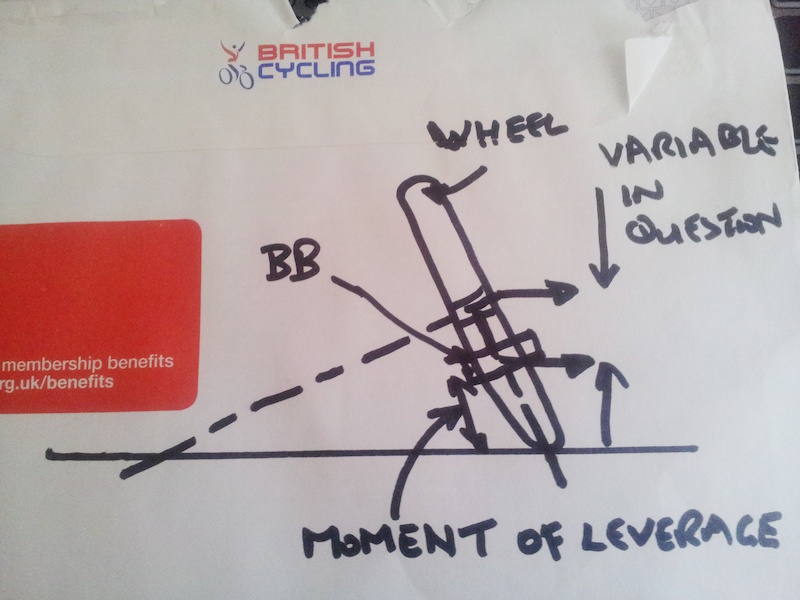 [/img]
(The arrows coming from the axle and BB are the cornering force and The moment of leverage arrowed is a dimension line... the actual moment will be the centre line of the wheel)
In simple terms, the lower the BB is below the axle, the more force that is going into making the tyre grip and the less force that is trying to stand the bike up.
No worries Bigjim, was just a thought.. going from other ppl's bike I've tried, I believe I'm roughly 'average' (neither long leg or long body) for my height.
I know what reach I can live with (current/old bikes), but don't have experience of anything any longer which is where I'm heading, in order to avoid a laidback seating position
jhj - how does the bike know where the axle is?
the lower the BB is below the axle, the more force that is going into making the tyre grip and the less force that is trying to stand the bike up.
This doesn't really mean anything. The tyre doesn't 'know' where the axle is and the force being applied to it is not dependent on the BB drop (axle to BB measurement).
Not to mention that the initial discussion was over weight distribution in a straight line rather than cornering...
The axle is where the force is being transferred from the bike to the wheel...
The BB is where the weight is concentrated
The bike doesn't know a whole lot about anything, wonderous creation though it is.
If you only ride your bike in a straight line:
a) I'd like to know where
and
b) BORING!!
Not to mention that the initial discussion was over weight distribution in a straight line rather than cornering...
well I don't think it was, which is why I was so highly amused by 0% weight through the handlebars statement, I can't imagine going into a corner with no weight on the bars at all, but I didn't want to say anything apart from maybe the person shouldn't go around telling people not to put any weight at all on the bars. personally I think weight transfer to the front end through the bars is one of the most useful skills to learn, but then I'm just a very average mountain biker.
The axle is where the force is being transferred from the bike to the wheel...
And so is every bit of the wheel and fork and frame between the ground and the rider. What's actually special about the axle?
jivehoneyjive - MemberThe axle is where the force is being transferred from the bike to the wheel...
The BB is where the weight is concentrated
Yes. Well kind of, the wheel is part of the bike so force isn't transferred from the bike to the wheel.
No. The weight isn't concentrated anywhere, but the centre of gravity of the bike and rider is nowhere near the BB.
In simple terms, the lower the BB is below the axle, the more force that is going into making the tyre grip and the less force that is trying to stand the bike up.
Also in simplistic terms, could this be applied to wheels too? (Hub axles replacing BB axle, obviously)
I feel a bit bad because we're straying off topic, but it's all interesting stuff...
You could have exactly the same BB height and Centre of Gravity, but with 2 different wheel sizes, the larger wheelsize will give more stability~ taken to extremes the smaller wheelsize could have the BB+COG above the axle, which would mean cornering forces automatically try to stand the bike up.
Go back to the ship analogy... though the pivot point is different, the overall principle is the same
Back to weight distribution and bigjim does have a very valid point; you selectively weight the bars to improve traction.
When you start analyzing, there's a heck of a lot of variables...
taken to extremes the smaller wheelsize could have the BB+COG above the axle, which would mean cornering forces automatically try to stand the bike up.
The pivot is at the ground, not the axle. The axle is just part of the structure, same as the rest of the fork and frame transferring load/forces from the rider to the ground. The overall forces on the bike 'trying to stand it up' are the same regardless of BB drop.
The tyre isn't just the pivot point, it's also where the load is concentrated...
How does that load get there and what plane does it act in?
Here's some more scribbling:
[img] 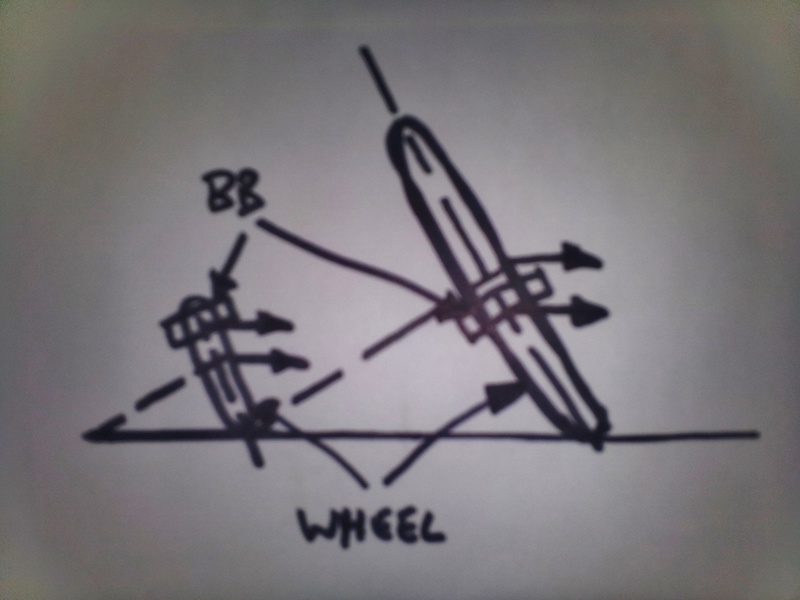 [/img]
What does 'load is concentrated' mean? The contact point in your diagram is the pivot (assuming the tyre isn't slipping).
The 'load' goes from the rider (to simplify things), through the bar, pedals (and saddle if seated) to the frame and fork, through the wheels where it contacts the ground.
In your picture, you could replace the whole bike with a solid object with infinitely small wheels and it would still contact the ground at the same point and the BB would still be in the same relative place and the rider's centre of mass would be in the same place. The net force 'trying to keep the bike upright' would also be the same. The model is exactly the same. The axle position is of no more relevance than where the headset it or where the disc caliper mounting point is - they're just points in the structure. You drawing the dashed line from the axle to the ground is of no relevance, it's just a random point you've chosen.
If you don't understand that, this discussion can't really progress.
Wasn't it so much easier when we just measured the seat tube?!
What we need now is some sort of online calculator where you can put all the frame data in and get the relevant measurements out....
And then we can argue over the formulae used to get those measurements 🙂
Though if there was an argument, some people would be right and others would just think they're right...
😉
Or post conspiracy theories, innuendo and misdirection about it...
So, have you come up with a justification for why you've drawn a line from the axle to the ground in your pics? 😉
Darn tootin...
Is there any force being passed from the frame and fork through the top of the wheel?