[quote="ajantom"]On the scales.....24 lbs.Without a full build of both, you've no way of working out where the extra weight has gone. I know on my first lightweight MTB, which was about 22 lbs in the mid 90's, a year of swapping the odd bit and changes to tyres, tubes and so on, saw it creep up to 24. Nothing replaced was particularly heavier, few grams here and there, but it all added up to near enough 2lbs. (Both weighed on proper scales)
Current weenie bike (which isn't really) cost me far less (we are talking going on for 50% less!), is far more capable and weighs about 21 lbs. Not weighed it for three years, but not actually changed much either. So i doubt there has been much in the way of change.
Been riding a 160mm Orange Alpine that weighs in at just over 30lb with dropper and a tough build. It descends like 40lb DH bikes used to, but it goes all day and can climb up pretty much anything.
That's exactly the point. Your Alpine will stand up to pretty much anything and the frame is not known as a feather weight. Why should a ht weigh the same?
ajantom - MemberHmmm, 18lbs...really? Post a pic hanging from some decent scales or I call bs on that
It's definitely doable, my Soda floated around the 21lb mark depending on tyres, and it had gears and a dropper and quite a lot of "light but not [i]super[/i] light" kit on it. (and wheels I had to true every couple of rides, to be fair).
It was a funny bike to ride though, rigid and lightweight meant I'd go to ride over things and it'd bounce off instead, it took a gust of wind or an obstinate pebble to knock it off line. In terms of capability, it knocked the shite out of my early-90s rigid though, brakes and tyres alone made all the difference.
I sometimes like to think "how far back do you have to go before this bike, would have been the best bike in the world". Really not very far in a lot of cases.
chestrockwell - MemberThat's exactly the point. Your Alpine will stand up to pretty much anything and the frame is not known as a feather weight. Why should a ht weigh the same?
If you're riding the same stuff, then mostly you want the same parts- so you end up with just the frame being lighter. (sometimes you'll want heavier parts on the HT, suspension coddles rims and tyres- I almost always had more back tyre on the Ragley than the Hemlock) And a lot of ht frames just aren't that much lighter. So in the end, a 6lb steel hardtail frame doesn't build up that much lighter than a 7lb full suss.
(it'll cost about £1000 less, new, though)
One of the bottom lines is, if you're building a burly hardtail you're not generally doing it because it'll be lighter than a burly full suss, you're doing it because hardtails are cool.
Is it just me that can ride lightweight kit quickly without breaking it then?
Maybe people have become used to ploughing through everything and expecting the kit to soak it up?
Not really.
I don't break much, if anything. Usually wears out first, or i get bored with it.
Hmmm, 18lbs...really? Post a pic hanging from some decent scales or I call bs on that.
Why would I bother doing that. You can disbelieve all you like, I have nothing to prove. I know my bike weighs 8.3kg (18.2lbs) and that is all I need to know. I even have a spreadsheet listing every single part and its weight on very accurate scales but again I don't need to show you that or prove anything.
As for strong components - XT brakes, Sram XX1 chainset, Hope hubs, Thomson stem/post etc,. nothing weak or likely to break there is there?
The only concession to light weight weaker stuff are the rims (340g Stans Alpine) and the tyres Continental Race king.
The whole point of this is to state that weight matters to SOME people and those that say it doesn't cannot talk for other people. No right or wrong here, but liking lighter bikes is not wrong.
Is it just me that can ride lightweight kit quickly without breaking it then?
not biting 😆
The only concession to light weight weaker stuff are the rims (340g Stans Alpine) and the tyres Continental Race king.
That's a fairly major concession right there...they obviously work for you and your riding, but a lot of people would tear them to shreds in no time, that's not saying they're rubbish, but it's back to the 'intended use' part of the equation, and comparing your light weight build with compromises appropriate to your riding to a burly bike for someone else's riding is pretty pointless as it's not a like for like comparison.
Earlier you said you couldn't even think about riding a bike that weighed 30lbs, well for some riding I wouldn't even entertain a rim <500g or a tyre <800g, and for others it'll be tyres > 1kg, suddenly the weight piles on, but it's for a reason.
If you're riding the same stuff, then mostly you want the same parts- so you end up with just the frame being lighter.
Yep, and I'd expect a ht to be a couple of pounds lighter so come in around 28lb for the same build.
Seems they aren't and that answers my original question. With this being the case they must be way over built or the manufacturers aren't trying.
You need context for that mol. What IS fast. What terrain? It's a mix too difficult to describe mostly.
It's no coincidence that of 6 of us who ride the same stuff together, we've all ended up with similar spec equipment.
IMO, Northwind comments about suspension coddling rims and tyres is a big factor for hardtails.
Yep, and I'd expect a ht to be a couple of pounds lighter so come in around 28lb for the same build
As Northwind said though, the 1-2lbs you lose on the frame you will often add a lot of back with a burlier set of rims and tyres so overall there's bugger all in it if you compare for the same intended use.
My Slackline is an easy 30lb - 5.5lb frame, 2x9, Lyriks, Reverb, Flows, Minions, Zee 203/180 brakes. It all adds up. I have a 22lb rockhopper if I want to mess around on xc.
Doesn't bother me at all that my hardtail weighs roughly the same as the full-sus. They both do exactly the same thing, which is basically anything I want. Only difference is that they offer two different riding experiences, both with the emphasis on fun, but also both being tough, reliable, low maintenance and capable of being ridden all day on the kind of trails I like (Pennines and Lakes). Great bikes for me, but not necessarily for everyone. Like I said, horses for course.
you will often add a lot of back with a burlier set of rims and tyres
Well this is about choice isn't it. If you don't care about weight you'll add burly wheels, if you do you won't. It's not necessary to build it heavy, light doesn't mean it's going to snap unless you treat it that way.
If you don't care about weight you'll add burly wheels
It's not necessary to build it heavy, light doesn't mean it's going to snap unless you treat it that way.
Even if you do care about weight, you might choose to add the burly wheels for the burlyness and capability/performance/reliability they provide, it's not that you don't care about weight, it's that there are other factors* which in some cases will override it. Sometimes it is necessary to add weight if the lighter components would either be too fragile or cost too much.
* for a lot of people that reason is £
I'm no weight weenie but it just seems wrong that a mid range ht is as lardy as a mid range fs. I love steel and would normally choose it above aluminium but a 50% heavier frame that costs 50% more seems lazy to me.
well, yes and no. kona say the Honzo AL is ~40% lighter than the steel. granted, it doesn't have the same dropout system ( sadly ), but ally frames are generally a fair bit lighter, so if you're comparing steel HT and FS frames typically built of ally or carbon, it's not that much of a stretch to get similar weights for the overall build?
My Chromag Rootdown is a hair under 30lbs.
Steel frame, big forks, dropper, big sturdy tyres and nice but not light parts (chromag bars and stem for example) and a SLX/XT level build will do that.
But I weigh 220lbs in my pants so I'm not worried about gram counting.
18lbs 4oz with tubes and heavy wheels, more than 500 quid though, nothing weight weenie though M9000 throughout, 240 Hubs, Pro Tharsis Post/Bars/Stem (not pictured) - could easily trim weight off it - doesn't feel fragile at all
[URL= http://i829.photobucket.com/albums/zz211/dansipods/2E86E3CB-53D5-4B3E-8ABA-A34E84B9BFAE_zpsotuzlqcg.jp g" target="_blank"> http://i829.photobucket.com/albums/zz211/dansipods/2E86E3CB-53D5-4B3E-8ABA-A34E84B9BFAE_zpsotuzlqcg.jp g"/> [/IMG][/URL]
it's that there are other factors* which in some cases will override it
Of course. But we have a choice. It feels like we are still facing the backlash from 90s weight weenieism, which started in about 2000, when people realised that solid bikes had something going for them. But that doesn't mean that light bikes don't have something else going for them.
I'm all for choice, however don't rubbish light kit just because you like heavy kit. It rides differently, some may like that.
My 31lb Patriot is the second one I've had. The first one was stolen, and it was 37lbs with coil forks and shock. The current one can be ridden all day; the original one though was just too damn heavy. So a lighter (and more expensive) build has made it into a bike that's almost as capable downhill (easily capable enough for trail riding) but can be used as a normal bike instead of a winch and plummet.
molgrips - Member
Is it just me that can ride lightweight kit quickly without breaking it then?
In all honesty, I ride better and faster these days, and can get away with lighter rims than I used to need on my HT back in the late 90s. But I wouldn't be going superlight as, well I'm not light, and I don't want to have to nurse it.
There's something deeply satisfying about putting dual ply tyres on a strong DH rim, pointing it down a hill and worrying about nothing except whether you can stay on top of the bike, HT or FS.
There's something deeply satisfying about putting dual ply tyres on a strong DH rim, pointing it down a hill and worrying about nothing except whether you can stay on top of the bike, HT or FS.
Yeah, there is, that's why I have more than one bike. I don't understand people who buy multiple bikes that are similar. For me, the whole point of multiple bikes is to cover as diverse a range of riding as possible.
Currently I have the Patriot, a rigid Salsa and an XC race bike. Pretty good coverage there I think 🙂
If I had to have one, though, I'd have to lose some of those different ways to ride.
I don't understand people who buy multiple bikes that are similar. For me, the whole point of multiple bikes is to cover as diverse a range of riding as possible.
I'm one of those people. I have two bikes, one FS, one HT. I ride the same trails on both, and choose largely on what I fancy at the time. They give wildly different ride experiences on the same trails, but have ended up similarly built to cope.
Having the right bike for the right circumstances isn't [i]always[/i] the most rewarding experience, but thats as much to do with my 'Can I get a bike over it?' mentality as anything else.
That said, I'm just a trail hacker. Racing, in any discipline is of no interest to me. Obviously if it was, I'd have the right kit for each discipline.
chestrockwell - MemberSeems they aren't and that answers my original question. With this being the case they must be way over built or the manufacturers aren't trying.
I've a feeling you may just be looking at bikes that are intentionally built sturdy not light (bearing in mind that they have to build the bike for the hardest use it'll reasonably face, under the fattest clumsiest fastest rider). Light hts are out there but they tend to be racier.
(IMO there's a wee bit of an absence in the middle; the "hard hitting xc bike", classic allrounder XC machine, for your red routes rider who doesn't want racy but does want fast... But I understand why it's a harder market to satisfy, and why manufacturers doing light bikes tend to make them racy.)
I'm all for choice, however don't rubbish light kit just because you like heavy kit. It rides differently, some may like that.
[i]I'm [/i]not rubbishing it, hence all the explanations in my posts about having both heavy and light bikes and saying it's all about intended use.
Let's face it, a lot of this comes down to where you ride and what a bike is being asked to do. World of difference between trail centre trails and natural stuff in places like the Lakes. A wheel set-up that works at Gisburn might last 10 mins on a Lakes descent, even in the hands of the best riders. Not knocking trails centres - it's just a big factor. The likelihood of crashing counts too. If you ride steep, techy stuff and reckon you might crash from time to time, then you'll want a more robust bike, and that's likely to be heavier. Doesn't mean you're not a good rider - just means you might ride more challenging trails and need a bike to suit.
There are now a lot of people riding the same rocky trails in the Lakes or Peaks as 10-20 years ago but a lot faster. That is partly down to the progession in bike technology but also down to the move away from XC being the ‘in’ thing, to a big surge in the populatily of DH, and now its settled somewhere in the middle with whatever ‘trail’ riding is called these days.
The bikes shown on this thread which are hovering around the 20lb mark or well below or even a good few lb heavier than that, will probably be ridden in an XC style on the trails (heck some pictured don’t even have a QR on the seat post let alone a dropper).
I used to have a Ti456 when they first came out and it was 23.5lb as I wanted to be XC fast, once my riding became more DH focused started putting Flow wheels on and proper 2.4 tyres, QR suspension to bolt through forks, chain guide, dropper post the bike soon turned into 27.5lb quite easily, but was far better suited and more composed on the downs and I was only marginally slower on the ups.
Put a good rider (i.e Strava top 1%) on a ‘trail’ focused bike and point him/her down the Beast, Cavedale, Garburn Pass etc and they’ll put in a good time. Put the same rider on that OPEN 18lb hardtail without a QR seat post collar, with a steep head angle and not proper suspension and he/she will be massively slower compared to their time on the trail bike.
Latest hardtail I’ve just built up is steel and 30lb, but its built around the style riding I now do.
I love weight threads and all the willy waving and blind optimism, then a wonderful combo of the two.
2013 26" Chameleon
Pikes
Reverb
X1 gears
Hope brakes, HS and hubs
Waay old singletrack rims
3c HRII's
It weighs 12 lbs. 😉
"hard hitting xc bike"
My Trek 29er is pretty much as you describe. An awesomely capable bike.
I just don't believe bikes are as fragile as many people think. What kills bikes IME is crashes, where the force is hitting areas simply not designed for it.
Back to the OP anything over 28lbs for a £1k+ hardtail is lardy and to be avoided.
Now I know why everyone seems to use uplifts!
Back to the OP anything over 28lbs for a £1k+ hardtail is lardy and to be avoided.
😆 one of my (2015 model year) hardtails (not the chameleon) weight 34/35lbs and its rrp was £3500 😆
I love weight threads and all the willy waving and blind optimism,
Proper weight weenies have scales.. like me...
weight 34/35lbs and its rrp was £3500
They saw you coming 😯
Proper weight weenies [s]have scales[/s] do it by feel...
FTFY
*I didn't pay rrp, and the tyres are 4 1/2 inches wide. 4lbs of it is inner tubes 😉
They give wildly different ride experiences on the same trails, but have ended up similarly built to cope.
Any bike can cope with almost anything. There's no 'need' to make a bike beefy to survive normal trail riding. It's about how fast you want to go, and what you want to compromise on.
A wheel set-up that works at Gisburn might last 10 mins on a Lakes descent, even in the hands of the best riders.
Nope. I've ridden my XC race bike with its 1300g wheels on DH courses, and on rocky mountain steep stuff. I just do it slowly and carefully. It's perfectly possible. Most Lakes trails have been there for 100 years and were being ridden on 90s rigid bikes. It's a completely different experience, but you can do it without breaking everything.
Wonder how much that Morf weighs on the fresh goods Friday?
Nope. I've ridden my XC race bike with its 1300g wheels on DH courses, and on rocky mountain steep stuff. I just do it slowly and carefully.
But why would you want too, when you could ride a pair of 1800g wheels on rocky trails fast and they will still work on all other trails too
Nope. I've ridden my XC race bike with its 1300g wheels on DH courses, and on rocky mountain steep stuff. I just do it slowly and carefully.
That's exactly the point people are making though isn't it, it's not that it can't be done, hell you could ride a road bike down if you took your time, the point is you're having to hold back...and for people that don't want to have to do that whether that be due to lack of skills, or the exact opposite then the heavier components are 'right' choice for them.
All.About.Intended.Use
which is what makes blanket statemenets like 'anything over/under X lbs is too heavy/light' a load of MooPoo!
But why would you want too, when you could ride a pair of 1800g wheels on rocky trails fast and they will still work on all other trails too
But why would you want too, when you could ride a pair of 1300g wheels on rocky trails fast and they will still work on all other trails too.
Not 1300g but I'm >100kg and regularly get airborne on some 29er Crest Wheels which if forum mob opinion is to be believed, should have the strength and stiffness of overcooked noodles.
As Dragon said, most of the time it's crashing that kills bikes, not riding them.
Amedias +1
I've a feeling you may just be looking at bikes that are intentionally built sturdy not light (bearing in mind that they have to build the bike for the hardest use it'll reasonably face, under the fattest clumsiest fastest rider). Light hts are out there but they tend to be racier.(IMO there's a wee bit of an absence in the middle; the "hard hitting xc bike", classic allrounder XC machine, for your red routes rider who doesn't want racy but does want fast... But I understand why it's a harder market to satisfy, and why manufacturers doing light bikes tend to make them racy.)
I think you've probably nailed it there. The current trail/enduro/gnar ht is far more capable than most of us where as xc race bikes are just that with a vacuum in the middle.
Going further there seems to be a trend in fs towards less travel, less weight, less toughness but still having aggressive geometry. I wonder if that's the next route for ht and I'm a year too early?
Rik + 1 Of course we can ride most bikes down Lakes descents, but many of us who like that sort of trail don't want to have to pick our way down carefully at a snail's pace just to protect our bikes. Done that 20 years ago, and personally I have more fun on bikes now than then.
Last weekend, I was riding a 27.5lb 6" travel slack angled carbon framed 'enduro' bike.
This weekend, I will be riding a relatively steep angled 24lb ti framed hardtail bike.
Guess what? I'll have the same, stupid big smile on my face and flies in my teeth!
The best bike or the best weight bike is the one you are riding at the time - a bit like the best camera on the camera thread the other day.
My steel Switchback was pretty light - not sure how much but a lot lighter than my Rune which was 33lbs or so. The only thing I kept an eye on weight wise was the wheels.
My current Ti one is much lighter.
Things like dropper posts add a good chunk of weight at 500g or so, especially compared to something like an ibeam post.
I try not to get too hug up about weight, feel is more important. My Rune was a porker on the scales but didn't feel like it when riding it even on long XC stuff.
it's not that it can't be done, hell you could ride a road bike down if you took your time, the point is you're having to hold back
But why would you want too, when you could ride a pair of 1800g wheels on rocky trails fast and they will still work on all other trails too
You wouldn't. Well, having said that - there is a certain smug satisfaction in making it. Cleaning something difficult is a recognised pleasure in MTBing.
However read that with respect to what I quoted. Someone was suggesting that the bike could not take it and would break in ten minutes. It won't.
The thing about light bikes is that they handle, stop and go very nicely. So if you aren't smashing your way down rocky steep trails and are on say woodsy singletrack, they can actually be very nice.
dragon - MemberMy Trek 29er is pretty much as you describe. An awesomely capable bike.
Original stache?
Why would I bother doing that. You can disbelieve all you like, I have nothing to prove. I know my bike weighs 8.3kg (18.2lbs) and that is all I need to know. I even have a spreadsheet listing every single part and its weight on very accurate scales but again I don't need to show you that or prove anything.
You have nothing to prove, but have a spreadsheet of individual part weights? Sorry, but that is a little sad 😆
The thing about light bikes is that they handle, stop and go very nicely. So if you aren't smashing your way down rocky steep trails and are on say woodsy singletrack, they can actually be very nice.
Exactly. And add riding uphill and the only area a light build bike will hold you back is on those rough downhills
where you want to go as fast as possible.
ajantom - MemberYou have nothing to prove, but have a spreadsheet of individual part weights? Sorry, but that is a little sad
If you want to make a light bike, you have to know what the bits weigh. (I have a spreadsheet of all the OE bits on my fatbike, but more because I thought it was funny... "THen I saved 1300g by changing the wheels!" On my normal bike, if I saved 1300g off the wheels I think I'd just have a rear hub.
the only area a light build bike will hold you back is on those rough downhills
And if you don't have any rough downhills in your area...?
And if you don't have any rough downhills in your area...?
Move?
What's wrong with smooth downhills?
Speed can be fun, but we all like a bit of tech, no?
Seriously, I visited a friend in Norfolk a few years ago. Think I'd go mad living there!
Speed can be fun, but we all like a bit of tech, no?
Everything is tech if you do it fast enough. And besides, rocks don't make tech. I've got rocky trails where you just have to brake and roll down, I've also got smooth stuff that's heart-in-mouth and hard to get right.
I visited a friend in Norfolk
I said smooth downhills, but still some downhills! Had a great deal of fun on my rigid bike in Hampshire last summer.
You have nothing to prove, but have a spreadsheet of individual part weights? Sorry, but that is a little sad
Well hardly a spreadsheet as just using 4 columns - part type, part make/model, part cost, part weight.
Just easier to log that way when building the bike and kept it as a record and it totals up the cost and weight as you go. And don't worry, I don't have any queries out to databases or any macro's in it...I would imagine you do loads of things that I would deem sad but we're all different so no need to apoligize..
Oh, I'm totally sad I many ways! You should see my catalogued and plastic sleeved record collection (though some of them are worth £100s so kind of has a point!)
Back to the original point of the thread though. I can see the point in *wanting* a light bike, but when it boils down to it, unless you are racing and watching the 'marginal gains' then a 28-30lb bike is going to be fine. I mean even a small bloke at about 9 stone (124 lbs or so) 4 or 5 pounds is a small % of their weight. More of a biffer like me at 13 stone, I probably lose 4 lbs when I poo!
What Molgrips said.
It's not all about the rocks, I went to uni in Sheffield, having access to rim smashing trails from your door is fun, and I miss it, but it's not the be all and end all, eventually you crave some speed and corners!
the only area a light build bike will hold you back is on those rough downhills where you want to go as fast as possible.
See I guess from my XC roots I want a bike that goes point to point as quick as possible. Even Enduro bikes have to compromise on the downhill capability to make them ridable uphill.
Anyway if Tracy Mosley thinks that if she was limited to one bike she'd have a 120mm full sus, then that's good enough for me.
Someone was suggesting that the bike could not take it and would break in ten minutes. It won't.
10 mins is internet exaggeration for sure, but the point is still valid, if you don't hold back and were to ride some lightweight stuff at full pelt in the way you can ride burlier stuff it wouldn't last [i]as long[/i].
I know from experience where the durability sweetspot is for my personal riding, and I know if I go under it I start breaking things sooner than I'd like.
The options therefore become, add weight for durability and strength/performance, or hold back, and frankly, I don't want to hold back!
If I want a nice gentle pootle I'll go out on my tourer (which weighs a ton), if I want to make life difficult I'll use my silly light SS, but I don't want equipment holding me back on general MTB rides, the only thing I want holding me back is me.
When racing it's a bit different, I still go as light as I can, but I take some more risks with equipment that I wouldn't use on a daily basis, not because its not outright strong enough, but because it doesn't have the extra leeway or the long term durability.
because it doesn't have the extra leeway or the long term durability.
Such as?
Such as?
well one example from earlier in the thread, Stans Podium rims...
very light, strong [i]enough [/i]but fatigue wise they die early, I also wouldn't trust them to repeated hard beatings.
Also, superlight tyres, they are not as durable, and they certainly don't have as much leeway for hitting pointy things.
Superlight rotors which either don't perform as well or can't take the occasional little bump.
And lightweight Alu drivetrain bits were steel lasts longer and is more bash proof
I'll also quite happily take a slightly heavier bigger fork on the trail with more bushing overlap and maybe even old school with a proper oil bath over some stunted-stanchion almost-dry flexier XC forks that I would happily use for racing.
EDIT - in fact any super light bits where either a bit more material or a different material would add a few grammes but make them sturdier.
Don't get me wrong though, I'm coming at this from both sides, I have light bikes and heavy bikes, I use them both, under different circumstances, I'm just firmly in the camp that says it is sometimes necessary to add weight to achieve certain requirements, when the alternative is a less durable or capable bike for the use you want to put it to.
Just because a 20lb XC whippet works for you, or even a 31lb bruiser of a HT, it doesn't mean that it will work for everyone else everywhere, and blanket statemnts like Xlbs is too heavy for a HT etc. are just too black and white in my eyes.
Where are all these mid range sub 30lb fs trail bikes?
Quick review of bike weights reported by my riding buddies- bikes specced for a weekend in Wales including Snowdon, where strava top 10s were obtained on rhyd ddu and rangers top to bottom, so durability and all day pedalability most important factors:
Aluminium reign with 1x11 pikes, procore at the back etc 31.6lb
Santacruz butcher 2x10 pikes 31.5lb
Carbon reign pikes 1x11 30.5lb
Spesh pitch 26 2x10 lyriks 33lb---fastest of all of us down most things
My Blur 4x pike air 454 reverb 2x10 i25s pro2s 2.5 minion UST etc 32.5lb
Depends on your idea of mid range I guess.
My nothing special HT, Prince Albert classic with revs 1x10 dropper and 2.3 tyres on arch ex is 28lb.
My five was 27lbs. It was originally 26 but I put bigger tyres on.
Must be bigger wheels then...
I knew I was right to stick with 26
the point is still valid, if you don't hold back and were to ride some lightweight stuff at full pelt in the way you can ride burlier stuff it wouldn't last as long.
It's just not possible to ride it quite as fast, but yes of course - if you **** it really hard, it'll break. That's obvious. However ****ting it hard is not a requirement to get down many trails. That's my point. It will last perfectly fine if you are sensible (yet not slow). It's not INHERENTLY short lived.
Stans Podium rims
Those are the extreme ultra light race only ones, yes? Not really a fair comparison. Compare something like say, Crest with Flow. Crest will last just fine if you ride normally and aren't an oaf. Flow if you want to push it harder. And by hard I mean properly exercising your bike, not going slightly quicker than mincing.
I'm just firmly in the camp that says it is sometimes necessary to add weight to achieve certain requirements
Of course, that's obvious. What I'm trying to say is that you don't HAVE to build a 30lb bike to prevent it falling to bits at the first rock. 24lb bikes are far more capable than some people apparently seem to think, and 21lb bikes can get down most things in the right hands or in the right part of the country.
Furthermore, there are OTHER advantages to light bikes - they ride really nicely - and if you don't ride in the rocky areas of the country you might actually have more fun on one.
Those are the extreme ultra light race only ones, yes? Not really a fair comparison
that's exactly what we were comparing, light things that can be too fragile Vs normal things that aren't.
The Crest v Flow thing in my mind isn't comparing light with normal, it's comparing with heavy duty. The Flow is a very tough rim.
And you know what, the Crest is still right at the limit of what I would consider an everyday XC rim, and I'd not be confident giving them a repeated hard time unless I had some pretty beefy rubber wrapped around them, which would kind of defeat the point. Maybe I'm being overly cautious but I've seen enough ruined lightweight rims over the years to sway my opinion. Arch would be more like it, and they're still a decent weight for their toughness.
normal things that aren't
I'm saying that there are two kinds of normal. Light normal and heavier normal, that normal people can choose between. DH and weightweenie kit are outside of that range.
Light normal bike - 25lbs, heavy normal bike = 30lbs, weightweenie bike = 20lbs
I'd not be confident giving them a hard time
Of course, that's precisely my point 🙂
I think we're banging the same drum but with one tiny difference in perspective/opinion:
[s]heavy [/s]normal bike = 28-30lbs, heavy = 32-33lbs+
but again, this is all dependant on where and who you ride with isn't it. My bikes were certainly a lot lighter when I lived in the South East vs the South West.
Whenever my non-racing bikes go < 26lbs I start getting failures or compromises I'm not willing to have, and so they creep back up.
I said it early on in the thread though, when a lightish tyre comes in at 600g, and a tougher burly one nearer 1kg, simply the difference in tyres for a ride or conditions can be 1-2lbs so getting hung up on 26vs28lb or 28vs30lbs is largely irrelevant without knowing the details.
It's like the old 'weighed without pedals' thing, they have to be as pedals are so personal, there'd be a lot more parity between bike weights if they were quoted without tyres and that was left up to the customer to pick to their preference, not that for one second I'm suggesting we start actually doing that! 🙂
My perspective might be skewed towards 26ers though. 29ers would seem to be a good chunk heavier.
that's exactly what we were comparing, light things that can be too fragile Vs normal things that aren't.
Not really. The 'normal' is the forgotten section in the middle. What's being compared is weight weenie stuff Vs over built tough gear. I can't accept a 30lb ht is normal.
@ chestrockwell
[url= http://www.mbr.co.uk/reviews/hardtail/bird-zero-3-2015-review ]Bird Zero 3 weight[/url]
So bathroom scales not far off!
That's more like it and puts Bird on the list!
Wheels are larger, tyres bigger and tougher, rims wider, frames longer, head tubes and seat tubes larger (tapered forks and dropper posts), forks thicker and CEN requirements for frame durability more demanding. On the plus side, these burlier bikes cover ground just as fast as their more dainty smaller wheeled predecessors, despite the extra weight.
If you find the 30lb mark psychologically bothering, either go alloy for the frame or hang a load of carbon bits off a steel frame. With bigger wheels and tyres and dropper posts I'm not sure steel is as advantageous as it used to be.
[img] 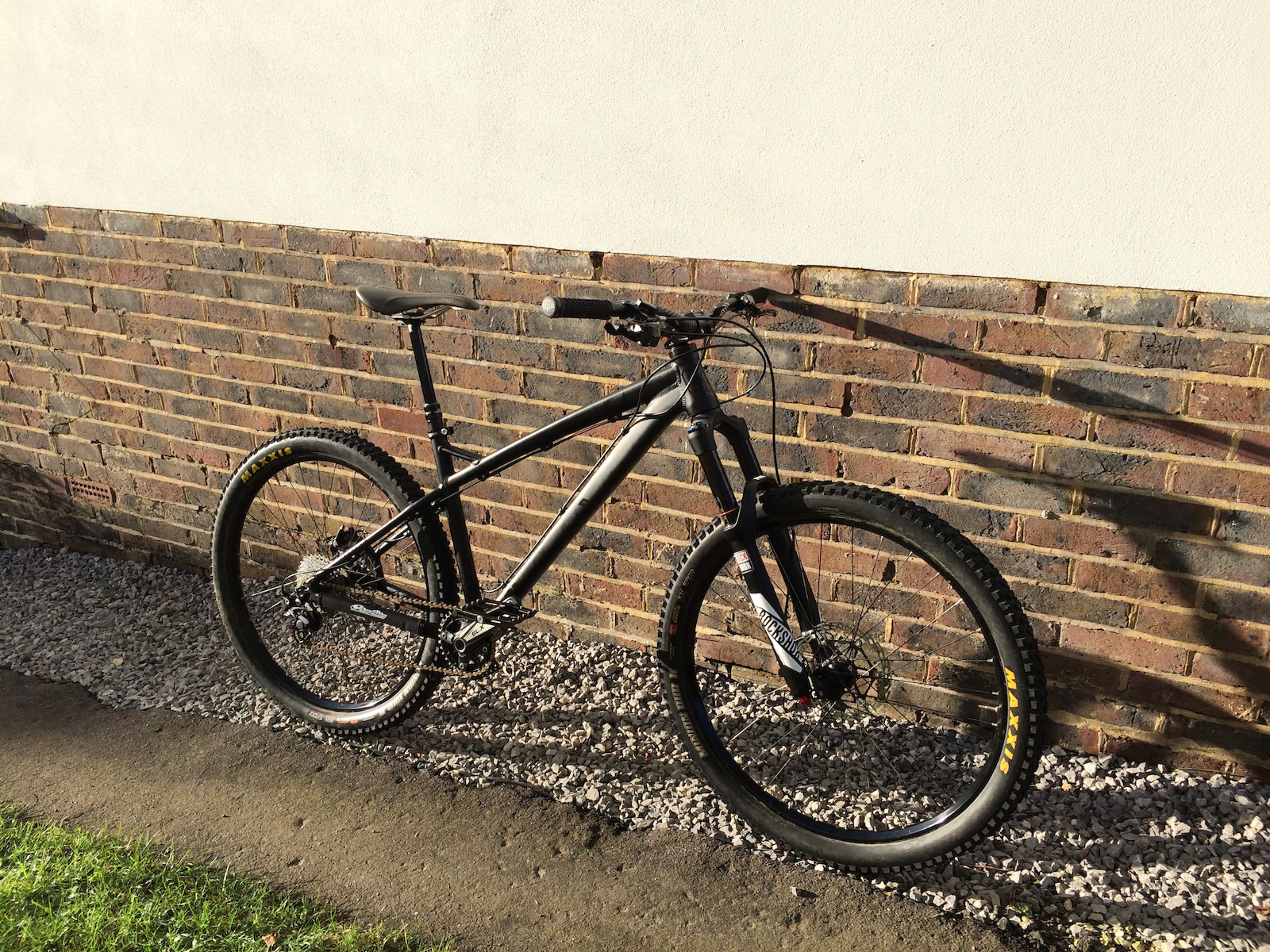 [/img]
That's 27.5lbs, built pretty damned strong. You could lose a fair bit of cost and excess strength without ending up with a flimsy bike or gaining weight.
That's what am talking about. 27.5lbs for a burly hard tail seems ok. Nice bike 🙂
molgrips, not meaning to cause offence, or doubt you but how are you getting your FS bikes so light?
My Carbon S-Works Enduro = 31lbs, but it has got HopeTech Enduro wheels and X-Fusion Vengeance forks
My carbon Capra with Lyriks, 1 x 11, e-thirteen wheels (light) and Raceface finishing kit, is still over 30lbs
Tl;dr
The problem here is meauring in pounds.
By converting to kilos you're at what? 13?
Thats seventeen more better! go on, have another slice of cake.
Tafkastr, not entirely sure, although being 26 helps a lot. Will check the weight again. It's got 3x9 XT, 66sls, hope hubs and brakes, maxis ignitors 2.35 tubeless, medium weight kit...
I keep meaning to go weigh my SIngular just for a laugh.... On-One Reet'ards and Alfine does not a light bike make....
TBH my road bike would do the same.....
Heavy guy - Heavy Bikes....
Cheers, Steve
Singular Swift with old On-One Reet'ard wheels, Alfine and Rockshox Recon Silvers 14.3kg....whats that about 32lbs? Doesn't matter as I like how it rides....
My Mk2 Kaff is 11.6kg..heavy for a road bike, I was surprised my wife's Merida Speeder was heavier by nears a kg.
Cheers, Steve
27.5lb on my Park scales, could go lighter with the tyres. Rode it today for first time since riding fat bike exclusively this year - it positively felt like a whippet! Despite being only a couple pounds lighter than my fat bike, it's like night and day riding them
[URL= http://i968.photobucket.com/albums/ae168/keepitsteel/image_zps5tr4ckbg.jpe g" target="_blank"> http://i968.photobucket.com/albums/ae168/keepitsteel/image_zps5tr4ckbg.jpe g"/> [/IMG][/URL]