UPDATE: CLASSIFIEDS section refreshed, redesigned, searchable: Go take a look
Oops....I take it back. Mine are actually on the way which would put the rotor into compression during braking.
If your bike's on a conveyor belt do the rotors go on the other way round?
cynic-al - Memberbut the pics above show the rotor as rotating counterclockwise?
I was meaning the pics of 6 or so discs in one post.
Disc goes on the left side of the wheel, wheel rotates in a forward direction = counterclockwise from the outside/left side. No?
Forget the brakes that bike is way too big for you, look at the normal sized bike behind it
Not wanting to bring a dose of the real world into it, but I suspect the grip on the tyre will give way a long way before any tension / compression factors come into it... And if it didn't you'd pivot over the bars and hurt yourself that way...
wibble - yes
Wowzer. I nip out for a bit and I've started a pub brawl.
Reading through, for the fifth time, I'm still not sure what the consensus is.
I think the answer is to pop one off and check for markings which they don't currently have on the visible side.
Anyone know if these are hope rotors? I could contact them.
Am I right in saying my brakes are Hope Minis?
(the bike in the back is my daughter's Islabike - wish I'd had a bike like that when I was 4)
Thanks for the input and debate..
The wrong way around, definitely. The arms should alway be pointing forwards.
Take a pole, put it on the ground at an angle towards you, and lean onto it. It'll take your weight. Put the pole leaning away from you at the same angle, and try leaning on it.
That's effectively what you're doing - you're relying on the rigidity of the braking surface to transmit the load to all the arms evenly enough to not deform. Whereas with the rotor the right way around, the force is transmitted directly to the hub.
Horray! Still going...
No, they're not right as per the usual way round that rotors are made. They're so overbuilt that nobody is going to die, least of all a kid on an islabike.
Yes, they are fitted correctly, as the way that Hope instruct you to fit them. There's no markings on the disc however, and you could fit them the other way.
I reckon that it's down to the squeal you always get from old hope brakes.. some bright spark at the factory tried fitting the rotors backwards to see if it reduced it, and it did so that's what they instructed.. maybe?
@Al: "but the pics above show the rotor as rotating counterclockwise?"
yup. Disc is rotating CCW so the braking force acts clockwise.
Take a pole, put it on the ground at an angle towards you, and lean onto it. It'll take your weight. Put the pole leaning away from you at the same angle, and try leaning on it.That's effectively what you're doing - you're relying on the rigidity of the braking surface to transmit the load to all the arms evenly enough to not deform. Whereas with the rotor the right way around, the force is transmitted directly to the hub.
But you're assuming that the force will increase as you lean on the arm no? In a bike the force would increase to a point and then stop as the wheel would loose traction. I'd imagine this point is much below the buckling strength (if that's the failure mode).
Yes, but hoping that one thing fails before another does isn't the best thing to do 🙂
I don't see the advantage in risking it.
cool i was right they are the good way round :d, if you're scared and want to listen to some bullshit on here turn them the other way round, you won't die anyway!!!
so i contacted Hope yesterday and they were helpfully quick to reply...
Hello Rick, when we manufactured this model we did indeed run them the
way you have shown us in the photo.Many thanks
NickService & Warranty
Hope Technology (IPCO) LTD
I tink i'll leave em. i'll sort a new dentist just in case
Well looks like some people on here should learn to respect professional opinion then.
So much for the "I don't care what somebody's LBS said"... Seems to me apologies are in order.
The Ashima issue was a problem with the rotor not just which way you fitted it.
Well looks like some people on here should learn to respect professional opinion then. So much for the "I don't care what somebody's LBS said"... Seems to me apologies are in order.
I think the operative word in the message from the chap at Hope is [b]did[/b].
Like I said in my original post, it won't matter which way around it is, but the better way [b]is[/b] the other way!
If we are all to have more respect for your LBS owner maybe you should also have some more respect for people on here that probably have more engineering experience and qualification than you might realise?
This wasn't towards you willej. Plus as you can read I have since the beginning said your brakes where the correct way forward, quoting a professional. As for the "more engineering experience" I have very much doubt most of the very vocal people on this thread are that qualified, as they would have told you the same than I and other did, to call hope directly.
Btw when I sold my hope mini originals (i.e. same vintage) had worn the braking surfaces pretty thin when I sold them a couple of years ago. Id check the rotor thickness of the braking surface vs the arms. Might want to have new rotors anyway...
Actually i thought will was the OP, so yes it was directed at you...
Dangerous?
Fox QR fork + Hope QR + disc brake = Yes (IME)
quoting a professional
I'm actually a 'professional'... you shoulda quoted me instead.
andyl - Member
@Al: "but the pics above show the rotor as rotating counterclockwise?"yup. Disc is rotating CCW so the braking force acts clockwise.
But you said
andyl - Member
But when you have the rotors the right way round the torque effect from braking puts them under tension
clockwise force = compression! Or am I missing something?
TroutWrestler - Member
Dangerous?Fox QR fork + Hope QR + disc brake = Yes (IME)
Why?
juan - Member
Actually i thought will was the OP, so yes it was directed at you...
You can call me Will if you like but it's not my name
titusrider - Member
Btw when I sold my hope mini originals (i.e. same vintage) had worn the braking surfaces pretty thin when I sold them a couple of years ago. Id check the rotor thickness of the braking surface vs the arms. Might want to have new rotors anyway...
Thanks will have a check
Yikes. I have the discs for my Hope Minis t'other way from the OP.
Hopefully death will be quick 😆
Me too - have done for 10 years 🙂
My feeling is the way round in the OP has the spokes in tension not compression which would be better?
Edit - all my bikes have the spokes of the disc in compression not tension. seems odd
If they were truly in tension, possibly - if, for example, there was a braking force at every point of the rotor (imagine lots of calipers on one rotor).
However it's not like that, there's an offset braking force at just one point on the rotor. If you imagine the hub held solid, and a tangental force at one point of the rotor, you'll see that the spoke is not in tension, it's experiencing a bending moment. Just like my analogy of trying to lean on a stick that's angled away from you.
Hope Mini User Guide has oposite way to OP.
Interesting Hope stated anything different.
I've a feeling the thermal expansion forces vs braking forces thing is wrong. Here's my reasoning.
braking causes heating of the rotor braking surface which expands, so the outer ring grows in circumference. the spokes stay cool and hence don't grow. the result is the spokes are in tension (a pure radial force actually), they are stretched slightly to 'reach' the expanded braking surface.
putting the rotor on with the spokes sweeping forward in the direction of rotation means gut feel is the spoke is in compression, but really it isn't. As bencooper points out, they feel bending moment and shear force, a pure tangential force, totally perpendicular to the expansion force.
I have the same brakes, with the same hub.
The set up was done by Merlin cycles, who I trust when it comes to mechanical stuff.
I mine are the otherway round to the OP's:
[IMG] 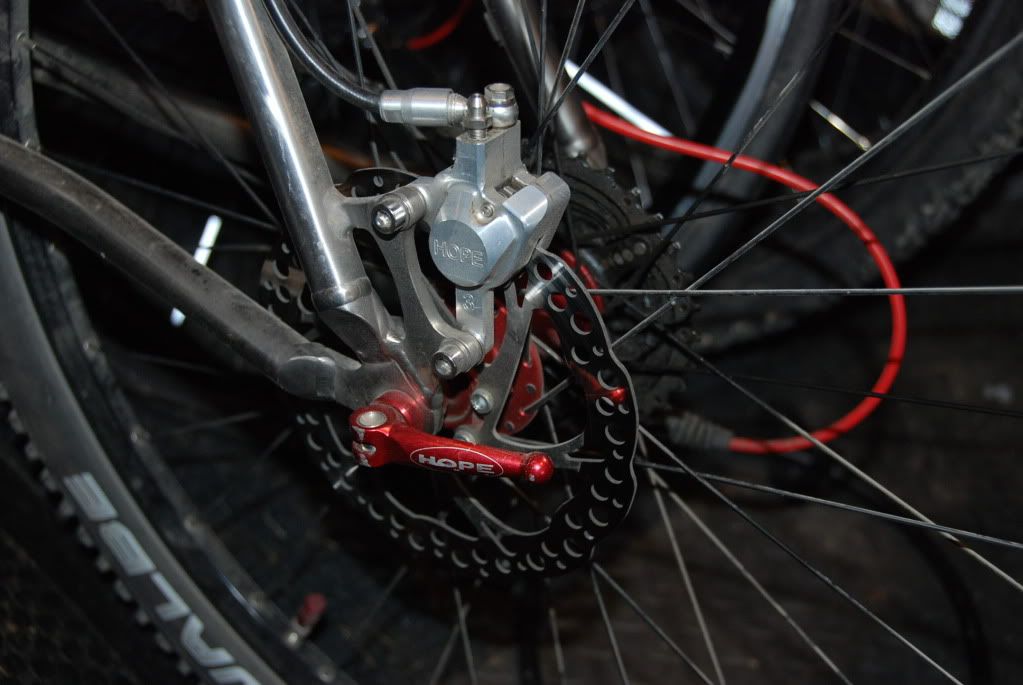 [/IMG]
Sorry about the lack of colour clash.

