Can't you go out for a ride now?
Love this thread. As has been pointed out there will be no compressive forces, plenty of others mind 😉 And no chance of the fork lifting off the axle under braking 🙂
I suggest use of superstar pads as when they catch fire (an inevitable consequence of the friction material parting from the backplate) the carbon wrap will fully cure.
Lastly I suggest running the brake cable nice and short, then [s]when[/s]if the bracket fails the tension on the wire will self-servo the calliper on, and you will have created a fail-safe system.
I hand it to you for try but you're a ****ing idiot
Awesome as always.
I was very confused by the direction arrow on your disk but I guess you just flip it round when you are ready to roll. Do we get video of the first run? Any suggestions for where it should be attempted?
*ALERT ALERT*
XX CHROMOSOMES DETECTED
*ALERT ALERT*
Genuine LOL 😆 😆
and don't forget, cable ties will work nicely in tension for when it fails 😀
Galvanic effect - yup I had wondered if I should mention that, but kind of wondered if it would ever make it to that point in it's life. Best to wrap some glass fibre and epoxy round the aluminium bit first. Actually, I would have wrapped the adapter and the fork leg first and then joined them.
leffeboy I don't believe in disc directions! (I've yet to see a convincing explanation). It won't flip round either as its centrelock.
Vid will be ootside my pad [s]when[/s] if it stops raining, I may even do ssstu a kerb-hop.
Galvanic effect? Given the epoxy and anodising and the fact that it's effectively sealed, is that likely?
"Galvanic effect? Given the epoxy and anodising and the fact that it's effectively sealed, is that likely?"
I wouldn't worry about that if I were you given the expected life span. Just cross it of the list of things to worry about, or list under trivial.
How much do you weigh out of interest and how many plies of fibre did you slap on there?
80kg and 7 layers around it.
I can work out what type of CF it is for you and you can tell me when it will break yes?
This thread is full of win
I can work out what type of CF it is for you and you can tell me when it will break yes?
I enjoy this "make it first then worry about if it might work" approach 🙂
greeble - Member
I hand it to you for try but you're a **** idiot
Hahahaha
Please, please, please video this!
I could do with a laugh.
Meanwhile in Edinburgh a middle aged tandemer is foaming at the mouth, turning purple and screaming as he takes a hammer to his computer.
Come on al this isn't real your just trying to smoke him out and make him reveal his new identity
7 layers eh? what made you think of 7?
What was that about composites having to have a balanced and symmetrical layup?
Anyway, It looks woven, are all the layers woven? are all of the layers in the same orientation? Any idea what the weight of the reinforcement is ? g/m2 ?
Just out of interest you don't work for Boeing do you?
7 layers was 3 width-long strips of the roll of CF I have. Yes it's all woven, all wrapped in the same way. I can't find the weight though.
Slogo - what if it works?
Al, for your test ride, if you can, mount a GoPro on the other fork leg pointing across at the caliper!
How long has it been curing for and whats the weather like where you are? (trying to work out when you might venture out)
A few hours on top of the radiator. I could prob tape a cam to the fork, good idea. It will be a still though, of course.
Been wet today but looking good for tomorrow. I want to finish it cosmetically before fitting it up though, and I may decide my ensuite bathroom install needs my time tomorrow.
I hope it does work. BUT if it doesn't, at least YBF will give you £250 towards fixing your face!
Why "far better"?
Because it's a lot easier to get the required strength. There's a good reason why disc mounts are normally in the place they are.
Because it's a lot easier to get the required strength. There's a good reason why disc mounts are normally in the place they are.
1. They should be on the same side front and rear. Can't go on the drive side on the rear so must go on the non-drive side.
2. Now they are on the non-drive side they can go on the front or the back of the fork. If they go on the front they are exposed to getting knocks and rain etc etc. Also the manufacturers would have to make a different caliper with the hose outlet on the other end as the caliper would need to be fitted upside down.
I know there are reasons in a properly manufactured part that is properly designed to put a brake caliper where it is BUT engineering decisions do sometimes get based on seemingly trivial things that are not-engineering based.
(just saying, not arguing)
They should be on the same side front and rear.
qqqque?
This very Blue Peter. I hope it works well enough and for long enough for you to avoid a trip to A&E.
SJS cycles are selling carbon disc forks for road bikes at the moment for not alot. These are not cross forks either. Any failures you get will not be due to galvanic corrosion.
It could work though. I suppose you are going to find out! That win.
@toys: reciprocity of course. Helps with things like centre lock brake discs etc. If you don't make something reciprocal when you had the chance you will normally regret it some time later. (quite impressed with my actually finding the right word considering I am a bit drunk)
Did he survive the test drive?
Been doing other things today. May do it tomorrow.
Video now please. I ordered a Saturday delivery 🙂
Edit: beaten to it by the Al
Can someone explain reciprocity in simple terms and why it dictates discs on same side?
I reckon there's a market for someone to run an 'engineering for frame designers' course.
Or 'Engineering for carbon cutlery fetishists' 🙂
Reciprocity is basically give/take. No idea why andyl thinks it relates to this topic, maybe he was thinking of "consistency".
aracer - Member
Because it's a lot easier to get the required strength. There's a good reason why disc mounts are normally in the place they are.
Can you explain why? (I'm sure you don't fall into the "because I know about this stuff" camp)
C-Al,
Looking good, but next time just make a whole frame, it's easier than sticking bits to something else!
Been doing other things today. May do it tomorrow.
I.
Reaaaaally.
Can't.
Wai.... zzzzZZZZZZZZ
Reciprocity in engineering terms is about using the reciprocal principle go effect balance to prevent vibration issues. In theory I think Andyl has a point, but I dunno if the effects in practice on a bike are significant.
It onlyworks in linear systems, and I'm not even sure a bike is a linear system.
In a inear system if you input a varying displacement at one point and measure the vibration response at another point, the response is the same if you reverse the input and measurement points. So if you displace the rear brake disc, and measure the vibration at the front brake disc, then inpjt the same displacement at the front brake disc and measure the vibration at the rear, themeasurements will be the same. Think of it like the associative rule in maths (which it is actually an example of) a *b=1 and b*a =1.
So potentially by having the brakes on the same side then the vibrati8ns could cancel eachother. I'mnot convinceda bike is a linear system, I also think the chances of the brake input at both ends being equal at any time during a ride are so low that it probably makes no difference. Good practice to think like this though, and chapaeu to andyl for raising it.
Plus toys19 the two are already out of line when on the same side as front and rear hub dimensions and dropout spacing varies. ARen't they? So would Moving it less than 100mm further across be significant?
Ctznsmth, I agree.
Blimmin phone keyboard..
Just having a think. The forces on the spacer will be acting in the direction of the blue line. This means the top will be in tension and the bottom will be in comprssion.
Do you believe the top and bottom are under tension, Al?
What do you think Martin?
So potentially by having the brakes on the same side then the vibrati8ns could cancel eachother. I'mnot convinceda bike is a linear system, I also think the chances of the brake input at both ends being equal at any time during a ride are so low that it probably makes no difference. Good practice to think like this though, and chapaeu to andyl for raising it.
/pedant
Alternatively, in a complex situation you may have resonant effects and create all sorts of adverse goings on.
the primary reason for having discs on one side is that that is what we have & the mass market don't like to be challenged with differences. I don't believe that there is any significant difference, especially for a post-mount.
and I may decide my ensuite bathroom install needs my time tomorrow.
Cutlery again? I hope it's a soup spoon your planning on shitting in
[pedant] the whole conversation about reciprocity, vibration and the question of linearity or not is all about natural frequencies, resonance and the complexity of the system. But you knew that right? [/pedant]
It would not surprise me if some other market force was the driver behind disc placement, but your point about "that is what we already have" makes no reference to the first decision to make disc placment, this is what andyl is considering in his point about reciprocity.
In reality the first discplacement may have been purely down to aesthetics (which is what I suspect), but then how do we know, there is no evidence that bike designers are rational at all.
Either way andl's point about it is valid and interesting.
Andyl wrote:
1. They should be on the same side front and rear. Can't go on the drive side on the rear so must go on the non-drive side.
Umm. Pardon my French. But beau locks. 😉
[img] 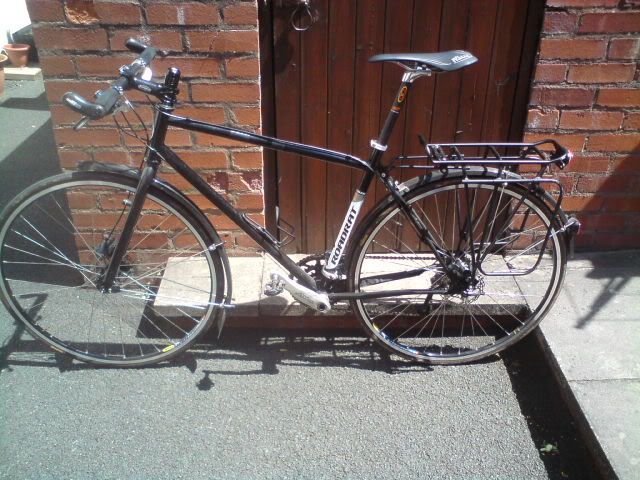 [/img]
Or that bike designers actually know much when it comes to engineering.
Exactly.
we have discs on one side for two reasons.
1 it can only go on one side on the back
2 you'd have to manufacture two different calipers to have them on different sides unless you put the front one in front of the fork which looks crap.
so basically manufacturing / marketing
Ooh fair point re reciprocity. Seems irrelevant here though.
Utterly. I like clubbers version too..
Putting aside the question of attaching the mount, is there not a potential problem in using a conventional fork blade for disc braking? I thought that disc fork blades are usually beefed up at the lower end to handle the different braking forces?
haha. you're not right al!
you want teh video?
YOU CANT HANDLE TEH VIDEO!
give it to 3:50pm, FFWD to 26s in:
We see the fear in your eyes in that final scene.
Surprised it at all didn't fall to bits when you rode off the kerb
That was a nice first test, but now you have your confidence I really think you should be going a bit faster and braking a bit harder.
For some reason Al I imagined you to be a fair bit older.
dissapointed^^^^^ won't be happy till you at least arrive in frame from stage right doing a proper endo stoppie on your front wheel from about 35mph. Bonus points will of course be awarded if you arrive in shot already sliding along on your face............ 😉
As chief said, plus riding straight towards that hairdressers car
endo!
It would probably be good if you could also ring that bell at least once during the test.
cynic-al - Member
What do you think Martin?
The way I see it, the caliper pulls away from the mount when the brake is applied. Tension both top and bottom. Whenever I have had a cable operated brake wound up and gripping the disc, it rotates with the wheel and pulls away from the bracket top and bottom.
I'm still fighting to see where folk find it under compression at the bottom fixing.
Your turn, what do you think? :OD
I_ache I never know whether to take that as a compliment or not - I usually choose to 😎
New pads weren't biting so top braking was unachievable.
Martin, looking at boblo's pic, I think the bulk of the braking force will be taken by the carbon wrap around the IS adaptor mount's top sideways hole and there won't be much other stress. If you take his blue arrow backwards it goes through that hole.
[img]  [/img]
Yeah, I agree.I think the bulk of the braking force will be taken by the carbon wrap around the IS adaptor mount's top sideways hole and there won't be much other stress
I still can't picture any compression at the lower end,though. Even if the forces were in the direction of the blue line* it shows the caliper pulling off the bracket. No compression.
*the blue line and its imaginary force is wrong too, Isn't it? Maybe I'm wrong but would it not follow the curvature of the disc? Would it not be a shearing force?
So, did you break a sweat trying it out? It would have been clip of the decade if it popped off :OD
I don't like the colour.
Blue line is correct.
No sweat, haven't you seen my similar threads before?
[i]For some reason Al I imagined you to be a fair bit older. [/i]
and less beardy.
It's like seeing an Archers actor. They never quite match the mental image you have 😉
AL you are awzums,gotta love a trier .
Please be updating youtube with an endo 360 combo 🙂
So the mount is still on? Keep testing, I want to see a result one way or another.
And going back to previous comments on same side etc, sorry was drunk, didn't explain myself very well. What I meant was back when it was decided which side was normal they obviously made some decisions. Some based on aesthetics, some practicalities, some engineering, some production/cost etc. The engineering challenge is by no means so great that allowances for other reasons can't be made.
By sticking to the same side you end up with a system that looks more balanced (even if it isn't) but also means you can interchange bits easier while keeping the caliper behind the fork leg and out of harms way. A good example here is Als CL brake disc which is technically turning the wrong way in use but I doubt it will matter in this case. In a world where people line up tyre logos with inner tube valves I can't see brakes being on opposite sides going down too well!
I remember Cy explaining the road rat brake position, I can't remember why but it did make sense. Was possibly due to adapting an old fork design (like Al) and/or as it means the wheel is less likely to be ejected from the drop outs and it's primarily a commuter bike so less rocks etc to smack a front mounted brake caliper.
But yes in other things when you don't make things symmetrical, or at least consider the effects of not being symmetrical, you can get problems (eg vibrations, undesirable loadings you now have to allow for etc etc).
less beardy
I dunno, anyone attempting bodging of this magnitude was always going to have a beard, weren't they?
I thought the roadrat things was also about making 'guard mounting easy?
You may be right IA - it's just not the mental image I had of him.
TJ always had wild grey hair and raggedy beard so Al, as the antithesis of TJ was clean shaven and smart. Odd, isn't it.
I salute you Al!
The pivot point, surely.I still can't picture any compression at the lower end,though. Even if the forces were in the direction of the blue line* it shows the caliper pulling off the bracket. No compression.
As a rotating force it won't be even across the block....
Correct.