Chipps lifts the lid on the obsessive world of 26in tyre reproduction fanatics.
Words Chipps | Photos House of Looptail and retrowhitetires
Hey, this feature looks even better when viewed via Pocketmags; you get the full graphic designed layout on your device FOR FREE! It’s not quite as beautiful as the paper magazine but it’s better than a basic webpage.
There are many classic mountain bike products that have come and gone. Some have been bettered over the years, some have improved with the times and some have mercifully just gone away. But what if you’re still riding a beloved 26in bike? What if you’re rebuilding a retro showcase full of New Old Stock components to take to the Malverns or some other retro-bike gathering? Some products are harder and harder to find, often with prices to match. And rubber products, like tyres and grips, simply don’t age well; however, well they’re kept. Yet, there’s still demand out there, whether from museum-grade retro collectors or ‘I love my old ‘80s cruiser’ alleycat diehards.
It won’t surprise you to learn that there are riders out there who’ve actually done something about it. Either as a passion project, a one-off ‘vanity’ commission, or as a genuine business venture. I caught up with a couple of them to find out what makes them tick and what goes into creating your own tyre moulds (clue: start with an idea, some contacts and a wodge of cash…).
Those distinctive white tyres
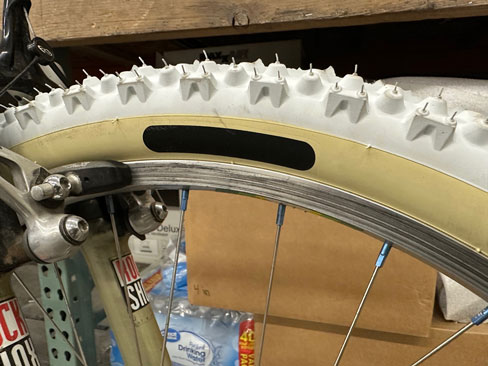
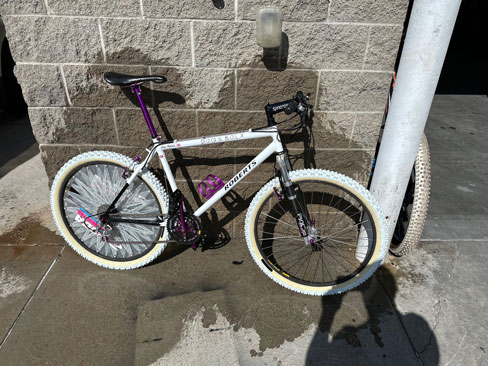
Aidan Bradney of Retro White Tires didn’t want to pay the increasingly large prices for ancient (and usually perished) white onZa Porcupines from the ’90s for his retro show bikes, so he reverse-engineered a ‘homage’ to them – and discovered that other old-school bike fans were interested enough for him to make a batch of them. Working with a Far-Eastern tyre supplier, he created a mould for a tyre that inspired a generation, but which hasn’t been available to buy this century. Rolling resistance and performance were secondary to making sure the white was ‘that’ white and the gumwalls were just the right shade of biscuit. Aidan even says: “Perfect for wall-hangers and occasional rides.” With no affiliation to the original brand, the tyres lack a logo’d ‘hot patch’, but everyone can tell the inspiration. And while you won’t see many ripping round your local trails, you WILL see them on period-perfect resto-mod bikes at bike shows like the Malverns Classic, where it would be unheard of to pair a Tioga Disc Wheel with anything else.
House of Looptail
On a more commercial scale, I managed to catch up with Wakeman from House of Looptail to ask about his own tyre journey.
I’ve always had a passion for wrenching, tinkering and creating, exhibited mainly in a love for cars, trucks, motorcycles and bicycles. I started in bike shops in ’87 and worked my way into a design and brand management gig by ’96. I am the founder of Surly Bikes and have designed nearly a hundred bikes or parts for multiple brands. In my experience, the best manufacturers welcome new ideas that challenge their capabilities and allow them to grow and continue doing what they do best; I was fortunate to have met the people of Panaracer decades ago, and have been incredibly lucky to work with them on these challenging tyre projects. It has not been easy for us, or for them, but here we are with two authentic high-end tyres down, and two more on the way. These ‘old’ tyres were very much a ‘new’ challenge for them.
What was behind the idea of getting tyres made?
You’re talking about a deep question with a complex, multifaceted answer here. Ha! But seriously… my generation was there for the beginnings of BMX, and mountain biking, and for all the characters and equipment along the way. These are Olympic sports now. The history, the stories, the personalities and the bikes are rich.
The bicycle industry has declared these old machines obsolete, but if a bike fits you, and suits you, and is fun to ride, and it continues to be serviceable, then nothing about it is obsolete. In fact, when you’re on a bike with a story, it’s twice the fun!
Riding these bikes, whether it’s an Annapurna or a Rockhopper, keeps them off the wall and out of landfills. And there’s always a special feeling when you get home from a great ride that didn’t require batteries or fork seals.
I decided I wanted to be a part of keeping these bikes alive. I actually want to be at the forefront of it, whether it’s tyres or whatnot. So when I finally got tired of cheap gumwalls, unrideable NOS tyres, new ‘tubeless compatible’ tyres that wouldn’t fit my rims or between my narrow chainstays, and looking at ‘Rocket Ron’ in 300-point type on my ’85 Salsa, I’d had enough and decided to do something about it.
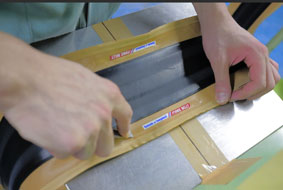
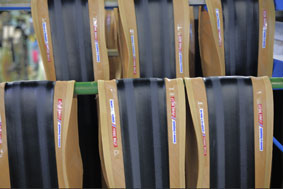
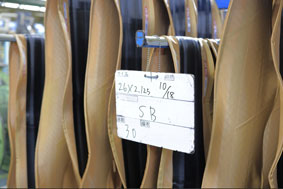
What made you pick the particular tyres(s) that you’re (re)making? And why limit it to 26in?
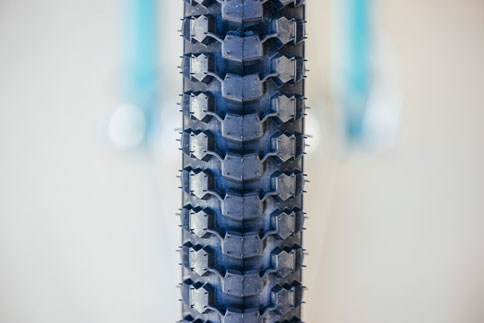
I picked the tyres that I loved from back in the day, all of which had been unavailable for decades at that point. As a BMX kid, the 20in Snake Belly™ was that unique, non-traditional tread design with the badass name; it worked inexplicably well, spawning a dozen copies, and when eventually up-sized to 26in became arguably the first ‘real’ mountain bike tyre. The Mitsuboshi Comp II™ was another iconic BMX choice, and perhaps the ultimate expression of a true, basic, motocross-style knobby, later becoming the basis for Specialized’s first mountain bike tyre in ’81.
Later on, when I was deep into the CNC-era of high-end mountain bike experimentation, for my terrain and riding style, there was not a finer tyre than the 2.35in Ritchey MegaBite Z-Max™. It wasn’t the only ‘large’ tyre of the day, but in my view, this tyre helped establish and further the understanding of what a large-volume tyre could offer off-road, if only your bike could fit it… And who said anything about limiting to 26in?
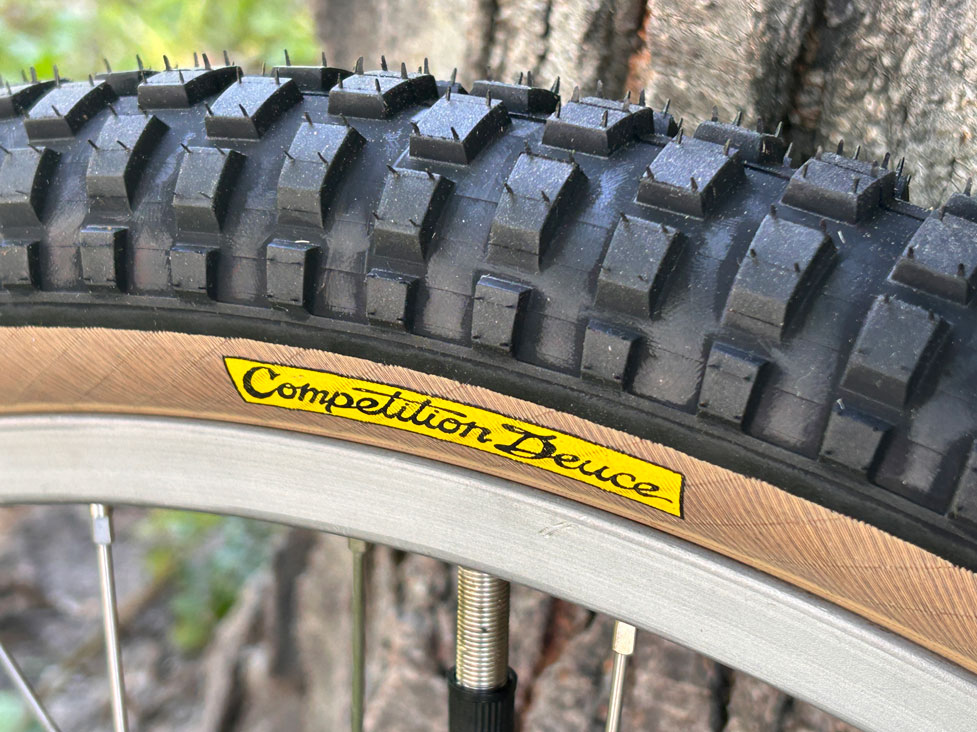
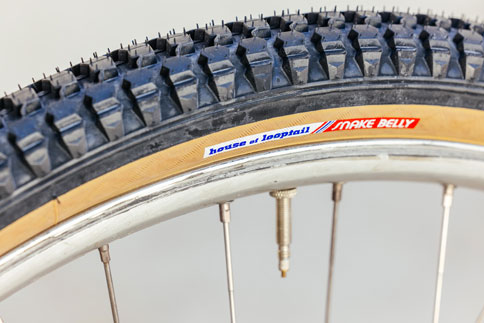
How hard was it to get the project off the ground? Did you know you had end customers, or was it just a hunch? Did you think you had enough connections in order to get tyres actually made?
It has been an extremely time-consuming project requiring every bit of patience that I’ve got, but the results have been worth it. Panaracer is a relatively small Japanese producer that focuses on quality over quantity, and they are generally maxed out producing a roster of tyres for their own concern and for those of multiple other brands. With some vocal support from their global sales manager, I was given a chance and a slot with their engineering and production teams. IMO, it’s not possible to find a better partner for a project like this and I’m deeply grateful to them.
It was time to do something substantive for the vintage bike community that fills a genuine need. Basically, I wanted tyres for my own bikes, and knew I wasn’t alone. I wouldn’t be the first, but I wanted to be the best; I had the connections and the experience, and I went for it. Certainly, I’d like to see a profit someday, but a return was not the motive here. Nobody with half a brain would jump into this if it were.
For those who’ve never made a tyre (i.e. all of us), what were the steps involved in designing, prototyping and making a finished tyre? How long did the whole process take? And if we all wanted to bring back a favourite tyre from the past, or have an idea for a new tread, can you give us an idea of how much investment is involved in making tyres?
It’s very possible to send an existing tyre overseas and ask for a copy to be made. What you will receive is a cheap tyre that rolls, holds air and somewhat resembles the original, which is just fine for some. I have no problem with people doing this, though, for myself, I wanted to do something the complete opposite.
If you’re wanting to create a lightweight, foldable, fully licensed, high-end tyre made from cutting-edge proprietary materials that fits correctly and performs as good as anything money can buy in 2025 – yet looks as though it was made 45 years ago – it’s an entirely different process that requires a detailed understanding of what you are after, a relationship with the original designer, the best possible manufacturing partner, tons of the aforementioned patience to the tune of years, and a five-figure mould investment. Per tyre.
What has the reaction been to your new tyres?
Extremely positive, particularly once people ride them. Cost has been a question mark for some, but our high-end tyres for old bikes are no more expensive than high-end tyres for new bikes, and once people see them and try them, those few extra dollars are quickly understood and/or forgotten. The word is getting out that these tyres are well worth the price of admission.
What’s next? Different treads? 29er versions? Other products?
Yes to all. Anything for vintage BMX cruisers, klunkers, or mountain bikes that isn’t already being produced, we’re keen to make, some of which are already available, i.e. barrel adjusters, pedal dust caps and the like. And, of course, vintage-style bikes requiring ‘new’ tyre sizes are on the menu. When a tyre works as good as the Snake Belly™, for instance, it’s appropriate for use on anything new or old, and we’re planning to make that a reality. As long as it’s fun.
Where can people find more about your tyres?


This is an interesting read – as someone who rides a 26″ bike not as a homage or retro anything, but just because it’s still great, I definitely know the feeling of trying to find new old parts to replace things as they wear out.
Not sure I’d go for white tyres, but if they could get some good 2.1″ tyres that are in the sweet spot of not too draggy/ not too slippy, I’d be keen!