UPDATE: CLASSIFIEDS section refreshed, redesigned, searchable: Go take a look
hammy uk...
Don't forget the Lefty! Things of beauty 😀
as little as 1/5th of the unsprung mass
Not quite that little here though? On a heavy motorbike fork maybe, I don't know. This USD stanchion and a beefier dropout / hub system, vs lower legs and hub of a normal 15mm axle fork. Moving internals position vary between form brand/model, not just USD vs conventional and a magnesium fork lower on its own weighs sod all. Less unsprung mass probably here but not a lot less than an already light SID etc.
The thing I really see missing is crown height - this fork design could have a lower A-C height than a normal 100mm fork.
Something no-on seems to of caught on to yet...
see you confused us with this by making it sound like you'd thought of something new, when in fact unsprung mass was mentioned several times on earlier pages....and comes up in every discussion about USD forks!
The thing I really see missing is crown height - this fork design could have a lower A-C height than a normal 100mm fork.
How helpful is this, though? I thought the limiting step was tyre/down tube clearance at max compression?
Unsprung mass you heathens.....
A "normal" fork has to control the movement of not only the wheel BUT the lowers, internals, etc AS WELL
This way there is as little as 1/5th of the unstrung mass needing to be controlled as there is only the wheel, axle and mounts to control.
Lighter mechanical, lighter springs, faster reacting, better damping, etc, etc, etc.....
Why do you think Ohlins, Marzocchi, Showa, Kayaba, etc have done forks like this for 20yrs on MX, Race and Road?
Unless the elite of STW's world class engineers know better than the top 5% of the worlds best suspension experts?
There is no way the sliders/drop out in this fork have a lower unsprung mass that the magnesium lowers of a Sid etc. Especially when the lowers of a normal fork actuate the spring via a 10mm hollow aluminum rod. As Jameso said, the dropout would at least need a larger hub interface if not axle to compensate for the loss in torsional stiffness from the lack of brace.
It'll probably have low static/dynamic friction due to the improved seal lubrication but apart from that it makes very little sense for mountain bikes. Horses for courses.
Definitely looks like wireless adjustment. Just seen on fresh goods magura have brought out a wireless kit for their forkd. Now where are the wireless gears!
Unless it uses some sort of brain concept
I wouldnt buy if there is no way to protect the stanchions. My lowers have loads of scratches....
Unsprung mass you heathens.....
A "normal" fork has to control the movement of not only the wheel BUT the lowers, internals, etc AS WELL
This way there is as little as 1/5th of the unstrung mass needing to be controlled as there is only the wheel, axle and mounts to control.
This always gets wheeled out in USD debates, I'm gonna do some copy/pasting from the last one:
For me it's all about having the oil sat on the seals.Cant imagine the unsprung weight thing matters.
Normal fork unsprung weight = front wheel+brake caliper+lowers+axle+half a damper cart+half a coil spring+some oil
USD unsprung weight = front wheel+brake caliper+stanchions+axle+half a damper cart+half a coil spring+some oilI'd guess you would see as big a change in unsprung weight by putting a lighter front wheel on - and noone says 'yea my suspension feels ace with this lighter wheel on...'
One of these days I'm gonna hit the garage and weigh some stuff, this has been annoying me for years
Definitely looks like wireless adjustment.
I wouldn't bet against adjustment by Allen key - what's that port for at the top of one if the legs?
The main reason for usd is the leverage forces acting on the slider/top bushing area.
on a conventional fork the leverage forces are acting on the top of the fork just below the crown causing the upper stantions to effectively 'bend'. This causes the upper bushing to bind as the fork compresses.
with a usd fork this leverage or bending action is directed into substantially more material which resists the bending motion better and also the 'top' bushing is now in a fixed position half way down the fork and doesn't bind as readily.
The only disadvantage is the rotational rigidity isn't as great due to the lack of brace.
I had some Avalanche Racing USD forks on my Brooklyn Racelink and whilst they were the plushest fork I'd ever owned the were like trying to steer with two pieces of spaghetti.
I'm hung over and have a banging Peroni induced headache and cant explain it clearly but the main advantage to usd forks is the leverage/binding/small bump compliance/ forces acting on a larger diameter something or other
Lack of visible adjustment is a bit weird. Not that I adjust my forks often at all, but I wonder if there's something steerer-based or electronic.
Lack of visible adjustment is a bit weird. Not that I adjust my forks often at all, but I wonder if there's something steerer-based or electronic.
If it is an XC race fork, why would you need adjustment? Seriously adjust it once and it is pretty much done for ever of that once it doesn't need to be that easily accessible. You really don't need to be tweaking the settings all the time. As long as you can get some air into it your done.
What about lockout? Most xc forks have some sort of remote lockout. That Magura upgrade is a wireless lockout if I read it right...
[img]  [/img]
Hopefully they'll have a decent damper in even if the adjustment ( most likely an on/off lockout a la sid xxwc) is electronic/ wireless, however the damping isn't as good as the rct3 on the ' lower spec' forks.
Have asked about price, availability etc on Friday but no info yet from Fishers
[img]  [/img]
Spill the beans! Looks like SRAM are making tub wheels as well.
Inverting stanchions effectively closer to trail obstacles. Genius.
Just waiting for all the "rad" coloured aftermarket silicone gaiter boots to appear.
Will they need special handlebars, like the 650b specific saddles we've seen recently?
Inverting stanchions effectively closer to trail obstacles. Genius.
Assume they will have guards, like MX bikes do.
[img] http://i.imgur.com/ncOpOtp.pn g" target="_blank"> http://i.imgur.com/ncOpOtp.pn g"/> [/img]
Ah you beat me to it Jamie. re: edited post!
PAH!
I was running something similar on my commuter bike way back in 2003!
[IMG] 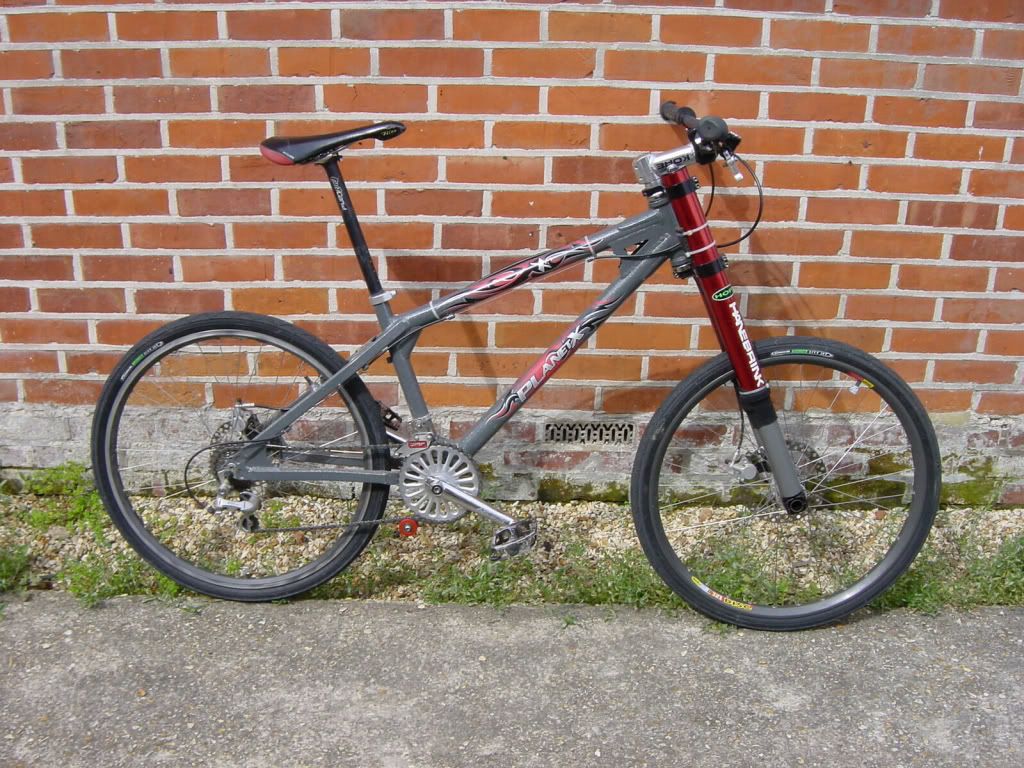 [/IMG]
Hey, snap! I had a planet x Jack Flash RAD with Shiver DC's on back in about 03! Less commuting, more stair hucking...
Ooo talking over commuting those work gonicely on my commuter to soften the ride on my dodgy wrist!
Think of the extra unsprung weight those stanchion guards will add! 🙂
[img]  [/img]
AlexSimon - Member
Lack of visible adjustment is a bit weird.
Little ports on the top, with adjusters underneath like everything else?
The adjusters could well be in the bottom as they are on MX bikes.
Ohlins on the MGP kit have rebound in the right leg and compression in the left. Everything kept simple and separate - one adjuster in each.
Base models tend to have rebound in the top and rebound on the base of the leg.
Rusty picked up on the other main benefit of this design - less "Stiction". The moment you incline a fork sideways the up/down" forces become "up/down/sideways flex" forces and they call it Stiction.
Nitride coatings, DLC, etc are used along with minute lubrication to assist in reducing it but the inherent increase in rigidity of this design makes them superior.
JCL - Member
There is no way the sliders/drop out in this fork have a lower unsprung mass that the magnesium lowers of a Sid etc. Especially when the lowers of a normal fork actuate the spring via a 10mm hollow aluminum rod. As Jameso said, the dropout would at least need a larger hub interface if not axle to compensate for the loss in torsional stiffness from the lack of brace.
You can't just compare a Mag lower though - there would never be "just" the lower - because the hub, spindle, springs, etc all are attached the the lowers on a "conventional" fork so all count towards unsprung mass.
Jamie, what are the chances of getting you to do a "Jamie photoshops STWers bikes" thread?
Utterly brilliant, as per!
Do folk really think unsprung weight matters?
You have say 3kg unsprung weight (fork lowers, wheel, tyre, brake) vs 70+kg (rider + rest of bike).
I can't see it - no matter what the fork manufacturers tell us!
Do folk really think unsprung weight matters?
All the world champions on the forum obviously do 😥
The rest don't give a shit which fork matters
You can't just compare a Mag lower though - there would never be "just" the lower - because the hub, spindle, springs, etc all are attached the the lowers on a "conventional" fork so all count towards unsprung mass.
And the hub, axle and internals aren't attached to the unsprung mass on a inverted fork??? If anything most of those items would be heavier on the inverted fork.
Also with the inverted fork there has to be a dropout to slider interface which wouldn't be needed on a conventional fork. I'd still put money on the conventional fork having lower unsprung.
cynic-al, unsprung has more effect the lighter the sprung mass.
Do folk really think unsprung weight matters?
Yerp. It does. It doesn't matter what the sprung weight is, if you can reduce the unsprung weight, it's easier to control it, so the suspension works better. 🙂
What evidence do you have PP?
Please don't say you read it in a mag/brochure!
Kind of (since a zero unsprung mass would mean being able to change direction immediately with no momentum to account for) but as usual does it have a real world benefit with the numbers we're talking about? And the ratio of sprung to unsprung mass does matter.
cynic-al - Member
What evidence do you have PP?
Please don't say you read it in a mag/brochure!
POSTED 7 MINUTES AGO # REPORT-POST
Physics
One of the problems of bike suspension, vs car or motorcycle suspension is the spring/unsprung mass ratio.
Thus bike suspension is far more reliant on very low breakaway friction, requiring higher spec bushings and is intolerant to secure seals.
It's clear some suspension items suffer with sealing issues to get the smooth movement at the expense of environmental resilience.
I can't wait to see the price!
I'll be surprised if they're under a grand.
Yes clubber+1
£1k?
One of the problems of bike suspension, vs car or motorcycle suspension is the spring/unsprung mass ratio.
+1
On a motorbike the bars/footpegs/saddle aren't displaced in the same way though as the 100kg+ bike requires much more force to gain significant momentum, so the suspension does the work on it's own. On an MTB your arms/legs do a lot more of the suspensions work, so in effect the whole bike's mass is 'unsprung mass', which is why light bikes feel so good.
I'm just taking a wild stab here, but i'd lay good odds on the fact that the unsprung mass on this fork vs a similar size/spring type/travel fork would probably be at best 100-200 grams, given the requirement for a seriously overbuilt hub interface and the weight of decent light lowers.
I agree that lower unsprung mass is good, the lower the unsprung mass the easier it is to keep on the ground and the more supple the fork could be built with lower seal breakaway force if so desired, additionally a USB self lubes much better so even looser seals could be used.
That said, I doubt it will feel any different apart from the lower torsional rigidity to a normal 15mm through axle fork. Factor in the 24" inches of fully active suspen sion you have working all the time you ride in your arms and legs and honestly the whole story is barely worth comment.
Does anyone know if they are using the Reverb keyway to add torsional stiffness, that'll be a clusterf_ck of servicing issues to deal with.
With the amount of torsional movement during riding.. and the amount of movement a reverb has after a few months of riding.. it would be pointless for them to take that tech over to the fork as the point where the 'key' technology will kick in, will be way past (torsionally) the point where riders will twist them 😀
Sorry guys, just stumbled across this from the lead story at http://singletrackworld.com/wp-content/uploads/2014/03/rockshox-everything-changes/ so apologies if I'm asking something that's already been discussed.
I'm far from an expert but, isn't putting the exposed part of the fork closer to the mud and slutch a Really Bad Idea? Aren't we just going to end up spending half of our lives servicing the things?
(And incidentally, whatever happened to gaiters? Did they fall out of favour simply because they look like crap?)
We're assuming that there will need to be guards attached a la MX/etc
Gaiters became unnecessary as sealing improved. Mostly. And they look carp 🙂
I suspect more crap hits the stanchions on forks now due to their proximity to the tyre than would get on the lowers on these forks from goign through puddles etc.
My discs tend to stay pretty clean, the brace etc on my forks is always covered in crap.
gaiters just tend to trap any dirt that finds its way in so aren;t ideal.
The use of the stanchion guards on this type of fork is a 'good thing' though.
I'm far from an expert but, isn't putting the exposed part of the fork closer to the mud and slutch a Really Bad Idea? Aren't we just going to end up spending half of our lives servicing the things?(And incidentally, whatever happened to gaiters? Did they fall out of favour simply because they look like crap?)
On a reasonably mucky ride, how much more filth is near the hub than is near the brace/stantions on right way up forks? Same? More at the top? That's what I notice anyway.
Gaiters? they store up all the crap and moisture inside them, and keep it rubbing against the stantions. Which is ace....

