C: 36.1 %
L: 29.0%
LD: 23%So that's a more stark comparison - 52% of the votes cast were *not* for the tories, whereas 36.1% were.
59.1% not for labour.
65.1% not for lib dems.
Same logic.
Just looking at some interesting stats regards the election. I have to say that something really does have to change although the stats do ask some very interesting questions of PR.
Sinn Fein, 5 seats from c.171,000 votes
BNP, 0 seats from c.500,000 votes
SNP, 6 seats from c.500,000 votes
UKIP, 0 seats from almost 1 million votes
It doesn't make much sense really, but then neither would a Parliament in which the BNP would have as much say as the Scottish National Party (although there isn't much to choose between them ideologically, they're both strongly nationalist parties 😉 ok ok, I'm just kidding. )
Here's a list of who got what votes.
This is for the whole of the UK, not just the population governed only by Westminster.
[IMG] 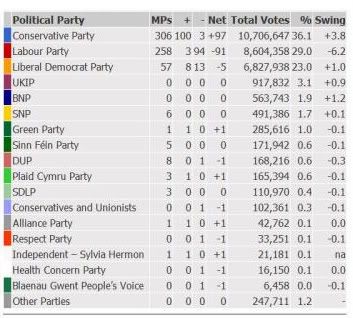 [/IMG]
The Libs should take AV. It's not PR but it's a fairer voting system where most votes count. It will change the patterns of voting considerably because the tactics are multi-party. It's also the basis for AV+ in the future which is PR. It's a step the Cons will just about accept.
They should just go for it.
Just out of interest, under a possibly AV system, would my ballot be spoilt if I didn't rank the candidates in order or preference?
Hmmm - averages out at roughly one set per 50,000 votes. That would give us 11 BNP MPs
"Just out of interest, under a possibly AV system, would my ballot be spoilt if I didn't rank the candidates "
it's all on Wikipedia: [url= http://en.wikipedia.org/wiki/Instant-runoff_voting ]Instant Runoff Voting[/url]
If 500,000 people vote for the BNP then their vote should be accounted for. Otherwise we're just saying we'll let you vote BNP for the moment because we know it won't transmit into seats in govt. What kind of ****ed up democracy is that ? The same kind that gives us FPTP I guess.
*sets stopwatch to see how long it takes to be called a nazi*
11 BNP MPs. We hate 'em but that reflects their true popularity and that that is what we should be worried about.
Well said buzz
If enough people vote for the BNP, they should get MPs. At the moment, they can be pretty much ignored in most constituencies. If they were getting elected, we'd have to argue with them and show them for what they really are.
JonD: following the nonsensical argument line, 2005 election.
[url= http://news.bbc.co.uk/2/hi/uk_news/politics/vote_2005/constituencies/default.stm ]link[/url]
Labour - 35.3%
Conservative - 32.3%
Lib dem - 22%
therefore 54% voted to not have a Labour government, compared to 35.3% did.
and as a reminder of seats
Labour - 356
Tory - 198
Lib Dem - 62
That would give us 11 BNP MPs
On the assumption that all their voters would still vote for them under PR.
A fair few people who vote BNP do so in the full knowledge that they don't stand a chance. Many people see voting BNP as merely a way of expressing dissatisfaction with genuine grievances. I reckon there's quite a bit of difference between the BNP and some of their voters, and it remains to be seen whether they could rely on every single vote they now get.
Of course the reverse might also be true, and more people might vote BNP if they thought they stood a better chance - although I doubt it. But I reckon you should be careful with not necessarily correct extrapolations.