I had the cammera out while I fed my spiders so here are one or two snaps.
This is a [i]Ceratogyrus meridionalis[/i] they are from Africa, Mozambique way.
[img] 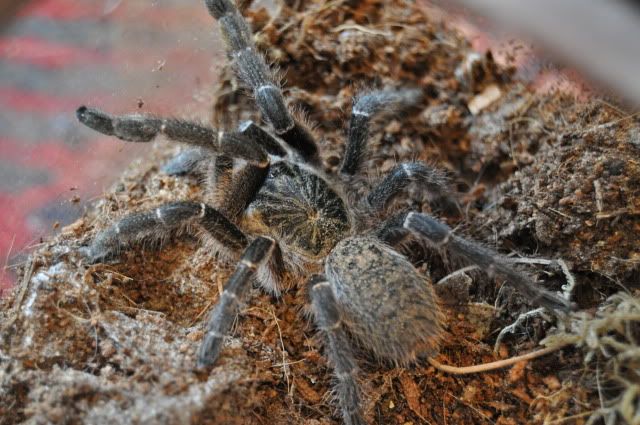 [/img]
They are normally quite shy but when they run they are quite fast. This one made a run for it when I was feeding them but caught it again with the old "glass and piece of paper" trick.
[img] 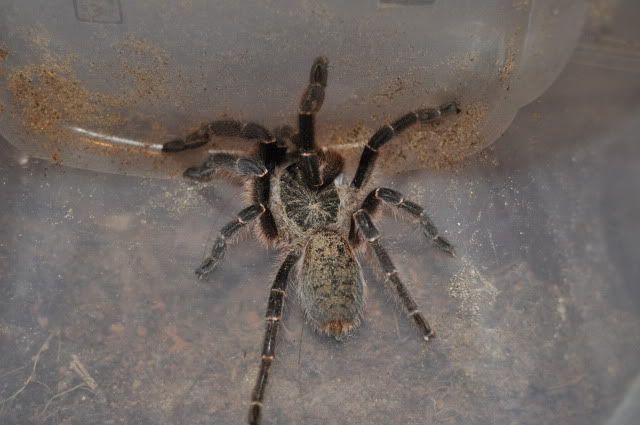 [/img]
(don't use paper for these though as they could bite through that)
I also have a female [i]B.boehmei [/i] She has just moulted so has bright new clothes.
[img] 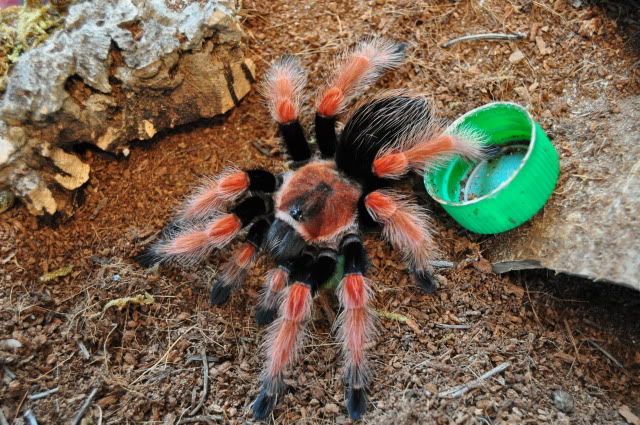 [/img]
This is a young [i]Theraphosa apophysis[/i]I'm not sure of the sex. Theraphosa are the largest of all spider and this one could reach a leag span of 28cm-30cm.
[img] 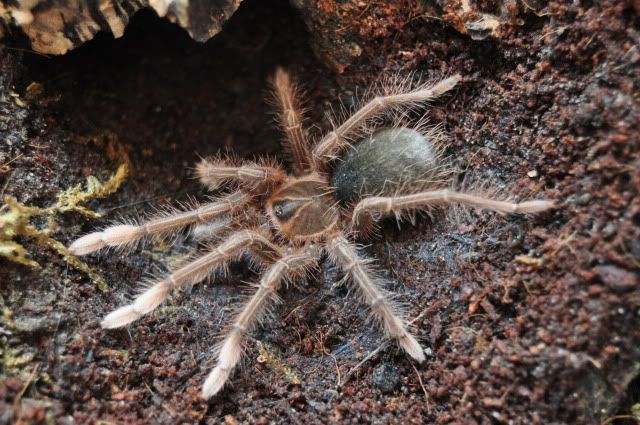 [/img]
This [i]Paraphysa parvula[/i] is ready for a moult. She is an adult female and normally they are more colourful. She is a few years old but doing well.
[img] 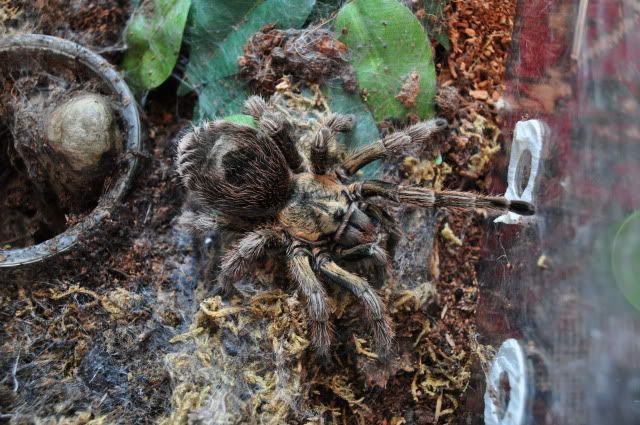 [/img]
and a male [i]Buthus iccitanus[/i] or ibericus
[img] 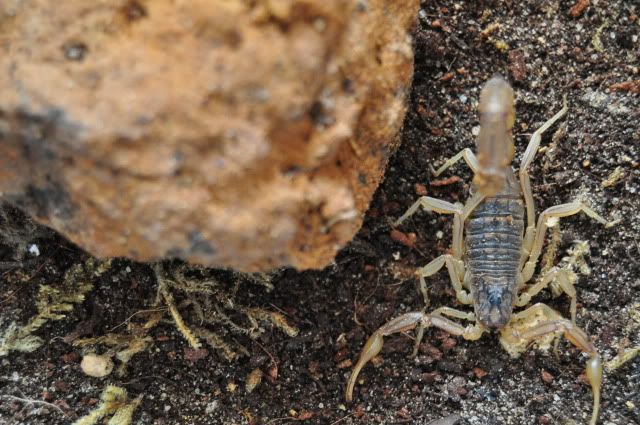 [/img]
Yay 😀
I forgot to add this one too.
She is an adult [i]Psalmopoeus cambridgei[/i] They are arboreal spiders (live in trees) but Psalmopoeus can be quite stocky. She has a leg span of about 20cm. They are from Trinidad and Tobago and can be quite narky, though this one is quite nice and has never really tried to bite me.
[img] 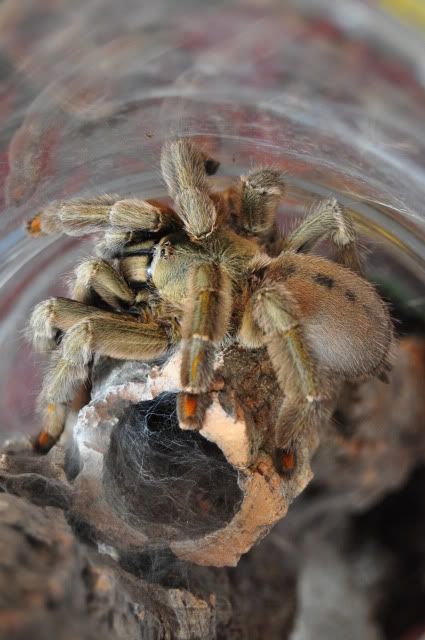 [/img]
I can appreciate them in the pictures...don't think I'd want to get very close to them though...
Fab been waiting for this, how many spiders have you got Roper?
I'm glad you list all the countries these spiders can be found in.
Lets me know where to avoid!
Pigface, it is hard to say. I have some spiderlings (native to here) which I will be releasing in a few weeks but I have tarantulas, other species of spiders, scorpions, centipedes and a very tiny mantis. I think a scorpion pair have mated which if successful could have 20 or 30 scorplings, a [i]Zoropsis spinimana[/i]has an eggsack which I'm watching closely. If the Z.spinimana sack is successful there could be about 100 slings (the last one had 101). So lets say a few give or take.
Lets me know where to avoid
You will be safe from spiders in either of the poles but that's about it I'm afraid 🙂
The vast majority of spiders are completely harmless to us and will run from you if they can.
I'm amused at the notion of a spider being described as 'a bit narky'.
Excellent!
Can I request an "Arachnids: Around the World With Roper" series of threads? Each thread with pics etc from a distinct continent, geographic locale etc.
Nice ones Pete - any news on the M balfouri? Here's a few of my "pokies" or Poecilotheria as we know them
P formosa
[IMG]  [/IMG]
P metallica
[IMG]  [/IMG]
P rufilata
[IMG]  [/IMG]
And last but not least my Horned Baboon - C darlingi
[IMG]  [/IMG]
Don't you just love them 😀
Helo Paul, I'll send be sending you and update email in a day or so, apologies for the delay. Hopefully with al the attached photos this time too 😕
great photos and a nice selection too. There might be room or a scorpling too if I'm lucky.
Can I request an "Arachnids: Around the World With Roper" series of threads? Each thread with pics etc from a distinct continent, geographic locale etc.
good idea. ill have a think, hadge has a good collection so maybe we cold use some of his sp too?
holy crap they're HUGE! i thought seeing the spiders in Réunion was bad...but these ones are real hairy aswell!
How much space does the storage for these crackers take? They look amazing but you must have rooms set aside for these things...
[i]Theraphosa are the largest of all spider and this one could reach a leag span of 28cm-30cm.[/i]
****ing hell!!
Sooo, I've been looking at this thread not daring to open all day. Now I need to lie down. LOL
This is one of my latest spiders - a juvenile male P metallica which I hope to breed with the other "blue" lady up above
[IMG]  [/IMG]
All the "pokies" I have pictured are in enclosures that measure either 10x10x14 or 8x8x14 as they require more height as they are Arboreal which means they are tree dwellers and they can climb - very very fast too. They are also what are known as "Old World" which means from Asia and they have very potent venom too and you do not want to get tagged by one. Here is a picture of some of my set-ups for the spiders above
[IMG]  [/IMG]
Fascinating creatures, they scare the bejeezus out of me though. I can appreciate why they appeal to folk though.
They are fascinating and there's an incredible diversity of types and each with their own temperament
[IMG]  [/IMG]
and also they vary in size too, some being huge 😉
[IMG]  [/IMG]
I'm no expert, but I think you might have made an id mistake with "male Buthus iccitanus or ibericus" - doesn't look much like a spider to me!
🙂
And that "P metallica" is gorgeous, love the colours.
lol @ "orange bitey thing"!
Those enclosures look great hadge. nicely set up.
Size and space can vary, though I do have a "spider" room or sorts. Depending on the species and type of spider I keep them in enclosures like the ones above. For younger spiders I use differnt variations of adjusted tupperware. Spiders don't like too much space, though this can vary on species. For example, quite a few terrestrial spider don't move arround too much. Once they are settled in they wait for prey to pass by them rather than looking for it. They will organise and maintain their enviroment but tend to only live in a small space. because of this their enclosures can be stacked, as long as they get the right heat, air and lighting. As long as they are provided "natural" conditions to live in they behave in a natural way, which can be very fascinating to watch.
I also do have dwarf tarantulas which are 3 or 4 cm long so much smaller, though they are lightning fast.
Theraphosa are the largest of all spider and this one could reach a leag span of 28cm-30cm.
*looks across at trusty Helix ruler. Shits pants*
LOLing at orange bitey thing!!
Stoner, I know!! how effing scary is that!
How much do they cost?
Roper/Hadge - how did you get into keeping them, where/when did the fascination start?
Here is the said "orange bitey thing" - Pterinochilus murinus or Orange Baboon Tarantula as it's known. They can live socially in groups too which isn't normal with most T's as they are very cannibalistic. I have a commune of these and also some of the pokies which I haven't shown yet.
[IMG]  [/IMG]
I love these spider threads. The photos are great - my Mrs isn't too keen though 😀
deluded - I've always liked wildlife and animals and obviously insects are all around us and spiders have never bothered me, as in picking them up. Tarantula's are just "bigger" than our native spiders and because there's such a diverstiy and they are relatively easy to keep and also some are cheap it's an easy hoby to get in to. I had one spider 2 years ago and now I have nearly 40 but they vary in price from £5 for a tiny baby ("sling" which is short for spiderling) to over £300 for a female of the P metallica in my pictures. I generally buy juveniles which are about £15-30 each and these are for me, easier to keep and feed. They are dangerous and some have very very nasty venom so you must be very careful but it's just a matter of common sense really. Some have hairs which they can flick at you which irritate your skin and are nasty if you get them in your eyes too.
Here's my oldest girl - she's a Chile Rose called Julie lol
[IMG]  [/IMG]
Cheers Hadge,
Like many on here viewing this thread, I’m mesmerised by them really. I don’t know if I’d be able to handle one though. I can’t understand (literally) why people are so inherently averse to them. I guess it’s something to do with anthropomorphism – that there shape is so different to our own?
The Chile Rose is the ONLY adult one I've handled and I don't hold her anymore as being totally honest there's no need to. They don't gain anything from it and invariably will try to escape and that could injure them if they fall from a height. If she bit you it would be like a bee sting but she could flick hairs at you. She is quite docile but to me I treat them as I would fish - nice to look at no need to touch.
See the flicking hairs thing. How does that work exactly? In detail. Hairs being flicked at me doesn't sound that bad but it obviously is from your posts. I have a horrid fascination with all things venomous and the hairs flicking thing sounds freaky. Tell me more.
Ps it's the eyes on the ****ers that bug me. Anything with a solid non expressive multiple eyed face is going to have that effect on me.
a leag span of 28cm-30cm.
I used to love these threads but surely, hopefully, please god, you mean mm not cm (or some mistype of inches).
Oh yeah, and have you ever been bitten and if yes describe it. And which is your most venomous one and what would be the bite ramifications of that one? (see, fascinated!)
**** that! Labradors for me!
Tarantula hairs are really more like hollow tubes but are called hairs, because they look like hairs. This type of hair is called urticating. Urticating hairs can also be found on certain caterpillars (processional caterpillars in Spain) but you are probably more familiar with them on stinging nettles. All new world tarantulas have them, but there are different types. (just to clear up something Hadge wrote above, old world tarantulas are in Asia but also can be found in Africa and Australia)
You can read more about the hairs here
[url] http://en.wikipedia.org/wiki/Urticating_hair#Urticating_hairs_in_tarantulas [/url]
This is what the different types of hairs look like
[img]  [/img]
My [i]Theraphosa apophysis[/i] (the one which can grow to 28cm -30cm) probably has the worse type and could be fairly medically significant, especially if the got into my eyes, as this could result in long term treatment and possibly permanent damage.
Others such as the [i]Brachypelma boehmei[/i] above do kick their hairs but they are not so bad. I have once been hit by some hairs from a Brachypelma and the result were cold like symptoms. The hairs on the skin result in a rash and itchiness. I didn't get them in my eyes.
The good news is old world tarantulas don't have urticating hairs and so don't have this defence mechanism. The bad news is they tend to make up for that with more potent venom.
However venom potency can be a bit if a tricky area. Not all bites will include venom and it depends on how defensive the spider is being to how much it will inject. Some could produce one bite while others could give you multiple bites in quite succession.
I should point out that because tarantula venom if quite pure NO-ONE HAS EVER DIED DUE TO TARANTULA VENOM. However some old world species could make your nauseous, produce severe cramps, fever, dizziness etcetera. Also some old world species venom also contain a very similar chemical to chillies in their venom, just so you know you have really been bitten.
The best way to avoid being bitten is, don't handle them. There are some "beginner" species like this [i]Grammostola pulchripes[/i]
[img] 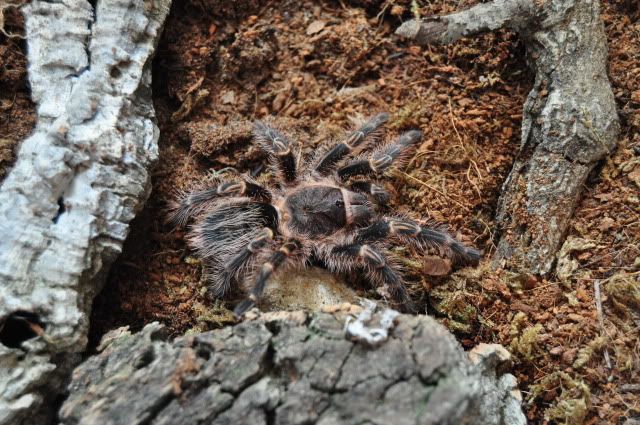 [/img]
Which have very mild urticating hairs, very mild venom (no worse than a bee sting) but a very mild temperament too. My G.pulchripes has never tried to bite me or even hinted it has any intention to do so. She is so docile, has never become agitated or threatened and so never seen me as a threat. When I feed my spiders I leave the lid off her enclosure and let her wander round the room, if she likes. She is so gentle and slow I can just scoop her up if she wonders too far.
I have never been bitten but have read quite a few bite reports. Some can be pretty bad but most mild to humans. I would rather be bitten by my G.pulchripes than say a more common pet like a dog.
That's the bad stuff about spiders, the good is rather endless. if you keep them well and as natural as possible you get a small window to watch a fascinating creature live naturally and well, and they can be both stunning and very, very odd.
Ta for the update!
Properly fascinating, bizarre, and a little bit scary. Thanks for sharing.
A spider that grows to 30cm!!!!! i,m guessing none of these could survive wild in the U.K. right,please tell me i,m right!!
Got a picture of one of the big ones next to something for scale? So far my brain is refusing to let me picture a spider *that* big!
I have to say, I like their eyes 🙂
The 30cm measurement is leg span (top left to back right legs) and the largest they can grow, though that is still a faire size. T.blondi is also the heaviest.
I don't have any adults but here is a photo
[img]  [/img]
and a video of someone handling one.(if you look about 2mins in you get to see the leg span a bit).
A spider that grows to 30cm!!!!! i,m guessing none of these could survive wild in the U.K. right,please tell me i,m right!!
Well you have had quite a bit of warm weather recently so.....

