UPDATE: Reviews section refreshed, redesigned, searchable: Go take a look
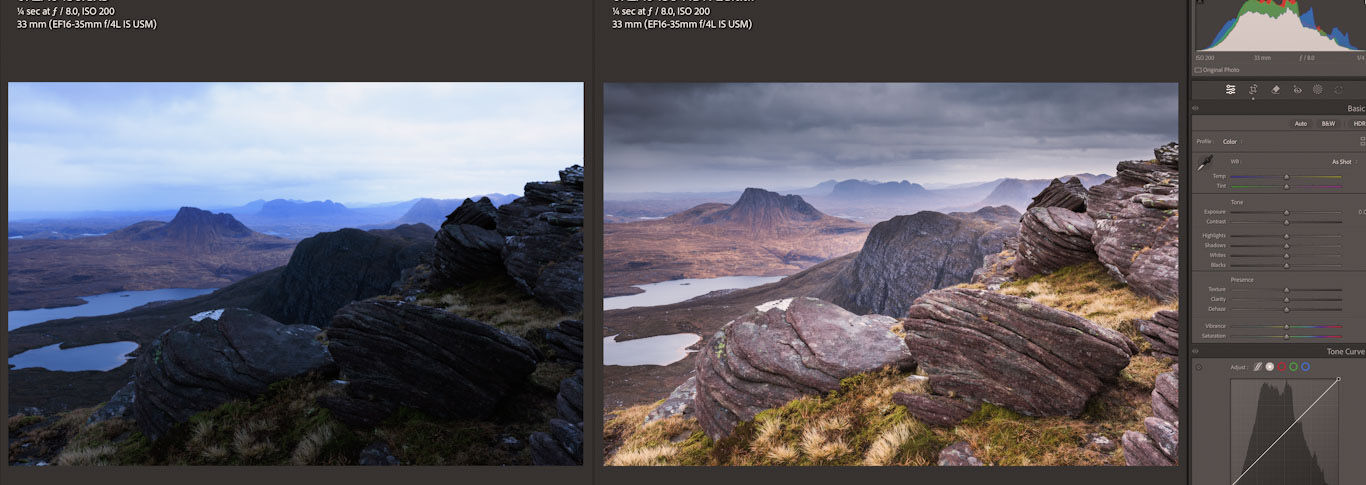
Example below shows image out of camera on the left, edited on the right. This scene had high contrast and the camera worked out 1/4 sec exposure to get all the information, but it made the sky overly bright and the rocks overly dark. The white balance was also too blue for my taste.
As it was a raw file, I was able to adjust the highlights, shadows and white balance to my preference. If I didn’t, I’d only have a pretty crappy image for the bin.
99% of photography is what you put in the frame and when you push the button, also what you keep out of the frame is as important as what you put in it.
That's sounds like conquer your fears before your fears conquer you....
99% of photography is what you put in the frame and when you push the button, also what you keep out of the frame is as important as what you put in it.
Well it clearly isn't 99%
Perfect composition, out of focus, wildly underexposed is clearly going to be a terrible photo.
Bad composition, pin sharp focus witha lovely depth of field and exposure that highlights the main focal point and softens everything else. Is also going to be a naff photo with an added bonus of wasted effort.
Elshalimo if younreally want to learn what iso etc mean try using the sunny 16 rule.
Set your camera to manual. Set your iso to something low like 100 (because low iso is better, also iso on a digital camera is weird it only really has one true iso, everything else is just amplification).
On a clear sunny day your default setting will be
f16 @ 1/100 (1/iso)
Now, if you want to change that say you want a faster shutter speed to capture akshun thats fine you can speed it up but you need to compensate. Every time the speed doubles (one stop) you need to adjust the aperture by one stop so...
F11 @ 1/200 same exposure, shallower depth of field less motion blur
F8 @ 1/400 etc.
Now you have finished with that subject but you want to photofraph say.... A tree standing lonesome in a field with taller trees in the distance and some hills to boot.
So back at f16 @ 1/100 but this time you goal is to decrease the depth of field to bring the tree and only the tree into focus. So you you increase the aperature by lowering the f number. And thats fine... Aslong as you compensate with your speed by making it faster.
Now. If the weather is different ats a bit cloudy you adjust your base setting by 1 stop. Use f11 and 1/100.
Now that all sounds complicated but heres the thing. All you need to remember is any change you make needs to be compensated by the same amount and all you actually need to do is remember what you get with the adjustments.
If you rattle off a set of photos of a scene and just step through each f number you will see the difference.
Josh I was a wire photographer for thirty years, he's starting out, keep it simple, think, concentrate on composition and timing, avoid distractions creeping in to the frame. He can learn about relative exposure, depth of field, visualisation, zonal placement etc etc etc a bit later.
So Elshalimo take lots of photos and enjoy it, dig allows instant feedback.
he's starting out, He can learn about relative exposure, depth of field, visualisation, zonal placement etc etc etc a bit later.
I am pretty sure he isn't.
Why I don't really agree with you though...
You can do that for sure, nothing wrong with snapping away. But if you want to improve* you need to understand which bits do what.
Composition is is all well and good but there are so many times when its depth of field that pulls out the bit that you see as the main event. Or you yo u want to have a huge depth of focus to capture a whole scene. If you go down your suggestion and you aren't content you will either want to know why or just become disenamoured with the whole thing.
*And specifically the OP wants to know how the settings work and what they do.
We'll have to agree to disagree Josh, for me learning pictorial awareness and the content of the pic are by far the most important thing when starting out and reading his post I would class him as starting out. I'm not suggesting snapping away, I'm talking about taking your time, learning to compose and anticipate, being precise, I do agree that learning to think in apertures is important, popping his camera on av and having a play will help with this but for me so many people forget the true basics, first make a great picture, or at least one that pleases you, you can't edit a bad picture in to a good one.
Btw depth of field and depth of focus are two completely different things...but I'm sure you knew that 😉
Despite having clicked the shutter release for a good many years I hadn’t heard the term “depth of focus” before, and assumed that JV just mis-spoke. Now I’ve looked it up I can share my wisdom:
Depth of focus is the range over which the image sensor or film can move behind the lens while the image remains acceptably sharp.
i was intrigued this week to look at a picture in a house i was working in. It was a black and white print of a valley and waterfall in what was i think america somwhere. I dont know but i think it was an ansel adams picture. The shot was down a valley in brooding weather in low light, the waterfall was half way along the valley and off centre. It was a stunning picture, very moving
I was looking at it for ages and it was mesmerising. I realised it was the placing of the waterfall that made it so good. If you made a frame with your fingers and 'cropped' it, it really changed the view and feel of the shot. Moving the waterfall left or right just killed it and it became mundane
so for me composition and light (time of day) is what i would be thinking about if i wanted to take better pictures but couldnt be bothered with anything more than basic editing ie cropping
Ansel Adams, f 64 and be there.
I’m a photographer and when I started learning in the 1980s I did it by spending my newspaper round money on a role of Truprint film with processing included every week. I learnt 36 frames at a time and have now been doing it for a job for probably as many years! It’s so much easier to learn now when you can see the results immediately, make a change and try again until you get what you like.
Enjoy it, have fun, it’s a hobby. Look at other people’s work with a critical eye and don’t be afraid to copy them. Once you’ve mastered the camera and the cliches you can really start seeing and experimenting.

