Forum menu
This sot of cropped up in last weeks home work for my students. But the mark scheme kind of ducked it saying a restive force changed the radius of the orbit
So I did the maths and got the answer. If a space ship fires a thruster producing a force in the opposite direction to it's velocity it will move into a lower orbit and speed up
I'm still a bit freaked by this. So googled it and it seems I'm correct
https://www.wired.com/2010/11/changing-orbits-and-changing-speed/
It's because the satellite looses potential energy which it coverts in kinteic energy
But it's still weird isn't it?
Define 'speed up'
Love this kind of stuff, yea I guess that would have to be true.
There is a guy on youtube called Scott Manley, he does great videos on orbital mechanics, like one where he discusses if you can de-orbit something from the space station using human power alone.
Is this the same as a figure skater spinning faster when they pull their legs in?
Rotational speed can be a bit of a headmess as I found when I was explaining how fast you would be going if you were stood on the equator to a nine year old last night. I think the figure skater / roundabout thing is related to the conservation of angular momentum (momentum preserved, mass goes inwards, skater speeds up)
"Define speed up"
Defining speed
distance, round the orbit, in metres, travelled per second. Ignoring the rotation of the planet and motion round the sun
Define Increase
more per second
Is it on a conveyor belt?
It does sound counter-intuitive, but true. Do a retro-thrust and speed up. But at 7km/s any thruster firing is just a small variation of pretty damn fast anyway.
Loose or lose?
NASA have to cover this sort of thing in training for EVAs with their rocket pack thingies. If you get separated from the space station/shuttle then getting back isn't just a case of aiming at it and firing a thruster.
"Loose or lose?"
No idea I'm dyslexic. very happy tp be told
"NASA have to cover this sort of thing in training for EVAs with their rocket pack thingies. If you get separated from the space station/shuttle then getting back isn’t just a case of aiming at it and firing a thruster."
I was wondering about that. Would it actually be weird on that scale? So it would. Thanks
That’s not quite what’s happening though, is it? What it says is that a reduction in altitude causes an increase in speed, but that in order to maintain circular orbit, you must decrease speed. So, the specific impulse required from the spacecrafts engine is not simply related to deltaV, but also deltaE. Simple.
That’s not quite what’s happening though, is it? What it says is that a reduction in altitude causes an increase in speed, but that in order to maintain circular orbit, you must decrease speed. So, the specific impulse required from the spacecrafts engine is not simply related to deltaV, but also deltaE. Simple.
But to achieve this the thruster just fires to oppose the motion?
Does it have a mysterious hole drilled in it?
This is a bit reminiscent of why Coriolis effects affect objects moving along the East-West axis.
It does seem counter intuitive, but it makes sense that less energy is required to maintain a lower orbit - if it took more energy, satellites would spiral away from earth as atmospheric drag slowed them. It's also true that a stable lower orbit implies moving faster. I guess the non-intuitive aspect is what acts on the object to speed it up, and it must be gravity. Anything in orbit is actually falling (accelerating) towards earth at just the right rate to maintain the radius of its orbit, so if it slows down, the gravitational pull will have a slight forward component, making it speed up.
I'm 99% sure this was mentioned in First Man.
From memory 2 astronauts are talking shop and one remarks to the other that he always forgets that fact or something along those lines.
I didn't like it enough to bother going and watching it again.lol
Yes, but has to fire for longer than would otherwise be required if one just considered initial and required orbital velocity as you have to also account for acceleration due to the change of PE to KE.
So, the specific impulse required from the spacecrafts engine is not simply related to deltaV, but also deltaE. Simple.
Pff... <rolls eyes> its not exactly brain surgery is it?
If gravity from a, or multiple sources is affecting, then yes.
If you are moving in deep space with no near by galaxys then it will slow you down. But that's kinda theoretical as there will always be a bit of gravity to consider, no?
Did you account for the mass loss when firing the thruster?
Yes - Currently reading Failure is not an Option and the resulting change in orbit gets mentioned as the reason for the failed first attempt to rendevous two spacecraft.
F=G m1 m2 / r squared = m1 w squared r.
It’s all about the gravitational forces between the satellite (m2) and the Earth (m1) equalling the centripetal force of the satellite. w is the angular velocity in rad s-1 of the satellite. G is gravitational constant 6.67 x 10⁻¹¹.
but, what do I know? See forum name.
It's like riding a bike
Going up hill you put in loads of energy but site down
Down hill even with the brakes on you speed up
Wally the centripetal force is the gravity. There is only one force in an orbit.
Gravitational constant x Mass of Earth = Angular velocity of satellite squared x radius of circle from centre of Earth to the satellite cubed.
So a constant = W2 x r3
So if r goes down a little, W (Angular velocity of the satellite) must increase considerably more, to keep the product of both the same.
For the satellite to be in orbit the Force between the two point masses (Gm1m2/r2) must equal the Centripetal force (m2W2r) so make them equal, cancel out the m2 on both sides and remove the r2 from the denominator to make r3 and you get Constant = W2 x r3.
Could be very very misguided and simplistic here.
ITS NOT ROCKET SCIENCE.
ITS NOT ROCK
ETING HORSE SCIENCE.
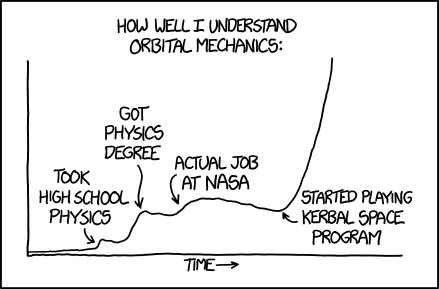
Strongly recommend downloading Kerbal Space Program (especially given the Scott Manley reference above), and having a go yourself!
It has explained a lot of how this stuff works to me in a way that A-level physics modules on the topic didn't.
While I was laid up with a broken hip, it took me a solid week to get to having a lunar/Mun lander, and getting it back successfully.
As Randall Monroe has it... https://xkcd.com/1356/