Forum menu
after knocking all the old rotten plaster off the walls we're updating the extention (old victorian solid brick one) and we need to insulate the wall. been looking at the methods and want to know what the pros think about Kingspan/celotex direct to the wall and battens over that and plasterboard over the top leaving room for cables and possibly some more insulation. is there a better method?
will it be necessary to apply a waterproof slurry to the wall before insulation?
Can I do the work before replacing the windows without too much disruption when we come to replace?
would it be worthwhile insulating the ground floor ceiling with some rockwool or similar while we're replacing the lath and plaster too?
thanks in advance.
you could just stud wall infront of brick wall and insulate between studs
Not a plasterer but there's nothing wrong with the method you're proposing providing the background is relatively flush. SHouldn't need a waterproof background with Celotex etc as it's a foil faced system anyway. If you're redoing the ceiling then yes insualte that too while you're making a mess. Doing the walls and ceiling will make a hell of a difference
yeah its quite flush. wouldn't want to put a stud infront as I would have to include ventilation into the void at the back to avoid condensation which means holes in 220mm brick wall.
Just strap it with cls fill the cavity with kingspan and board over with foil back boards. If your replacing ceiling then fire some rock wool in as it won't do any harm. If its a window wall then remember your ingo will be 3 inch deeper also that goes for internal door frames as well you might need to replace stiles.
Highclimber, I do solid wall insulation and we use a method very similar to what you describe (a few differences but the theory is the same)
If you need details as to what materials etc we use, and the specific method feel free to email.
Nealglover@Gmail.com.
(I'm on my phone at the moment so can't type too much, but will be happy to once I'm home)
Just dry line using thermal ins boards 12mm plasterboard with a 37mm insulastion
On the. Back this give you a thermal break that is the beqst way for what you need
And it will not let water pass through hope this helps cheers andy
Dot and Dab 50mm insulated plasterboard onto the brickwork and a skim finish, quick easy and reasonably cheap.
Oh ground floor ceiling. Why would you insulate that. And their should nd be a void as cls and kingspan are both 3 inch. Maybe am wrong though that's how I ve seen it done I just come along after and skim over all the hard work the joiners done
Dot and dab insulated boards. That's a new one on me
You beat me to it Andy
Potts
Are you a plasterer mate
My lads will be dotting and a dabbing insulated board from tomorrow on my current development!!
And Kingspan comes in varying sizes!
dot and dab insulated boards isn't as thermally efficent as 50mm of solid insulation with a PB over the top. I'm not looking for cheap or quick, just good thermal efficency.
Yeah but it's mostly new work and I was nt being smart I have rarely worked with insulated board and I ve never thought about dot dabbing it always just seen it screwed to timber kits. You live and learn as they say
Just done a room as you describe. Bare brick to start with. 50mm Celotex on walls, 100mm on roof, held on to wall by screwing through 2x1" treated battens with long screws to wall/joists. Expanding foam in all bigger gaps, and foil tape on all insulation board joins. The plasterboard screwed to battens and skimmed. Wickes is very competitive on insulation board prices at the minute if you're not after big quantities. I've left a channel for plumbing pipes and backfilled with rockwool, and surface mounted electrics in conduit since it's only a utility room.
Before
[IMG]  [/IMG]
During
[IMG] 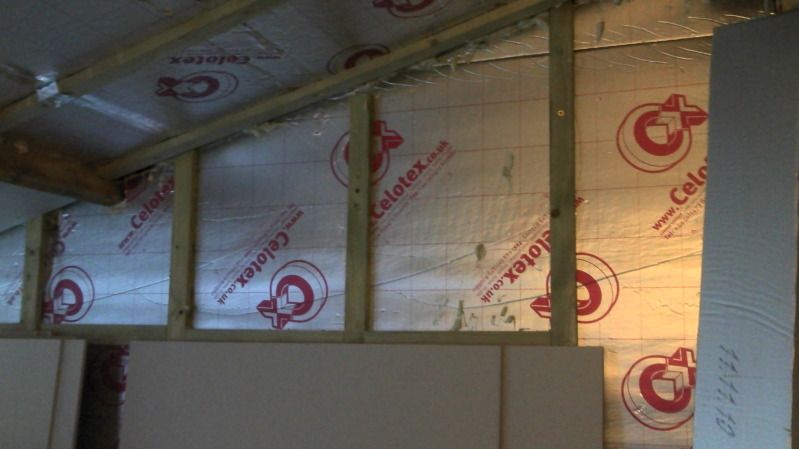 [/IMG]
[IMG]  [/IMG]
Sort of done(paint to come when I've skimmed the loo next door too)
[IMG]  [/IMG]
Make sure they use the fixings one in each corner and one in the
Middle mate
How do you get those fixing in the wall through the battens and celotex? Normal plugs and screws? Drill though both and then push the plug through on the end of a screw?
Yes, near enough. Drill the batten first with wood bit in cordless. Offer batten to board and mark holes through, then drill through with longish masonry bit in SDS drill (hard walls in this house), pop plug onto 100mm screw, tap through, nip up. Jobs a bit quicker when you have three drills on the go to save swapping bits over, but still a long winded job by the time you get all the battens and noggins in. Decent grippy wallplugs are a must, and go down 1/2mm on hole size if the walls are flaky so the holes aren't so stable.
You can use nylon fixings that will fix the boards directly to the wall, using drywall adhesive foam also.
They come in sizes up to 200mm (enough to fix 150mm insulation board) which removes all timber and metal fixings from the construction.
Removing the timber helps to keep a continuous insulation layer, and removing the metal fixings reduces cold bridging.
Obviously these are small differences in terms of insulation, but you use a lot less materials, and the job is far faster using this method. Reducing costs in two areas.
Do you just then dot dab the plasterboards onto the celotex?
No!! Dot and dab onto cellotex/Kingspan is not recommended!!
I'll throw in my tuppence worth
Could you not utilise a gyplyner universal system which essentially creates a new stud frame braced back to the existing wall structure, this allows a zone for you to run you new services within (electrical etc) and fix gyproc thermaline super to the face of the studs. Therfore you are creating a new independant wall lining with no cold bridging...
Not much to add, but I recently bought some plasterboard.
These guys were way cheaper than any DIY shed for insulation and plasterboard and way cheaper than anywhere else I could find to sell me a smallish quantity of plasterboard:
Free delivery too.