UPDATE: Reviews section refreshed, redesigned, searchable: Go take a look
Has anyone drilled their frame for a stealth Reverb,Orange Alpine 160, or similar Orange, any hints or tips would be welcome,
i was thinking of buying the rubber cable inserts from Orange then drilling a hole to fit, is it that easy?
http://www.orangebikes.co.uk/shop/components/bolts_n_stuff/2015_internal_dropper_routing_guide
I just drilled a 4mm hole in mine then angled/rounded it with a rat tailed file.Nice and tight to the hose so no need for a grommit.
Drilling a slot makes the routing easier. Two small pilot holes. Then larger. Then file between the two.
Rorschach can you take a photo of how you've done yours? I'm interested too, as KS only do a 150mm drop in the integra.
[img]  [/img]
It's helpful that the st is about 3ft thick!!
http://www.orangebikes.co.uk/archive/2014/alpine-160_frame/
swing arm is in the way, need to find a good route,,
Take the swingarm off.About 30mm up from BB on front face of st.Run up the top of the downtube through shock mount.Couple of stick on guides or better still SUGRU....jobs a goodun'
http://www.orangebikes.co.uk/bikes/alpine-160-frame
new Alpine seems to come out just above shock mount, must go down through BB and up. On mine the BB is solid no holes into the seattube or down tube.
Swing arm off then drill, need to get a new stealth post my old reverb is 5 years old in November still going strong but a bit wobbly 😀
P clips hold hoses and cables in place by shock
Interesting thread as I'm looking to do the same on my Scott Voltage - so basically at least 30mm above the BB on the front face of the seat tube.
Is anyone who's doing / done this using a grommit?
I thought about drilling the seat tube and decided what's the point - still have 6 miles of tubing floating about.
Got it drilled in a much more convenient spot;
[img] 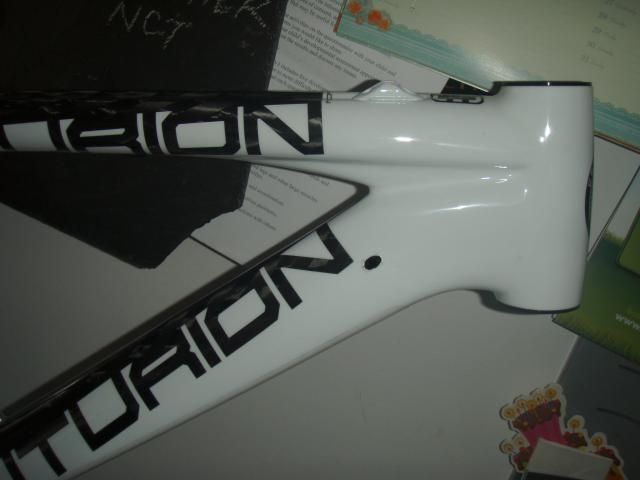 [/img]
Mine is on a full sus so I have the linkage etc to feed the cable through. - Keen to keep the cable out of the way
As a mechanical engineering graduate, can I just chip in with the input that drilling holes in a frame is a [i]really[/i] bad idea.
can I just chip in with the input that drilling holes in a frame is a really bad idea.
So all these manufacturers who drill holes in their frames are doing a bad thing?
I'd better repair the bottle boss holes, cable end holes and hose holes too then?
tbf, mine is a cheap NOS frame that if it dies isn't the end of the world and was drilled and sealed by a composites expert.
From a structural integrity perspective, yes. Also, internal routing means that cable wear becomes invisible and could lead to catastrophic failure without warning.
I think the main problem is that designers are not necessary very aware of fracture mechanics or stress risers and more concerned with a 'clean' look to sell more units.
are you a recent graduate..
Have another look at the bottle boss holes...see if they're just a hole in a tube or has some reinforcing material been added...
As a mechanical engineering graduate, can I just chip in with the input that drilling holes in a frame is a really bad idea.
As an automotive engineering undergraduate (finished 3rd year) and having built 3 frames myself (all of which I've drilled holes for cables), what's the worst that can happen? 😉
de Havilland Comet?
I drilled my Hemlock, had a coversation with Cy that went like "This is probably the best place, but I'm not going to promise it doesn't break in half". Which seemed fair to me. If I remember rightly it was as close to the BB and as far away from any holes and pivots as possible, basically avoiding weak spots and high load areas. I put it about 2 inches up from the BB just because a) it's a good place for hose curve and b, tool access.
On an Orange I'd avoid drilling out through the bottom of the BB shell as that's a fairly common failure point for them already... Not that a new hole necessarily makes that any worse, I don't know the cause of those cracks but it's not likely to help...
And yep, don't make a round hole, make a slot. The hose needs to go through at an angle.
Have another look at the bottle boss holes...see if they're just a hole in a tube or has some reinforcing material been added...
99% of the time they are just a hole with a rivnut in it (not to belittle your 3 years of sitting in a classroom taking notes).
Liteville produced a very helpful guide to drilling their frames, might help with placement and hole size.
[url= http://syntace.my1.cc/liteville/pdf/RockShox_Reverb_Stealth_an_Liteville_engl.pdf ]http://syntace.my1.cc/liteville/pdf/RockShox_Reverb_Stealth_an_Liteville_engl.pdf[/url]
So all these manufacturers who drill holes in their frames are doing a bad thing?
That's the point though, isn't it? The manufacturers design and build the frames taking in to account where they want to put holes and how these holes will affect the frame.
Some numb head in his/her garage does not have access to how said frame was designed so is taking a risk. If I was that desperate to have stealth routing I'd buy a frame that already accepts it.
"don't make a round hole"
That de Havilland Comet mentioned is a sort of famous fracture mechanics disaster case. Airliners that crashed repeatedly because they had square windows in an aluminium body - on account of the sharp edges resulting in stress risers and a start point for a crack and resultant fracture. So, I would really strongly caution against any sort of a hole - on a micro scale, a drill or filling away can leave all sorts of jagged edges that honestly would drastically reduce the strength of the frame and cause it to fail (crash - ouch etc) unexpectedly.
"bottle boss"
Sure there's a nut thread - which at a bare minimum would protect tube in similar way to why eyelet rims are stronger than without - but often the fitting is such that the threaded part becomes a structural part of the hole and would serve to limit crack propagation.
"Cy"
A bike maker with a mechanical engineering degree and "I'm not going to promise it doesn't break in half" is a good honest call.
That's the point though, isn't it? The manufacturers design and build the frames taking in to account where they want to put holes and how these holes will affect the frame.Some numb head in his/her garage does not have access to how said frame was designed so is taking a risk. If I was that desperate to have stealth routing I'd buy a frame that already accepts it.
I have a 2012 frame that didn't have stealth routing, the 2013 frame is identical in every other way other than a slot drilled for stealth routing.
guess where i drilled the slot...
"The manufacturers design and build the frames taking in to account where they want to put holes and how these holes will affect the frame"
Well...not necessarily - I'd be willing to bet the engineers face-palmed the designers decision to cut open new Specialized down tubes to make a box for snacks. Already, there's such painfully bad design from other makers that results in internal routing rubbing against carbon steerers in forks!
PLEASE, LEAVE YOUR CABLES OUTSIDE & USE A FRAME PROTECTOR STICKY rather than get busy with a drill/file for a clean look and cause a hurty tumble and red-face on the trails
@alsolofty - Do you think you need to be a chartered engineer to be a frame builder then?
"Do you think you need to be a chartered engineer to be a frame builder then?"
I didn't mean to come across as a know-it-all, and I'm well aware of frame-building tradition that shares more in common with artistic black-smithery than book-learning, but there's a few subtle concepts that maybe don't make common sense to begin with - like:
1. Temperature stuff - metal looks pretty robust stuff, but the mechanical properties can be radically altered according to heat treatment - so getting busy with welding kit might really ruin the strength of the tubes without a bit of tech nouse informing it all.
2. Work hardening - I've had a browse through books by contemporary frame builders and it is fully frightening watching them bend a fork and then think they can unbend it back a bit into shape with no impact on strength.
3. Fracture mechanics - (soz for geek) but do you remember those glass rods for stirring beakers with in chemistry class? Ok so in a test machine, try bending them until they snap - then dunk them in hydrofluoric acid for a bit to remove surface scratches etc and try bending them again - serious orders of magnitude stronger before they snap! Similarly rubbing a gear cable away at the inside of a frame WILL have majorly weakening effect on it.
4. CNC kit is mostly crap. Sorry HOPE/Chris King etc - all hype over substance. Compared with a forged compenent, the internal stress distibution of a CNC component is way less than optimum. In real engineering, CNC is used to make a prototype and then use a different technique to make a robust item.
[i] In real engineering, CNC is used to make a prototype and then use a different technique to make a robust item.[/i]
I think you'll find that in real engineering people assess the loads a component is likely to be placed under during it's working life and use a material and manufacturing technique that produces something fit for purpose.
Sometimes that will involve CNC, sometimes not.
"I think you'll find that in real engineering people assess the loads a component is likely to be placed under during it's working life and use a material and manufacturing technique that produces something fit for purpose."
OK - but, consider a stem - a CNC unit with the same structural strength as a forged unit, will just weigh more because it's not the optimum strength for weight solution. Sure it looks trick and sells well, but it's inefficient component design. Machining is generally used to face/finish, for small runs or tricky shaped stuff, but it mostly results in components with poor structural properties compared to comparable alternative techniques.
It's carbon - metal fatigue, work hardening, fracture mechanics and CNC can kiss my hairy backside.
If grit and stuff was getting into the frame on a regular basis maybe wear abrasion would be a problem.
Most people who drill carbon use a slot because it's easier to do - in my case it was drilled at the correct angle, was ring reinforced (ohh matron!) internally and then correctly sealed.
We all understand the reasons for not doing it (it's why most manufacturers will just give a blanket "do not do" after all) but we wanna know if anyone has done it and are they dead yet?
In my case, yes and no.
[i]OK - but, consider a stem - a CNC unit with the same structural strength as a forged unit, will just weigh more because it's not the optimum strength for weight solution.[/i]
you're not wrong, just ignoring the point I was making that it's about fitness for purpose of the resulting component not just slavishly avoiding CNC for the sake of it.
4. CNC kit is mostly crap. Sorry HOPE/Chris King etc - all hype over substance. Compared with a forged compenent, the internal stress distibution of a CNC component is way less than optimum. In real engineering, CNC is used to make a prototype and then use a different technique to make a robust item.
Hope and Middleburn and Chromag and others forge a blank to a near net shape then CNC that. CNC'ing from random bits of billet is stupid/impossible depending on internal stresses of that. Buddy of mine tells funny story of trying to machine chainring from odd bits of plate that then curled up like a saucer.
I did it to an Enduro.
Raced it, uplifted it even did some xc mincing on it.
Didn't die.
"It's carbon...fracture mechanics can kiss my hairy backside"
Hmm, I really wish that was true! There might be a very good reason why warranties are generally shorter for carbon composite frames/kit.
Also, drilling into a carbon composite tube could really ruin the integrity of the fibre lay-up - moving beyond the micro scale level of making a new handy spot for a crack to sprout from.
"If grit and stuff was getting into the frame on a regular basis maybe wear abrasion would be a problem."
I admire your optimism! It might be that just the cable outer is more than capable of scratching the tube inside - and even just scratches really can hugely lower the strength of kit. Also, even internal routing done by the manufacturer isn't competently sealed - it's a rubber grommet so it doesn't rattle in the shop or California at best.
I'm only posting to try and prevent an ouch - soz if I come across as just wanting to pretend I'm clever or point-score.
"Hope...and others forge a blank to a near net shape then CNC that. "
fair enough - but I sometimes see lots of machining done on surfaces that don't require it, seemingly for aesthetic reasons. Didn't mean to single out one manufacturer, but from the HOPE website about their seat clamp, "CNC machined from billet 2014 T6 aluminium" and to most customers, if it looks trick and shiny it gets bought! The fact that a forged clamp could be lighter and stronger seems to be sidestepped a bit.
(anyway, the CNC thing was just an aside about how, sadly, it not always most sensible engineering strategies that are used by wider bicycle industry)
I'm messing to an extent, I know you're being helpful - but cable on frame rub does bugger all - cable on frame with muck grinds holes in stuff.
The hose is zip-tied in place so won't be moving much - couple that with little to no muck and I'm betting the frame will last longer than the drivechain/forks.
The frame was reinforced and re-sealed to stop cracks propagating - carbon fibre is a lot more repairable than alu.
If it hasn't died yet (it hasn't) it'll keep going for ages.
Bikes aren't spaceships, they aren't designed to the n'th degree. Sensibly drilling holes in them is fine.
Get off your "I'm an engineer" high horse, no one cares.
"they aren't designed to the n'th degree"
Maybe true. But, lighter weights can be a factor in shifting units and extra drilling might be enough to cause failure in a situation an intact frame would have survived.
We've sort of been here before - in the context of lightweight road racing bicycles, it used to be all-go to spend evenings drilling nearly everything - but significantly the thin wall frame tubes were left intact - less weight to loose for one but also maybe to avoid risk of a tumble.
So it seems the feeling from those who have done it that it isn't a massive issue if placed in the right place. Right?
The reason for doing it is the cable routing is a nightmare and the cable kinks quite badly when the seat is lowered which catches on my pads/legs. Had to replace the hose once already due to a kink forming in it.
If drilling 2 small holes in a frame is enough to make it fail then it was going to fail anyway.
Drilling components to remove weight and drilling for internal cables are two totally different scenarios.
Drilling components to remove weight and drilling for internal cables are two totally different scenarios.
In what way? I'd assume the former having more impact on strength and stability than the latter
Bushwacked - I'd assume the former having more impact on strength and stability than the latter
In exactly that way
With stealth hosing there should be little to no hose movement anyway, it's not fretting away like moving cables do. Well, you could possibly route it so it does but with the normal "exit the seattube then run outside to the bars" approach it shouldn't do, and easy to avoid.
In the defence of recent engineering graduates, I'd point everyone at the reliability disaster that was the Scott Hi-voltage. The one with the integrated mudguard on the downtube, which all(most all) cracked around the tube where it bolted on.

