Avinox talk the torque. The debate rolls on.
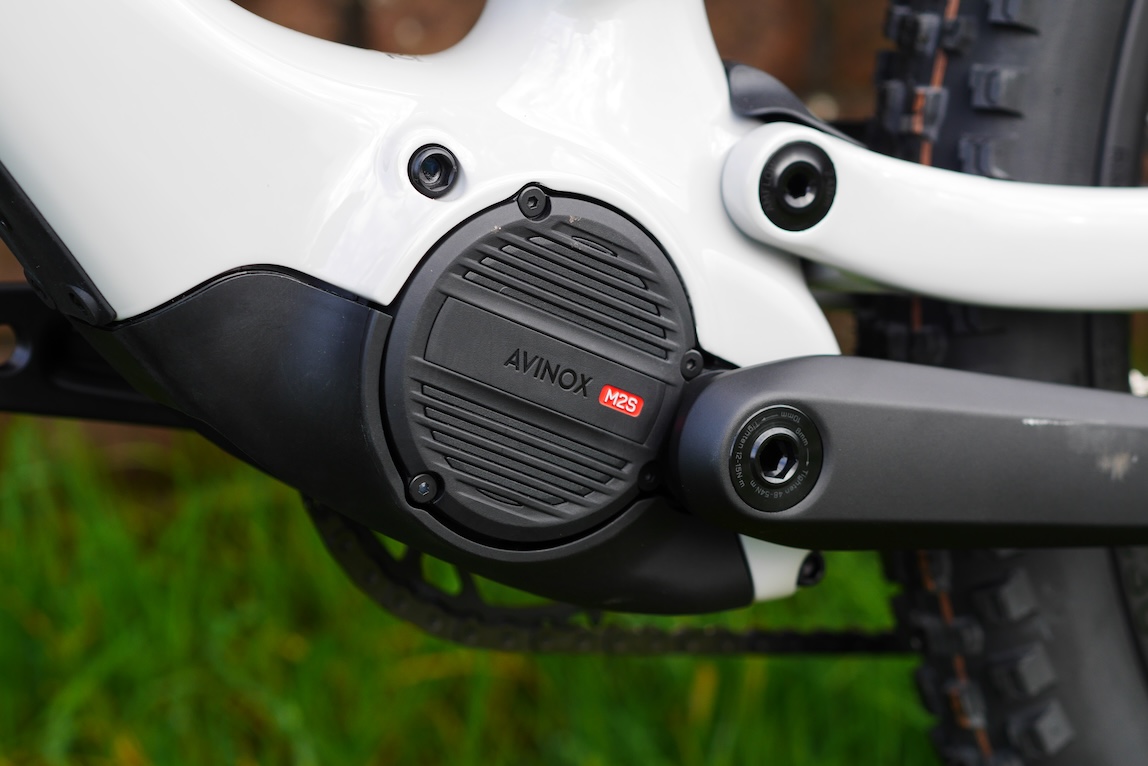
Avinox Pursues Power with Purpose
Avinox reveals its philosophy and makes the case for more power in mountain biking
In mountain biking, power is often misunderstood. For some, higher motor output raises concerns about safety, trail impact, or component wear. For Avinox, power is not about excess, but about possibility. Power can help more people ride farther, climb steeper, and tackle terrain that might otherwise be out of reach.
Our approach to power is rooted in a simple principle: technology should expand access to mountain biking while preserving safety, reliability, and rider control.
Power Is About Capability, Not Speed
When people hear that an eMTB motor delivers high power, they often express concerns about danger, assuming higher power also means higher speed. In reality, these are two very different things. Speed is what ultimately determines safety risk. Power is the force that helps riders accelerate, especially at low speeds and in demanding situations such as steep climbs, technical ascents, and navigation around obstacles.
Avinox systems comply fully with all applicable speed regulations, and we strongly support the implementation and enforcement of speed limits. That means our high power output is not designed to make riders go faster than allowed. It is designed to make difficult terrain more manageable. Whether it is clearing a rocky ledge, climbing a steep incline, or helping a less experienced rider maintain momentum, more power can make mountain biking both easier and safer.
Safety Is a Function of Control
Any bicycle can gain significant speed on a descent, whether it is powered or not. This is not unique to eMTBs. The safety challenge in mountain biking is managing speed, maintaining traction, and giving riders the confidence to overcome high-resistance obstacles in complex terrain.
Avinox focuses on delivering power precisely when it is needed. Our intelligent assistance algorithms provide smooth, predictable support that helps riders maintain control in various situations. In many cases, more available power improves safety by reducing the likelihood of stalling, losing balance, or being forced to dismount in difficult terrain.
Flexible Power for Real-World Riding
Different riders face different challenges. A steep technical climb requires a different level of support than a flowing cross-country trail. A loaded cargo bike climbing a hill has different needs than a lightweight commuter.
Avinox addresses this with customizable riding modes and user-adjustable settings, allowing riders to tailor assistance – including maximum output – to match the terrain and their personal preferences. This flexibility provides support when it matters most while maintaining efficiency and control.
Democratizing Mountain Biking
Mountain biking should be accessible to more people, regardless of fitness level, body type, age, or physical limitations. High-powered systems help make that vision a reality. With greater assistance, riders can:
- Conquer steeper climbs
- Ride longer distances
- Explore more challenging trails
- Recover more easily from technical mistakes
- Build confidence faster
For heavier riders, riders with disabilities, and those hauling cargo, higher power can be considered essential, rather than a luxury. A rigid, one-size-fits-all power limit risks excluding riders who benefit most from additional assistance.
Designed to Protect the Bike
Power only matters if the system remains reliable. Avinox carefully balances performance with durability, avoiding the trap of increasing output solely to claim bigger numbers. Advanced sensors and software continuously monitor riding conditions and adjust torque delivery to protect key components.
For example, the system automatically reduces power during gear shifts, minimizing drivetrain stress and extending the life of chains, cassettes, and derailleurs. Smooth, precisely controlled power delivery also reduces wear on tires, brakes, and wheelsets.
System-Level Optimization
A high-performance motor cannot be developed in isolation. Avinox takes a complete system approach, optimizing the entire bicycle platform to handle elevated power output, including:
- Tyres
- Brakes
- Wheels
- Frame design
- Battery architecture
- Charging systems
- Software controls
This integrated engineering ensures that riders benefit from maximum capability without compromising safety or reliability.
Higher Power Does Not Threaten the Industry
Some argue that offering more powerful motors could invite regulatory scrutiny or harm the industry. We believe that view oversimplifies a much more nuanced issue. Avinox supports responsible regulation and strict compliance with all applicable laws. At the same time, we believe innovation should not be constrained by arbitrary power limits that lack a clearly explained basis.
The industry benefits when manufacturers focus on solving real rider challenges and respecting the diverse needs of users. Progress should be guided by safety, performance, and accessibility, not by assumptions that more power is inherently problematic.
Beyond Power: The Full Avinox Advantage
Power is only one part of what makes Avinox different. Our commitment to innovation is reflected in every aspect of the system, including:
- Compact and lightweight motor design
- Outstanding power-to-weight ratio
- Seamless hardware and software integration
- Intelligent assistance algorithms
- Lightweight, high-capacity batteries
- Fast charging capabilities
- Sophisticated system controls
Together, these technologies create a riding experience that feels intuitive, natural, and remarkably capable.
The Future of eMTB Performance
At Avinox, maximum power is not about pushing limits for the sake of headlines. It is about empowering more riders to experience mountain biking in ways that are safer, more enjoyable, and more inclusive. By combining high power with intelligent control, system-level engineering, and rider-focused innovation, Avinox is redefining what an eBike motor can do. Because when technology is thoughtfully designed, more power means more opportunity.
— Ends —
Where does Singletrack World Magazine stand on this?
We’ll be honest with you: we don’t know.
We certainly clutched our collective pearls when news first broke about the Avinox motor’s power numbers. We very nearly came out with a statement even (“We stand with Hans” etc). But we held off until we the actual bike arrived and we could experience it it firsthand.
And after riding the Avinox-ed Amflow PX… we don’t know what we think now.
Our initial reaction was possibly conflating “more power” with “more speed”. But the assist stops at 15mph like every other motor out there. And, crucially, the Avinox system is significantly less prone to wheelspinning/kicking up dirt than rival systems, due to its more sophisticated hardware (and arguably software).
The sole ‘problem’ we keep circling back to is that the Avinox motor’s power can virtually remove the whole ‘Type 2 Fun’ aspect of cycling. It can make things (well, climbs) very, very easy. Is this a problem for anyone other than the rider on the bike? We’re entering the weird – but still important – arena of the ‘point’ of mountain biking.
Needless to say, we shall be discussing the whole thing in an upcoming Podcast. Stay tuned.



There must come a point where the available power is, to quote Rolls Royce, “sufficient".
IMO it’s similar to people who obsess about range when looking at EVs when most EV drivers agree that more than about 250-300 miles is pretty pointless. It just adds weight that you have to drag around the rest of the time which detracts from the overall driving experience.
Same with power on ebikes – why does anyone regularly need the same sort of power that only the likes of Pogacar can generate for a sprint. Yeah you can do steeper or trickier climbs but that’s as much about controlled power delivery as the absolute number.
So whatever “sufficient" power is for an ebike (and I think we’re already there) let’s stop being impressed by big power numbers and focus on how the thing actually rides. I’d rather ebike motors started getting smaller, lighter, quieter, more efficient, more reliable and (even) more natural feeling than adding power for the sake of it.
What’s the TL:DR?
“Some people need more assistance than others, therefore more power is always better… and we’re not doing it for headline numbers to win market share, honest.”
“Avinox systems comply fully with all applicable speed regulations, and we strongly support the implementation and enforcement of speed limits. That means our high power output is not designed to make riders go faster than allowed."
So have Avinox now made it impossible to defeat the built-in speed limiter? Last I heard you just needed to connect via a VPN and tell it you were in New Zealand to remove the speed-based power cut-off entirely.
MTB will eat itself.
Riders should be able to use as much power as the manufacturers can provide – subject to the vehicle being suitably classed and licensed/insured/taxed accordingly. That will inevitably place restrictions on where the vehicle can be used too.
Seriously, if you want an electric motorbike, just buy one and accept the restrictions and laws that go with it.
“Whether it is clearing a rocky ledge, climbing a steep incline, or helping a less experienced rider maintain momentum, more power can make mountain biking both easier and safer."
Will Avinox be making jetpacks to make rock climbing both “easier and safer"?
Funnily enough, the points under “Beyond Power: The Full Avinox Advantage" were the reasons I ordered one of the new PRs. I could’ve gone for a PX if it was for the power. My current bike has easily enough power. It’ll be fascinating to find out how the range improves by dialling down the power in the app. Can’t wait!
This is the bit I can’t quite work out with Avinox and the legality, in the UK at least, of their system.
Happy to be corrected but in the UK isn’t it pedal assist up to 15.5mph AND max continuous power output of 250W?
So, technically many of their bikes are not legal, at least for road use and no doubt a fair amount of ‘public’ land.
Note I don’t really care of a particular bike is legal or not however if they’re selling it as a massive market product I’d have thought they would be…
Avinox release here
Reads like ChatGPT output. 82 – 92% AI written apparently depending on which checker I used.
Continuous Rated power and Peak power are different as far as testing and EN15194 are concerned. At some point a lab in Germany will get some funding to run tests that show how long peak power (or, simple >250W) is able to be produced and compare that to the definition of ‘continuous’ in the test. The speed cap is most relevant, But I think we need a type/class power regulation within the EPAC regs. There is an E-MTB standard which is just a copy of EN15194 for the electronic parts, and that might be good to change to set a different power limit on E-MTBs Vs load carrying transport. 1500W cargo bike, yes, fine. E-MTB? Up for debate. I don’t agree with Bosch’s position fully, but I expect the Avinox approach could be the one to cause problems for some aspects of MTB.
Grrrrssss
It wouldn’t be able to be sold in the UK if it wasn’t fully legal, but that’s the same for probably every e-bike except gen1 Spesh KSL & LSL which are 250 W max not just continuous, and the new Orbea thing (Rallon?) maybe. I believe there’s also some debate about what 250 W continuous power actually means.
I have an M2S in my Druid E. The motor was not the deciding factor, rather the fact it’s a shorter (not short) travel bike than my previous KSL that rides exceptionally well and just happens to have 1.75 BHP.
It was the best option for me; no stupid cable routing (looking at Santa Cruz here – I want to run my rear brake into the RHS of the frame), and I knew roughly when it would be available (was considering a Norco thing with a Bosch Gen 5 but weren’t available when I put my deposit down in October 2025) and more importantly, I could get it as a frame only.
It’s mint blatting up straight fire roads etc. on the way to the top of the hill to go back down again, but 1300 W and 130 Nm are totally pointless/dangerous anywhere else. Even on the flat all I do is get to 15.5 mph more quickly just to bounce off the limiter.
I have boost turned off, turbo is 1000 W & 100 Nm, and I use it mainly in eco (250 W & 30 Nm) and auto (600w, 60 Nm). I don’t get 1500 W & 150 Nm as I don’t have the fancy 700 Wh battery.
FWIW, mine isn’t and won’t be derestricted – I’d be happy for that loophole to be slammed shut, whether it’s VPN, chipping, speedi boxes or whatever.
Nah, balaclavas make me itchy
This is the bit I’m not clear on. Surely if in turbo it puts out 1000W continuous then it’s not legal as it can be switched into and left in that mode?
Even if that’s peak then I’d be surprised if the continuous rating was only 250W in turbo.
To be honest it all needs tidying up in terms of the power output etc.
As for them not being sold if they’re not legal. Plenty of stuff is legal to sell but not legal to own (or more accurately when it comes to ebikes, use) in certain situations.
The child’s ebike conversion isn’t legal, I’m well aware of that, but there was no issue buying it from a bona fide UK based shop.
Setting turbo to 1000 W sets it to 1000 W peak. Not continuous.
Like I said, literally nearly every e-bike puts out more than 250 W peak, regardless of the motor with a couple of exceptions. However, all EPAC meet the EPAC requirements on continuous power. Whether that is clear or not and how it’s measured should be the discussion.
Yep agree and yes, I’m vaguely familiar with the peak/continuous bit but learning all the time.
I’m still willing to bet that, whilst a lot of these bikes notionally comply with the regs, they are capable of putting out more than 250W of power for longer than simply ‘peak’.
But as you say, that is what (if anything) needs looking at a bit more and I agree with your earlier point that the speed limit is more important than the power output…
I rode a pre production prototype of the first generation Amflow bikes. It was not restricted which became abundantly clear as I flew up a 20 to 25% road climb at full gas like it was flat. After I got over the rush of blimey, that was quick, I didn’t feel any great desire to repeat it.
Human nature is such that there are riders who will happily derestrict their motors in their desire to go as fast as possible. Therein lies the potential problem. How many riders does it take not playing by the rules for it to become a significant issue? If you look at all the Deliveroo, Just Eat and Uber Eats riders round Glasgow on throttle control e bikes, they are happy to disregard the law and are apparently untroubled by the consequences when they get lifted by Police Scotland.
The concern comes in whether we get to a point where there is a critical mass of riders who ride derestricted, high power e bikes on shared use trails and other users end up getting hurt. Could trail access come under threat? Possibly. I just don’t know.
let them make as powerful motors as they want then let the law mark them as motorcycles in return. hans rey said it best in his letter to e bike manufacturers.
For balance I have very rarely ridden trail centres since I got ridden into at Winlater on a climb. Presumably I was going to slowly.
The bloke was on an e-bike and needed to grow a brain.
The problem is dicks on e-bikes are getting harder to avoid as people seem to not enjoy cycling uphill. If you make e-bikes faster or more powerful it will only exacerbate the problems.
Ahahahahahahaaaa…..
Sorry, excuse me while I control the stitch in my side. Where do you live, 1992? Next you’ll be telling me all kids’ toys are rigorously controlled by strictly enforced safety standards.
All of the legal restrictions are dependent upon the place of use, not the ownership. If you have (access to) private land then they are perfectly legal.
Sorry that happened to you. There’s no excuse for that, whether uphill or down, e-bike or not
Yup. He was a prick and probably still is in other aspects of his life.
It was noticeable at Boltby at weekend that some of the Amflow riders were going up hill far quicker than any of the other ebike riders.
There is no debate these this break the intention of the law. The 250 W continuous power test is 20 minutes, but the legislators misunderstood that the test requires a minimum, and that a more powerful motor can still pass it.
This German site does very thorough testing. For the previous gen avinox M1 here: https://ebike-mtb.com/en/avinox1-test/
It can produce around three times the limit for 20 minutes. Clearly against the intention of the poorly drafted regulation.