UPDATE: CLASSIFIEDS section refreshed, redesigned, searchable: Go take a look
There isn't enough landmass in the UK to home sufficient turbines to provide for our current demand, and that's not including the energy from gas. I hope/think that renewables are the answer in the long run, but it won't be wind turbines. Certainly not onshore anyhow.
agreed.
Let's have more of the base generation provided by nukes and save some of the resources to make your next bike, car, or axe/saw for making your home when we're relegated to hunting and foraging 🙂
Aluminium plants are already sited next to hydro power stations. Bio-oils are fine for making plastics. Going back to wood for many items would reduce demand for metals and plastics. A transport system based on rail would improve efficiency and use electricity.
Seems to me like we are talking about a failure of capitalism here.
No-one wants to do anything because there is still money to be made with the status quo.
In the UK we seem to have taken a step back from the forefront of developing solutions and technology in the energy sector, for pure reliance on the tried and tested.
Aluminium plants are already sited next to hydro power stations
but what it actually needs is for the Alu plant to be situated next to hydro leccy (or other form of leccy) since Bauxite to Alu process uses electolysis, but ALSO to be situated next to a huge array of parabolic solar reflectors all focussed at the furnaces.
Be no night shifts though, so plenty of spare time for all the workforce.
Seems to me like we are talking about a failure of capitalism here.
Well if you look at alternatives they were/are even more polluting and less energy efficient.
OTOH molgrips, when it becomes eye buggeringly expensive to dig up oil and coal, renewables will start looking more like a business opportunity.
But we won't get #2 without #1.
Renewables are a very attractive business opportunity already due to ROCs and grants.
Where are we going to get the wood from? Especially since our forests will be gone to make way for turbines?
I'm voting hydro/ tidal at the moment. We are an island With some very strong tides FFS. The tech might not be quite there at present but I'm sure it will be. The SNP seem to agree.
Yes that's true. But that point will only be reached when everyone's stretched to the absolute max. Which is no fun for us.
In the UK we seem to have taken a step back from the forefront of developing solutions and technology in the energy sector, for pure reliance on the tried and tested.
True though not completely, look at how the UK shelved wind turbine development when it was ahead of the game and how much it is now worth to countries like Denmark and Germany who continued with it.
But we have some very innovative companies leading the way in wave and tidal development, but desperately struggling for investment, and you are now seeing the big boys like Kawasaki coming in with megabucks after companies like MCT have been struggling away developing for years with next to no money, which is a shame in a way, but probably good for the future of the industry as a whole.
Britain ain't what it was though in being innovative, you are right.
A transport system based on rail would improve efficiency and use electricity
They can be nuclear powered too 🙂
Saves distributing power across a network, and you know it's traction was not powered by oil/coal.
Nuclear powered trains, I like it.
Would presumably have to be a mahoosive train before it was worth popping in an A4W and not stringing some wires over the rails...
The SNP seem to agree.
Others, who may be better qualified, may not:
[url= http://www.theregister.co.uk/2013/07/11/alex_salmonds_fantasy_of_a_tidalpowered_scotland_washed_away/ ]http://www.theregister.co.uk/2013/07/11/alex_salmonds_fantasy_of_a_tidalpowered_scotland_washed_away/[/url]
As philtrickebank posted, some people have been researching what it might take to achieve a whole-UK solution. It would take a rather strong political will, however:
[url= http://www.zerocarbonbritain.com/ ]http://www.zerocarbonbritain.com/[/url]
Nuke generators small enough to fit in a locomotive definitely exist. Had a feeling the ones in HMS Astute? are pretty small. Those on board several spacecraft are basically tiny, but won't stick out the required energy.
edit: and given that subs and aircraft carriers are nuke powered, there's no technological reason stopping cargo ships from being powered the same way (assuming that there are sufficient radioisotype resources, of course).
It's not a non-sequitur, it's an illustration of the scale of the problem - that nuclear and renewables are competing technologies.
They are - they both compete with fossil fuels. That's what the renewables lobby should be focussing on.
There isn't enough landmass in the UK to home sufficient turbines to provide for our current demand,
The key word in your sentence is "current". We're a grossly wasteful country.
They are - they both compete with fossil fuels. That's what the renewables lobby should be focussing on
No, they compete with each other. Regardles of the renewables industry, it's what the UK government wants.
I think both Salmond and the register are pretty off the mark there, both pretty pointless, the notion that you would fully develop one small area of seabed like that isn't real world practical so Salmond shouldn't have even said anything like that in the first place regardless of the numbers he came out with, he's always full of it. The register article seems to have been written by a lazy possibly drunk student and doesn't mention any other scottish areas of tidal development, 2/10.
Others, who may be better qualified, may not:
Thanks, I now think that maybe nuclear is the answer. I'm not remotely convinced by the "lets be veggies and grow trees to burn" idea.
The key word in your sentence is "current". We're a grossly wasteful country.
I've been labouring this point for a while. Still don't think wind is the answer.
Thanks, I now think that maybe nuclear is the answer. I'm not remotely convinced by the "lets be veggies and grow trees to burn" idea.
It's one answer if the question is "what technology could make a moderate contribution to our electricity requirements in 10 years' time".
But the idea that it is the answer to a low carbon future is just wishful thinking.
I've been labouring this point for a while. Still don't think wind is the answer.
I don't think anyone is arguing that wind is [u]the[/u] answer. It can (and does) however make a meaningful, low carbon contribution to our energy needs.
If you grow anything to burn, I suspect it'll have to be more like bamboo, not trees, cos it grows so quickly.
One reason why bamboo is used as a cellulose source to make semi-synthetic fabrics via some rather nasty chemical processes. The other is so you can market it as "bamboo", which sounds eco. US FTC didn't buy that though 😉
I can't believe that educated people have wasted effort on it. I do hope that report wasn't publicly funded.
No, they compete with each other.
No, fossil fuels compete with both of them. That's the obvious answer. I'm surprised you can't see it.
By the way, it's fossil fuels, not nuclear, that are responsible for global warming - something that will cost hundreds of trillions of pounds, and billions of lives. It does actually make Chernobyl look trivial by comparison, if only people would wake up and look at things objectively.
No, fossil fuels compete with both of them. That's the obvious answer. I'm surprised you can't see it.
They compete with each other. This is a publicly stated aim of the present government.
By the way, it's fossil fuels, not nuclear, that are responsible for global warming
I haven't argued otherwise - what's your point?
wobbliscott - Member
I hate the way we're so focussed on CO2 emissions as the only environmental issue to be concerned about - especially as the jury is still out on the impact.
+1 but it is very naughty to say so!!!
But we only have a couple of months or so until the next IPCC report. And with all the leaks, let's see if [i]The Economist[/i] magazine was right in its idea that...
That seems to reflect a growing sense that climate sensitivity may have been overestimated in the past and that the science is too uncertain to justify a single estimate of future rises.
An unearthly voice from beyond the ban just FB messaged me and basically said ZOMG, talk about Scotland, in response to talk of renewables not being a feasible alternative. There is some use of wiki here incidentally... (content is mine)
Scotland already generates 39% of its power from renewables, and that's rising at a pretty outrageous rate- doubled since 2007 with no sign of slowing (projects already in construction will increase that pace of growth) 10 years ago it was almost all hydro, now 60% is onshore wind. Renewables are now the single biggest electricity source and generate enough to satisfy the entire domestic load. (obviously disclaimers about steady load apply here, with so much being wind- ironically the downside of the wind generation boom is that it's outstripped our pumpstorage)
This diagram here:

Is pretty good to give an idea of distribution, though it's slightly out of date obviously, the current figures push nuclear into second place- renewables grew by 10% in 2011.
People mentioned "there's not enough landmass for wind"- the stats above don't yet include a significant amount of offshore wind, but watch this space, 4gw of offshore production is already in planning or construction- more than the current onshore total.
Pretty crazy stuff- and again, I'm pretty surprised by the numbers, I knew we were renewables-daft but I had no idea about the rate of growth. Scotland's well equipped with renewable opportunities but it's hardly unique, this could be repeated elsewhere.
The departed would also like to ask how we fuel the necessary massive increase in nuclear plants. At current rates we run out of known uranium reserves in about 90 years, predicted uranium reserves (ie forecast but as yet undiscovered) in about 230, according to scientific american. That doesn't sound to me like a good base for fast growth. What's the long term?
Alternatives, sure. MOX thermal works but am I right that there's still not a single all-MOX reactor in the world? The mixed-cores are a good development obviously for reducing uranium dependence and I don't think there's any likely barrier to all-MOX working but we're not there yet. (and it's stil a limited resource is it not?) Fast breeders and thorium etc all seem promising but we can't harness long term energy policies to a horse that's not been born yet.
[quote=Northwind ]
So you've got alternatives, [b]but still mostly unproven[/b]- huge potential here but we're saddling our horse to future tech really with thorium, fast breeders etc. ?
Like tidal power....
The thing about nuclear is still the cost. The UK Govt can't get a new nuke program running because they won't guarantee a high enough subsidy. And that's not taking into account decommissioning.
http://www.reuters.com/article/2013/07/19/europe-nuclear-energy-idUSL6N0FP2P820130719
Arr jim lad, there be editing
Personally I'm holding out for orbital solar. Both dependable and frickin awesome. Unless you get the microwave beam squint and fry a city or something, but that'd also be frickin awesome. Could be used against the swarm of godzillas that's bound to result from the nuclear surge.
People mentioned "there's not enough landmass for wind"- the stats above don't yet include a significant amount of offshore wind,
Talking about the UK rather than Scotland, where the profile is somehwat different.
The upsurge in renewables is welcome however I wonder if we are reducing development of technologies such as tidal and carbon capture and storage for imported wind turbines. I heard there are 100,000 jobs linked to wind turbine manufacture in Denmark. If we could develop and market a tidal based product we could generate many skilled jobs.
athgray - MemberThe upsurge in renewables is welcome however I wonder if we are reducing development of technologies such as tidal and carbon capture
Well. No reason it should be mutually exclusive tbh... I think the industry would argue that they're underrresourced in general, not because of wind developments. Still a hell of a lot of development ongoing though, with an eye to making sure that (unlike wind, nuclear, etc) they don't rush into production.
molgrips - MemberTalking about the UK rather than Scotland, where the profile is somehwat different.
By my understanding England also has some shore 😉 And less Donald Trump.
It has similar area and probably less coast, but ten times the population...
[quote=molgrips ]It has similar area and probably less coast, but ten times the population...
Englandandwales is about twice the area of Scotland - but yeah, much, much higher population.
The amount of coastline isn't a limiting factor, we're talking about big numbers from fairly localised schemes, not about ringing the country in propellors. A drop in the ocean as it were.
Scotland already generates 39% of its power from renewables...
Sorry old bean, if you're quoting Wikipedia, then I would contest that number. Not that it matters hugely, but [url= http://vitaminccs.wordpress.com/2013/07/17/global-energy-systems-conference-2013-day-2/ ]as I showed on the blog[/url], in 2011 Scotland generated around 27% of its electricity from renewables [url= https://www.gov.uk/government/uploads/system/uploads/attachment_data/file/65906/7343-energy-trends-december-2012.pdf ]according to the DECC stats[/url] (which one would assume are more reliable than the pro-renewables Scottish Government's press release which is cited in the wiki entry...). This is indeed up from around 19% in 2010, and a significant increase, so not contesting the trend, just the numbers. 😉 Carry on.
http://www.bbc.co.uk/news/uk-scotland-21966678
Scotland generated 7% more renewable electricity in 2012 than it did the previous year, data has shown.The Department of Energy and Climate Change report said 14,600 Gigawatt hours were generated in Scotland from renewables such as wind and hydro.
The Whitehall department said this represented more than a third of the UK's total renewables output in 2012.
The Scottish government said it had generated enough electricity to power the equivalent of every Scottish home.
The amount generated also represented 39% of Scotland's total electricity needs.
The DECC figures showed that wind generation in Scotland was 8296 GWh, up 19% on 2011, and more than four times the level in 2006.
By the end of 2012, there was 5,883 MW of installed renewable electricity capacity in Scotland, an increase of 22% from the end of 2011.
Northwind. Was thinking of the ending of the carbon capture project at Longannet due to funding, as well as funding issues with Pelamis wave generation. It would be a shame if we lost out on these technologies and the jobs they bring. Wind farms are well and good but their construction and operation do not bring the finances and jobs compared to their manufacture.
No mention of dynamic demand yet?
"Virtual power station" apparently.[i]
The upsurge in renewables is welcome however I wonder if we are reducing development of technologies such as tidal and carbon capture and storage for imported wind turbines. I heard there are 100,000 jobs linked to wind turbine manufacture in Denmark. If we could develop and market a tidal based product we could generate many skilled jobs.
Onshore wind is proven and established so is a safer investment than emerging technologies, yes. But you have eon and SSE investing in Pelamis for example, and they don't mess around, which shows some positive signs for the future. There are various tidal and wave companies from the UK at the cutting edge, but the big boys like Kawasaki are now stepping in and they have a whole lot to throw at this.
Re wind turbines and UK jobs/technology/construction etc, the stats for Robin Rigg offshore wind farm show "32% of the development, manufacture and construction for the site was carried out by UK-based business"
, which isn't a massive proportion. A lot of ports around the UK are gearing up for the forthcoming increase in offshore wind construction though, including support for turbine construction, so that is likely to improve I would imagine.
The Department of Energy and Climate Change report said 14,600 Gigawatt hours were generated in Scotland from renewables such as wind and hydro.
Link to the report in question? I can't find a DECC report which states anything the BBC article is claiming. Not saying it doesn't exist, but I can't find it. (And certainly not the first time the BBC has swallowed wholesale rubbish that a press release has fed them - I can think of an unrelated example.) The links in the [url= http://www.scotland.gov.uk/Resource/0042/00428635.pdf ]Scottish Govt. report[/url] also don't give this data, or give different numbers. But then I am pretty tired so maybe I'm just not paying attention to what I'm reading. But again, not that it matters much, and happy to stand corrected if someone can point me directly to the source of the BBC/DECC numbers!
Nuclear Fusion will be good!
Once they can keep it running and reduce input and raise output energy.
One thing that no one has mentioned yet is the building of HVDC interconnectors to 'smooth out' the longer term peaks and troughs of renewable energy. A notable recent proposal is the Northconnect cable from Peterhead to Norway. http://www.northconnect.no/
During winter in Norway their Hydro electric production decreases due to lakes freezing, but here in winter it is anticipated we will often likely have 'excessive' energy generated from eg wind power. Vice versa in the summer when our wind resource is lower, hydro from Norway is at its peak.
Existing HVDC interconnectors such as Britned have been very successful, and there are even proposals for one between the UK and Iceland to take advantage of Iceland's geothermal and hydro http://askjaenergy.org/transmission/hvdc-subsea-link/
Oh, and HVDC substations are the coolest most sci-fi mahoosive things I've seen for a long time
[img]  [/img]
[img] 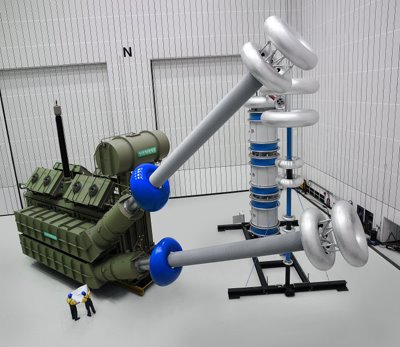 [/img]
[img]  [/img]
How do they overcome losses on a cable that length?
How do they overcome losses on a cable that length?
Well that's why they use HVDC instead of AC, there are still losses though.

