UPDATE: CLASSIFIEDS section refreshed, redesigned, searchable: Go take a look
The bigger issue comes when you don’t understand what it’s telling you either.
It’s just a tool, and as such can be used well to craft amazing things, or badly to make a hot mess.
💯
"I've bought this dSLR so now all my photos will be awesome!"
Since I first created this thread quite a lot has happened at my work. As expected writing code has now become the pursuit of dinosaurs or deluded luddites.
I haven’t written a line of code in 6 months but still class myself as a ‘dumb’ AI user. Some more technical people in my team (who don’t have to distract themselves with management meetings) are way ahead and productivity has increased massively. In fact I think some developers have been holding back in an effort to not make themselves redundant.
There is a problem however, which in a nutshell is the cost of tokens. The accountants haven’t yet figured out a way to pass the cost of AI on to clients, and there are people in the company (mostly civil engineers who think they can bypass using software engineers) who are even more dumb users than I am, and as a result are costing untold amounts of money which the company can’t afford.
The upshot is that now we have been assigned token quotas, which unsurprisingly aren’t enough. One of my devs burned through his monthly quota in half a day. So now we’re in a weird limbo where tokens are the new currency and we have to beg for more.
So not getting made redundant just yet, mostly because of institutional inertia and the inability of finance people to adapt to something new.
Difficult to say where it’s all going right now but for anyone in software development I’d advise getting into cloud infrastructure and architecture. It’s going to be a while before they’re impacted in the same way as writing code has.
☝️😳 Doh
edit - for cougars post above
I think we might be safe from redundancy for now (lots of noises about valuing our technical expertise and wanting to boost productivity rather than cut staff costs etc.) but now it looks like we will be forced to use Ai whether we like it or not. AI use is already one of our KPIs (I'm just praying it is one that I can easily fudge, or may just have to forego my derisory year-end bonus) but we're now being sat down and told that we WILL be using it more going forward. I'm just not sure what the mechanism will be for that.
I've yet to see anything useful that it can do for me, it certainly isn't improving productivity as everything it produces is so error prone and requires so much re-working to fit the structure we use. As such I'm trying to understand the agenda for forcing us to use it, I'm actually beginning to suspect a sort of '1000 monkeys with 1000 typewriters' approach whereby they hope that if enough of us are forced to use it, eventually we'll figure out something it can usefully do.
Of course, in the meantime the actual day-job is not getting done, which is usually what stops me when I go down an AI rabbit-hole, the realisation that I've just spent half a day messing around in CoPilot and meanwhile the actual content I am supposed to have produced is still sitting there unwritten.
On Sky News just now... apparently 73% of the UK workplace have adopted AI. Report goes on to say that those who have adapted and adopted to using it are seeing better career progression.
I'm sure this won't get looked at when the bubble goes pop...
My manager has fully adopted it, to the degree where he no longer thinks. He was bad before, but now he feeds everything into Copilot and uses the output as work instructions. He is so moronic that he doesn't even rewrite the output - just cuts and pastes his entire question and answer session. In our meetings he is blank faced, and cannot remember anything. Which is fine on a lot of levels, as I ignore him now, and if he asks why I have not done X, I just state that he revoked the instruction verbally during our last chat. It's all very bizarre. He has never been creative or imaginative and so now thinks the AI has made him into a super human.
On Sky News just now... apparently 73% of the UK workplace have adopted AI. Report goes on to say that those who have adapted and adopted to using it are seeing better career progression.
I'm sure this won't get looked at when the bubble goes pop...
73% adopted a.i.........Yeah?...... 🙄
I call absolute bollox on that one, perhaps it's a sign of where I live, who my mates are and what jobs they do but no-one I know has the slightest ****ing interest in a.i. nor would it ever help them in their work.
Skipper/deckhand/roofer/gardener/fish factory worker/farm worker/dyker.
Define "adopted"... It's built in to most Microsoft software so even if you don't press the button, it's still there.
The roofer is probably using some kind of accounting software and that'll now have AI in it.
Skipper/deckhand/roofer/gardener/fish factory worker/farm worker/dyker.
tradies found to use use different tools to office workers, more at 11
The roofer is probably using some kind of accounting software and that'll now have AI in it.
Given who my bro’s boss is I doubt that, he’s good with a saw and a hammer but when he got a replacement phone my bro had to set it up for him - i imagine he’d throw a bunch of receipts towards his accountant and hope for the best
Thanks. That sounds similar to my experiences. On the whole, not good enough for serious use but OK for quick and dirty or novelty value. Unless I’ve misinterpreted.
Interesting. I think I can see what you are saying but not sure I'd put it quite like that. There have certainly been cases where I have used it and ended up thinking "that was impressive but does it actually add any value?". But that's true of any new tech. It takes a bit of time to get past the wow factor and see where it adds value.
I tend to treat AI like a willing colleague who knows a fair bit but is prone to making mistakes. I can hand it various tasks but I'll need to check the results.
Currently I can't see it making me redundant. I am (or at least should be) an expert in my field and in many ways AI seems to be making experts more important as they are needed to spot the increasingly subtle mistakes it makes.
However, it does make me more productive in the sense that I can complete some tasks more quickly if I use it than I could if I didn't. So, in a university sector that is desperate to save costs (i.e. reduce staff) in order to survive, I can see how that would lead to fewer staff overall. Probably fewer entry level posts, which raises the question of where the experts of the future will come from.
The point above about the increasing cost of tokens is a good one too. It does look as though AI companies are acting like drug pushers. Burning through billions of dollars of venture capital in order to give us all discounted tokens in the hope that we get hooked and they can then ramp up the prices. If companies/institutions really see a value in AI then they should probably be working now to install open source models on their own hardware otherwise they are just going to end up spending the money they were spending on staff on buying tokens from a few mega-rich US companies, which could be a disaster.
My 'career' trajectory (25+ years) has been technical writer > information architect > UX designer / product designer (retch).
It's not so much that AI can now do everything I've been doing, but that it can produce artefacts that make it look like it can. To a lot of project folk, AI output looks identical to mine, and in most cases more expansive (which is mistaken for more considered) and at higher resolution (which is mistaken for more finished).
And all done in a few seconds; and on anyone's desk, instead of in an expensive contractor's head.
In the world of shallow thinking, fake-Agile and democratisation that my world has become, this is enough to make project folk question my worth. Job descriptions were already moving far away from what attracted me in the first place, and AI has just super-heated that.
Really, I'm looking for an escape, and I think my career is probably already over. It's not just the AI, but I think the AI was the clincher, for me. I don't think it's right, and I suspect/hope that my core skills transfer to other areas where they are still needed - but that puts me at the bottom of a curve, and at the bottom of the pile, at a late stage in life.
... time for a ride in the woods I think. 😐
I think its now good at writing code, especially with tools like Codex and Claude Code, even with backend multithreaded C++ stuff. The amount of corrections I have to make is very small. Its failing is it seems to overthink a lot and code ends up quite bloated. Its incapable of asking questions, certainly relevant questions. Also, i think they've got to this point with brute force. It writes quite a lot of unit tests to check its work, as well as the code itself, then has to process all that as additional tokens. At the moment doesn't matter, until they ramp up the price. By then the code will so bloated and complex, we'll all have no choice but to use it even more. lols.
The point above about the increasing cost of tokens is a good one too. It does look as though AI companies are acting like drug pushers. Burning through billions of dollars of venture capital in order to give us all discounted tokens in the hope that we get hooked and they can then ramp up the prices.
This is about where I'm at right now in thinking.
I've read stories about companies who have bought into this stuff and then burned through their monthly allotted AI credit in two days with staff doing stuff like converting Powerpoint docs into PDFs. Meanwhile, home users are using this power to create photos of themselves as Muppets and action figures.
I can get behind a mandate of "look, at least try it," people fear change, but this wholesale drive to AIify everything cannot be sustainable. It's not a case of the AI bubble will burst, but rather it has to.
I've read stories about companies who have bought into this stuff and then burned through their monthly allotted AI credit in two days
We’ve just moved to a new billing model with GitHub copilot where we have a company wide quota of tokens per month and it’s up to the GitHub admins to share them out as required. On the day it launched someone (obviously a very dumb user) - and before they assigned individual quotas - burned through the company’s entire month’s quota in 3 hours. Managing it is a huge problem and probably the main reason why I think the AI ‘revolution’ may well stall when everyone realises they’re being rinsed by rapacious AI providers unless they put significant effort and investment into managing it.
Here people use it to find email addresses, or to tidy up their outgoing emails. Neither of which saves any time or improves things at all. One bod used it to find off the beaten path places for his holiday - that did my head in for some reason. Just can't follow the logic of that one.
Dear boss,
Thank you for 5 page document you sent which explains the task that you would like me to do. While it superficially reads like a thorough and comprehensive work spec, it is in fact riddled with contradictions and nonsense once you actually read into the detail.
Please could you just send me the 3 line prompt that you used to generate the document? That would be a much more effective way for you to communicate what you want.
Or we could, y'know, have a 5 minute chat about it.
Thanks.
On Sky News just now... apparently 73% of the UK workplace have adopted AI. Report goes on to say that those who have adapted and adopted to using it are seeing better career progression.
I'm sure this won't get looked at when the bubble goes pop...
🤣🤣🤣🤣🤣🤣🤣🤣🤣
what a meaningless description.
Since I first created this thread quite a lot has happened at my work. As expected writing code has now become the pursuit of dinosaurs or deluded luddites.
I haven’t written a line of code in 6 months but still class myself as a ‘dumb’ AI user. Some more technical people in my team (who don’t have to distract themselves with management meetings) are way ahead and productivity has increased massively. In fact I think some developers have been holding back in an effort to not make themselves redundant.
There is a problem however, which in a nutshell is the cost of tokens. The accountants haven’t yet figured out a way to pass the cost of AI on to clients, and there are people in the company (mostly civil engineers who think they can bypass using software engineers) who are even more dumb users than I am, and as a result are costing untold amounts of money which the company can’t afford.
The upshot is that now we have been assigned token quotas, which unsurprisingly aren’t enough. One of my devs burned through his monthly quota in half a day. So now we’re in a weird limbo where tokens are the new currency and we have to beg for more.
So not getting made redundant just yet, mostly because of institutional inertia and the inability of finance people to adapt to something new.
Difficult to say where it’s all going right now but for anyone in software development I’d advise getting into cloud infrastructure and architecture. It’s going to be a while before they’re impacted in the same way as writing code has.
Magic beans? But with no magic. And no value. And charlatans hawking BS as the next tech success? IDK, but I’m thinking Ed Zitron was right some time ago. This is an interesting mathematical experiment but it is not a business in any real sense.
Maybe all those unbuilt data centers and overpriced but unmade HDDs and RAM sticks will emerge to a world begging for awesome capabilities to run GTA VI in due course?
Edit. Imagine how awesome GTA VI would be if it had had a big chunk of the LLM investment! Or, we could have spent it on stopping malaria or HIV or …
I still worry that our bosses will look at it and think, yep, that's good enough, and sack us anyway. That being said our whole team has just been drafted in to manually carry out a task that AI was supposed to be able to do, it achieved something like a 20% accuracy rate at a relatively simple word matching and sorting task

Two words: stochastic parrots. 🦜
In March 2021, a group of four researchers—a collaboration of linguists and computer scientists—published their now legendary paper “On the Dangers of Stochastic Parrots: Can Language Models Be Too Big? 🦜”
The paper received significant attention at the time (in part because Google fired two of the authors, Timnit Gebru and Margaret Mitchell, shortly before its publication). It argued that large language models (LLMs) generate text by statistically predicting likely sequences of words rather than understanding what they are saying—a process the authors captured with the metaphor of a “stochastic parrot,” a system that repeats patterns without comprehension.
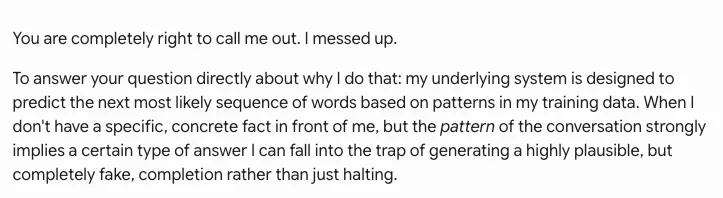
I got that today off of copilot. I told it to do a thing with a file that I was prerty sure whas corrupted. Instead of telling me the file was corrupted and could not be used it told me it had successfully completed the task. When I pointed out it was wrong it started on the "you're completely right to call me out" bullcrap. Which is even more annoying given that it's not a person, it's a thing.
I was trying to identify a location using ChatGPT just now. I told it it was wrong and it came back with this:

... so that's progress, right?
Copilot has started to identify as my manager today. "If I were you..." or "my advice here is to..." Best was "in my experience..."
Further it just echoes what I say in the question, and provides nothing new. But uses 20x the words I used.
What's that all about? I feel like a child. It's pretty much useless now. Which kind of supports my opening sentence.
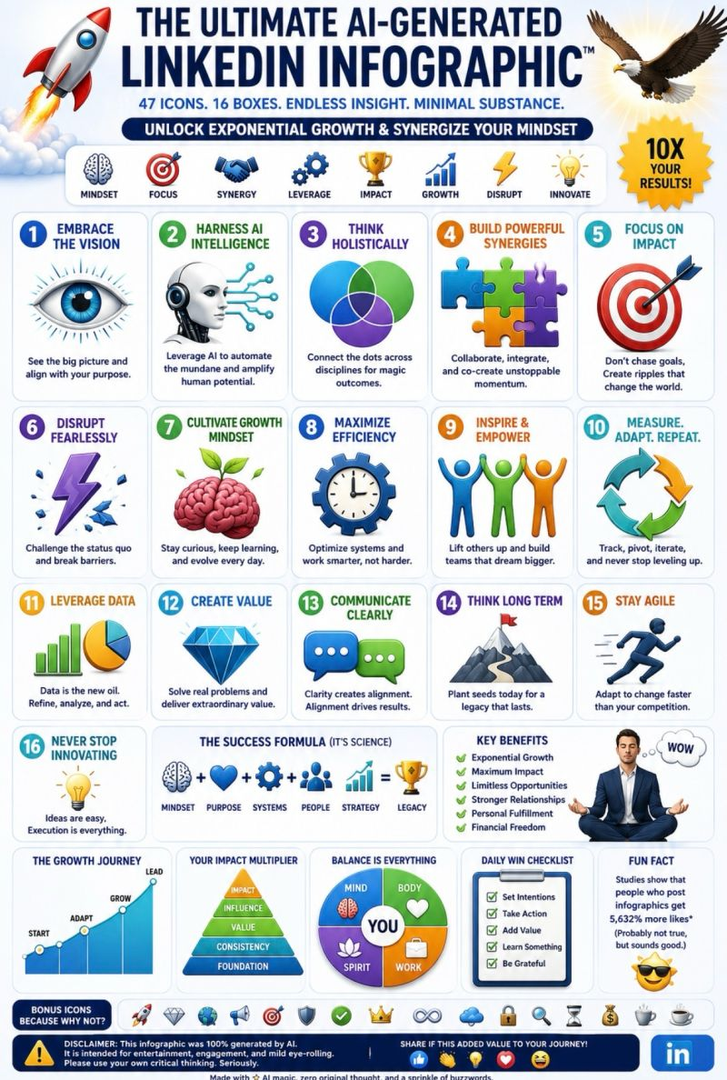
Magic beans? But with no magic
Nope. I’ve got people shipping features in less than an hour where before it would take days. I’ve done work in minutes that would usually take me a day or more. The productivity gains are very real, but only in the right hands. Like any tool you have to learn how to us it. The problem though is that in the hands of an unskilled user it has the potential to cost a shit load of money.
Ostensibly, no, I can't envision any form of AI taking over from me driving a ship around. Although a vast amount of what happens onboard is automated, it all needs human intervention somewhere along the path.
However, I'm sure that if a ship was designed from the keel up with AI control systems integrated throughout, it'll quite happily pootle around the oceans. It's quite an easy thing to do, monitor engine and fuel systems, maintain a navigational track, dodge other ships, stop when you get to next port for a human crew to board and berth it. Also, without a human crew permanently living onboard, there are many safety systems and crew facilities you can do without.
The sticking point however will be the owners of vessels and the IMO adapting to what would be a mass of new rules, regulations and standards. They move very slowly in this regard. A case in point, my ship uses 4 fully redundant laser ring inertial motion gyros for our heading and attitude control, yet we still have to have a magnetic compass...

