UPDATE: CLASSIFIEDS section refreshed, redesigned, searchable: Go take a look
Amazing to think it is all over, grew up in a village where there was a huge mining disaster https://en.wikipedia.org/wiki/Abercarn_colliery_disaster
Celynen South was just up the road.
I can recommend Big Pit mining museum for an insight to how hard a job it was
In first? I blame Thatcher. 😉
Coal is a huge part of the history and wealth that we enjoy in Britain today.
...so WAS slavery.
Huge up here in the NE too but long gone. Too inefficient to extract coal that was so once newer methods came along it was doomed.
Grew up in NE Derbyshire. Massive industry when I was a lad. My mum worked for a company that made pit head coal processing kit. Couple of my mates went down the pit at 16, both father's were miners. Strike hit when I was 17/18. Coal industry would have always struggled in face of globalisation, but Thatcher driven policy to face down union power accelerated that decline massively. Left wastelands of unemployment in mining villages across S Yorks.
As an 11 yr old on holiday in Derbyshire I spent a day fishing next to a striking miner - can still remember him and what he explained. Important part of my education.
Couple of uncles went to the mines in NE. Couple more worked in ship yards.
Thoresby closed here in the summer. We live in a former mining/steel area, mostly gone before Thatcher - didn't Wilson close more pits than Thatcher?
Hard dangerous work. Local guys I've spoken to say they are glad they never had to follow their Dads into it. I understand the problem of cheaper coal from abroad, not sure how much we could/should have carried on trying to keep our domestic supplies going in terms of energy security. Once you close it, it is gone.
Mate worked for a group who dealt with old pit sites. The number of experienced mine engineers who can deal with any problems that arise is also in decline.
back in my youth I got to about 20 shifts off being fully face trained at Bolsover colliery, quit not long before the miners strike & it took two weeks before I stopped coughing up black stuff, find if difficult to believe that my working life once involved crawling up and down a space no bigger than twice the distance from my knuckle to my elbow in absolutely filthy conditions
Edit - for someone who's parents both graduated from oxford uni (although I hasten to add we don't really move in those circles), its something I a damn proud of having done & was certainly both an eye opener & education of my young self
very good drac, I marvelled at the 50+ year olds who'd been there since 14 from the days of george orwells road to wigan pier
I can't find it but there was a BBC article that showed the Thatcher years had no impact (negative or positive) on Coal production or number of people employed in mining.
Both declined steadily from the end of WW1 at a fairly constant rate.
I can't find the article but this one includes the production numbers:
http://www.bbc.co.uk/news/uk-politics-22070491
Wonder if in 50 or 100 years we'll be going after it again, when all the oil and gas runs out?
(An idle thought, not a prediction, before you start 🙂 )
I can't find it but there was a BBC article that showed the Thatcher years had no impact (negative or positive) on Coal production or number of people employed in mining.
It was reducing anyway yes.
http://www.dmm.org.uk/colliery/a007.htm
Wonder if in 50 or 100 years we'll be going after it again, when all the oil and gas runs out?
It hasn't stopped just the process has. Many of the old colliery sites around here have or are being opencast now extracting millions of tones that deep mining couldn't.
Many years ago I worked in coal mines abroad. It is a frightening, noisy and truly awful work environment. Part of me is not sad to see its end.
The impact of the strike was to create a perception that unionised and heavy industry, coal steel etc was risky old fashioned and so not worthy of investment. Ironic given the labour costs of modernised heavy industry are actually realitively low so at the most basic level, decline from global competition is weaker. This lack of investment contributed greatly to the decline of traditional industries over time. Bringing a false sense that UK could survive as post industrial, finance and services led economy. The extent of the North South divide that resulted in late 80s and 90s was massive. But the NUM dud walk into the Tory trap, there really is something about picking your fights.
...so WAS slavery.
I made no suggestion that mining (and the industrial gains from it) was anything other than something that has benefited us, even to this day.
Mining is in decline across the world at the moment. Even the Chinese are struggling.
Opening open cast round us now. Wondering if there is scope for a trail centre when the first one closes in a year or so....
Slavery is in decline across the world at the moment. Even the North Koreans are struggling.
I worked on the Selby Coalfields in the 80s,hailed as the 'Superpits'. ,they lasted less than 20 yrs before becoming unprofitable. I am sure there is still a load of coal to be had,they just need an efficient method of extraction if the price ever does go back up.
I don't think anyone will be that sad to see it go as an industry unless you are some hardcore lefty. Grim work, with a dire safety record.
More mines closed under Labour than the Tories.
Oh and Big Pit is a great visit.
I don't think anyone is arguing that coal mining was a brilliant job or a that coal mining isnt inevitably on a worldwide downward spiral. But it is emblamtic of a conscious policy of non investment in industry and the creation of a finance and service based economy on one hand and the lack of any sort of exit strategy for communities where the employment heartvwas ripped out and no alternatives available. Don't you love the metropolitan politicians of every hue who get teary eyed about GreatvBritain as the cradle of the industrial revolution and the birth place of the modern world, and in the breath criticising the ."undesering poor" and ****less lazy dolites in areas where industry has gone and even after nothing has come to replace it
When they say "Deep Coal Mining" does this mean that no one is now going underground to mine coal or is it some other definition. Is this really the last coal mine?
I made no suggestion that mining (and the industrial gains from it) was anything other than something that has benefited us, even to this day.
I can't say that I didn't fail to decline any attempt to resist not to not parse that sentence 😉
People who slavishly trot out the old mantra that Thatcher destroyed the mines are living in cloud-cuckoo land. How do they think making the mines less competitive would have prolonged their lives? Mining and quarrying are knife-edge industries and are more subject than any other to the vagaries of labour costs and overheads, commodity prices, exchange rates and cheaper competition.
The old "blame the Tories" era was a sorry symptom of the stupidity and complacency of post-war Britain. Workers and management were still living in the time of the colonies when Britain enjoyed cheap raw materials and monopoly markets.
My buddy runs a huge glasshouse in Gloucestershire, heated by coal and woodchip. Colombian coal is cheaper than British, so why would he want to buy British coal?
Good.
You ever been down a coal mine? A real, working mine? Suspect not.
I have (not in the UK mind you), and it was the grimmest, most depressing, thoroughly unpleasant experience of my life. Hot, dark, painfully claustrophobic, dirty, noisy, wet... Everywhere you looked their were machines waiting to lop your head off, and the mine rescue team were on permanent standby with serious equipment and procedures to get people out if there was a problem.
There is no way that we should be sending people down to do this in the 21st century. No objection to coal mining if achievable by robots. I don't agree with Thatcher's reasons for doing what she did but am I sorry about it? Nope.
"way of life" blah blah blah. Believe me, I'd be happy to subsidise a minor's children on the dole for the rest of their lives than ask them to go down a pit.
conscious policy of non investment in industry
There's a clear difference between 'non-investment' and what was happening in the coal industry.
'Loss without limit' as Scargill proposed.
I think it was the pig headedness on both sides of the argument that caused so much hardship during the strike. Thatcher was a bully and Scargill was an ego maniac idiot. Why couldn't a settlement be reached, I was a teen and it did seem like a fight to the death.
Where Thatcher was wrong was the callousness of which the closures were done. There was no help given to soften the blow of losing an industry where most of the population worked or were involved. Between Risca and Brynmawr was devastated absolutely destroyed and still isn't the same now. That is a legacy of shame.
I work in North East Derbyshire/North West Nottinghamshire and it's a sad place now the mines have gone - not that they'd have been that nice when they were here but they're just hollow towns of unemployment now.
I have to visit the Coal Authority for work and the photos in there and the details on the plans make it sound horrific to work in there.
Globalti. I'm not arguing that completely uneconomic industry maintained, but combination of investment to improve productivity plus planned exit must better than just binning whole sectors and creating economic wastelands. You criticise the post war concensus, but the growth in that period was higher over that period until it all went tits up in the 70s than in the "free market" period since Thatcher.
The problem with small state is that big industry often needs longer term investment to improve productivity and maintain its global position, if the state will not provide then as it doesn't fit with political ideology or free trade rules then some other state will. China is the example now, massive manufacturing based sustained by artificially undervalued currency and Govt subsidy to uneconomic industrial production eg steel in a globally reducing market - and two fingers to free trade rules because they are powerful enough to do it. Even the most avid neo-classicist would argue that markets only work if everyone plays by the rules.
It will all end in tears.
Pretty sure there were some closed (unprofitable) mines with ~50% of the coal still in there. Some have been opencast, some can't.I am sure there is still a load of coal to be had
Eventually they'll be profitable again.
Who knows where the miners will come from.
You ever been down a coal mine? A real, working mine? Suspect not.
As it happens, yes, I went down a pit, right to the face, in South Shields in 1977 and have explored plenty of derelict lead, copper and other mines in the UK since then so I do know what the conditions are like.
So why didn't British mine owners invest in automation at that time?
What do people think could have replaced mining in communities that relied almost 100% on the mines and their associated businesses for employment? The mines provided everything including the healthcare and social lives of the miners and their families. During the 18th and 19th centuries Britain made the jump from an agricultural to an industrial economy and urban populations exploded. Just what was the government supposed to offer those communities by way of employment?
What sort of automation are you talking about? The kit British Coal had in their high output pits was state of the art. It was never an industry that could be fully automated.
Hopefully they will all be back in work within 12mths, currently working on a tender for a new Potash Mine under the yorkshire dales that's hopefully starting late 2016.
seems to sum it up really and they managed to get silicosis into a punk song, bless em
Here they are on the coal face with their pick axes.
[img] 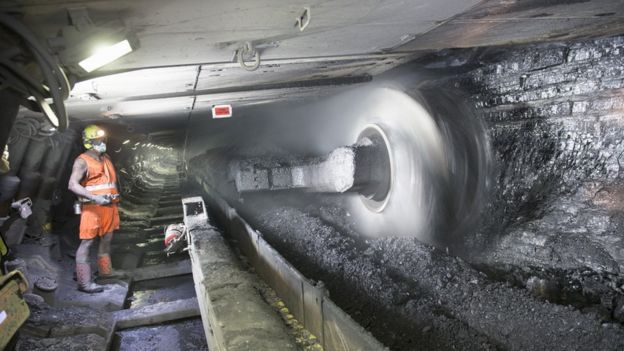 [/img]
Just what was the government supposed to offer those communities by way of employment?
I know! Imagine a government having some sort of social responsibility for it's citizens. Far better to shut the bloody lot down and let the communities rot.
They could just move to where the jobs are. Like their great^n grandparents did. And the rest of us do.
Well, they could always do what I did and move to where the work is. I'm from a mining area (north Notts) and my dad was a miner for a while but I'd never go back again.
Finding yourself another job? What an utter dreadful suggestion.
> There was no help given to soften the blow of losing an industry
Yes there was, the place was awash with money. Every light industrial units with miles of my local pit was built with local development agency and EU money.
The difference is that in some areas they grabbed the money and helped people get jobs, in other areas they were too busy moaning to go out and take the opportunities available.
Finding yourself another job? What an utter dreadful suggestion.
The problem is that in some areas, usually industrial northern parts of UK, the coal/steel/mine/chemical/power plant is the ONLY employment. When it closes, so do most of the other businesses. There is no other employment, certainly for the numbers that are laid off, and trying to start a business in an area where money is tight, no-one has a job...
My grandfather in West Yorks was and his greatest pride was to see his children and grand children was to go onto into further education and university. It was a dangerous occupation where death or serious injury was a constant threat and long term illness almost inevitable. The demand for coal is falling, in a few years the UK will have no coal powered power stations, so closure of the mines is almost inevitable.
To link the closure of the mines with the fight between Thatcher and Scargill is foolish. Even Scargill knew that the mines would close in the long run, he was trying to get the best for his members. However the previous battles with the unions and the rise of Thatcher, it was a fight he was never going to win. In doing this they (Thatcher/Scargill) drove the industry into teh ground, without any planning for the long term. The legacy of this can be seen in the old pit villages and towns and will be there for generations.
Coal won't be coming back. Not unless we can work out clean ways of extracting the energy from it.
Guardian have a nice graphic of the closures over the years at the link below. Interesting to see which areas closed when
[url= http://www.theguardian.com/business/ng-interactive/2015/dec/18/the-demise-of-uk-deep-coal-mining-decades-of-decline ]Coal mining decline[/url]

