UPDATE: Reviews section refreshed, redesigned, searchable: Go take a look
I turn it off, how the f*** do you do donuts with it on!
Once upon a time a friend was invited to help another friend set up the handling on his Caterham at a airfield/track day so he loaded up his (new to him) BMW company car with a bootful of tools and trundled down the M4 on a pissing wet day with a blustery cross wind. BMW gave every impression it was going to kill him at slightest notice while travelling in a straight line.
Friend of friend was a no-show. Trackday organisers offer paid-for place. Was taken as an opportunity to scope out the level of demonic possession in the BMW.
First lap, the first hint of trouble and the stability control kicked in very aggressively. Nasty lurching as the electronics modulated the throttle. But it didn't kill and it didn't oversteer and it didn't fishtail. Bimmer was a comfort spec 323 coupe with a wallowing ride quality that invariably made passengers queasy.
With the stability control off, discovery that the car had a party trick for drifting, adjustable, stable and accurate initiated at 100mph on the runway, gliding in an arc to join the coned off track in the taxiway waving at the TVRs, Loti and Porsches being overtaken. Trip to nearest tyre shop needed to get three down-to-the-canvas tyres replaced.
Moral of this story (besides public roads not being conducive to drifts initiated at 100MPH with net-positive outcomes)?: Stability control stayed engaged ever after. Bad, lurching stability control has its place. Anything you can do to expand your experience so you're not surprised by how your vehicle reacts is good.
Very broken by the sound of things and its simply impossible for a FWD car to power oversteer
its really not impossible. Power oversteer simply means its oversteering whilst power is applied. The balance of fore/aft grip on that car was such that, whilst accelerating round a corner, if there wasnt sufficient grip, the rear would step out first. Applying more throttle would balance it, but it was still power oversteer.
Just don’t see how braking is going to help. No grip, no brakes?
tyres never have *no* grip unless they're in the air. Whilst aquaplaning they have very little grip, on a wet corner they have some grip. Grip can be used to change your momentum in some axis - so if you corner at the limits of the car, then apply throttle (or brakes), the car will no longer corner as hard (as some of that grip is being used for changing your speed).
If you get a car completely sideways, braking doesn't make much of a difference (as the tyres are sliding sideways over the tarmac, applying lateral braking force won't matter) - but locking all 4 wheels does stop the car gripping when not-quite-straight again and pinging you into a barrier.
fwiw, if you've run out of grip in any car, deploying the clutch is a good idea if you have presense of mind to do so, as it removes any engine influence from the tyres leaving more available for turning
it’s a complex system and all you need is some part to fail…
the driver is the weakest link in most cars, what proportion of crashes are due to component failure?
Oh the ESP will come on 4WD when it is slippery enough 🙂
Conditions have been pretty bad here (Helsinki region) and our driveway has been turned into ice field with some water on top. Spreading grit on does not help much as it sinks into ice during the day. My winter tyres could not keep car in place on the driveway on brakes, it just slid to the bottom. Studded winter tyres in wives car are bit better.
Just don’t see how braking is going to help. No grip, no brakes?
If you have anti-lock brakes, they'll brake to the limit of the grip you have. If you have stability control and have lost the back end because you overcooked it into a corner and had a panicky lift of the throttle, the rear tyres may regain traction once you bleed off some speed and the stability control will sort you out. Basically, once you get badly out of shape, you're probably going to crash so anything you can do to crash at a slower speed will help.
its really not impossible. Power oversteer simply means its oversteering whilst power is applied. The balance of fore/aft grip on that car was such that, whilst accelerating round a corner, if there wasnt sufficient grip, the rear would step out first. Applying more throttle would balance it, but it was still power oversteer.
That might be your interpretation, but it's not the generally accepted definition.
What you're describing is the rear breaking traction first on a corner, and can be due to geometry or chassis balance, or a number of other things, it's oversteer whilst on the power, but it's not power oversteer.
The balance of fore/aft grip on that car was such that, whilst accelerating round a corner, if there wasnt sufficient grip, the rear would step out first. Applying more throttle would balance it, but it was still power oversteer.
That is not power oversteer you are describing
That is not power oversteer you are describing
I'm not implying that TJ is ever wrong about anything, but in this case he is right.
This is going to turn into one of those threads where people start arguing that FWD cars can drift, and then try and prove it by showing loads of videos of 205s and DC2s lift off oversteering round corners, isn't it?
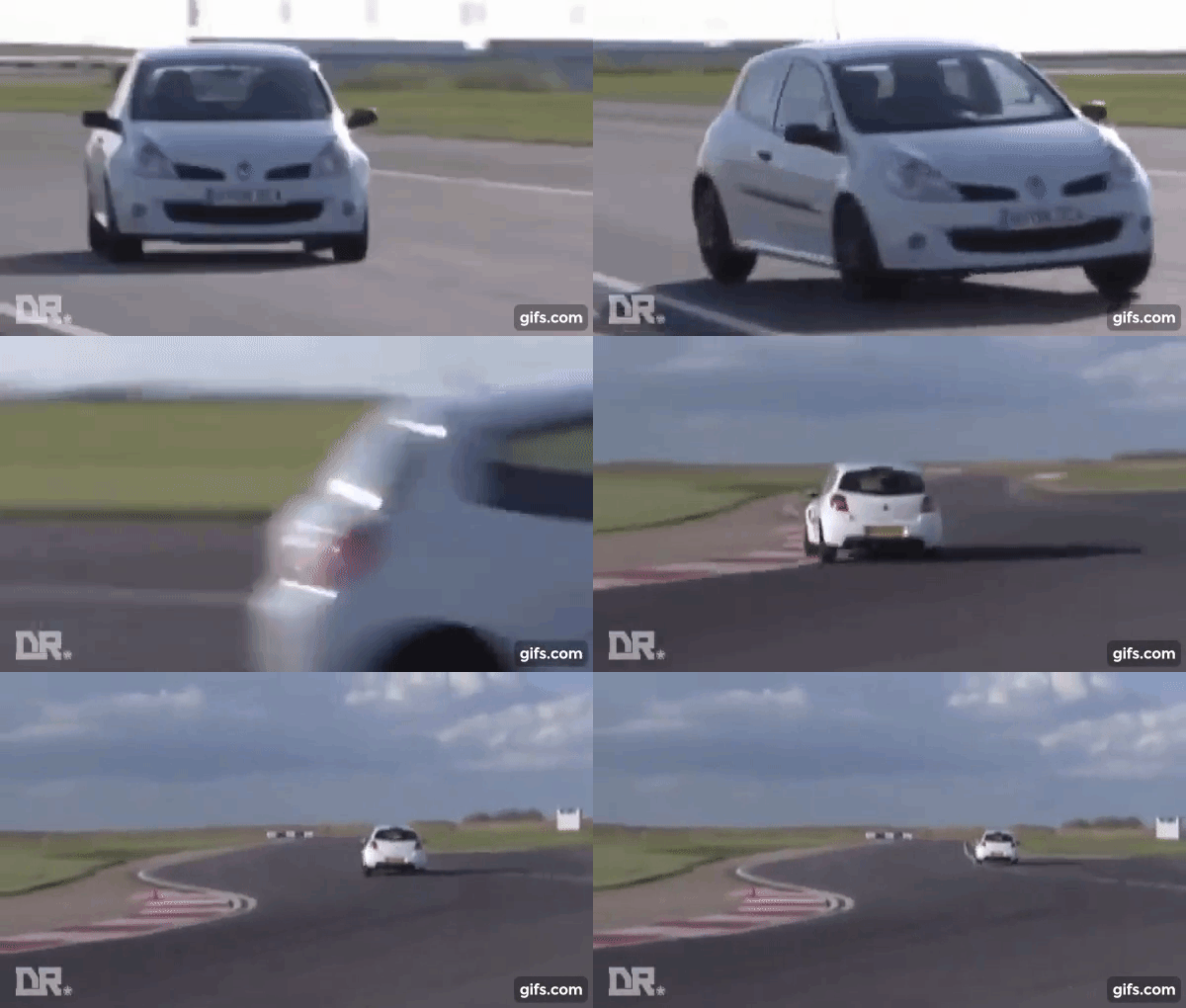
We were told that Mercedes invented ESP back when they launched the 1st A Class. It was one of the first small cars with the wheels at the extremes of the body. It failed the ELK test and rolled over so they either had to invent something that countered this or they started again costing billions.
In the old days we used to get sent with our customers to Mercedes testing facilities to see how these systems worked. Basically if you picture your car with 4 brake pedals thats in effect what you have. But a computer controls each one independantly 1000's of times per second and takes into account vehicle loading, centre of gravity, steering wheel input and throttle input. We used to have a go on a simulator which was basically 4 pads on the floor, a screen of a car driving and we had to try to get it around a track safely.
Anyhow, the next demonstration was a skid pan with a chicane of cones. The skid pan was watered slippy tiles. Just walking on it was slippy. You had to hit it at 60kph AND NOT TOUCH THE BRAKE PEDAL. I loved it, violent steering left then right. The front bumper would almost bottom out and the thing would slam on its brakes in every way to get it to follow the direction of steering. Absolutely no counter steer or hitting the throttle to pull you out of a skid. The ESP system would cut the throttle anyhow.
We would do this a few times and also take our competitors vans out and be shown why our latest generation was better than the others. Empty, 500kg, 1t. It made big differences.
We would also do the ELK tests and at the end of the day they would get the Ford Transit or whatever and compare the tyres after a whole day doing this. The ford was shagged but the Merc tyres barely worn despite out performing the ford all day on the tests.
Its an amazing piece of kit that i have unintentionally tested out at 80mph going sideways on a motorway before.
its the old french clock again thols2
I have never been sideways on a motorway at 80mph. Does this make me a driving god or not? It's all so complicated.
ESP has been in development since 80's but first Merc A-Class definitely was one of first cars which actively relied on it.
The systems have come a long way, e.g late 90's there were some systems which couldn't handle situations where wheels on other side were on slippery surface and other side on a grippy surface.
pdw
Free Member+1 to steer in the direction you want to go.
Thing is with that, you have to apply the correct amount of lock and unwind it at the right time and quickly to prevent it snapping the other way.
I used to have a fiesta which oversteered at whim and got quite proficient at this (no ESC and it still had the original and by-then rock-hard 10 year old pirelli p6000 ditchfinder pros fitted from the factory!).
However even in that very predictable car it was quite difficult to unwind at exactly the right point, would be even more so if it only happens occasionally.
But on a car with esc I think it would still be safer to simply hold the steering wheel where it is and let the computer do its thing, as the front wheels will still be pointing in roughly the right direction when it straightens back up.
There's loads of vids of people driving reasonably modern motors into the scenery after what looks like the equivelant of PIO. If the clot in the hot seat is messing about, presumably it can be almost impossible for the systems to recover?
There’s loads of vids of people driving reasonably modern motors into the scenery after what looks like the equivelant of PIO. If the clot in the hot seat is messing about, presumably it can be almost impossible for the systems to recover?
Ye cannae change the laws of physics
If you barrel it into a corner way too fast for the conditions, no ESP/AYC is going to be able to pull you out of it, it's as simple as that.
Where it will help us with things like throttle and brake induced imbalances/changes of traction mid corner. So the classic hoofing the accelerator too hard too early on corner exit in a rwd car, or a panic lift off potential tankslapper mid corner, for instance.
There’s loads of vids of people driving reasonably modern motors into the scenery after what looks like the equivelant of PIO.
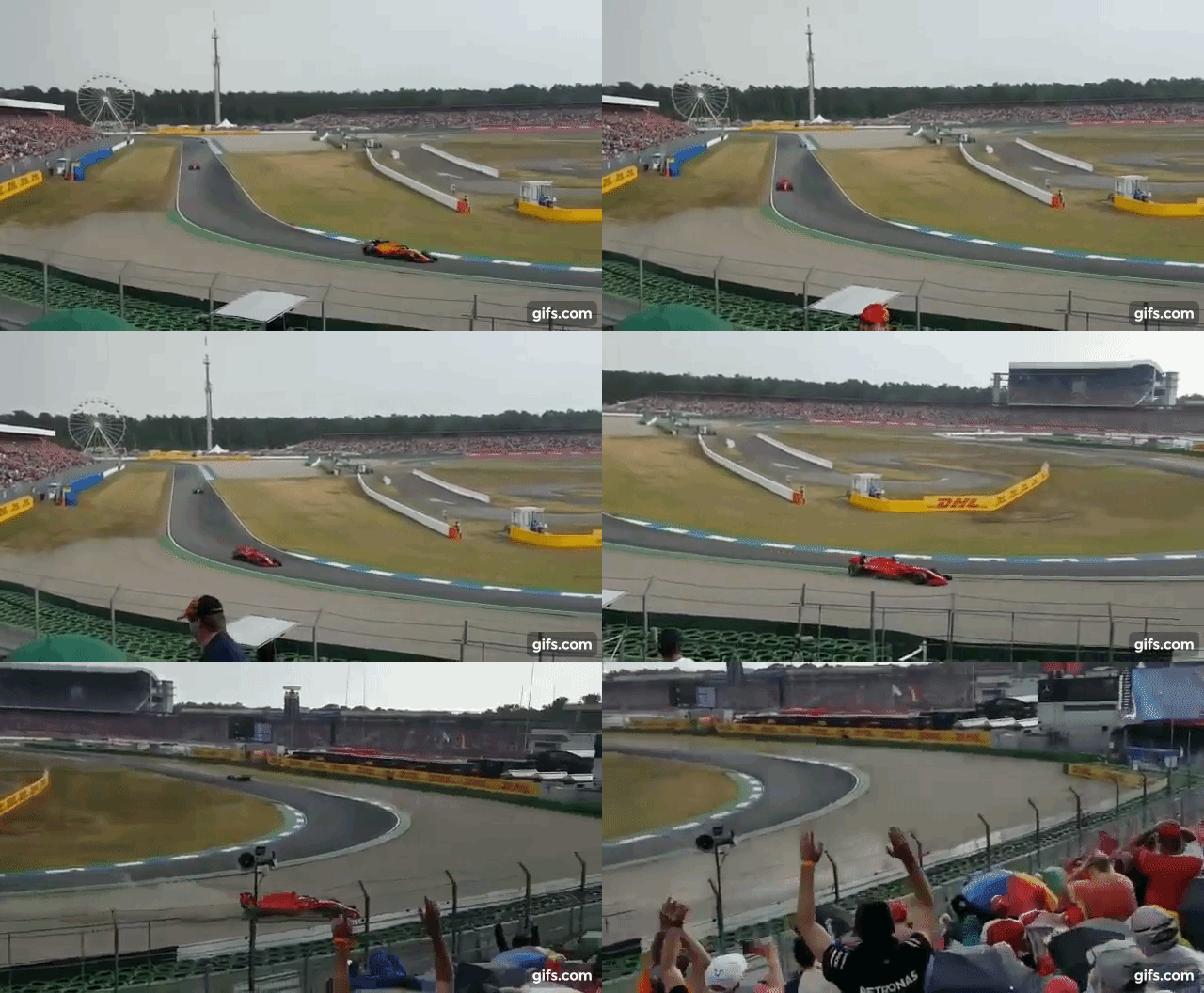
To the OP. Best advice (and you know this I'm sure) is to slow down on unfamiliar roads and/or in poor conditions.
I can't remember the last time I triggered the ESP on one of my cars on the road, but in situations like you had the best thing is to let the system work, dont hit the brakes too hard or put in large steering inputs. New ESP systems work really well.
I do quite a few track days in my cars and they have ESP settings for quicker driving. I leave the ESP on since I'm no driving god and actually I go quicker with the ESP on. You can really feel how well they work on track and it does help you get round the corners with less drama.
It's really clever stuff and it's great to see this kind of technology (sort of) filtering down to motorbikes in the form of 6-axis IMU's to help out the ABS and traction control systems.
As a biker, my next bike will certainly have the latest electronics.
I turn it off, how the f*** do you do donuts with it on!
You are a Policeman AICM £5 😀
I was driving on ice/snow a day or so ago...snip...Just wondered if I should be doing something different.
You could try an intermediate ESP setting, if there is one, so that you have engine power. Switch to full ESP when you're back on the road
Same for Quattro, you just never see that light
I've managed it a couple of times 😉
You are a Policeman AICM £5

and DC2s lift off oversteering round corners
brings back good memorys, did about 10 trackdays in my DC2 and playing with lift off oversteer was good fun and for the fast laps the LSD did a good job allowing plenty of power without understeer.
was much more fun for the next 70+ trackdays in a severn style kitcar with high power to weight though. its a really good way of learning car dynamics with no electronics to help at all.
i'm sure that the more you can do to help the electronics contol a car the more likely it is they will save the sitution.
braking comments above, save the brakes for after the point of no return, once you're into an unrecoverable spin lock it down,you will stop quicker.
tyres never have *no* grip unless they’re in the air. Whilst aquaplaning they have very little grip, on a wet corner they have some grip.
I had to pick up a BMW once somewhere down in the darkest depths of the South-west, probably Cornwall, and when I checked the tyres, the rear ones were 1.6mm, as far as my gauge could tell, which bothered me a wee bit. FFWD to the M4 and it’s started raining, by the time I get to J18 at Tormarton, I’m going uphill in fairly heavy rain, and I’m vividly aware of the fact that the car is gently fishtailing at between fifty-sixty mph.
It was at that point that instead of carrying straight on for Chippenham, I bailed and came back via Bath, with the slow traffic.
That was a bit unnerving.
If the rear end is stepping out in a FWD car on a public road, you are either driving like a total * or have just *ed up and are likely headed for a crash whatever you do.
I'm afraid I can confirm that. Ended up rubber side up.
The best advice is to learn to read the road better!
Most drivers i sit with have no idea how to read the road, in fact,few even look at it, or far enough into the distance. Really, you should never be surprised by a loss of grip, as all the signs are there, you just need to read them! I can't emphasise enough how doing some advanced driver training will totally change how you drive and give you a level of safety that is, imo, impossible to get any other way.
I'm biased, but this guy is one of the best:
He also has a good you-tube channel and has published a couple of books that are worth a read.
I actually contributed to his "how not to crash" book, in the chapter detailing how to drive a modern car with ESP, and its best to get that book at read the chapter (blantant plug!), but broadly, should you start to loose grip, these are, on average (ie they can't possibly suit every situation perfectly!), the best actions:
1) If you are at "High" throttle openings, immediately reduce your throttle by at least 50% of your currently held level. This is good rule, and it tries to balance what happens when a tyre slips due to a high torque input from the engine, against what happens when the tyre slips because it is unable to carry the lateral load asked of it (ie a momentum driven slip). You almost certainly never want to completely come off the throttle if possible.
2) If you are at a large handwheel input (note: handwheel means what most people call the steering wheel, ie the round thing you hold as a driver, but used to be clear that we are not talking about the "steering wheels" ie the wheels / tyres at the front of the car), again, either hold the same angle (understeer) or reduce it quickly by about 50% (oversteer)
3) If you then feel that the slip is not reducing but increasing, nail the brake pedal hard. The ABS will help you control the yaw of the car (under/oversteer ie rotation) and should you run out of road and talent, you'll be going both slower, and most likely forwards (rather than sideways) when you hit something. This is really important because side impacts are still the no 1 killer of car occupants, where as frontal impacts are now extremely well mitigated against
IME, after doing lots of advanced driver training as both student, observer and instructor, most drivers CANNOT accurately enough control a modern car at high slip ratios in the exact instant they need too and without warning (see poor observation / anticpation section...) and in most cases, will make things worst when they try too.
This usually involves FAR too large a handwheel input, usually about 180deg out of phase with the yaw, ie making things worse not better (fishtailling). Again, IME, to instincitively catch and control a modern car when it slides, which they do at high speed thanks to there massively wide grippy tyres and huge lateral stifness, takes a lot of skill, and critically experience and practice, which most drivers simply don't possess.
I do urge anyone to do a real skid pan session, but not to try to teach you how to correct a slide, but more importantly to help you:
1) Recognise the onset and likely hood of a slid developing BEFORE it does. To learn to feel for the onset of a loss of grip
2) Understand just how hard it is to accurately catch such a slide at any speed above about 7 mph (watch youtube for reference, as people stick no end of nice cars into the scenery, having watched too many episodes of Top Gear and thought "how hard can it be".... 🙂
It's also worth noting that most people who get into slides are only in a slide because of poor road positioning for the speed at which they are travelling. Learning to position your car properly, enabling you to drive FASTER and SMOOTHER is the real key to driving. The very best drivers (like Reg) will astonish you by the speed you see on the speedo, but the calmness and smoothness at with which they apply that speed (and often, with the lack of speed they choose to carry in a lot of situations)
@bails more the doughnut reference rather than driving shenanigans... 😀
lift off gently as modern cars are designed to go 'neutral' when this is done, even rear wheel drive^; unlike the German fast saloons and French hot hatches of old which were much more fun to drive. As others have said the esp* needs grip to work most effectively, once you have done this keep steering the way you want to go and reapply the accelerator pedal gently once the sliding has stopped and hopefully be on you way/ have a crash at a lower speed.
^ Obviously this is not always possible due to physics
* esp is I think Bosch groups trade mark
If you have enough space the esp will eventually sort things out but this is not the case on a road - the system is designed to assist mistakes by drivers on unfamiliar roads or when distracted and works on a basic principle of what people usually do in a panic - it will not sort out catastrophic failures of talent.
If you really know what you are doing it will interfere with your actions but I think if you are that good you will understand that the system is quicker than you and on a public road it will sort an issue in a manner which is safer due to the lack of space available.
My understanding is, just steer where you want to go. ESC / ESP etc is better than you, it can 'think' quicker and it can do things you can't like brake wheels independently, but it doesn't know where you want to go, it also can't entirely break the laws of physics, if you want to turn 30 degrees left, and there's only grip for 20 degrees, you're going to crash. The good news is that cars have loads of grip these days and ESP does let you get away with a lot, so you probably won't.
Again, this is only my understanding, but most systems are pretty much identical, some manufactures did develop their own systems, most just buy in Bosch, even if they brand it differently, even the ones who made their own, bought IP from Bosch to make it work.
I'd be interested to know that with really modern cars with steering assist, would the system deploy a "dab of oppo" to try to stop a slide? even with electronic steer, the wheel is still physically attached to the wheels, so it would be quiet violent and hurt the driver, also, if it resulted in the car going out of it's lane and hitting and oncoming car, would they be liable if the driver claimed the car, not them, caused the crash.

