UPDATE: CLASSIFIEDS section refreshed, redesigned, searchable: Go take a look
Well why?.
Seriously though I don't know why.
Because designing the forks to cope with the additional strains and stresses is quite tricky.
Arguably they are overkill - v-brakes do a perfectly good job.
The roadie market is pretty conservative (apart maybe from carbon fibre).
Tyre contact patch is tiny - I can comfortably lock the wheels using my Ultegra brakes, and they modultae just fine. Why would I want to add more weight for unnecessary levels of braking?
That's why!
Because they don't need them.
As above......
My road bike is a MTB h/tail with slicks,rigid forks & disc brakes.First time out in the wet was very interesting 😕
Some do
[img]  [/img]
Well I would like to have some disc brakes that work well despite the weather as a road bike can be really quick and get quite scary sometimes.
But like Ourmaninthenorth mentioned try to get some proper braking without locking the wheels when Your tires are 23mm wide and pumped up to 120psi. Just too much in my opinion.
My 105 brakes were just fine with shaving off speed but current Tektro Oryx work better when it rains/snows 🙂
But thing is, Druidh Your bike has drop bars, but is that Kona a proper road frame or a CX frame? XT on rear as well. Just some roadies would not qualify it as a 100% road bike.
But if I had a bike like a tourer/commuter with ability to put panniers wider tyres, than to stop all the extra weight I think I would like to have discs as well.
Yeah that's not a road bike, there's no point at all in discs on a true road bike. On touring bikes they make sense. They would add a lot of weight and probably make the bike less controllable.
mieszko - Member
But thing is, Druidh Your bike has drop bars, but is that Kona a proper road frame or a CX frame? XT on rear as well. Just some roadies would not qualify it as a 100% road bike.But if I had a bike like a tourer/commuter with ability to put panniers wider tyres, than to stop all the extra weight I think I would like to have discs as well.
It also has a triple chainset - to most roadies, that's also against the rules 🙂 But your thinking is the same as mine - added weight deserves better breaking. And for those that want to start on about "lack of modulation" / "disk brakes locking up too easily", then I'd just suggest you're a bit ham-fisted. You need the hands of a lover, not a fighter.
Because the bike would be significantly heavier to allow for the additional loads that disc brakes put forks and frames under in places that they currently don't have. Also hubs, wheels and brakes would be heavier as well.
Maybe, when a disc brake equiped bike can be produced under 15lb in weight then you'll start to see them be used, until then.
The brakes on my road bike work fine so I couldn't see any need for fitting discs and to be honset it would be too much braking. Also in general you can see whats up ahead much better than you can on an mtb so there isn't the need for last minute braking.
I'll be fitting a front disc to my cx commuter though but its got 32mm slicks and I ride it a lot in the rain.
Put discs on this..
[url=  ]Nice road bike[/url]
And I for one would give you a good shoeing.
😉
God! It looks like the cat threw up over that bike. Ugly isn't the word.
why don't road (racing) bikes have discs? most importantly, the UCI rulebook I'd guess
I reckon someone could produce a disc-braked bike that was at the weight limit if they were allowed, though I doubt there'd be much advantage in braking performance - I certainly think you would need the hands of a druidh if you were using discs on a high speed alpine road descent in the wet. Also, if it was dry I wonder how badly a minimalist disc set up might overheat (then again, I don';t do this riding so I don't know how badly conventional brakes suffer either)
Conventional brakes can get very hot, hot enough to melt tubular glue and roll tubs off the rim, or cause blowouts in clinchers. Like MTBing though, if you brakes properly you'll be fine, if you drag the brakes the whole time, you won't be!
How many more times do we have to see that picture druidh? I wish I had a quid for everytime I had seen it, could probably afford to buy you a proper road bike with the proceeds 😉
Disc brakes would be a welcome addition to my touring tandom; it's a nightmare to stop on steep/wet descents with a lot of luggage on the back (no not you dear - panniers I mean)
Basically because it's lethal. I put 25mm tyres on my 29er with discs to commute and the power overwhelms the contact patch on anything other than dry, smooth roads. Don't do it, no point.
Mister P - Member
How many more times do we have to see that picture druidh? I wish I had a quid for everytime I had seen it, could probably afford to buy you a proper road bike with the proceeds
I have others. . . .
[img]  [/img]
It's not really about UCI rules, or weight, or the conservatism of roadies. they simply don't need them. I doubt any roadie coming down a 20 mile alpine descent would ride any quicker with discs. they often accidentally lock up with rim brakes. discs would just be too much braking power for the available tyre-ground grip.
if you have normal road brakes and they're not enough, try cleaning/scouring the braking surfaces or maybe switching to some better pads.
tourers and tandems are a different matter though - fatter tyres with bigger contact patch, bike weight less important but load weight much higher.
they often accidentally lock up with rim brakes
what, the front ?!!!!!!
I don't think many people would suggest discs purely for absolute power - other than in wet or clag, either of which would potentially make road descents dangerous with discs as I suggested above. Think it's more to do with consistency, self-adjustment (could you wear out a set of blocks so as to affect lever function on a single mountain stage, for example ?) and, if done well, resistance to overheating
it's very easy to throw yourself over the bars with good road brakes (i use dura-ace) and the back can be locked up easily. if you run fat tyres 38c + then maybe disks would be useful but for ordinary road bikes they are not needed.
i can't see a set of pads being worn out enough on a mountain road descent to affect braking, i'm still on a set of pads that have lasted a year and 6000+ miles.
some tandems do have a disk 'drag brake' for speed moderation on long downhills
or a drum based one
[img] 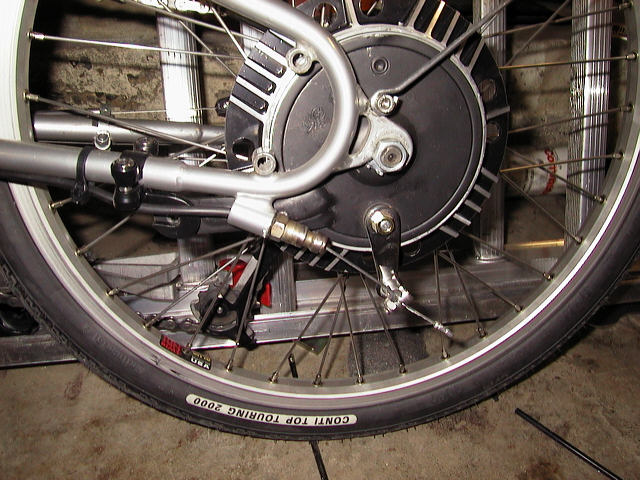 [/img]
6000 miles on a set of blocks - blimey, might cut some down & superglue onto my worn disc pads (if only someone would make disc pads where the material could easily be removed from the backing...)
I reckon the over the bars tendency is quite strongly linked to position too though - arse high, hands low etc. Maybe all tour de francers should use discs AND adjustable seatposts
"[i]Maybe all tour de francers should use discs AND adjustable seatposts[/i]"
they don't need to, they know how to ride a bike
🙂
they don't need to, they know how to ride a bike
aye, such is their unmatched skill, I've seen them combine it effortlessly with abseiling, ice skating, skittles, ...
:winkythingy: :bigkiss:
"what, the front ?!!!!!!"
Yes, it happens from time to time. you'll see someone braking hard into a corner and the front wheel just locks and goes from under them.
"Maybe all tour de francers should use discs AND adjustable seatposts "
I'm sure you're right. To be fair to them though, they just use whatever bike they can get their hands on. if only they had bikes designed perfectly for the job at hand...
🙂
you'll see someone braking hard into a corner
now you're just trying to upset JoB, suggesting they don't know how to ride a bike like that
:dontlikethosescaryfaces:
The popular answer seems to be that disc brakes are tod heavy and too powerful for road bikes. So make smaller, lighter less powerful ones for the road that give as much stopping power, still work in the wet and don't wear out your rims. Maybe not for racers where forks may need beefed up and dropouts redesigned.
They are dangerous in a bunch racing situation, there is too much risk of a tyre/ disk contact/ overlap in large racing bunches where the riders are very close..
and they are too much for skinny tyres
good for tandems though
The limit to road bike braking is tyre grip, not brake power. Proper dual pivot rim brakes work well enough and are lighter than discs for reasons others have gone
I've got a CX with disc brakes on and it is great offroad but in the wet with 25mm slicks things can get very spicy very quickly, especially when you add in a bit of road film to make the discs all grabby. It's OK with wider semislicks or proper 'cross tyres though.
Proper road bike with 105 brakes is perfectly adequete, I have ridden it in the Alps on long hairpin descents and been just fine and I'm quite heavy (15st). Can't say I've ever wanted more brakes on it.
[img]
Uuugh, that's wasn't originally designed to take the Arai was it? You do know your bolt holding the torque arm to the pacman has fallen out don't you? Oh, and who invented a combination ladder/tandem? 😆
Here's a good'un.
6.8kg, with disc brakes.
And three calipers...
[url= http://www.canyon.com/_en/technology/project68.html ]http://www.canyon.com/_en/technology/project68.html[/url]
The spoke/rim loading is also reduced, as the spokes on both sides of the wheel only have to carry half of the braking force.
Yes, its been a significant problem for years those flippy/ floppy elastic hubs where the spoke flanges aren't mechanically fixed to each other.
I have not had particularly good experiences with disc brakes on my mountain bikes, and am not a convert particularly. My road bike's brakes work absolutely fine. In the sense that they do not require any attention at all and work well all the time (braking distances may be increased on very wet roads, but you knew that anyway, right?).
Obviously when someone produces super-light disc brakes allowing for lighter rims saving rotating weight blah blah blah so that they are widely taken up at the top of the sport that will all be very positive I'm sure. It is unlikely to make the £1,000 bikes of Sunday club run enthusiasts like me any better or cheaper or better value I suspect.
🙂
"make smaller, lighter less powerful ones for the road that give as much stopping power"
Less powerful but with as much stopping power? Eh?
I think the basic answer is actually "it aint broke..."
But I think there may be advantages.
What about tiny little discs, for road bikes? 100,120 or 140mm? Think of long, steep, alpine descents, in the rain. Plus, you'd be able to produce lighter rims (use of disc brakes has led to lighter rims in MTBs), less rotating weight, therefore greater acceleration and more efficient braking. Then, you could have ultra-light carbon rims.
Makes a lot of sense, to me.
I think it's because roadies are snobby bastards, who wouldn't want to be seen following MTB technology; that's really what it is.
There are already road wheels with carbon rims......
Yes- carbon rims that have to be built tough, to withstand braking forces, and weigh as much as alloy rims. thus negating the benefits of using a lighter material.
No good reason why no road discs, though, is there? Let's be honest.
I'd put discs on my roadie, if the products were available, no question. I don't accept for a second the argument that road bikes don't need them.
Bike design and uptake moves slowly, that's just the way it is. And roadies are conservative types at heart. Until the hardware is available and of a decent spec then it's difficult to make the shift. But it will happen.
"[i]No good reason why no road discs, though, is there? Let's be honest. [/i]"
yes, for all the reasons just given
reggiegasket - Member
I'd put discs on my roadie, if the products were available, no question. I don't accept for a second the argument that road bikes don't need them.Bike design and uptake moves slowly, that's just the way it is. And roadies are conservative types at heart. Until the hardware is available and of a decent spec then it's difficult to make the shift. But it will happen.
LOL. Remind me again - which discipline of cycle sport banned skinsuits because they didn't fit in with the "image" despite their performance advantage?
As professional road racing is currently a richer sport than mountain-biking, with a substantial global recreational market full of people who are just as susceptible to buying the latest must-have item as the posiest mountain-biker (and indeed many of them are the same people), I rather think it likely that there is no good reason why road discs, actually.
🙂
It's possible to suggest reasons why they might be good, but bottom line is that there is a lively international racing scene performing at a very high level wityhout the assistance of this vital technology. The teams and manufacturers competing have the money and know-how available to use the technology if it would give them an advantage in extremely competitive competitions. I'm sure the UCI currently doesn't allow it, and there may be an element of snobbery there, but I suspect if good designs were being brought forward by the main component makers they wouldn't stand in the way. Afterall, it's a safety thing, and it dfoesn't make the bikes look stupid.
"[i]And roadies are conservative types at heart.[/i]"
no they're not, they'll try anything to gain an advantage, which is why there aren't discs on road bikes
Have you seen how much carbon road forks flex when you hit a bump though? It really is quite surprising if you watch it.
I guess it should be possible to make carbon forks that can take all the extra force on them, but they'd have to be less bendy than existing ones, which are apparently designed to be bendy to reduce the effect of bumps in the road.
On the locking up thing - I locked up the front just after hitting 75km/h once, it skidded a tiny bit, but in a straight line, just like a back tyre skid. That was jolly scary. It was because we were aiming to hit silly speeds down this particular descent where you get up to full speed just before a 120 degree turn, marked for cars as a recommended speed of 20km/h. The later you slow down for the corner the faster you can go, I just left it a bit too late.
Joe

