UPDATE: CLASSIFIEDS section refreshed, redesigned, searchable: Go take a look
Thanks so far - thinking about this further and reading the responses I think a 'modern' 140 to 150mm travel bike with modern long, low, slack geometry (and probably 650b to keep on-trend ) with nice stiff forks and a suspension design renown for good climbing would be right for me. Raid the piggy bank and make it carbon and it probably won't be a lot heavier than my current Flux which in its current setup isn't especially light.So what bike fits the bill?
You have just described a Bronson. Except the long bit.
Love mine.
Or the low, and slack bit...
sorry deviant, I know what you mean but I was actually talking about the air version. I was 100% coil'n'oil until I fitted them.
[img]  [/img]
[i]What 'speed' do you think high & low speed damping refers to? [/i]
😀
just ridden a single speed rigid 29er, most fun I have had for ages.
To expand on the low vs high speed damping point (if anyone cares!) here's how it works. It isn't low vs high bike speed, nor low vs high frequency, nor low vs high amplitude.
It's low vs high [b]shaft[/b] speed, so you can be on the low speed circuits when riding very fast with the suspension moving small amplitudes at high frequency to maintain grip over niggly terrain or large amplitudes at low frequencies as you pump over large undulation.
The high speed circuits tend to get used for sharp hits, big hits, sudden movements and so on - not just when going fast through the rough but also when jumping, dropping and battling uphill over big lumpy stuff.
The other point I was making was about how the rear suspension works to counteract pedalling induced bob. I really didn't expect the Spitfire to pedal this well - I was somewhat worried that even with the climb switch on the CCDBa that it would be a squishy sluggish affair on more pedally trails. I've been so curious to work out how such a compliant unflappable descender could climb and sprint this well that I ended up trawling through the mother of all MTB geek blogs (translated by google from the original Spanish no less!) Designing a high level of anti-squat into the linkage increases the kickback and that hardtail-like feeling when you're turning the pedals because the anti-squat stiffens the suspension, so you can't just stomp away in the rough and expect it to climb over all the bumps but conversely it means that your pedalling input goes into pushing the bike forwards instead of bobbing up and down and warming your damper oil...
Northwind's Hemlock's anti-squat curve is like this:
[IMG] 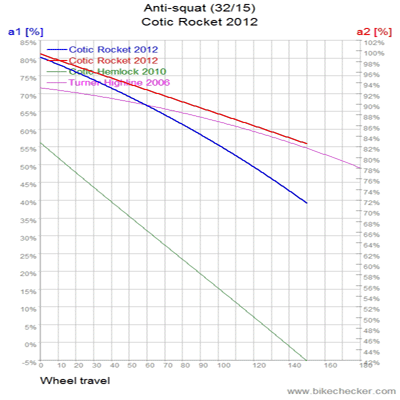 [/IMG]
Note that this is for a 32:15 ratio and the smaller chainring increases anti-squat. The key number is at the 30% sag point where it exhibits about 36% anti-squat, so the suspension is active but bobby and inefficient and needs increased low speed compression damping aka platform to pedal well.
My Spitfire's anti-squat curve is like this:
[IMG] 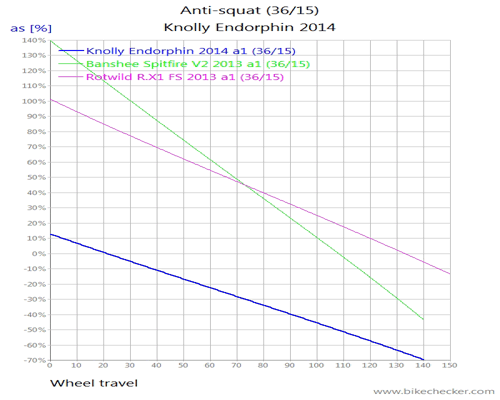 [/IMG]
At the 30% sag point it exhibits about 85% anti-squat on a larger 36t ring, so about 90% on a matching 32t chainring. If you turn that on its head this very efficient pedalling linkage cancels all but 10% of the forces which cause suspension bob whilst the very active linkage of the Hemlock needs the damper to deal with 65% of those forces or suffer inefficient squishy pedalling. Basically the Hemlock is over six times as bouncy under pedalling as the Spitfire with the suspension fully open. That's why with the Spitfire you can run the damping set up for descending because you don't need it to stop pedalling related annoyance.
If you drop to the granny ring you get a load more anti-squat and that's why older pre-1x10/11 designs often have less anti-squat in the middle ring because they expect you to climb in the granny. I think it's important to think about how and where you personally ride - most of my climbs are short, sharp and not techy, hence standing up and stomping works great with the Spitfire. If I had epic big mountain climbs to do then I'd want a granny ring (or 1x11) and there would be an argument for something really active that can rock-crawl over boulders. There's no such thing as perfect suspension, just the least badly compromised for your needs (but that doesn't sound good in an advert...)
There are lots of other suspension designs with similarly clever anti-squat and such but I think the KS-link stands out as a really well balanced design which also has good anti-rise (braking action), good shock rate progression (better for getting a nice wheel spring rate and damping behaviour) and its short link solid rear triangle configuration (with ribbed stays) lends itself to very high stiffness and low friction making it both very active and very confidence inspiring when you're pushing hard. The downsides are slightly longer chainstays (429mm 26" & 439mm 27.5") than is currently fashionable (a good thing in practice I think, if not so good for selling bikes at the moment!) and quite a lot of chain growth so you're on the limit of a short cage mech with 1x10 11-36 (I'm about to swap my Zee for a medium cage SLX).
Pivot Mach6 is currently favorite - just need to do some serious financial negotiating with more sensible half!
I had a 2004 Bullit with 2004 Boxxers with 170mm front and rear as my xc bike for many years. Did the Dyfi a few times on it. I loved that bike because of the rear shock. It climbed like a hard tail. It's a real shame 5th element stopped making bike bits.
Bought a 456 with 66rc forks so 150 mm front. Again a great little bike. I now have a very little use 2006 S work Enduro 160mm. Also have Scott racing expert with fox 32 with 120 travel. A big blast now and again.
chiefgrooveguru - with all that chain growth - do you not find it takes the pedals away from you on techy climbs?
Last bike I rode with a lot of chain growth was the Intense 5.5 and it was very hard work on rocky/steppy climbs.
You have the cream of 105mm bikes (clue as to what I have :D) which won't get made again and is worth peanuts. Keep it in addition to what you might get.
Any frame with lockouts. Or a shorter travel frame without.
I'm selling my longer travel frame as its a bugger to pedal uphill due to squishy long travel forks.
Chief - (in a nice way) that is the geekiest post. Ever! Not the high / low speed stuff which I thought mst know but graphs and stuff. Good work.
Alex - I have a Rune which also uses the KS Link and I've never notice the chain growth whilst climbing (32tooth front ring with an 11-36 cassette out back). I do have to run a slightly longer chain than I would normally.
Fantastic post that... It's nice when the numbers back up your objective impressions, doesn't always (often?) happen 😆
Always think anti-squat is a bit of a misnomer, implying that the effect is limited to squat/bob when o'course it's just suspension movement in general. So pedal through a rock garden, and science happens, the same forces that are resisting bob are also affecting how the suspension soaks up the terrain.
Which, tbf, is probably one of the most sensible compromises to make- because most of the time, you get a mix of pedalling on the smooth and the rough, and you do the serious pedalling on the smoother bits.
Where I stop being able to follow it is chaingrowth... Because presumably, from a suspension interaction point of view, chaingrowth is applying a similiar (weak?) force to pedalling?
chiefgrooveguru - with all that chain growth - do you not find it takes the pedals away from you on techy climbs?
It's not something I've noticed but I'm used to riding a hardtail. The time I have noticed pedal kickback is when I'm coming up short on a double and have slightly back pedalled and lifted the front instead of nosing in the front and swooping the back up and over the lip - then when the rear wheel cases the landing I feel it kick through the pedals. But that's just poor jumping technique being punished!
Mindmap, my hobbyist geekery went so far with my last hobby that it turned into a business - and ruined the hobby... I shall have to avoid going much further with my analysis or I'll start doing something stupid like designing a frame! 😉
Northwind, I think anti-squat only controls suspension compression not extension. I don't understand all of it but it seems to be calculated as the response to the moment generated by your mass lagging the mass of the bike when you pedal, basically like an upside down pendulum, so the taller you are the more anti-squat you 'need'. In other words it isn't up and down but back and forth creating a rotation which causes up and down which the anti-squat attempts to cancel. The chain growth seems to be a side effect of the suspension design as opposed to something which helps out - Señor Linkagedesign analyses just anti-squat, anti-rise, leverage ratio and pedal kickback.
I asked Keith @ Banshee about the blog and he said he'd provided measurements directly so if other manufacturers are doing the same then it should be pretty accurate!
Back to the original post, google the graphs of the YT Capra and Liteville 601 if you want to see how much travel you can make work in a pedal friendly design - they're 170mm and 190mm respectively!

