UPDATE: CLASSIFIEDS section refreshed, redesigned, searchable: Go take a look
Keva I am only 1.70m 😉
Rider with camelbak and all 12stone (christmas pud still there, I'm afraid)
Bike [b]now[/b] 28.3lbs
sorry guys, went into Merlin and bought the Revs Teams.
[img] 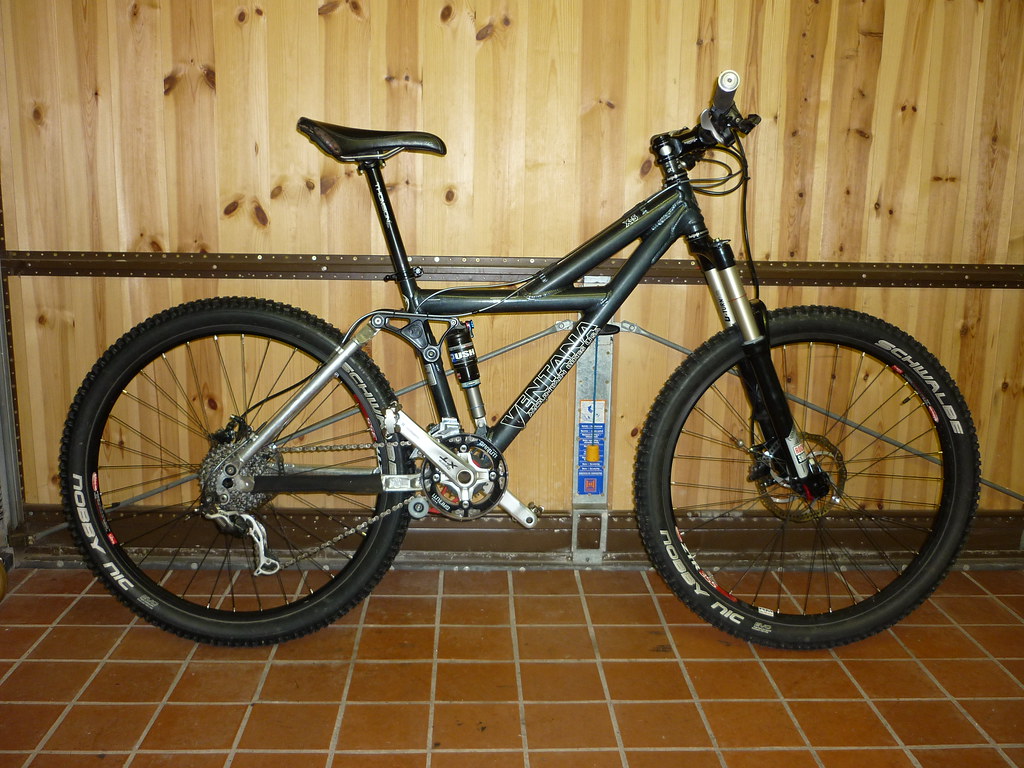 [/img]
agree about the fitness thing, just had the dosh burning a hole in my pocket. 🙄
now for ti bolts 😆
those end caps look like they weigh about four stone. 😀
now for ti bolts
just remember that Ti is for bling/longevity not weight saving as it's about 60% more heavy than aluminium.
Of course crickey makes a good point about the camelback and the kit folk carry - hence I have one 750ml bottle - refilled en route, multitool, tiny pump, tube, a puncture kit 3 sram links and one ordinary link, m5 and m6 nut and bolt.
Thats about a 3 kg saving on most of you for less money 🙂
I understand the point that a 3% difference in bike weight is not much - but it really seems to make much more difference than that in practice
poppa - Member
...The only thing getting you up that hill is the force acting on the cranks. Not trying to sound rude, but I am not sure what you mean by the rider 'moving forward and then the bike gets pulled up'...
First let me make it clear I am talking about steep hills, not those that are easily spun up.
As it happens I was out training on hills today. (Riding up the descent of the StrathPuffer track if that means anything to you - it is reasonably steep and has a few features which can stall a bike).
I'm always interested in improving my riding so I tried a number of things.
1. I stayed seated and maintained a fixed position - no body movements in any direction - and rode until I was physically unable to go further and stalled. I then went back to the start point.
2. I stayed seated until it felt hard to pedal and then got out of the saddle and used my weight as usual until I stalled.
3. I got out of the saddle at my normal point and used my weight as normal.
No 1 was hopeless, 2 was better, and 3 got me much further - up to the ice where I couldn't pedal any further.
I don't think this will surprise anyone who rides a singlespeed bike.
OK the physics. Yup, to take a given mass up a certain height in a certain time will take the same amount of work regardless of gearing. But there are some places where the gearing is not low enough and body weight has to be thrown around or you will stall.
Of course it all depends what you call steep. It's unavoidable up here in the Highlands.
However I thought of an experiment that anyone can do.
Next time I go out I will take 2x1000ml water bottles with me, and also a Camelbak with the same amount of fluid and try the climb with each alternately. The combined mass will be the same with both.
The bike with water bottles on will be the same weight as the bike I used in my earlier experiment, so this method removes the variability between the bikes (although they were more or less identically specced). I'll report back next time I head out that way.
[i]just remember that Ti is for bling/longevity not weight saving as it's about 60% more heavy than aluminium. [/i]
Since the majority of bolts on an MTB are either load bearing or need strength, then they are steel and can be replaced with Ti - saving half the weight.
In fact the only bolt I can think is alloy on mine, is the one pre-tensioning the headcap/stem.
if weight had nothing to with it then why doesn't everyone ride DH race bike up the hill. Just pump the air up so the suspension is efcective locked out then at the top let the air out fly down.
O ya becuase no one wants to pedal a 40lb monster up a hill, do they?
Crikey you point is valid, however your point is that you have proved there actually is a perfomance gain, small but a gain none the less.
I am 84kg, 7% bodyfat I own the lightest tools I can find and only carry what I need on all day rides. therefore the only place I can save weight is my bike. I know that the perfomance gain will be small but its still a gain.
Or as those claiming weight makes no difference "That may work in practice but it doesn't work in my theory".
"just remember that Ti is for bling/longevity not weight saving as it's about 60% more heavy than aluminium."
What total nonsense, aluminium bolts are useless in most locations on a bike which are designed for steel, they simply lack the strength.
if weight had nothing to with it then why doesn't everyone ride DH race bike up the hill.
Cos the geometry is shit for riding up hills, pretty obvious i would have thought.
Of course weight makes a difference just not a massive one, epsecially for the average rider.
BR - just to clarify you will find that all the bolts on every bike on the planet are alloy.
Steel is an alloy to began with, its not an element. Titanium when used for engineering purposes is always an alloy and so is aluminium other than pure coatings (even then both are usually merged with other elements to get the best performance). Infact you will be very hard pressed to find a pure metal used anywhere in load bearing engineering. Sorry to point that out.
59 time the pain - so if they brought out adjustable travel dual crowns (they arleady exist, there just rubbish) then the geo would be much better for riding up hills, the head angle would reduce by ~3 degrees to 67 or 68, and the wheelbase would reduce. You fit a schmidt and a standard block and bingo your riding up the hills but the bike would weight 40+lbs and everyone would be banging on about how much it weighed would they not?
Yet according to people on here the is no real benefit between a 20-25lb bike and a 40-45lb bike hell its only worth a few seconds. Odd then that only a few ride there DH bikes up the hills, and get people on these forums having a go at them for doing it. Plus none of the big suspension manufacturers have 8" adjustable forks.
[img]  [/img]
if your rides involve any of this you'll be glad of a light bike, regardless of how much your camelbak weighs.
but on the way down...
Thanks Dirtynap - you get the Pedantic's Prize for the evening...
BR - Thanks, i realised after posting that its was a crappy post
It seems many of us disagree on whether weight makes a difference...! 😆
I guess in some situations it definitely does, but I also suspect that for many of us it's not really that big a deal.
Seeing as I don't race (apart from on social group rides of course..) I will continue buying mid-range stuff and avoiding the price premium for very light kit.
The thing is you don't have to spend a fortune to get a reasonably light bike. It's more attention to detail.
You do have to spend a lot of time checking weights and swapping out components etc.
My favourite weight savers are getting rid of surplus metal which costs nothing, eg shorten seatpost, keep steerer tube short, and lots of minor bits of attention to detail.
Rotating weight is the first place to start, tyres, rims, combined weight of shoe and pedal. For example by using Schwalbe SL tubes, at an additional cost of £6 you can save 180gms of rotating weight on a 29er. That's worthwhile.
Weight saving is painful if you're paying £1/gramme. Much more fun if it costs nothing to lose 75gms (shorten seatpost if you can)
Nice bike by the way! Really like the look of the frame 8)
"You a chubby chaser waswas?"
well, she tells me her current weight is 7 stone 12, she ran a half marathon last Sunday, is doign a 20 miler in a month and a marathon in 2 months. She did lose 3 stone in a year after taking up running though - this was all weight she gained after having two babies.
I think it's not that she weighs a lot (now) that bothers her it's that she always has to watch what she eats even though she's, arguably, doing more exercise than me.
I'm not really a racer so I've never looked into anything like this before. However, I want to complete a couple of 24 hour solos this year so out of curiosity I did some measurements last night:
6ft 6"
18st 6lb
38" Waist
17" Neck
According to a couple of web calculators I have around 18% body fat. Considering the state I was in 2 years ago I'm OK with that.
I have 3 bikes. An XL Yeti 575, weighing under 30lbs, a XL Commencal Meta 6 probably about 38lbs and a fully rigid 21" Alfined Scandal 29er which will be completed at the weekend, probably about 25lbs.
I seem to ride at the same pace whether I'm on the Yeti or the Commencal, admittedly the Commencal takes a bit more effort up hill but I don't feel it that much. Really curious to see if I'm much quicker on the Scandal.
The big difference to me is fitness. If I'm feeling great, well rested it doesn't matter what bike I'm on and if I'm knackered, again I will be much slower.
rockitman - Member
...I want to complete a couple of 24 hour solos this year
..If I'm feeling great, well rested it doesn't matter what bike I'm on
It will after 24 hours (my experience)
What total nonsense, aluminium bolts are useless in most locations on a bike which are designed for steel, they simply lack the strength.
Chain ring bolts, headset, all mech bolts, brake levers, shifters are all fine with aluminium. A lot of people are running them in disc callipers, particularly in post mount forks, and I've yet to come across anyone with a problem. They're not as strong, but they're not useless. A friend of mine replaced all his bolts with alu (stem, rotors, the lot), I certainly wouldn't condone it, but he'd not had one snap in a lot of riding.
I'd sooner replace a few bolts with alu, than all of them with ti, they cost about 60p a bolt and weigh half what ti do!
For trail riding the bike quality and handling is more important than weight. I prefer a lighter bike if I'm riding marathons, enduro's and 24 hour races solo. IMHO rotational weight on the wheels will become apparent a few hours into any long event on the climbs. Psychologically I want a well set up and light-ish bike that will support my 15 stone well without breaking and will do a great job - this also helps the mindset on long events. I'm with epicyclo on that!
Point taken epicyclo. It's one of the reasons I'm building the Scandal 🙂
I did SITS as a pair last year and snapped the Yeti on lap 1. Had to ride the Commencal for the remainder and did over 12 hours on it. I reckon I'll be OK with the Scandal / Yeti combination for the full 24 hours...
njee20
[i]I'd sooner replace a few bolts with alu, than all of them with ti, they cost about 60p a bolt and weigh half what ti do!
[/i]
You miss the point, the idea is to use the lightest material that is appropriate. So aluminium where strength is not needed, and Ti where it is.
Certainly wouldn't want to risk aluminium rotor bolts, nor stem ones either..., but happy to be [b]proved[/b] otherwise.

