UPDATE: CLASSIFIEDS section refreshed, redesigned, searchable: Go take a look
I'm not taking the piss out of the Monolink for being a URT. It isn't. I didn't when I saw a Lefty either. Or a fat bike. Etc. I'm not saying it's a bad design. I'm saying there are issues, which partly I noticed when looking at the linkages, partly when watching their own marketing video! The riders feet get knocked about way more on the Monolinks than the other designs.
Chain growth easily can be designed out - you just make the pivot concentric with the BB. But that gives you no anti-squat, hence bobbing as the rider's mass goes through the acceleration/deceleration cycle as you pedal. So you design in the chain growth you need to get the pedalling efficiency you want.
I like that they were different but when a company claims to do everything because it's better engineering then it better make sure it's marketing matches the engineering truths. And as well as the pedalling efficiency claim, if you subtract the BB path from the axle path then you end up with a normal amount of rearward travel. The rider's mass is coupled to the BB so you can't pretend it doesn't matter when the riders mass is what matters.
It stiffens up when you stand up because the effective pivot point moves from the front pivot to the rear pivot, changing the leverage ratio and shortening the rear travel (thus adding travel to the front?) I can see why some riders would really like it. I can see why others wouldn't.
The bigger issue now would be making everything stiff enough for what's expected, not easy with that construction although going to a wider BB and making it all in carbon would probably do the job. Packaging a bigger wheel with long travel and dropper posts would be very hard.
I think with something as feel<>reaction based as riding a bike, you need to ride something to judge what it does and not theorise too much. Some things should be crp in theory but aren't. That then makes a mockery of your previous theorising. And Paul Turner is no fool.
(never ridden one myself but would like to)
I have a ML7. Its ace. I was never especially a fan of the forks, which promised more than they delivered, IMO. A large ML8 or Durance is pretty much the only 26" wheel bike I'd consider buying these days.
Just a wild guess but I suspect the reason the bikes aren't around anymore or that nobody uses the design is that it's crap.
From watching that video I'm sure that BB moves more than 10mm relative to the frame. Just what you need when the suspension is cycling three times a second though some fast chatter.
If chain growth wasn't a problem, but desired from a rear suspension system, we would all still be riding around on GT RTS'! The more chain growth you have, the more pedalling affects the suspension system. By eliminating pedal bob (or getting as close to eliminating it as possible) you are allowing the suspension to move only when acted upon by the terrain under the wheels.
Do you realise that all full suspension designs have manipulated axle paths and pivot locations that use chain growth to counteract the effect of pedalling induced squat? What they don't do is manipulate axle paths for bump absorbing abilities (well to be fair Zerode do) or to maintain wheelbase. That's marketing.
You really need to think about this further if you want to argue the merits (if any) of the design.
I'm not saying it's a bad design. I'm saying there are issues, which partly I noticed when looking at the linkages, partly when watching their own marketing video! The riders feet get knocked about way more on the Monolinks than the other designs.
Indeed, there are issues on paper. The reality is when riding though, that what is a 125mm travel suspension frame when seated is effectively becomes a 115mm travel frame when stood up. That is the most layman way of putting it...
Chain growth easily can be designed out - you just make the pivot concentric with the BB. But that gives you no anti-squat, hence bobbing as the rider's mass goes through the acceleration/deceleration cycle as you pedal. So you design in the chain growth you need to get the pedalling efficiency you want.
But what if you could design out chain growth, getting a beautifully active suspension system, and also completely isolate any pedal induced bob too...? That's essentially what they tried with the Monolink. It's not perfect, but it does a good job of trying to do just that. Using chain growth to counteract pedal bob is a workaround effectively. Some companies design a very effective suspension system, others don't. But using one force to counteract another force isn't ideal, by design you would completely remove their effects on the suspension system completely if you could.
It stiffens up when you stand up because the effective pivot point moves from the front pivot to the rear pivot, changing the leverage ratio and shortening the rear travel (thus adding travel to the front?) I can see why some riders would really like it. I can see why others wouldn't.
Agreed, it's not for everyone. Some I know hated one when they tried it, but many love it. It's not just the looks that are Marmite about Mavericks!
The bigger issue now would be making everything stiff enough for what's expected, not easy with that construction although going to a wider BB and making it all in carbon would probably do the job. Packaging a bigger wheel with long travel and dropper posts would be very hard.
Again, agreed. There was rumours of a carbon front end, with tapered headtube etc. some years back, before the advent of 650b on the mass market. The design lends itself pretty well to mid to short travel 26" wheeled bikes, but bigger wheels and longer travel would make for a very long back end sadly.
Just a wild guess but I suspect the reason the bikes aren't around anymore or that nobody uses the design is that it's crap.
You won't know as it's doubtful by your tone you'll ever even try one!
Do you realise that all full suspension designs have manipulated axle paths and pivot locations that use chain growth to counteract the effect of pedalling induced squat?
Indeed. As stated further up in this post, it's a workaround. Logically, if you could remove chain growth and pedal induced bob from acting on a suspension system at all, you would. When you utilise chain growth to minimise the effects of pedal bob, the suspension system is immediately less active over the bumps! You do realise that don't you...? 🙄
You really need to think about this further if you want to argue the merits (if any) of the design.
As opposed to 15 minutes worth of musing over a video on the internet, and concluding it must be crap even though you've not even ridden one and know very little about the design and what it tried to achieve in the first place? 😕
I didn't design the system, but I did spend a lot of time researching the merits of it, and chatting directly with the then owner of the company via email numerous times, to work out how and why it was better than other systems, and how and where any limitations of the system may affect me. I'm not trying to deny that there aren't limitations to the system, there are many. But on the right application (a 26" short to mid travel XC/Trail bike) the system works very well indeed for many people.
I'd just like to add that I've never ridden one but it's been great reading another slag off something you have never used thread 🙂
[img] 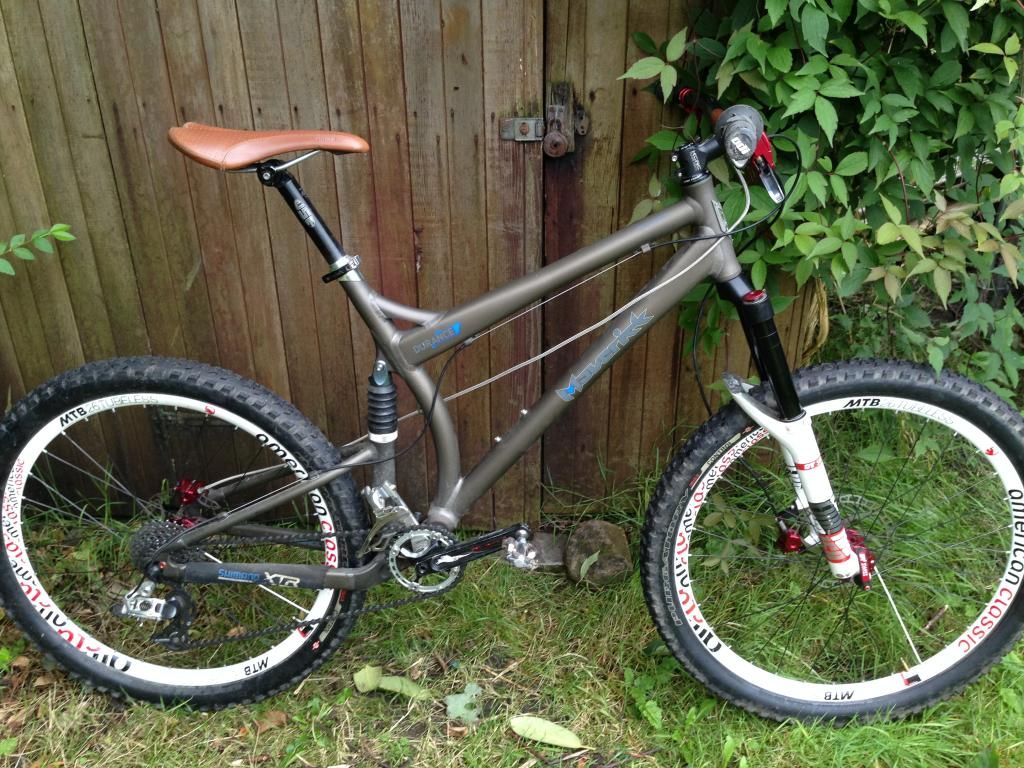 [/img]
Anyway the main issues are how the colour interacts with the z-plane interface and mostly that nobody rides a brown seat anymore.
Hands up - who is commenting about the ride of the bike and has never actually ridden one?
O.K. O.K. you caught me out at Laggan demo day all those years ago with that ML7.3? :O) I went on to buy the ML7.5 and loved heaps about it. I'm still sure the seat tube angle could be worked on as I seemed to have a prob on it with the height I had the seat (although a large that I tried a few years ago with a shorter stem and the seat lower felt better in some ways)
There's so much chat on this thread talking about what should and shouldn't work. So many theories on why this is better or why something can be so wrong because of what it might do.. but the fact is, like Tim says, ride it first then judge. The whole worry of a bb moving whatever direction as you were about to negotiate whatever, is just getting sucked into reading too much waffle on suspension design and not riding enough bikes to know and feel it for yourself.
I'll admit, I was more in the same boat to begin with and it wasn't until I had a proper ride of our demo ML8 with 36's up front that I realized that it was probably the best example in mtb history of how the looks of a bike,compared to the ride of the bike, along with how wrong it might be on paper compared to older similar looking designs just doesn't add up!
I got a copy of Memory Map and plotted a route up to Lochan Fada and dropped down the gulley into Loch Maree,returning along the shore back to Incheril around 2004 as it looked amazing on the 3d fly through. God knows what it was going to be like but I soon found out that it was fairly rough with a few hidden rocks at the top. I think it was the third ride of that route that I took the ML8. The confidence I had and the way it ate everything up was just amazing and I've never felt a bike feel so efficient over such a wide variety of terrain. This is what made me question these bikes and post this thread. The idea of the tapered head tube, beefier out the back with the larger wheel size, steeper seat tube angle etc. It would be up there, if not, the most incredible performing bike on the market today.
It seems like the mtb world is missing something by losing this design, or what it could have evolved into. Having ridden the likes of the tallboy ltc over all sorts of terrain, I was very very impressed but I'm still confused why a design that rode like it did in 2005 is still possibly more superior over todays so called super bikes.. and that it would take only a few changes to recreate something that would blow all of them away.
Indeed. As stated further up in this post, it's a workaround. Logically, if you could remove chain growth and pedal induced bob from acting on a suspension system at all, you would. When you utilise chain growth to minimise the effects of pedal bob, the suspension system is immediately less active over the bumps! You do realise that don't you...?
No! If you removed chain growth the suspension would compress/extend significantly and be very inefficient. Unlike motorized vehicles bicycles don't have a linear power delivery.
The options are, manipulate axle path via instant centre location to produce chain growth, shock based inertia valves (Specialized Epic), shock based volume changes and compression damping (lever/remote/electronic sensor actuated), mechanical leverage rate change (Canyon).
Some are more efficient than others but when you're not pedalling they all transfer the impact forces to the suspension/shock independent of the rider, the Maverick doesn't. Simple as that.
Shame the thread has gone this way.
Could have been fun.
One of my issues with Paul Turner and the Maverick approach is that some of the justifications he came out with for his designs were quite hard to swallow. I had some DUC 32s which were no doubt incredibly plush and - if fettling is your thing - easy to open up and get your hands dirty. The thing is they were twisty. Turner argued that it shouldn't matter due to the small contact patch of the wheel and I - being hugely inexperienced in these things - believed him.
However the reality of my riding - mud, rocks, ruts - meant that often there was much more than a "small contact patch" between wheel and terrain. It made no logical sense to me that a fork that flexy was a good idea.
Even after many many hours in the saddle with Paul Turner's designs it can still be hard to believe.
Shame the thread has gone this way.
Could have been fun.
My thoughts exactly. I wanted to try a Maverick when they existed, I remain curious about the design and all I've done is been sceptical of certain claims. And then Mr Thinks-he-knows-it-all shoots me down in condescending style.
FYI mboy, any single pivot with a high pivot point (is that all of them?) will have a predominantly rearward axle path. And any mechanism to improve pedalling efficiency will reduce suspension activity, however you dress it up with marketing spin. Personally I prefer a bike with high pedalling efficiency when you pedal (ie with chain tension) but high suspension activity when not pedalling and off the saddle. If you climb fireroads out of the saddle and rough stuff in the saddle then the Monolink looks brilliant. It looks very compromised for out of the saddle descending, that's what I've been questioning. So far the faux science doesn't stack up and although I ride with lots of different people, the only one who owned a Maverick no longer does, so I can't try one...
I think the trick is to realise that [i]every[/i] bike is a massive bundle of compromises.
The human movement/interaction/input on a mountain bike is hugely complicated and all sorts of small adjustments can have massive impacts.
A friend was one of the few dealers in the UK so I got to ride a few.
Without exception, they were excellent bikes. I didn't really like how they looked, and found them a bit heavy for my main use (TQs) but I had to admit they were really good around the woods and general riding... just not for me, the only reason I didn't end up with one. I think they might feel a bit tall and steep these days, but so does everything from that time.
Don't suppose anyone has a left hand fork guard kicking around they'd sell me?
I think the trick is to realise that every bike is a massive bundle of compromises.
The human movement/interaction/input on a mountain bike is hugely complicated and all sorts of small adjustments can have massive impacts.
I know, I do spend quite a lot of time riding a number of the bloody things!
If you can't see the negatives of having the main mass of a vehicle (the rider in this case) positioned on a link between the frame and rear axle I give up!Look at the above video. Ignore the axle path crap, it's pure marketing. Impacts are causing that BB to move relative to the frame. And that is on those minor, slow speed impacts in the video. Imagine hitting high frequency bumps going into a turn. If the rear suspension isn't fully independent and has to move the riders mass to react it will absolutely effect traction and braking.
It's not though is it? If you video'd a Santa Cruz VPP or DW linked bike over a bump the BB would move up too. If it helps, think of it as a 4.5" travel bike that gains half an inch when sat down (when your not using the suspension that much anway), rather than a 5" bike that loses 0.5".
I think that's your problem. I tought the suspension would be noticeable when being ridden, but my overall impression after riding one was that it felt like a ~4" short travel XC bike (which it is)when out of the saddle sprinting or going downhill, but uphill seated the efficiency was incredible, kinda like riding a contemporary 3" travel bike but with the step/root swallowing efficiency of a 5" bike.I haven't ridden one. Some designs are so obviously flawed that you don't need to ride them. Harsh but true.
Comparing to the Giant Anthem (100mm) and Spesh Stumpjumper (the 120mm version) I also demo'd, the giant felt like the pedals (which is where your weight is, not the BB) moved/fed back more, the spesh felt almost as efficient, but very 'dead'.
No! If you removed chain growth the suspension would compress/extend significantly and be very inefficient. Unlike motorized vehicles bicycles don't have a linear power delivery.
Just imagine for a second, in a Halcyon world where thinking outside of the box is possible, what might happen [i]IF[/i] the pedalling forces didn't impact on the suspension performance...
And then Mr Thinks-he-knows-it-all shoots me down in condescending style.
I responded to your highly condescending personal response, claiming I was merely spouting marketing BS and the "pieces of eight" comment. Until then, I hadn't aimed any responses at anyone in particular other than asking if JCL had actually ridden one or not! 😕
FYI mboy, any single pivot with a high pivot point (is that all of them?) will have a predominantly rearward axle path.
No they don't. Short of designs such as a GT RTS, a Brooklyn Machine Works and those Zerode's, the single pivot isn't high enough to allow for a particularly rearward path. You can see that in the Maverick video posted earlier on this thread for instance.
And any mechanism to improve pedalling efficiency will reduce suspension activity, however you dress it up with marketing spin.
Anything based on clever shock technology, or utilising chain growth etc. then yes I agree with you. The Monolink is, in my opinion, so far the best effort that exists that manages to improve pedalling efficiency with as close to zero chain growth and allow the suspension to remain fully active all the time. As has been stated a number of times, there are many compromises that have been made to achieve this (of which one is stiffening when out of the saddle, another that the BB moves in relation to the saddle), but it does work pretty well.
Personally I prefer a bike with high pedalling efficiency when you pedal (ie with chain tension) but high suspension activity when not pedalling and off the saddle.
Fair enough, you're definitely well catered for then. I find any suspension system where the suspension system stiffens noticeably when pedalling, quite offputting. Hence why I probably got on so well with the Maverick.
If you climb fireroads out of the saddle and rough stuff in the saddle then the Monolink looks brilliant.
The seated climbing traction of the Maverick is part of its appeal yes.
It looks very compromised for out of the saddle descending, that's what I've been questioning. So far the faux science doesn't stack up
It is slightly more compromised for out of the saddle descending than other designs, agreed. But the level to which it is, is small. It's not so small that you won't notice it, but depending on your riding style, it will either be totally undesirable or in fact it might even be a bonus.
IMO I think if you're a pedal masher and like a bike to feel mega active all the time except for when you're pedalling, then you definitely won't get on with a Maverick. If you have a smooth pedalling style, yet apprecaite a design that stiffens slightly when out of the saddle sprinting (like I said, almost like an auto pro-pedal for out of the saddle moments), and don't mind the fact it won't be the most active bike out there when descending out of the saddle, you will get on with a Maverick very well. We're all different, and fortunately what doesn't suit one person may suit another very well. I've ridden a big number of suspension bikes over the years, and many that other people have raved about I haven't particularly liked, so clearly I'm a little bit different to the norm myself! 😛
I don't need to have a go on one to see some of the issues!
Dear god...
I'm half looking out for some SC32s for my Curtis. Seem to go for reasonable prices on eBay etc. Maybe its because they're shit but I'll reserve judgement until I've used some. 🙄
I've had an ML7 for years. It works really well particularly on techy climbs where it functions like a mountain goat wearing crampons. I've long ago lost interest in the opinions of people who think it shouldn't work or can't see beyond the admittedly esoteric aesthetics…
I'm not a huge fan of the forks, particularly the SC32, but the DUCs are very light for what they are, fully user serviceable and if you can be arsed to tweak them, work reasonably well.
Anyway...
CBA to read [b]all[/b] of ^^^that^^^ but, my tuppence worth is a mix. I bought a new ML7/5 from Skyline in 2006 (maybe, it was around then) and it was excellent all around South Wales and bits of the Lakes that I rode. They do climb incredibly well (which was a big part of why I bought it).
However, I had a problem with the shock getting stuck down in the middle of a descent, which messed my day up pretty comprehensively, and the subsequent 3 months without the bike was unacceptable. I guess I started to question the reliability.
The other thing that I grew to realise was that I didn't like the way the suspension stiffened up when out of the saddle, and ultimately the combination of these two things meant I sold it. All of the experience I have of the suspension is of course not backed up by any empirical data.
I do love the forks though, and regret selling the DUCs and the SC32s I had.
However, I had a problem with the shock getting stuck down in the middle of a descent, which messed my day up pretty comprehensively
I had that with a Fox RP2 on my Intense, and an RP23 on my Ellsworth, so not a Marevick specific thing by a long way!
Never ridden a Maverick but rode a Klein Palomino for a while, it was a fantastic XC bike, not soo good in bigger rougher stuff, but then it really wasn't supposed to be, I don't think it felt any more compromised than any other bike I've ridden and had some massive plus points elsewhere, a bit like most designs really!
Really don't get the slating without riding thing, even if I thought a particular design was rubbish I'd want to ride one just to see how it did feel!
Personally I'm a massive fan of Lawwill rear ends, another design that's pretty much disappeared these days, has its own set of quirks, positive and negative, but it suits [i][b]me[/b][/i] really well
I had an ML7 for a couple of years. It was a bit disappointing and taught me not to buy a bike without a test ride first!
It had some very good points, it was great in tight singletrack and had good traction on climbs, but that suspension design...Oh my God it was crap! I want some squat when standing up descending to slacken the bike a bit along with some suspension movement too, and I want it not too bob when sitting climbing and it did the opposite. For me I prefer a VPP or good horst link. I'm probably wrong, but that's my two pence worth!
Suspension that's soft going up and stiff coming down?
As compromises go, it sounds a pretty poor one.
This thread is brill, it's reminding me a lot of the full sus vs hardtail threads that were plentiful here when I first found STW back in 2002. 😀
FWIW I had a day long demo on an ML7.5 (I think) back in 2006 or so. I don't really remember what I thought of the bike and the rear suspension, sadly. I do remember that my opinions of the frame were largely drowned out by my impressions of the SC32s, which were spiky pieces of crap. I since heard that it was really easy to crack them open and set up their internals so that they were really lovely, but that had obviously not been done on this demo set.
(The bike also had one of Maverick's dropper posts, which seemed like a promising idea, but one which required more travel and a remote instead of the undersaddle lever.)
[i]Could Maverick make a come back?[/i]
[img]  [/img]
Suspension that's soft going up and stiff coming down?As compromises go, it sounds a pretty poor one.
Indeed. Exactly like a URT. Not only that but how do set suspension sag for a design that is more active when seated?
Just imagine for a second, in a Halcyon world where thinking outside of the box is possible, what might happen IF the pedalling forces didn't impact on the suspension performance...
Welcome to reality. That is why bikes have a percentage of anti-squat in the kinematics. To counteract the load forces from pedalling.
Imagine telling the Giant or Santa Cruz engineers that they can improve their bikes performance if they mount the BB in the middle of the lower link. They would look at you like you were on crack.
The Maverick is semi suspended. Nothing more.
I was going to post, but then I looked through JCL's posting history and realised there was no point.
I shall be riding my 9 year old trusty Maverick tomorrow evening and laughing at how it's semi-suspension has tricked me all these years.
Alexsimon, i am sure peaty, athertons and hannah are all reading this feeling all sour about their world cup wins and podiums with the newly-acquired wisdom that they were only on inferior semi suspended bikes too.
Which reminds me i would love a go on one of them too.
Maverick's design was never intended to be a WC DH winning one - it was meant for real-world use by normal people. That they were used on early Enduro style races (they were called Super D or something like that) in the US, with up and down sections sort of points to their intended all-round use.
It's nice how everyone's open-minded about all this though.
The lack of a basic understanding of bicycle suspension and marketing gullibility is nice too.
It's a wonder we aren't all riding FS tricycles with such an informed public.
Indeed. Exactly like a URT. Not only that but how do set suspension sag for a design that is more active when seated?
It may look a lot like a URT, but the extra link in the system is the key. And I set the sag the same way as I do on any other bike... Put a reference pressure in, ride it a bit, add some if needed or let some out. Will always take a shock pump with me on the first few rides on a new bike too to fine tune the suspension pressures. Setting the suspension pressure purely by sag is very misleading, some forks and shocks are a lot more linear than others. Much better to have the suspension setup to just about use all of its travel maybe once or twice on a typical ride for an individual.
Welcome to reality. That is why bikes have a percentage of anti-squat in the kinematics. To counteract the load forces from pedalling.
So you're advocating that it's fine for a suspension system to be less efficient when pedalling? That's fair enough if that's important to you... Maverick were merely advocating that it's more important for the suspension to be efficient when pedalling, at a slight compromise to efficiency when stood up rather than seated (yet still a whole lot more than a hardtail remember). Just because something doesn't suit you, doesn't make it wrong!
Imagine telling the Giant or Santa Cruz engineers that they can improve their bikes performance if they mount the BB in the middle of the lower link. They would look at you like you were on crack.
You do realise who the Maverick founder is right? Because your history is showing some gaps in its knowledge as well as your understanding of suspension design... Paul Turner is/was the Godfather of suspension on a Mountain Bike. Some designs he brought out may not have been to everyones taste, but you have to remember that at many points over the last 2 and a bit decades, ANY of the big manufacturers would have given their right arm to have worked with him! In fact, you should remember that Trek licensed the design for a few years for the Klein Palomino too...
The lack of a basic understanding of bicycle suspension and marketing gullibility is nice too.
£5 says you work in the industry, most likely Trek or Specialized, and you are happy regurgitating their marketing guff every single day! 😉
He's probably in IT, and lives in Cobham Surrey...
LOL at chunky.
If only we could add a poll..."who's talking the most guff?"
Sorry JCL, I'd vote for you.
That's uncanny. My parents live in Cobham!
But I live in Vancouver. Bring your Maverick out. We'll go ride some trails and see how you get on with it.
I'm pretty sure a link to Vancouver doesn't automatically improve suspension knowledge... Otherwise Bryan Adams would be a suspension oracle!
Setting the suspension pressure purely by sag is very misleading, some forks and shocks are a lot more linear than others.
Sag is the best way of finding a starting point, before adjusting sag up and down, adding or removing volume spacers and adjusting all the damping controls. Fortunately shock sag is best set seated so the Monolink would behave normally. Looking at the length of the link it would appear that if you've set the sag at 30% seated it'll reduce when standing due to the change in the leverage curve. It looks like some of the issues I initially saw with the design are counteracted by other changes - it's a complex puzzle when the mass of the rider is so much greater than the mass of the vehicle - so the standing stiffening isn't quite so extreme.
Much better to have the suspension setup to just about use all of its travel maybe once or twice on a typical ride for an individual.
This is an oft said but illogical statement.
Maverick were merely advocating that it's more important for the suspension to be efficient when pedalling, at a slight compromise to efficiency when stood up rather than seated
I don't think efficiency is the right word because that confuses the active nature of the suspension with the pedalling efficiency losses caused by the suspension.
Looking back at reviews from the era it seems Mavericks were considered very good uphill but not quite as good downhill. Considering that 6" bikes are far more downhill focused than back then, one suspects that the Monolink wouldn't be a great design for an enduro (TM) bike, although I can see it having its place in XC bikes. If you look at how suspension designs have changed just in the last few years they've tended towards increased anti-squat for pedalling efficiency and so you can run low BB heights without constantly grinding your pedals on techy climbs.
Unfortunately although JCL does make good points quite often he has a talent for consistently winding up those he's addressing, which rather defeats the object...
£5 says you work in the industry, most likely Trek or Specialized, and you are happy regurgitating their marketing guff every single day!
Irony alert. 😆
I really enjoyed the time I spent with Grizelda (Loddrik's old frame I think?), and every now and then think about getting a replacement, or an ML8, but I kind of think that they're an idea who's time has been.
While they were a real demon on technical and loose climbs not too many years back, I'm not sure they'd really have any characteristics to make them stand out from the pack nowadays. Aside from their looks, of course.
I have a vancouver sized boner right now.
^^ Okay... Why are you telling us this...?
Vinnyeh,
Grizelda is currently residing in our garage! About to be pensioned off, if you want to be reunited, let us know 🙂
That's uncanny. My parents live in Cobham!
But I live in Vancouver. Bring your Maverick out. We'll go ride some trails and see how you get on with it.
I don't believe this person is for real. I'd like to say what I think but I'd probably just get another ban.
I have a vancouver sized boner right now.
Just as well my wife doesn't read this forum...
I don't believe this person is for real. I'd like to say what I think but I'd probably just get another ban.
Go for it! I'm unoffendable. Just bleep out the offending words, we'll be able to put 2 and 2 together.
'While they were a real demon on technical and loose climbs not too many years back, I'm not sure they'd really have any characteristics to make them stand out from the pack nowadays.'
The trails are the same. All that someone needs to do is what I was dreaming about in the original post. Or something along those lines.
The trails are the same but the competition isn't. Again, I suspect that's why they are no more.
If people enjoy them good for them, same with hardtails. But anyone trying to argue that the design was superior in any aspect to a number of designs currently on the market is having a laugh.
I also don't know why people keep bringing up Paul Turner? Sure, he came up with the first telescopic bicycle fork but it wasn't like it someone else was going to copy a simplified dirt bike fork at some stage anyway. It was hardly an inspired, original design.
There are far smarter people working in the bike industry these days who hardly anyone knows the names of.

